4. Consider a mixture of two components X and Y that you want to analyze by...
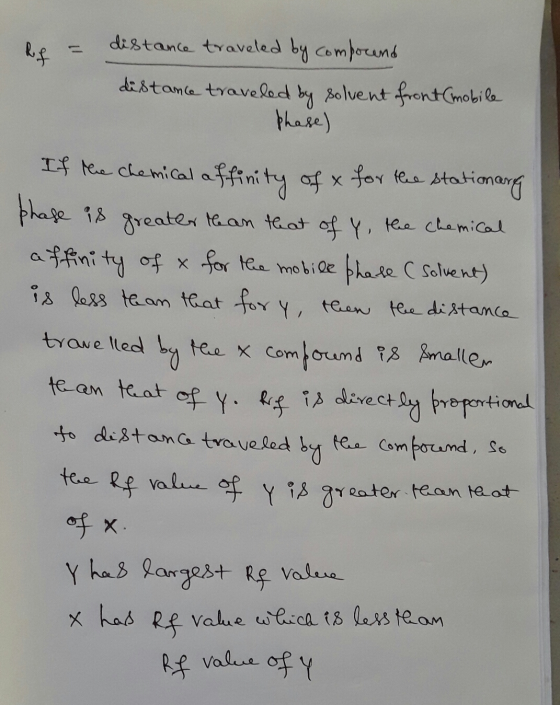
4. Consider a mixture of two components X and Y that you want to analyze by paper chromatography. If the chemical affinity of X for the stationary phase is greater than that of Y, and the chemical affinity of X for the mobile phase is less than that for Y, which substance will have the largest Rf value upon analysis of the developed chromatogram. Explain your answer.
Homework Answers
Add Answer to:
4. Consider a mixture of two components X and Y that you want to
analyze by...
In a chromatographic separation of two components A and B. Component A has a value of...
In a chromatographic separation of two components A and B. Component A has a value of Rf greater than component B. This implies: a. A has a higher affinity than B for the mobile phase b. B has a higher affinity than A for the mobile phase c. B eludes first in column d. A has a higher affinity than b for the stationary phase Explanation:
Table 2: Alcohol and Ketone Standards GC Retention Times GC#: Retention time Alcohol Standard Mixture Phent...
 Table 2: Alcohol and Ketone Standards GC Retention Times GC#: Retention time Alcohol Standard Mixture Phent ion= 2.05Smin low Peak 1 Compound Name: athanol Rapesnal utanal aclapeatanal 4.755min oilng 6.895min .230 min Peak 2 Compound Name: Peak 3 Compound Name: Peak 4 Compound Name: GC#:1 Ketone Standard Mixture Retention time 2.575un Peak 1 Compound Name: Acclono Butanon a Pentanone 2tHex anon Peak 2 Compound Name: min Peak 3 Compound Name: 615 min 1D. 307 min Peak 4 Compound Name: Part...
1. List two errors in the typical student set up for performing thin layer chromatography illustrated...
 1. List two errors in the typical student set up for performing thin layer chromatography illustrated here. 2. Define the following terms: Analyte: Stationary Phase: Mobile phase: Solvent Front: Origin: Rf Value: 3. Compound y traveled 6.2 cm while the solvent front traveled 11.1 cm. Calculate the Rf value for compound y. 4. Compound Z has an Rf value of 0725. When a chromatogram was developed, it moved 3.3 cm from the origin. How many cm did the solvent front...
3. There are two major components in the chromatography experiment: the solvent system (mobile phase) and...
3. There are two major components in the chromatography experiment: the solvent system (mobile phase) and the paper (stationary phase). Which of these major components is more polar phase and which is less polar phase? Explain using Lewis structures. (please PLEASE use the lewis structures, thats the part of the question I don't have yet!) 4. What parts of the molecules in the stationary phase will interact with the molecules that are being separated? Please answer this question using the...
1) Calculate the Rf value of a spot that travels 5.7 cm, with a solvent front...
 1) Calculate the Rf value of a spot that travels 5.7 cm, with a solvent front that travels 13 cm. 2) A student spots an unknown sample on a TLC plate and develops it in pentane solvent. Only one spot, for which the Rf value is 0.05, is observed. Is the unknown material a pure compound? What can be done to verify the purity of the sample using thin-layer chromatography? 3) You try to synthesize n-hexyl bromide as a product...
2. If two different compounds have the same Rr value, how might they be identified using paper chromatography?...
 2. If two different compounds have the same Rr value, how might they be identified using paper chromatography? 3. Why is it important to keep the spots on the paper as small as possible? 4. If the solvent pool at the bottom of the beaker touched the spots on the 1.5cm line, what would happen to the spots? How would you address this error? 5. If you were teaching a student how to do paper chromatography, what three pieces of...
Hi can someone help me with my pre lab theory questions (1,2,3) on rate of elution...
 Hi can someone help me with my pre lab theory questions (1,2,3)
on rate of elution or Rf? Here is some background below. Please
help explain as many as possible (1-3)! I dont really get the
relation ships in this lab, thank you!
1. What factors affect the rate of elution in organic compounds? 2. Explain what is the relationship between polarities of compounds (polar/non- polar compound) and rate of elution (Rf). 3. Explain what is the relationship between solvent...
Hi can someone help me with my pre lab theory questions (1,2,3)
on rate of elution or Rf? Here is some background below. Please
help explain as many as possible (1-3)! I dont really get the
relation ships in this lab, thank you!
1. What factors affect the rate of elution in organic compounds? 2. Explain what is the relationship between polarities of compounds (polar/non- polar compound) and rate of elution (Rf). 3. Explain what is the relationship between solvent...
A process is carried out between two states X and Y in a reversible way and...
A process is carried out between two states X and Y in a reversible way and with a difference between the initial and final entropies S final - S initial = Sxy (where Sxy> 0) in stationary conditions. We want to replace this process with a faster but irreversible one (between the same states, X and Y). Will the entropy variation in the work substance be less, greater, or equal in the new process? Why?
1. A mixture containing Compound X and Compound Y is analyzed using silica gel TLC. a....
 1. A mixture containing Compound X and Compound Y is analyzed using silica gel TLC. a. If Compound X has an Rf value of 0.7 and Compound Y has an Rvalue of 0.3, which compound is more polar? Explain. b. The solvent traveled 50 mm. How far did Compound Y travel? 2. Why isn't it reasonable for an R. value to be greater than 1? 3. How many spots would you expect to see if you conducted a TLC separation...
at you 7.54 Consider a binary mixture of a and b at T 300K and P = 40 kPa. A graph of the fugacity of species a as a fu...
 at you 7.54 Consider a binary mixture of a and b at T 300K and P = 40 kPa. A graph of the fugacity of species a as a function of mole fraction is shown below. Use Henry's law as the reference state for species a and the Lewis/Randall rule for species b. Show all your work 40 38 36 T-300 K P: 40 kPa 34 32 30 28 26 24 22 20 18 16 14 12 10 4 2...
 Table 2: Alcohol and Ketone Standards GC Retention Times GC#: Retention time Alcohol Standard Mixture Phent ion= 2.05Smin low Peak 1 Compound Name: athanol Rapesnal utanal aclapeatanal 4.755min oilng 6.895min .230 min Peak 2 Compound Name: Peak 3 Compound Name: Peak 4 Compound Name: GC#:1 Ketone Standard Mixture Retention time 2.575un Peak 1 Compound Name: Acclono Butanon a Pentanone 2tHex anon Peak 2 Compound Name: min Peak 3 Compound Name: 615 min 1D. 307 min Peak 4 Compound Name: Part...
 1. List two errors in the typical student set up for performing thin layer chromatography illustrated here. 2. Define the following terms: Analyte: Stationary Phase: Mobile phase: Solvent Front: Origin: Rf Value: 3. Compound y traveled 6.2 cm while the solvent front traveled 11.1 cm. Calculate the Rf value for compound y. 4. Compound Z has an Rf value of 0725. When a chromatogram was developed, it moved 3.3 cm from the origin. How many cm did the solvent front...
 1) Calculate the Rf value of a spot that travels 5.7 cm, with a solvent front that travels 13 cm. 2) A student spots an unknown sample on a TLC plate and develops it in pentane solvent. Only one spot, for which the Rf value is 0.05, is observed. Is the unknown material a pure compound? What can be done to verify the purity of the sample using thin-layer chromatography? 3) You try to synthesize n-hexyl bromide as a product...
 2. If two different compounds have the same Rr value, how might they be identified using paper chromatography? 3. Why is it important to keep the spots on the paper as small as possible? 4. If the solvent pool at the bottom of the beaker touched the spots on the 1.5cm line, what would happen to the spots? How would you address this error? 5. If you were teaching a student how to do paper chromatography, what three pieces of...
 Hi can someone help me with my pre lab theory questions (1,2,3)
on rate of elution or Rf? Here is some background below. Please
help explain as many as possible (1-3)! I dont really get the
relation ships in this lab, thank you!
1. What factors affect the rate of elution in organic compounds? 2. Explain what is the relationship between polarities of compounds (polar/non- polar compound) and rate of elution (Rf). 3. Explain what is the relationship between solvent...
Hi can someone help me with my pre lab theory questions (1,2,3)
on rate of elution or Rf? Here is some background below. Please
help explain as many as possible (1-3)! I dont really get the
relation ships in this lab, thank you!
1. What factors affect the rate of elution in organic compounds? 2. Explain what is the relationship between polarities of compounds (polar/non- polar compound) and rate of elution (Rf). 3. Explain what is the relationship between solvent...
 1. A mixture containing Compound X and Compound Y is analyzed using silica gel TLC. a. If Compound X has an Rf value of 0.7 and Compound Y has an Rvalue of 0.3, which compound is more polar? Explain. b. The solvent traveled 50 mm. How far did Compound Y travel? 2. Why isn't it reasonable for an R. value to be greater than 1? 3. How many spots would you expect to see if you conducted a TLC separation...
 at you 7.54 Consider a binary mixture of a and b at T 300K and P = 40 kPa. A graph of the fugacity of species a as a function of mole fraction is shown below. Use Henry's law as the reference state for species a and the Lewis/Randall rule for species b. Show all your work 40 38 36 T-300 K P: 40 kPa 34 32 30 28 26 24 22 20 18 16 14 12 10 4 2...
Most questions answered within 3 hours.
-
Where is the error in this code sequence?
String s1 = "Hello";
String s2 = "ello";...
asked 10 months ago -
Financial data for Joel de Paris, Inc., for last year
follow:
Joel de Paris, Inc.
Balance...
asked 10 months ago -
Consider this reaction:
Al2(SO4)3 (aq)+ BaCl3
(aq) Al2Cl6 (aq)- +
3BaSO4(s) . What is the...
asked 10 months ago -
Suppose that Savneet is considering increasing her
recent random sample from 20 car rentals to 40...
asked 10 months ago -
Trucks arrive at an unloading terminal at an average rate of 120
per hour.
Trucks arrive...
asked 10 months ago -
Why are methanol and ethanol completely soluble in water while
octanol is not very little soluble....
asked 10 months ago -
A facilities manager at a university reads in a research report
that the mean amount of...
asked 10 months ago -
When the CuSO4 is rehydrated by adding water to the anhydrous
compound, is this an endothermic...
asked 10 months ago -
A ray of sunlight is passing from diamond into crown glass; the
angle of incidence is...
asked 10 months ago -
A block of mass 0.249 kg is placed on top of a light, vertical
spring of...
asked 10 months ago -
how do the kidneys compensate in the presences of acidosis
a) trigger hyperventilate
b) reserve acid...
asked 10 months ago -
Question 501 pts
The rental rate of capital to the firm increases. Which of the
following...
asked 10 months ago