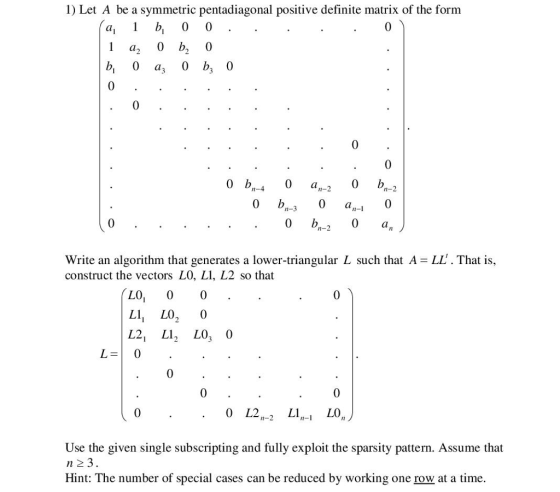
I cannot use double subscripts, 2d arrays, or nested for loops for this problem. Here is the algorithm I have come up with so far:
L0[1] = sqrt(a[1]);
L1[1] = 1 / L0[1];
L2[1] = b[1] / L0[1];
L0[2] = sqrt(a[2] - (L1[1] / L0[1]) * (L1[1] / L0[1]));
L1[2] = (0 - (L2[1]) * (L1[1])) / L0[2];
L0[3] = sqrt(a[3] - (L2[1]) * (L2[1]) - (L1[2]) * (L1[2]));
for(i = 3; i <= n; i++)
{
L2[i-2] = (b[i-2] - b[i-3] * b[i-4]) /
b[i-2];
L1[i-1] = (L0[i] - (L2[i]) * (L1[i])) /
L0[i];
L0[i] = sqrt(L0[i] - (L1[i]) * (L1[i]) -
(L2[i]) * (L2[i]));
}
I'm not sure if I should add or change anything in this solution.
Homework Answers
L0[1] = sqrt(a[1]);
L1[1] = 1 / L0[1];
L2[1] = b[1] / L0[1];
L0[2] = sqrt(a[2] - (L1[1] / L0[1]) * (L1[1] / L0[1]));
L1[2] = (0 - (L2[1]) * (L1[1])) / L0[2];
L0[3] = sqrt(a[3] - (L2[1]) * (L2[1]) - (L1[2]) * (L1[2]));
for(i = 3; i <= n; i++)
{
L2[i-2] = (b[i-2] - b[i-3] * b[i-4]) /
b[i-2];
L1[i-1] = (L0[i] - (L2[i]) * (L1[i])) /
L0[i];
L0[i] = sqrt(L0[i] - (L1[i]) * (L1[i]) -
(L2[i]) * (L2[i]));
}
Add Answer to:
I cannot use double subscripts, 2d arrays, or nested for loops
for this problem. Here is...
Plz use nested loops , read the question carefully, i need help step by step solution...
 Plz use nested loops , read the question carefully, i need
help step by step solution using ( spyder)..
Exercise 2 Write a Python program (Lab7-ex2.py) that reads from the user an integer n, displays the triangular number sequence up to the n term (ie. 1,3, 6, 10,. n"term). The triangular of a number n is calculated as "n(n+1)/2" where n is a nonzero positive number. Note that your program should display a suitable error message if n is entered...
Plz use nested loops , read the question carefully, i need
help step by step solution using ( spyder)..
Exercise 2 Write a Python program (Lab7-ex2.py) that reads from the user an integer n, displays the triangular number sequence up to the n term (ie. 1,3, 6, 10,. n"term). The triangular of a number n is calculated as "n(n+1)/2" where n is a nonzero positive number. Note that your program should display a suitable error message if n is entered...
just part 4,5,6 Problem 3: The purpose of this problem is use the Nested Interval Property...
 just part 4,5,6
Problem 3: The purpose of this problem is use the Nested Interval Property to show the existence of the square root of a positive number A. Thinking of A as an area, start with a rectangle with sides ao bo such that aoboA. Define b( bo)/2 and aA/b1, so that abi-A. Repeating this process, one creates sequence {an^ni and sbn^n1 defining nested intervals In such that I -VA. The different parts of this problem will guide you...
just part 4,5,6
Problem 3: The purpose of this problem is use the Nested Interval Property to show the existence of the square root of a positive number A. Thinking of A as an area, start with a rectangle with sides ao bo such that aoboA. Define b( bo)/2 and aA/b1, so that abi-A. Repeating this process, one creates sequence {an^ni and sbn^n1 defining nested intervals In such that I -VA. The different parts of this problem will guide you...
Mountain Paths (Part 1) Objectives 2d arrays Store Use Nested Loops Parallel data structures (i.e...
Mountain Paths (Part 1) in C++ Objectives 2d arrays Store Use Nested Loops Parallel data structures (i.e. parallel arrays … called multiple arrays in the zyBook) Transform data Read from files Write to files structs Code Requirements Start with this code: mtnpathstart.zip Do not modify the function signatures provided. Do not #include or #include Program Flow Read the data into a 2D array Find min and max elevation to correspond to darkest and brightest color, respectively Compute the shade of...
Mountain Paths (Part 1) in C++ Objectives 2d arrays Store Use Nested Loops Parallel data structures...
Mountain Paths (Part 1) in C++ Objectives 2d arrays Store Use Nested Loops Parallel data structures (i.e. parallel arrays … called multiple arrays in the zyBook) Transform data Read from files Write to files structs Code Requirements Start with this code: mtnpathstart.zip Do not modify the function signatures provided. Do not #include or #include Program Flow Read the data into a 2D array Find min and max elevation to correspond to darkest and brightest color, respectively Compute the shade of...
1. (All students!) For matrices with special properties, it is possible to create special version...
 1. (All students!) For matrices with special properties, it is possible to create special versions of Gauss elimination. Suppose matrix A (nxn) is symmetric (which means that A-A). Suppose also that A is positive definite; this means that the scalar = xTAx is always 20 for every vector x , and J-0 only if x = 0 In this case it can be shown that the usual Gauss elimination process, which effectively creates the factorization A LU, can be simplified...
HERE IS THE CODE I FIXED BUT STILL DOESN'T WORK NOTE: THE VARIABLE x = zeros(size(b))...
 HERE IS THE CODE I FIXED BUT STILL DOESN'T
WORK
NOTE: THE VARIABLE x = zeros(size(b)) CAN'T BE CHANGED CAUSE HAS
BEEN SET BY ASSESSOR
HI EXPERTS I NEED HELP TO SOLVE THIS HOMEWORK PROBLEM FOR MATLAB
CODE
A COUPLE OF TIMES I TRIED LAST TIME TO ASK BUT ALL OF THE
ANSWERS WERE WRONG
PLEASE KINDLY HELP ME FIND THE RIGHT SOLUTION, ANY HELP WILL BE
VERY APPRECIATE
Engineering Computations and Modelling > Week 6 Homework > Backward Substitution...
HERE IS THE CODE I FIXED BUT STILL DOESN'T
WORK
NOTE: THE VARIABLE x = zeros(size(b)) CAN'T BE CHANGED CAUSE HAS
BEEN SET BY ASSESSOR
HI EXPERTS I NEED HELP TO SOLVE THIS HOMEWORK PROBLEM FOR MATLAB
CODE
A COUPLE OF TIMES I TRIED LAST TIME TO ASK BUT ALL OF THE
ANSWERS WERE WRONG
PLEASE KINDLY HELP ME FIND THE RIGHT SOLUTION, ANY HELP WILL BE
VERY APPRECIATE
Engineering Computations and Modelling > Week 6 Homework > Backward Substitution...
2. Here is a sorting algorithm that I like to use. Given an unsorted list of...
 2. Here is a sorting algorithm that I like to use. Given an unsorted list of size n, let Xx represent the data in location k of the unsorted list. Compare xi to X2 and switch if necessary so that they are in sorted order, smallest first. Compare Xn-1 and Xn and switch if necessary so that they are in sorted order, smallest first. • Compare x3 with its left neighbors, switching if necessary so that the 3 first entries...
I cannot get i) or j) 3. (20 marks) Consider the parallel lines L, : x=...
 I cannot get i) or j)
3. (20 marks) Consider the parallel lines L, : x= -3 +8 2 [1] and L2: x = 0 + [2] 4. and 11 [3 -21 the planes P1 : 3x + 2y + 2z = -7 and P2 : 2.x – 2y - 2 = 11. (a) Find the equation of a plane in standard form containing both L, and L. (b) Find an equation of the line of intersection of P, and...
I cannot get i) or j)
3. (20 marks) Consider the parallel lines L, : x= -3 +8 2 [1] and L2: x = 0 + [2] 4. and 11 [3 -21 the planes P1 : 3x + 2y + 2z = -7 and P2 : 2.x – 2y - 2 = 11. (a) Find the equation of a plane in standard form containing both L, and L. (b) Find an equation of the line of intersection of P, and...
Fix this C++ below so does not use any loops at all. Use recursion instead. here...
Fix this C++ below so does not use any loops at all. Use recursion instead. here is some guides given. Create a directory to hold assignment 3. Copy files hailstone.cpp, Makefile and dotestassignment 2 to the assignment 3 directory. Edit the comments at the top of hailstone.cppto say that this is assignment 3. You should be able to keep the same contracts, 'next' function and 'main' function from assignment 2, unless they contained errors that needed to be fixed. If...
MATLAB code starts here --------- clear T0=2; w0=2*pi/T0; f0=1/T0; Tmax=4; Nmax=15; %--- i=1; for t=-Tmax: .01:Tmax...
 MATLAB
code starts here ---------
clear
T0=2;
w0=2*pi/T0;
f0=1/T0;
Tmax=4;
Nmax=15;
%---
i=1;
for t=-Tmax: .01:Tmax
T(i)=t;
if t>=(T0/2)
while (t>T0/2)
t=t-T0;
end
elseif t<=-(T0/2)
while (t<=-T0/2)
t=t+T0;
end
end
if abs(t)<=(T0/4)
y(i)=1;
else
y(i)=0;
end
i=i+1;
end
plot(T,y),grid, xlabel('Time (sec)'); title('y(t) square wave');
shg
disp('Hit return..');
pause
%---
a0=1/2;
F(1)=0; %dc freq
C(1)=a0;
for n=1:Nmax
a(n)=(2/(n*pi))*sin((n*pi)/2);
b(n)=0;
C(n+1)=sqrt(a(n)^2+b(n)^2);
F(n+1)=n*f0;
end
stem(F,abs,(C)), grid, title(['Line Spectrum: Harmonics = '
num2str(Nmax)]);
xlabel('Freq(Hz)'), ylabel('Cn'), shg
disp('Hit return...');
pause
%---
yest=a0*ones(1,length(T));
for n=1:Nmax
yest=yest+a(n)*cos(2*n*pi*T/T0)+b(n)*sin(2*n*pi*T/T0);...
MATLAB
code starts here ---------
clear
T0=2;
w0=2*pi/T0;
f0=1/T0;
Tmax=4;
Nmax=15;
%---
i=1;
for t=-Tmax: .01:Tmax
T(i)=t;
if t>=(T0/2)
while (t>T0/2)
t=t-T0;
end
elseif t<=-(T0/2)
while (t<=-T0/2)
t=t+T0;
end
end
if abs(t)<=(T0/4)
y(i)=1;
else
y(i)=0;
end
i=i+1;
end
plot(T,y),grid, xlabel('Time (sec)'); title('y(t) square wave');
shg
disp('Hit return..');
pause
%---
a0=1/2;
F(1)=0; %dc freq
C(1)=a0;
for n=1:Nmax
a(n)=(2/(n*pi))*sin((n*pi)/2);
b(n)=0;
C(n+1)=sqrt(a(n)^2+b(n)^2);
F(n+1)=n*f0;
end
stem(F,abs,(C)), grid, title(['Line Spectrum: Harmonics = '
num2str(Nmax)]);
xlabel('Freq(Hz)'), ylabel('Cn'), shg
disp('Hit return...');
pause
%---
yest=a0*ones(1,length(T));
for n=1:Nmax
yest=yest+a(n)*cos(2*n*pi*T/T0)+b(n)*sin(2*n*pi*T/T0);...
 Plz use nested loops , read the question carefully, i need
help step by step solution using ( spyder)..
Exercise 2 Write a Python program (Lab7-ex2.py) that reads from the user an integer n, displays the triangular number sequence up to the n term (ie. 1,3, 6, 10,. n"term). The triangular of a number n is calculated as "n(n+1)/2" where n is a nonzero positive number. Note that your program should display a suitable error message if n is entered...
Plz use nested loops , read the question carefully, i need
help step by step solution using ( spyder)..
Exercise 2 Write a Python program (Lab7-ex2.py) that reads from the user an integer n, displays the triangular number sequence up to the n term (ie. 1,3, 6, 10,. n"term). The triangular of a number n is calculated as "n(n+1)/2" where n is a nonzero positive number. Note that your program should display a suitable error message if n is entered...
 just part 4,5,6
Problem 3: The purpose of this problem is use the Nested Interval Property to show the existence of the square root of a positive number A. Thinking of A as an area, start with a rectangle with sides ao bo such that aoboA. Define b( bo)/2 and aA/b1, so that abi-A. Repeating this process, one creates sequence {an^ni and sbn^n1 defining nested intervals In such that I -VA. The different parts of this problem will guide you...
just part 4,5,6
Problem 3: The purpose of this problem is use the Nested Interval Property to show the existence of the square root of a positive number A. Thinking of A as an area, start with a rectangle with sides ao bo such that aoboA. Define b( bo)/2 and aA/b1, so that abi-A. Repeating this process, one creates sequence {an^ni and sbn^n1 defining nested intervals In such that I -VA. The different parts of this problem will guide you...
 1. (All students!) For matrices with special properties, it is possible to create special versions of Gauss elimination. Suppose matrix A (nxn) is symmetric (which means that A-A). Suppose also that A is positive definite; this means that the scalar = xTAx is always 20 for every vector x , and J-0 only if x = 0 In this case it can be shown that the usual Gauss elimination process, which effectively creates the factorization A LU, can be simplified...
 HERE IS THE CODE I FIXED BUT STILL DOESN'T
WORK
NOTE: THE VARIABLE x = zeros(size(b)) CAN'T BE CHANGED CAUSE HAS
BEEN SET BY ASSESSOR
HI EXPERTS I NEED HELP TO SOLVE THIS HOMEWORK PROBLEM FOR MATLAB
CODE
A COUPLE OF TIMES I TRIED LAST TIME TO ASK BUT ALL OF THE
ANSWERS WERE WRONG
PLEASE KINDLY HELP ME FIND THE RIGHT SOLUTION, ANY HELP WILL BE
VERY APPRECIATE
Engineering Computations and Modelling > Week 6 Homework > Backward Substitution...
HERE IS THE CODE I FIXED BUT STILL DOESN'T
WORK
NOTE: THE VARIABLE x = zeros(size(b)) CAN'T BE CHANGED CAUSE HAS
BEEN SET BY ASSESSOR
HI EXPERTS I NEED HELP TO SOLVE THIS HOMEWORK PROBLEM FOR MATLAB
CODE
A COUPLE OF TIMES I TRIED LAST TIME TO ASK BUT ALL OF THE
ANSWERS WERE WRONG
PLEASE KINDLY HELP ME FIND THE RIGHT SOLUTION, ANY HELP WILL BE
VERY APPRECIATE
Engineering Computations and Modelling > Week 6 Homework > Backward Substitution...
 2. Here is a sorting algorithm that I like to use. Given an unsorted list of size n, let Xx represent the data in location k of the unsorted list. Compare xi to X2 and switch if necessary so that they are in sorted order, smallest first. Compare Xn-1 and Xn and switch if necessary so that they are in sorted order, smallest first. • Compare x3 with its left neighbors, switching if necessary so that the 3 first entries...
 I cannot get i) or j)
3. (20 marks) Consider the parallel lines L, : x= -3 +8 2 [1] and L2: x = 0 + [2] 4. and 11 [3 -21 the planes P1 : 3x + 2y + 2z = -7 and P2 : 2.x – 2y - 2 = 11. (a) Find the equation of a plane in standard form containing both L, and L. (b) Find an equation of the line of intersection of P, and...
I cannot get i) or j)
3. (20 marks) Consider the parallel lines L, : x= -3 +8 2 [1] and L2: x = 0 + [2] 4. and 11 [3 -21 the planes P1 : 3x + 2y + 2z = -7 and P2 : 2.x – 2y - 2 = 11. (a) Find the equation of a plane in standard form containing both L, and L. (b) Find an equation of the line of intersection of P, and...
 MATLAB
code starts here ---------
clear
T0=2;
w0=2*pi/T0;
f0=1/T0;
Tmax=4;
Nmax=15;
%---
i=1;
for t=-Tmax: .01:Tmax
T(i)=t;
if t>=(T0/2)
while (t>T0/2)
t=t-T0;
end
elseif t<=-(T0/2)
while (t<=-T0/2)
t=t+T0;
end
end
if abs(t)<=(T0/4)
y(i)=1;
else
y(i)=0;
end
i=i+1;
end
plot(T,y),grid, xlabel('Time (sec)'); title('y(t) square wave');
shg
disp('Hit return..');
pause
%---
a0=1/2;
F(1)=0; %dc freq
C(1)=a0;
for n=1:Nmax
a(n)=(2/(n*pi))*sin((n*pi)/2);
b(n)=0;
C(n+1)=sqrt(a(n)^2+b(n)^2);
F(n+1)=n*f0;
end
stem(F,abs,(C)), grid, title(['Line Spectrum: Harmonics = '
num2str(Nmax)]);
xlabel('Freq(Hz)'), ylabel('Cn'), shg
disp('Hit return...');
pause
%---
yest=a0*ones(1,length(T));
for n=1:Nmax
yest=yest+a(n)*cos(2*n*pi*T/T0)+b(n)*sin(2*n*pi*T/T0);...
MATLAB
code starts here ---------
clear
T0=2;
w0=2*pi/T0;
f0=1/T0;
Tmax=4;
Nmax=15;
%---
i=1;
for t=-Tmax: .01:Tmax
T(i)=t;
if t>=(T0/2)
while (t>T0/2)
t=t-T0;
end
elseif t<=-(T0/2)
while (t<=-T0/2)
t=t+T0;
end
end
if abs(t)<=(T0/4)
y(i)=1;
else
y(i)=0;
end
i=i+1;
end
plot(T,y),grid, xlabel('Time (sec)'); title('y(t) square wave');
shg
disp('Hit return..');
pause
%---
a0=1/2;
F(1)=0; %dc freq
C(1)=a0;
for n=1:Nmax
a(n)=(2/(n*pi))*sin((n*pi)/2);
b(n)=0;
C(n+1)=sqrt(a(n)^2+b(n)^2);
F(n+1)=n*f0;
end
stem(F,abs,(C)), grid, title(['Line Spectrum: Harmonics = '
num2str(Nmax)]);
xlabel('Freq(Hz)'), ylabel('Cn'), shg
disp('Hit return...');
pause
%---
yest=a0*ones(1,length(T));
for n=1:Nmax
yest=yest+a(n)*cos(2*n*pi*T/T0)+b(n)*sin(2*n*pi*T/T0);...
Most questions answered within 3 hours.
-
Where is the error in this code sequence?
String s1 = "Hello";
String s2 = "ello";...
asked 10 months ago -
Financial data for Joel de Paris, Inc., for last year
follow:
Joel de Paris, Inc.
Balance...
asked 10 months ago -
Consider this reaction:
Al2(SO4)3 (aq)+ BaCl3
(aq) Al2Cl6 (aq)- +
3BaSO4(s) . What is the...
asked 10 months ago -
Suppose that Savneet is considering increasing her
recent random sample from 20 car rentals to 40...
asked 10 months ago -
Trucks arrive at an unloading terminal at an average rate of 120
per hour.
Trucks arrive...
asked 10 months ago -
Why are methanol and ethanol completely soluble in water while
octanol is not very little soluble....
asked 10 months ago -
A facilities manager at a university reads in a research report
that the mean amount of...
asked 10 months ago -
When the CuSO4 is rehydrated by adding water to the anhydrous
compound, is this an endothermic...
asked 10 months ago -
A ray of sunlight is passing from diamond into crown glass; the
angle of incidence is...
asked 10 months ago -
A block of mass 0.249 kg is placed on top of a light, vertical
spring of...
asked 10 months ago -
how do the kidneys compensate in the presences of acidosis
a) trigger hyperventilate
b) reserve acid...
asked 10 months ago -
Question 501 pts
The rental rate of capital to the firm increases. Which of the
following...
asked 10 months ago