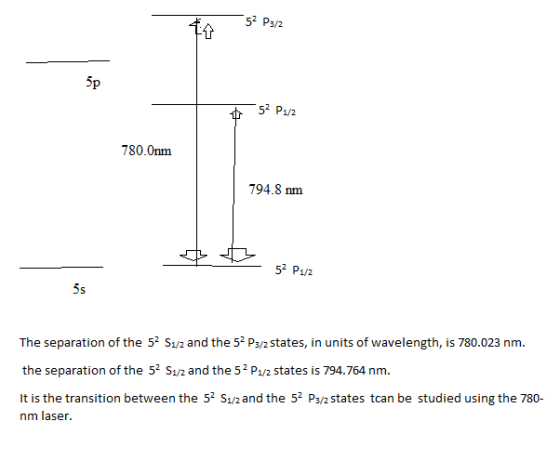
Show that the splitting of the 52P1/2 and the 52P3/2ther states due to Hso is ζ...
Show that the splitting of the 52P1/2 and the 52P3/2ther states due to Hso is ζ (r) 3 2/2.
Homework Answers
Add Answer to:
Show that the splitting of
the 52P1/2
and the 52P3/2ther
states due to Hso
is ζ...
2. a. Draw and show the crystal field splitting of the d orbitals in an octahedral...
 2. a. Draw and show the crystal field splitting of the d orbitals in an octahedral complex, a tetrahedral complex, and in a square planar complex.(clearly label the orbitals) b. Explain the difference in the following crystal field splitting values (1) Co(NH3).]2+ 10200 cm"! : [CO(NH3).]* 22,900 cm (ii) [Cr(H20).]** 17,400 cm. ; [Cr(CN).]3-26,600 cm (iii) [MnF6]?- 22,200 cm-"; [ReF.]?- 27,800 cm- (iv) [Co(NH3).]2+ 10,200 cm '; [Co(NH3)4]2+ 5,900 cm c. Draw and show the filling of 6 d electrons...
3. For small amount of damping, show that the damping ratio ζ can be approximated from the respon...
3. For small amount of damping, show that the damping ratio ζ can be approximated from the response curve as 212nωωζω−=. 1ω and 2ω are the frequencies on either side of resonance, where the amplitude is 12 of its maximum value. Explain how you can apply this result to the measurement of damping coefficient.
2. Which of the following compounds would be expected to show spin-spin splitting in their 'H NMR spectra? (Check the a...
 2. Which of the following compounds would be expected to show spin-spin splitting in their 'H NMR spectra? (Check the appropriate Box). No Splitting Splitting Compound cm No Compound Splitting Splitting (CH3)3C-O-CH (CH3)2CH-O-CH3 Br-CH2CH2CH2-Br Br-CH:CH-Br H₂CT , CH₂
Show that the irreducible polynomial x4 - 2 over Q, has roots a, b, c in its splitting field such...
Show that the irreducible polynomial x4 - 2 over Q, has roots a, b, c in its splitting field such that the fields Q(a, b) and Q(a, c) are not isomorphic over Q (Hint: The roots are (4√2, -4√2, 4√2i, -4√2i), and the splitting field is Q(4√2, i,).)
2.) Starting with the octahedral (ML6) crystal field splitting pattern below: A.) Draw the d-orbital splitting...
 2.) Starting with the octahedral (ML6) crystal field splitting pattern below: A.) Draw the d-orbital splitting for a tetragonally compressed compound (ML6). This is where the ligands along the z-axis are pushed closer to the metal center, and the ligands along the x and y-axis are pulled further from the metal center (10 marks). B.) Continue this trend until the ligands along the x and y axes are completely removed, and show the d-orbital splitting for the resulting linear complex...
2.) Starting with the octahedral (ML6) crystal field splitting pattern below: A.) Draw the d-orbital splitting...
 2.) Starting with the octahedral (ML6) crystal field splitting pattern below: A.) Draw the d-orbital splitting for a tetragonally compressed compound (ML6). This is where the ligands along the z-axis are pushed closer to the metal center, and the ligands along the x and y-axis are pulled further from the metal center (10 marks). B.) Continue this trend until the ligands along the x and y axes are completely removed, and show the d-orbital splitting for the resulting linear complex...
can you show me the mechanism and the products. thank you 1 eq HSO, OH +...
 can you show me the mechanism and the products. thank
you
1 eq HSO, OH + NH, heat NaOH ОН ОН heat TEA
can you show me the mechanism and the products. thank
you
1 eq HSO, OH + NH, heat NaOH ОН ОН heat TEA
Problem 3: Determine the splitting field of the polynomial (2 -2)(2-3)(2 -4) over Q. Find its deg...
 Problem 3: Determine the splitting field of the polynomial (2 -2)(2-3)(2 -4) over Q. Find its degree over Q. Verify if all points of the splitting field are constructible.
Problem 3: Determine the splitting field of the polynomial (2 -2)(2-3)(2 -4) over Q. Find its degree over Q. Verify if all points of the splitting field are constructible.
Problem 3: Determine the splitting field of the polynomial (2 -2)(2-3)(2 -4) over Q. Find its degree over Q. Verify if all points of the splitting field are constructible.
2. Compute the ζ and ωd for the damped system with m=1 kg, c=2 kg/s, and...
2. Compute the ζ and ωd for the damped system with m=1 kg, c=2 kg/s, and k=10 N/m. Is the system overdamped, underdamped, or critically damped? Calculate the damped natural frequency. Compute and plot the solution given the initial conditions x0 = 10 mm and v0 = 0 mm/s. (Hint: Use the same steps in Q1. Pay attention to units). 3. Consider the system x’’+ 4x’ + x = 0 for x0 = 1 mm, v0 = 0 mm/s. Is...
splitting patterns lastly let’s discuss Splitting Patterns Lastly, let's discuss why some signals are comprised of...
 splitting patterns lastly let’s discuss
Splitting Patterns Lastly, let's discuss why some signals are comprised of only a single peak, called a singlet, while other signals exhibit splitting, and may appear as a doublet, triplet, quartet, quintet, sextet, septet, octet, nonet, etc. Splitting is due to neighboring H's. That is, H's that are separated by 3 covalent bonds are called "neighbors". Each neighbor splits a signal, and the pattern observed matches the N+1 rule: the number of peaks observed is...
splitting patterns lastly let’s discuss
Splitting Patterns Lastly, let's discuss why some signals are comprised of only a single peak, called a singlet, while other signals exhibit splitting, and may appear as a doublet, triplet, quartet, quintet, sextet, septet, octet, nonet, etc. Splitting is due to neighboring H's. That is, H's that are separated by 3 covalent bonds are called "neighbors". Each neighbor splits a signal, and the pattern observed matches the N+1 rule: the number of peaks observed is...
 2. a. Draw and show the crystal field splitting of the d orbitals in an octahedral complex, a tetrahedral complex, and in a square planar complex.(clearly label the orbitals) b. Explain the difference in the following crystal field splitting values (1) Co(NH3).]2+ 10200 cm"! : [CO(NH3).]* 22,900 cm (ii) [Cr(H20).]** 17,400 cm. ; [Cr(CN).]3-26,600 cm (iii) [MnF6]?- 22,200 cm-"; [ReF.]?- 27,800 cm- (iv) [Co(NH3).]2+ 10,200 cm '; [Co(NH3)4]2+ 5,900 cm c. Draw and show the filling of 6 d electrons...
 2. Which of the following compounds would be expected to show spin-spin splitting in their 'H NMR spectra? (Check the appropriate Box). No Splitting Splitting Compound cm No Compound Splitting Splitting (CH3)3C-O-CH (CH3)2CH-O-CH3 Br-CH2CH2CH2-Br Br-CH:CH-Br H₂CT , CH₂
 2.) Starting with the octahedral (ML6) crystal field splitting pattern below: A.) Draw the d-orbital splitting for a tetragonally compressed compound (ML6). This is where the ligands along the z-axis are pushed closer to the metal center, and the ligands along the x and y-axis are pulled further from the metal center (10 marks). B.) Continue this trend until the ligands along the x and y axes are completely removed, and show the d-orbital splitting for the resulting linear complex...
 2.) Starting with the octahedral (ML6) crystal field splitting pattern below: A.) Draw the d-orbital splitting for a tetragonally compressed compound (ML6). This is where the ligands along the z-axis are pushed closer to the metal center, and the ligands along the x and y-axis are pulled further from the metal center (10 marks). B.) Continue this trend until the ligands along the x and y axes are completely removed, and show the d-orbital splitting for the resulting linear complex...
 can you show me the mechanism and the products. thank
you
1 eq HSO, OH + NH, heat NaOH ОН ОН heat TEA
can you show me the mechanism and the products. thank
you
1 eq HSO, OH + NH, heat NaOH ОН ОН heat TEA
 Problem 3: Determine the splitting field of the polynomial (2 -2)(2-3)(2 -4) over Q. Find its degree over Q. Verify if all points of the splitting field are constructible.
Problem 3: Determine the splitting field of the polynomial (2 -2)(2-3)(2 -4) over Q. Find its degree over Q. Verify if all points of the splitting field are constructible.
Problem 3: Determine the splitting field of the polynomial (2 -2)(2-3)(2 -4) over Q. Find its degree over Q. Verify if all points of the splitting field are constructible.
 splitting patterns lastly let’s discuss
Splitting Patterns Lastly, let's discuss why some signals are comprised of only a single peak, called a singlet, while other signals exhibit splitting, and may appear as a doublet, triplet, quartet, quintet, sextet, septet, octet, nonet, etc. Splitting is due to neighboring H's. That is, H's that are separated by 3 covalent bonds are called "neighbors". Each neighbor splits a signal, and the pattern observed matches the N+1 rule: the number of peaks observed is...
splitting patterns lastly let’s discuss
Splitting Patterns Lastly, let's discuss why some signals are comprised of only a single peak, called a singlet, while other signals exhibit splitting, and may appear as a doublet, triplet, quartet, quintet, sextet, septet, octet, nonet, etc. Splitting is due to neighboring H's. That is, H's that are separated by 3 covalent bonds are called "neighbors". Each neighbor splits a signal, and the pattern observed matches the N+1 rule: the number of peaks observed is...
Most questions answered within 3 hours.
-
Where is the error in this code sequence?
String s1 = "Hello";
String s2 = "ello";...
asked 11 months ago -
Financial data for Joel de Paris, Inc., for last year
follow:
Joel de Paris, Inc.
Balance...
asked 11 months ago -
Consider this reaction:
Al2(SO4)3 (aq)+ BaCl3
(aq) Al2Cl6 (aq)- +
3BaSO4(s) . What is the...
asked 11 months ago -
Suppose that Savneet is considering increasing her
recent random sample from 20 car rentals to 40...
asked 11 months ago -
Trucks arrive at an unloading terminal at an average rate of 120
per hour.
Trucks arrive...
asked 11 months ago -
Why are methanol and ethanol completely soluble in water while
octanol is not very little soluble....
asked 11 months ago -
A facilities manager at a university reads in a research report
that the mean amount of...
asked 11 months ago -
When the CuSO4 is rehydrated by adding water to the anhydrous
compound, is this an endothermic...
asked 11 months ago -
A ray of sunlight is passing from diamond into crown glass; the
angle of incidence is...
asked 11 months ago -
A block of mass 0.249 kg is placed on top of a light, vertical
spring of...
asked 11 months ago -
how do the kidneys compensate in the presences of acidosis
a) trigger hyperventilate
b) reserve acid...
asked 11 months ago -
Question 501 pts
The rental rate of capital to the firm increases. Which of the
following...
asked 11 months ago