


Homework Answers
as per the HOMEWORKLIB RULES when multi questions are posted as
single question we have to answer first one only.but i solved 15
questions for you 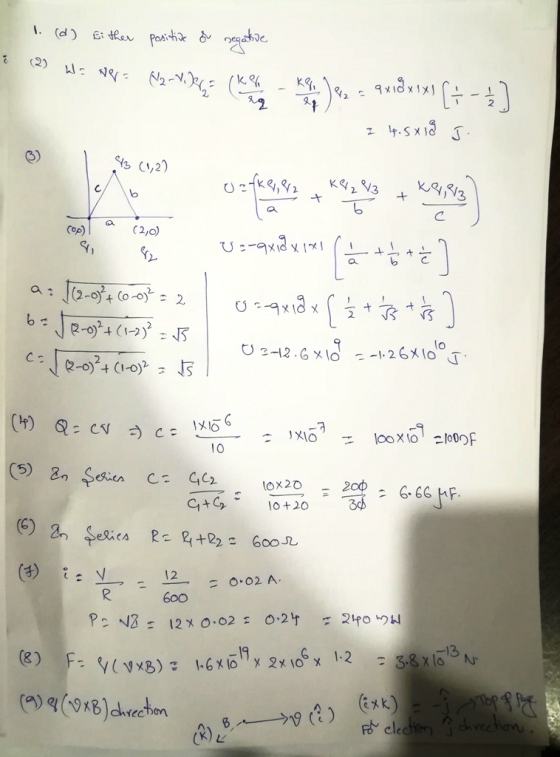

Add Answer to:
Bob places a neutrally charged conducting ball next to a large, charged plate. The conducting ball...
help please, only the right answer QUESTION 1 Bob places a negative test particle next to...
 help please, only the right
answer
QUESTION 1 Bob places a negative test particle next to a large, charged plate. The test particle moves away from the plate after Bob releases it. What is the net charge on the plate? O a. Positive b. Either positive or negative, but it is impossible to tell which c. Negative d. Neutral QUESTION 8 An electron travels to the right with speed v. A magnetic field points toward the top of the page....
help please, only the right
answer
QUESTION 1 Bob places a negative test particle next to a large, charged plate. The test particle moves away from the plate after Bob releases it. What is the net charge on the plate? O a. Positive b. Either positive or negative, but it is impossible to tell which c. Negative d. Neutral QUESTION 8 An electron travels to the right with speed v. A magnetic field points toward the top of the page....
A conducting rod is being dragged along conducting rails, as shown in (Figure 1)
 Part A A conducting rod is being dragged along conducting rails, as shown in (Figure 1). The magnetic field is directed out of the screen. In what direction does the induced current flow through the light bulb? There is no induced current. The induced current flows through the bulb from the left to the right. The induced current flows through the bulb from the right to the left. Part B A circular loop of conducting wire is moving through a uniform magnetic field, as...
Alice G LOO Bob Let's revisit the simultaneity problem from worksheet 11. To make things concrete,...
 Alice G LOO Bob Let's revisit the simultaneity problem from worksheet 11. To make things concrete, we'll include specific numbers. Bob is standing on the ground watching Alice go by in a high-speed train. As seen in Bob's reference frame, Alice is traveling to the right at speed v = +0.80c. As measured in Bob's frame, Alice's rail car is 12 m long. Alice is sitting in the exact center of the train car. At the instant that the Alice...
A proton with charge 1.602 x 10^-19 C moves at a speed of 300 m/s in...
A proton with charge 1.602 x 10^-19 C moves at a speed of 300 m/s in a magnetic field at an angle of 65 degrees. If the strength of the magnetic field is 19 T, what would be the magnitude of the force the charge experiences? 8.28 x 10^-16 N 13.78 x 10^-15 N 5.09 x 10^-14 N 7.75 x 10^-17 N An alpha particle travelling at 2155 m/s enters a magnetic field of strength 12.2 T. The particle is...
Find the total electric potential at the origin for charges X at (2.0, X/5) m; -X...
 Find the total electric potential at the origin for charges X at
(2.0, X/5) m; -X at (3.0, -2.0) m, and 2X at (2.5, 2.0) m.
X=42
X=42 for 5,6,8,&9 as well.
5. A solenoid has 50 turns in X cm. What current is needed to produce a magnetic field of 25 tesla inside the solenoid? 6. A new material has an index of refraction of X. What is the velocity of light through this material? What's the minimum angle...
Find the total electric potential at the origin for charges X at
(2.0, X/5) m; -X at (3.0, -2.0) m, and 2X at (2.5, 2.0) m.
X=42
X=42 for 5,6,8,&9 as well.
5. A solenoid has 50 turns in X cm. What current is needed to produce a magnetic field of 25 tesla inside the solenoid? 6. A new material has an index of refraction of X. What is the velocity of light through this material? What's the minimum angle...
1. A rectangular coil of wire with sides W and H has N turns. To its right is a region of uniform...
 1. A rectangular coil of wire with sides W and H has N turns. To its right is a region of uniform constant magnetic field of magnitude B. The width of this region, L, is greater than W. The direction of the field is out of the page Starting outside the region of magnetic field, the coil moves with constant speed v to- wards, into, and out of the region of field, as shown. A light bulb of resistance R...
The simple oscillating circuit shown above is made from a parallel plate capacitor connected to a solenoid. The capacitor has plates 3.0 cm x 6.0 cm separated by 2.0 mm and filled with a material...
 The simple oscillating circuit shown above is made from a parallel plate capacitor connected to a solenoid. The capacitor has plates 3.0 cm x 6.0 cm separated by 2.0 mm and filled with a material with a dielectric constant x- 8.0. The air-filled solenoid is 12.0 cm in length, with a diameter of 2.5 cm, and wound with 150 turns. The capacitor is charged to 0.25 uC, and the switch is closed at time t-0. A) What frequency radio wave...
2) The force that a magnetic field exerts on a charged particle is given by Ę...
 2) The force that a magnetic field exerts on a charged particle is given by Ę = qö xĒ. A particle with mass m= 2.0x10⁸ kg and charge q = +2.5x10⁻⁸C has an initial speed of v = 4+2 x 10³ m/s (in the x- y plane). The magnetic field vector and velocity vector are B and û, respectively are displayed on the coordinate axis below. The angle between the vectors is 135 degrees. Use unit vector notation when describing...
13. A metal bar of height 20cm lying in the plane of the page is moved...
 13. A metal bar of height 20cm lying in the plane of the page is moved through a magnetic field at a speed of 0.2m/s towards the right (see the figure below). The field has magnitude 0.5T and points out of the page. The charge separation induced in the bar is the same as would be caused by an EMF: a. 0.004 V upward b. 0.0004 V downward c. 0.02 V upward d. 0.02 V downward 0.2 m/s B-0.5T 4....
2) The force that a magnetic field exerts on a charged particle is given by F...
 2) The force that a magnetic field exerts on a charged particle is given by F = qö x B. A particle with mass m = 2.0x10 kg and charge q - +2.5x10°C has an initial speed of v = 4/2 x 103 m/s (in the x- y plane). The magnetic field vector and velocity vector are 5 and 0, respectively are displayed on the coordinate axis below. The angle between the vectors is 135 degrees. Use unit vector notation...
 help please, only the right
answer
QUESTION 1 Bob places a negative test particle next to a large, charged plate. The test particle moves away from the plate after Bob releases it. What is the net charge on the plate? O a. Positive b. Either positive or negative, but it is impossible to tell which c. Negative d. Neutral QUESTION 8 An electron travels to the right with speed v. A magnetic field points toward the top of the page....
help please, only the right
answer
QUESTION 1 Bob places a negative test particle next to a large, charged plate. The test particle moves away from the plate after Bob releases it. What is the net charge on the plate? O a. Positive b. Either positive or negative, but it is impossible to tell which c. Negative d. Neutral QUESTION 8 An electron travels to the right with speed v. A magnetic field points toward the top of the page....
 Part A A conducting rod is being dragged along conducting rails, as shown in (Figure 1). The magnetic field is directed out of the screen. In what direction does the induced current flow through the light bulb? There is no induced current. The induced current flows through the bulb from the left to the right. The induced current flows through the bulb from the right to the left. Part B A circular loop of conducting wire is moving through a uniform magnetic field, as...
 Alice G LOO Bob Let's revisit the simultaneity problem from worksheet 11. To make things concrete, we'll include specific numbers. Bob is standing on the ground watching Alice go by in a high-speed train. As seen in Bob's reference frame, Alice is traveling to the right at speed v = +0.80c. As measured in Bob's frame, Alice's rail car is 12 m long. Alice is sitting in the exact center of the train car. At the instant that the Alice...
 Find the total electric potential at the origin for charges X at
(2.0, X/5) m; -X at (3.0, -2.0) m, and 2X at (2.5, 2.0) m.
X=42
X=42 for 5,6,8,&9 as well.
5. A solenoid has 50 turns in X cm. What current is needed to produce a magnetic field of 25 tesla inside the solenoid? 6. A new material has an index of refraction of X. What is the velocity of light through this material? What's the minimum angle...
Find the total electric potential at the origin for charges X at
(2.0, X/5) m; -X at (3.0, -2.0) m, and 2X at (2.5, 2.0) m.
X=42
X=42 for 5,6,8,&9 as well.
5. A solenoid has 50 turns in X cm. What current is needed to produce a magnetic field of 25 tesla inside the solenoid? 6. A new material has an index of refraction of X. What is the velocity of light through this material? What's the minimum angle...
 1. A rectangular coil of wire with sides W and H has N turns. To its right is a region of uniform constant magnetic field of magnitude B. The width of this region, L, is greater than W. The direction of the field is out of the page Starting outside the region of magnetic field, the coil moves with constant speed v to- wards, into, and out of the region of field, as shown. A light bulb of resistance R...
 The simple oscillating circuit shown above is made from a parallel plate capacitor connected to a solenoid. The capacitor has plates 3.0 cm x 6.0 cm separated by 2.0 mm and filled with a material with a dielectric constant x- 8.0. The air-filled solenoid is 12.0 cm in length, with a diameter of 2.5 cm, and wound with 150 turns. The capacitor is charged to 0.25 uC, and the switch is closed at time t-0. A) What frequency radio wave...
 2) The force that a magnetic field exerts on a charged particle is given by Ę = qö xĒ. A particle with mass m= 2.0x10⁸ kg and charge q = +2.5x10⁻⁸C has an initial speed of v = 4+2 x 10³ m/s (in the x- y plane). The magnetic field vector and velocity vector are B and û, respectively are displayed on the coordinate axis below. The angle between the vectors is 135 degrees. Use unit vector notation when describing...
 13. A metal bar of height 20cm lying in the plane of the page is moved through a magnetic field at a speed of 0.2m/s towards the right (see the figure below). The field has magnitude 0.5T and points out of the page. The charge separation induced in the bar is the same as would be caused by an EMF: a. 0.004 V upward b. 0.0004 V downward c. 0.02 V upward d. 0.02 V downward 0.2 m/s B-0.5T 4....
 2) The force that a magnetic field exerts on a charged particle is given by F = qö x B. A particle with mass m = 2.0x10 kg and charge q - +2.5x10°C has an initial speed of v = 4/2 x 103 m/s (in the x- y plane). The magnetic field vector and velocity vector are 5 and 0, respectively are displayed on the coordinate axis below. The angle between the vectors is 135 degrees. Use unit vector notation...
Most questions answered within 3 hours.
-
Where is the error in this code sequence?
String s1 = "Hello";
String s2 = "ello";...
asked 10 months ago -
Financial data for Joel de Paris, Inc., for last year
follow:
Joel de Paris, Inc.
Balance...
asked 10 months ago -
Consider this reaction:
Al2(SO4)3 (aq)+ BaCl3
(aq) Al2Cl6 (aq)- +
3BaSO4(s) . What is the...
asked 10 months ago -
Suppose that Savneet is considering increasing her
recent random sample from 20 car rentals to 40...
asked 10 months ago -
Trucks arrive at an unloading terminal at an average rate of 120
per hour.
Trucks arrive...
asked 10 months ago -
Why are methanol and ethanol completely soluble in water while
octanol is not very little soluble....
asked 10 months ago -
A facilities manager at a university reads in a research report
that the mean amount of...
asked 10 months ago -
When the CuSO4 is rehydrated by adding water to the anhydrous
compound, is this an endothermic...
asked 10 months ago -
A ray of sunlight is passing from diamond into crown glass; the
angle of incidence is...
asked 10 months ago -
A block of mass 0.249 kg is placed on top of a light, vertical
spring of...
asked 10 months ago -
how do the kidneys compensate in the presences of acidosis
a) trigger hyperventilate
b) reserve acid...
asked 10 months ago -
Question 501 pts
The rental rate of capital to the firm increases. Which of the
following...
asked 10 months ago