
Homework Answers
Potassium carbonate is a white solid which is soluble in water. The solution of K2CO3 and pure water must have reached it's saturation level, that's why, even though it was stirred for several hours, the excess amount of K2CO3 left at the bottom of the flask. But if we add small amount of K2CO3 in pure water, it dissolves almost immediately because the solution is not saturated yet. We can keep adding the salt and it will keep dissolving till it hits it's saturation level. If we still keep adding, the excess amount of salt will be left at the bottom of the flask.
Note: saturation level can be increase with the increase in temperature. Therefore, excess of K2CO3 that is left at the bottom of the flask, can be dissolved with increase in temperature of the solution
Add Answer to:
I add pure water (at 25 degrees C) and K2CO3 to a flask, then
stopper the...
Question 1 (22 pts) A. I set a glass of vodka (40% ethanol, 60% water, 25°C)...
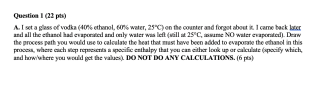 Question 1 (22 pts) A. I set a glass of vodka (40% ethanol, 60% water, 25°C) on the counter and forgot about it. I came back later and all the ethanol had evaporated and only water was left (still at 25°C, assume NO water evaporated). Draw the process path you would use to calculate the heat that must have been added to evaporate the ethanol in this process, where each step represents a specific enthalpy that you can either look...
1. Procedure A. Lithium 2,6-dimethylphenoxide. In a 300-ml. flask, equipped with a magnetic stirrer and a...
 1. Procedure A. Lithium 2,6-dimethylphenoxide. In a 300-ml. flask, equipped with a magnetic stirrer and a reflux condenser and flushed with nitrogen, are placed 150 ml. of toluene (freshly distilled from sodium), 1.40 g. (0.202 mole) of lithium metal (Note 1) and 25.0 g. (0.205 mole) of resublimed 2,6-dimethylphenol. The mixture is heated under reflux with stirring for 36 hours; a nitrogen atmosphere is maintained for the reflux period (Note 2). The condenser is replaced by a distillation head with...
PartA: Penny-→ Cu2+(aq) Make sure it is dated prior to 1982. Record mass to nearest 0.001 I. Weig...
 PartA: Penny-→ Cu2+(aq) Make sure it is dated prior to 1982. Record mass to nearest 0.001 I. Weigh a copper penny. grams. 2. Place 450 mL of distilled water in a clean 600-mL beaker. Place the beaker on a hotplate and heat until the water boils. Do not wait for the water to boil now, but proceed with the rest of the experiment. You will need this water for rinsing in step C3. CAUTION. You will generate poison°แs nitrogen dioxide...
I need help finding the theoretical yield (in grams) of triphenyl methanol product in this experiment....
 I need help finding the theoretical yield (in grams) of
triphenyl methanol product in this experiment. PLEASE SHOW WORK, I
would like to learn the steps.
below is pictures of the procedure with amounts of chemicals
used
126 Experiment 10 EXPERIMENTAL PROCEDURE All glassware used in a Grignard reaction must be scrupulously dried, Dry the following glasstare in an af 110°C for at last 20 mini drying to Canadair 8 ml comical rial 5 ml con vial, air cond glass...
I need help finding the theoretical yield (in grams) of
triphenyl methanol product in this experiment. PLEASE SHOW WORK, I
would like to learn the steps.
below is pictures of the procedure with amounts of chemicals
used
126 Experiment 10 EXPERIMENTAL PROCEDURE All glassware used in a Grignard reaction must be scrupulously dried, Dry the following glasstare in an af 110°C for at last 20 mini drying to Canadair 8 ml comical rial 5 ml con vial, air cond glass...
Introduction to Equilibrium Lab report Please help answering the question #2 (a,b,c,d) Thanks! ...
 Introduction to Equilibrium Lab report
Please help answering the question #2 (a,b,c,d)
Thanks!
Question
Procedure
Notebook
Complex ion equilibrium 1. Formation of the complex ion: 38 a) What evidence was there that a new chemical substance had formed? b) How did the reaction change the initial iron and thiocyanate concentrations? Would the reacon av tken place ifthe proportions hadtbenhioneric raior? 2. Adding and removing reactants: a) What effecet did adding the reactants (Fe' or SCN-) have on he briumcmposition? evidence...
Introduction to Equilibrium Lab report
Please help answering the question #2 (a,b,c,d)
Thanks!
Question
Procedure
Notebook
Complex ion equilibrium 1. Formation of the complex ion: 38 a) What evidence was there that a new chemical substance had formed? b) How did the reaction change the initial iron and thiocyanate concentrations? Would the reacon av tken place ifthe proportions hadtbenhioneric raior? 2. Adding and removing reactants: a) What effecet did adding the reactants (Fe' or SCN-) have on he briumcmposition? evidence...
Pre-lab Questions: Importance A one-step preparation of aspirin from its precursor, salicylic acid, via an ester...
 Pre-lab Questions:
Importance A one-step preparation of aspirin from its precursor, salicylic acid, via an ester formation illustrates one of synthetic organic chemistry's most important uses, making the drugs that treat all types of illnesses. OH HOOH Background Aspirin is a prodrug of salicylic acid, the actual active drug. A compound related to salicylic acid, salicin, was first isolated from willow bark in the mid 1700's, but willow-bark extract was used by the ancient Greeks as a treatment for pain...
Pre-lab Questions:
Importance A one-step preparation of aspirin from its precursor, salicylic acid, via an ester formation illustrates one of synthetic organic chemistry's most important uses, making the drugs that treat all types of illnesses. OH HOOH Background Aspirin is a prodrug of salicylic acid, the actual active drug. A compound related to salicylic acid, salicin, was first isolated from willow bark in the mid 1700's, but willow-bark extract was used by the ancient Greeks as a treatment for pain...
I need help answering the rest of these. Experiment TA Lab Team Members Finding Equilibrium Constants:...
 I need help answering the rest of these.
Experiment TA Lab Team Members Finding Equilibrium Constants: The Solubility of Borax Report Sheet Part A: Titration of Room Temperature Borax: Kg Molarity of Standard HCl solution: 004 u Temperature of room temperature borate mixture (T); T. in 20.00 Tin 293.15 K Trial 1 LLLLLL Final buret reading HCl, mL Initial buret reading HCI, ml 135.26 12.40 110.48 11.052 Trial 3 Trial 2 (if done) 138.53 39.00 18.83 18.76 110.66 110. 36...
I need help answering the rest of these.
Experiment TA Lab Team Members Finding Equilibrium Constants: The Solubility of Borax Report Sheet Part A: Titration of Room Temperature Borax: Kg Molarity of Standard HCl solution: 004 u Temperature of room temperature borate mixture (T); T. in 20.00 Tin 293.15 K Trial 1 LLLLLL Final buret reading HCl, mL Initial buret reading HCI, ml 135.26 12.40 110.48 11.052 Trial 3 Trial 2 (if done) 138.53 39.00 18.83 18.76 110.66 110. 36...
For the preparation and standardization of NaOH with KHP im supposed to boil water for 1hr and 30 min to remove CO2
For the preparation and standardization of NaOH with KHP im supposed to boil water for 1hr and 30 min to remove CO2....the problem is that if I don't boil it for that long and (30 min) b/c of not enough time but I put the water I boiled for 1/2 hr aproximately into a NaOH bottle with a CO2 absorber and stored it there for a few days. I would assume that I would have to boil the water again...but...
Introduction: The technique used to separate an organic compound from a mixture of compounds is called...
Introduction: The technique used to separate an organic compound from a mixture of compounds is called Extraction. Extraction process selectively dissolves one or more of the mixture compounds into a suitable solvent. The solution of these dissolved compounds is referred to as the Extract. Here the organic solvent dichloromethane is used to extract caffeine from an aqueous extract of tea leaves because caffeine is more soluble in dichloromethane (140 mg/ml) than it is in water (22 mg/ml). However, there are...
please find the purpse, Discussion, conclusion un 27 Phoenix June 20 8:10 PM a 35AEXPERIMENT 35A...
 please find the purpse, Discussion, conclusion
un 27 Phoenix June 20 8:10 PM a 35AEXPERIMENT 35A Triphenylmethanol PROCEDURE ether MgBr+ C-OH + MgBr(OH) OMgBr 0 Addct Addition of Benzophenone While the phenylmagnesium bromide solution is being heated and stirred under reflux, make a solution of 1.09 g benzophenone in 2 mL of anhrudrous ether in a 5-mL conical vial. Cap the vial until the reflux period is over. Once the Grignard reagent is cooled to room temperature, draw some of...
please find the purpse, Discussion, conclusion
un 27 Phoenix June 20 8:10 PM a 35AEXPERIMENT 35A Triphenylmethanol PROCEDURE ether MgBr+ C-OH + MgBr(OH) OMgBr 0 Addct Addition of Benzophenone While the phenylmagnesium bromide solution is being heated and stirred under reflux, make a solution of 1.09 g benzophenone in 2 mL of anhrudrous ether in a 5-mL conical vial. Cap the vial until the reflux period is over. Once the Grignard reagent is cooled to room temperature, draw some of...
 Question 1 (22 pts) A. I set a glass of vodka (40% ethanol, 60% water, 25°C) on the counter and forgot about it. I came back later and all the ethanol had evaporated and only water was left (still at 25°C, assume NO water evaporated). Draw the process path you would use to calculate the heat that must have been added to evaporate the ethanol in this process, where each step represents a specific enthalpy that you can either look...
 1. Procedure A. Lithium 2,6-dimethylphenoxide. In a 300-ml. flask, equipped with a magnetic stirrer and a reflux condenser and flushed with nitrogen, are placed 150 ml. of toluene (freshly distilled from sodium), 1.40 g. (0.202 mole) of lithium metal (Note 1) and 25.0 g. (0.205 mole) of resublimed 2,6-dimethylphenol. The mixture is heated under reflux with stirring for 36 hours; a nitrogen atmosphere is maintained for the reflux period (Note 2). The condenser is replaced by a distillation head with...
 PartA: Penny-→ Cu2+(aq) Make sure it is dated prior to 1982. Record mass to nearest 0.001 I. Weigh a copper penny. grams. 2. Place 450 mL of distilled water in a clean 600-mL beaker. Place the beaker on a hotplate and heat until the water boils. Do not wait for the water to boil now, but proceed with the rest of the experiment. You will need this water for rinsing in step C3. CAUTION. You will generate poison°แs nitrogen dioxide...
 I need help finding the theoretical yield (in grams) of
triphenyl methanol product in this experiment. PLEASE SHOW WORK, I
would like to learn the steps.
below is pictures of the procedure with amounts of chemicals
used
126 Experiment 10 EXPERIMENTAL PROCEDURE All glassware used in a Grignard reaction must be scrupulously dried, Dry the following glasstare in an af 110°C for at last 20 mini drying to Canadair 8 ml comical rial 5 ml con vial, air cond glass...
I need help finding the theoretical yield (in grams) of
triphenyl methanol product in this experiment. PLEASE SHOW WORK, I
would like to learn the steps.
below is pictures of the procedure with amounts of chemicals
used
126 Experiment 10 EXPERIMENTAL PROCEDURE All glassware used in a Grignard reaction must be scrupulously dried, Dry the following glasstare in an af 110°C for at last 20 mini drying to Canadair 8 ml comical rial 5 ml con vial, air cond glass...
 Introduction to Equilibrium Lab report
Please help answering the question #2 (a,b,c,d)
Thanks!
Question
Procedure
Notebook
Complex ion equilibrium 1. Formation of the complex ion: 38 a) What evidence was there that a new chemical substance had formed? b) How did the reaction change the initial iron and thiocyanate concentrations? Would the reacon av tken place ifthe proportions hadtbenhioneric raior? 2. Adding and removing reactants: a) What effecet did adding the reactants (Fe' or SCN-) have on he briumcmposition? evidence...
Introduction to Equilibrium Lab report
Please help answering the question #2 (a,b,c,d)
Thanks!
Question
Procedure
Notebook
Complex ion equilibrium 1. Formation of the complex ion: 38 a) What evidence was there that a new chemical substance had formed? b) How did the reaction change the initial iron and thiocyanate concentrations? Would the reacon av tken place ifthe proportions hadtbenhioneric raior? 2. Adding and removing reactants: a) What effecet did adding the reactants (Fe' or SCN-) have on he briumcmposition? evidence...
 Pre-lab Questions:
Importance A one-step preparation of aspirin from its precursor, salicylic acid, via an ester formation illustrates one of synthetic organic chemistry's most important uses, making the drugs that treat all types of illnesses. OH HOOH Background Aspirin is a prodrug of salicylic acid, the actual active drug. A compound related to salicylic acid, salicin, was first isolated from willow bark in the mid 1700's, but willow-bark extract was used by the ancient Greeks as a treatment for pain...
Pre-lab Questions:
Importance A one-step preparation of aspirin from its precursor, salicylic acid, via an ester formation illustrates one of synthetic organic chemistry's most important uses, making the drugs that treat all types of illnesses. OH HOOH Background Aspirin is a prodrug of salicylic acid, the actual active drug. A compound related to salicylic acid, salicin, was first isolated from willow bark in the mid 1700's, but willow-bark extract was used by the ancient Greeks as a treatment for pain...
 I need help answering the rest of these.
Experiment TA Lab Team Members Finding Equilibrium Constants: The Solubility of Borax Report Sheet Part A: Titration of Room Temperature Borax: Kg Molarity of Standard HCl solution: 004 u Temperature of room temperature borate mixture (T); T. in 20.00 Tin 293.15 K Trial 1 LLLLLL Final buret reading HCl, mL Initial buret reading HCI, ml 135.26 12.40 110.48 11.052 Trial 3 Trial 2 (if done) 138.53 39.00 18.83 18.76 110.66 110. 36...
I need help answering the rest of these.
Experiment TA Lab Team Members Finding Equilibrium Constants: The Solubility of Borax Report Sheet Part A: Titration of Room Temperature Borax: Kg Molarity of Standard HCl solution: 004 u Temperature of room temperature borate mixture (T); T. in 20.00 Tin 293.15 K Trial 1 LLLLLL Final buret reading HCl, mL Initial buret reading HCI, ml 135.26 12.40 110.48 11.052 Trial 3 Trial 2 (if done) 138.53 39.00 18.83 18.76 110.66 110. 36...
 please find the purpse, Discussion, conclusion
un 27 Phoenix June 20 8:10 PM a 35AEXPERIMENT 35A Triphenylmethanol PROCEDURE ether MgBr+ C-OH + MgBr(OH) OMgBr 0 Addct Addition of Benzophenone While the phenylmagnesium bromide solution is being heated and stirred under reflux, make a solution of 1.09 g benzophenone in 2 mL of anhrudrous ether in a 5-mL conical vial. Cap the vial until the reflux period is over. Once the Grignard reagent is cooled to room temperature, draw some of...
please find the purpse, Discussion, conclusion
un 27 Phoenix June 20 8:10 PM a 35AEXPERIMENT 35A Triphenylmethanol PROCEDURE ether MgBr+ C-OH + MgBr(OH) OMgBr 0 Addct Addition of Benzophenone While the phenylmagnesium bromide solution is being heated and stirred under reflux, make a solution of 1.09 g benzophenone in 2 mL of anhrudrous ether in a 5-mL conical vial. Cap the vial until the reflux period is over. Once the Grignard reagent is cooled to room temperature, draw some of...
Most questions answered within 3 hours.
-
Where is the error in this code sequence?
String s1 = "Hello";
String s2 = "ello";...
asked 11 months ago -
Financial data for Joel de Paris, Inc., for last year
follow:
Joel de Paris, Inc.
Balance...
asked 11 months ago -
Consider this reaction:
Al2(SO4)3 (aq)+ BaCl3
(aq) Al2Cl6 (aq)- +
3BaSO4(s) . What is the...
asked 11 months ago -
Suppose that Savneet is considering increasing her
recent random sample from 20 car rentals to 40...
asked 11 months ago -
Trucks arrive at an unloading terminal at an average rate of 120
per hour.
Trucks arrive...
asked 11 months ago -
Why are methanol and ethanol completely soluble in water while
octanol is not very little soluble....
asked 11 months ago -
A facilities manager at a university reads in a research report
that the mean amount of...
asked 11 months ago -
When the CuSO4 is rehydrated by adding water to the anhydrous
compound, is this an endothermic...
asked 11 months ago -
A ray of sunlight is passing from diamond into crown glass; the
angle of incidence is...
asked 11 months ago -
A block of mass 0.249 kg is placed on top of a light, vertical
spring of...
asked 11 months ago -
how do the kidneys compensate in the presences of acidosis
a) trigger hyperventilate
b) reserve acid...
asked 11 months ago -
Question 501 pts
The rental rate of capital to the firm increases. Which of the
following...
asked 11 months ago