Part 1: Our Sun rotates about the center of our Galaxy (mG≈4×1041kg) at a distance of...
Part 1:
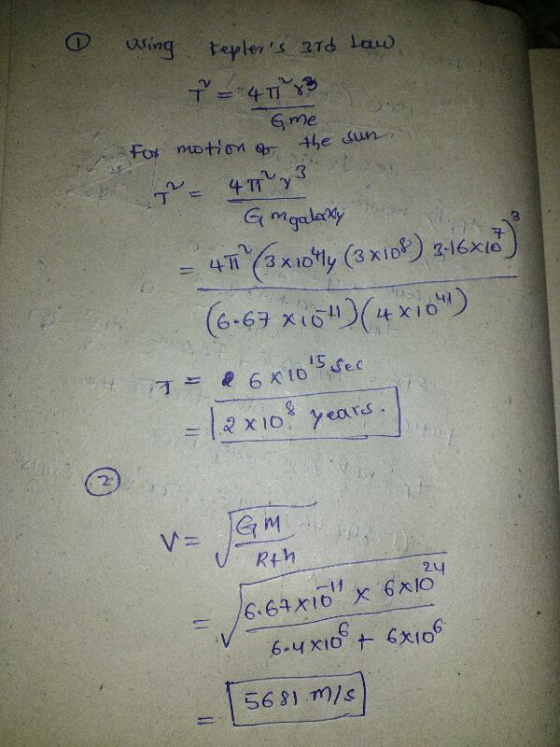
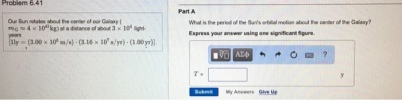
Our Sun rotates about the center of our Galaxy (mG≈4×1041kg) at a distance of about 3×10⁴ light-years [1ly=(3.00×10⁸m/s)⋅(3.16×107s/yr)⋅(1.00yr)].
What is the period of the Sun's orbital motion about the center of the Galaxy?
Express your answer using one significant figure.
Part 2:
Calculate the speed of a satellite moving in a stable circular orbit about the Earth at a height of 6000 km .
v=???? m/s
Homework Answers
Add Answer to:
Part 1:
Our Sun rotates about the center of our Galaxy (mG≈4×1041kg) at
a distance of...
Problem 6.41 Part A Our Sun rotates about the center of our Galaxy mc 4 x...
 Problem 6.41 Part A Our Sun rotates about the center of our Galaxy mc 4 x 10 "kg) at a distance of about 3 x 101 light years What is the period of the Sun's orbital motion about the center of the Galaxy? Express your answer using one significant figure. yen (3.00 × 10⁸ m/s) . (3.16 x 10, s/yr) . (1.00 yr)] Submit My Answers Give Up
2. Consider a system consisting of the Sun, Earth, and a satellite in a circular orbit...
 2. Consider a system consisting of the Sun, Earth, and a satellite in a circular orbit about the Earth. (a) Plot the gravitational acceleration of the satellite due to Earth's gravity as a function of the altitude of the satellite as measured from the surface of the Earth. Scale your plot so that the altitude goes from 0 km to 104 km. (b) Assume that the satellite instantaneously lies on the line between the Earth and the Sun. Make two...
A star rotates in a circular orbit about the center of its galaxy. The radius of...
A star rotates in a circular orbit about the center of its galaxy. The radius of the orbit is 7.9 x 10²⁰ m, and the angular speed of the star is 1.8 x 10⁻¹⁵ rad/s. How long (in years) does it take for the star to make one revolution around the center?
Astronomers have observed a small, massive object at the center of our Milky Way galaxy. A...
Astronomers have observed a small, massive object at the center of our Milky Way galaxy. A ring of material orbits this massive object; the ring has a diameter of about 10 light years and an orbital speed of about 210 km/s . A) Determine the mass of the massive object at the center of the Milky Way galaxy. Give your answer in kilograms. B) Give your answer in solar masses (one solar mass is the mass of the sun). C)...
Astronomers have observed a small, massive object at the center of our Milky Way Galaxy. A...
Astronomers have observed a small, massive object at the center of our Milky Way Galaxy. A ring of material orbits this massive object; the ring has a diameter of about 14 light-years and an orbital speed of about 100 km/s. A. Determine the mass M of the massive object at the center of the Milky Way Galaxy. Give your answer in kilograms. B. Give your answer in solar masses (one solar mass is the mass of the sun) C. Many...
numbers, the other with the equations. Put a box around the answer to each part. 1....
 numbers, the other with the equations. Put a box around the answer to each part. 1. An object's circular orbital velocity vc around the earth can be calculated using the equation ", where ve is the circular orbital velocity, μ-3.98601 E5 km3/s, is the earth's gravitational parameter, and r is the distance of the object from the earth's center. Some commercial satellites, like DirecTV, are in an orbit where they take one sidereal day (23h 56m 4.09s) to orbit the...
Plaskett's binary system consists of two stars that revolve in a circular orbit about a center...
 Plaskett's binary system consists of two stars that revolve in a circular orbit about a center of mass midway between them. This statement implies that the masses of the two stars are equal (see figure below). Assume the orbital speed of each star is |v vector| = 170 km/s and the orbital period of each is 14.5 days. Find the mass M of each star. (For comparison, the mass of our Sun is 1.99 times 10^30 kg.) 1.02e-9 If you...
draw picture, explain answer for part a and b Which step does the ball hit first?...
 draw picture, explain answer for part a and b
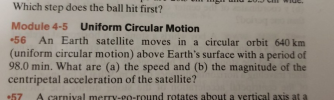
Which step does the ball hit first? Module 4-5 Uniform Circular Motion 56 An Earth satellite moves in a circular orbit 640 km (uniform circular motion) above Earth's surface with a period of 98.0 min. What are (a) the speed and (b) the magnitude of the centripetal acceleration of the satellite? 57 A carnival merry-9o-round rotates about a vertical axis at a
draw picture, explain answer for part a and b
Which step does the ball hit first? Module 4-5 Uniform Circular Motion 56 An Earth satellite moves in a circular orbit 640 km (uniform circular motion) above Earth's surface with a period of 98.0 min. What are (a) the speed and (b) the magnitude of the centripetal acceleration of the satellite? 57 A carnival merry-9o-round rotates about a vertical axis at a
We know that the Earth moves about the Sun due to the gravity force exerted by...
We know that the Earth moves about the Sun due to the gravity force exerted by the Sun, that is, the Earth is a “satellite” to the Sun, just like the moon to the Earth. Assume the Earth follows uniform circle motion about the Sun, and ignore gravity force due to objects other than the Sun. Estimate the orbital speed of the Earth = _______ m/s? The Earth has mass =5.98 x 1024 kg and radius 6.4 x 10⁶ m....
Astronomical observations of our Milky Way galaxy indicate that it center. (For your calculations, assume that...
 Astronomical observations of our Milky Way galaxy indicate that it center. (For your calculations, assume that the galaxy's mass is concentrated near its center.) has a mass of about 8 × Ό11 solar masses. A star orbiting near the galaxy S periphery. S ,, e İ-lit ears or ts (a) What should the orbital period of that star be? yr If its period is 6.7 x ǐ07 years instead, what is the mass of the galaxy? Such calculations are used...
 Problem 6.41 Part A Our Sun rotates about the center of our Galaxy mc 4 x 10 "kg) at a distance of about 3 x 101 light years What is the period of the Sun's orbital motion about the center of the Galaxy? Express your answer using one significant figure. yen (3.00 × 10⁸ m/s) . (3.16 x 10, s/yr) . (1.00 yr)] Submit My Answers Give Up
 2. Consider a system consisting of the Sun, Earth, and a satellite in a circular orbit about the Earth. (a) Plot the gravitational acceleration of the satellite due to Earth's gravity as a function of the altitude of the satellite as measured from the surface of the Earth. Scale your plot so that the altitude goes from 0 km to 104 km. (b) Assume that the satellite instantaneously lies on the line between the Earth and the Sun. Make two...
 numbers, the other with the equations. Put a box around the answer to each part. 1. An object's circular orbital velocity vc around the earth can be calculated using the equation ", where ve is the circular orbital velocity, μ-3.98601 E5 km3/s, is the earth's gravitational parameter, and r is the distance of the object from the earth's center. Some commercial satellites, like DirecTV, are in an orbit where they take one sidereal day (23h 56m 4.09s) to orbit the...
 Plaskett's binary system consists of two stars that revolve in a circular orbit about a center of mass midway between them. This statement implies that the masses of the two stars are equal (see figure below). Assume the orbital speed of each star is |v vector| = 170 km/s and the orbital period of each is 14.5 days. Find the mass M of each star. (For comparison, the mass of our Sun is 1.99 times 10^30 kg.) 1.02e-9 If you...
 draw picture, explain answer for part a and b
Which step does the ball hit first? Module 4-5 Uniform Circular Motion 56 An Earth satellite moves in a circular orbit 640 km (uniform circular motion) above Earth's surface with a period of 98.0 min. What are (a) the speed and (b) the magnitude of the centripetal acceleration of the satellite? 57 A carnival merry-9o-round rotates about a vertical axis at a
draw picture, explain answer for part a and b
Which step does the ball hit first? Module 4-5 Uniform Circular Motion 56 An Earth satellite moves in a circular orbit 640 km (uniform circular motion) above Earth's surface with a period of 98.0 min. What are (a) the speed and (b) the magnitude of the centripetal acceleration of the satellite? 57 A carnival merry-9o-round rotates about a vertical axis at a
 Astronomical observations of our Milky Way galaxy indicate that it center. (For your calculations, assume that the galaxy's mass is concentrated near its center.) has a mass of about 8 × Ό11 solar masses. A star orbiting near the galaxy S periphery. S ,, e İ-lit ears or ts (a) What should the orbital period of that star be? yr If its period is 6.7 x ǐ07 years instead, what is the mass of the galaxy? Such calculations are used...
Most questions answered within 3 hours.
-
Where is the error in this code sequence?
String s1 = "Hello";
String s2 = "ello";...
asked 11 months ago -
Financial data for Joel de Paris, Inc., for last year
follow:
Joel de Paris, Inc.
Balance...
asked 11 months ago -
Consider this reaction:
Al2(SO4)3 (aq)+ BaCl3
(aq) Al2Cl6 (aq)- +
3BaSO4(s) . What is the...
asked 11 months ago -
Suppose that Savneet is considering increasing her
recent random sample from 20 car rentals to 40...
asked 11 months ago -
Trucks arrive at an unloading terminal at an average rate of 120
per hour.
Trucks arrive...
asked 11 months ago -
Why are methanol and ethanol completely soluble in water while
octanol is not very little soluble....
asked 11 months ago -
A facilities manager at a university reads in a research report
that the mean amount of...
asked 11 months ago -
When the CuSO4 is rehydrated by adding water to the anhydrous
compound, is this an endothermic...
asked 11 months ago -
A ray of sunlight is passing from diamond into crown glass; the
angle of incidence is...
asked 11 months ago -
A block of mass 0.249 kg is placed on top of a light, vertical
spring of...
asked 11 months ago -
how do the kidneys compensate in the presences of acidosis
a) trigger hyperventilate
b) reserve acid...
asked 11 months ago -
Question 501 pts
The rental rate of capital to the firm increases. Which of the
following...
asked 11 months ago