A star rotates in a circular orbit about the center of its galaxy. The radius of...
A star rotates in a circular orbit about the center of its galaxy. The radius of the orbit is 7.9 x 10²⁰ m, and the angular speed of the star is 1.8 x 10⁻¹⁵ rad/s. How long (in years) does it take for the star to make one revolution around the center?
Homework Answers
angular speed =  = 2
= 2 /T
/T
where T is time period for one revolution
Hence , T = 2/ = 2 /
(1.8 10-15
) = 3.491 1015
s
10-15
) = 3.491 1015
s
time period in years = ( 3.491 1015
) / ( 3600 24 365
) = 1.11 108
years
Add Answer to:
A star rotates in a circular orbit about the center of its
galaxy. The radius of...
Chapter 08, Problem 51 Chalkboard Video A star has a mass of 2.10 x 1050 kg...
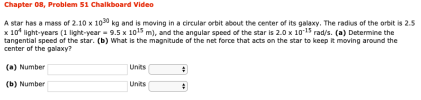 Chapter 08, Problem 51 Chalkboard Video A star has a mass of 2.10 x 1050 kg and is moving in a circular orbit about the center of its galaxy. The radius of the orbit is 2.5 x 10⁴ light-years (1 light-year = 9.5 x 10¹⁵ m), and the angular speed of the star is 2.0 x 10⁻¹⁵ rad/s. (a) Determine the tangential speed of the star. (b) What is the magnitude of the net force that acts on the star...
A planet in a circular orbit about a star has an orbital radius of 6.10 au...
A planet in a circular orbit about a star has an orbital radius of 6.10 au . If the star has a mass that is 1.20 times our own Sun's mass, determine the time ? , in units of Earth years, for one revolution of the planet around the star
15 > A horizontal circular platform rotates counterclockwise about its axis at the rate of 0.813...
 15 > A horizontal circular platform rotates counterclockwise about its axis at the rate of 0.813 rad/s. You, with a mass of 68.9 kg, walk clockwise around the platform along its edge at the speed of 1.17 m/s with respect to the platform. Your 20.1 kg poodle also walks clockwise around the platform, but along a circle at half the platform's radius and at half your linear speed with respect to the platform. Your 18.9 kg mutt, on the other...
tion 9 of 15 > A horizontal circular platform rotates counterclockwise about its axis at the...
 tion 9 of 15 > A horizontal circular platform rotates counterclockwise about its axis at the rate of 0.955 rad/s. You, with a mass of 69.9 kg, walk clockwise around the platform along its edge at the speed of 1.21 m/s with respect to the platform. Your 21.1 kg poodle also walks clockwise around the platform, but along a circle at half the platform's radius and at half your linear speed with respect to the platform. Your 17.7 kg mutt,...
A star near the visible edge of a galaxy travels in a uniform circular orbit. It...
A star near the visible edge of a galaxy travels in a uniform circular orbit. It is 42,700 ly (light-years) from the galactic center and has a speed of 275 km/s. Estimate the total mass of the galaxy based on the motion of the star. Gravitational constant is 6.674×10⁻¹¹ m3/(kg·s2) and mass of the Sun Ms=1.99 × 1030 kg. The total visible mass (i.e., matter we can detect via electromagnetic radiation) of the galaxy is 1011 solar masses. What fraction...
Part 1: Our Sun rotates about the center of our Galaxy (mG≈4×1041kg) at a distance of...
Part 1: Our Sun rotates about the center of our Galaxy (mG≈4×1041kg) at a distance of about 3×10⁴ light-years [1ly=(3.00×10⁸m/s)⋅(3.16×107s/yr)⋅(1.00yr)]. What is the period of the Sun's orbital motion about the center of the Galaxy? Express your answer using one significant figure. Part 2: Calculate the speed of a satellite moving in a stable circular orbit about the Earth at a height of 6000 km . v=???? m/s
1) Please furnish the following definitions, carefully including the dimension of each and every quantity you...
 1) Please furnish the following definitions, carefully including the dimension of each and every quantity you introduce. For example if momentum is P-mv, then me mass, unitske. V velocity, units. m/s. Each definition is worth 5 points: Centripetal force; Rotational Kinetic Energy, Angular acceleration; Speed of a satellite in a circular orbit around a planet of mass M. 2) The planet X revolves in an approximately circular orbit around a star. The radius of its orbit is 1.496x10m. Given that...
A satellite is in a circular orbit around the Earth at an altitude of 2.24 x...
 A satellite is in a circular orbit around the Earth at an altitude of 2.24 x 10⁶ m. (a) Find the period of the orbit. (Hint: Modify Kepler's third law so it is suitable for objects orbiting the Earth rather than the Sun. The radius of the Earth is 6.38 x 10⁶ m, and the mass of the Earth is 5.98 x 1024 kg.) h (b) Find the speed of the satellite. km/s (c) Find the acceleration of the satellite....
A 85.7 kg horizontal circular platform rotates freely with no friction about its center at an initial angular veloc...
 A 85.7 kg horizontal circular platform rotates freely with no friction about its center at an initial angular velocity of 1.59 rad/s. A monkey drops a 8.67 kg bunch of bananas vertically onto the platform. They hit the platform at of its radius from the center, adhere to it there, and continue to rotate with it. Then the monkey, with a mass of 20.7 kg, drops vertically to the edge of the platform, grasps it, and continues to rotate with...
A 85.7 kg horizontal circular platform rotates freely with no friction about its center at an initial angular veloc...
 A 85.7 kg horizontal circular platform rotates freely with no friction about its center at an initial angular velocity of 1.59 rad/s. A monkey drops a 8.67 kg bunch of bananas vertically onto the platform. They hit the platform at of its radius from the center, adhere to it there, and continue to rotate with it. Then the monkey, with a mass of 20.7 kg, drops vertically to the edge of the platform, grasps it, and continues to rotate with...
 Chapter 08, Problem 51 Chalkboard Video A star has a mass of 2.10 x 1050 kg and is moving in a circular orbit about the center of its galaxy. The radius of the orbit is 2.5 x 10⁴ light-years (1 light-year = 9.5 x 10¹⁵ m), and the angular speed of the star is 2.0 x 10⁻¹⁵ rad/s. (a) Determine the tangential speed of the star. (b) What is the magnitude of the net force that acts on the star...
 15 > A horizontal circular platform rotates counterclockwise about its axis at the rate of 0.813 rad/s. You, with a mass of 68.9 kg, walk clockwise around the platform along its edge at the speed of 1.17 m/s with respect to the platform. Your 20.1 kg poodle also walks clockwise around the platform, but along a circle at half the platform's radius and at half your linear speed with respect to the platform. Your 18.9 kg mutt, on the other...
 tion 9 of 15 > A horizontal circular platform rotates counterclockwise about its axis at the rate of 0.955 rad/s. You, with a mass of 69.9 kg, walk clockwise around the platform along its edge at the speed of 1.21 m/s with respect to the platform. Your 21.1 kg poodle also walks clockwise around the platform, but along a circle at half the platform's radius and at half your linear speed with respect to the platform. Your 17.7 kg mutt,...
 1) Please furnish the following definitions, carefully including the dimension of each and every quantity you introduce. For example if momentum is P-mv, then me mass, unitske. V velocity, units. m/s. Each definition is worth 5 points: Centripetal force; Rotational Kinetic Energy, Angular acceleration; Speed of a satellite in a circular orbit around a planet of mass M. 2) The planet X revolves in an approximately circular orbit around a star. The radius of its orbit is 1.496x10m. Given that...
 A satellite is in a circular orbit around the Earth at an altitude of 2.24 x 10⁶ m. (a) Find the period of the orbit. (Hint: Modify Kepler's third law so it is suitable for objects orbiting the Earth rather than the Sun. The radius of the Earth is 6.38 x 10⁶ m, and the mass of the Earth is 5.98 x 1024 kg.) h (b) Find the speed of the satellite. km/s (c) Find the acceleration of the satellite....
 A 85.7 kg horizontal circular platform rotates freely with no friction about its center at an initial angular velocity of 1.59 rad/s. A monkey drops a 8.67 kg bunch of bananas vertically onto the platform. They hit the platform at of its radius from the center, adhere to it there, and continue to rotate with it. Then the monkey, with a mass of 20.7 kg, drops vertically to the edge of the platform, grasps it, and continues to rotate with...
 A 85.7 kg horizontal circular platform rotates freely with no friction about its center at an initial angular velocity of 1.59 rad/s. A monkey drops a 8.67 kg bunch of bananas vertically onto the platform. They hit the platform at of its radius from the center, adhere to it there, and continue to rotate with it. Then the monkey, with a mass of 20.7 kg, drops vertically to the edge of the platform, grasps it, and continues to rotate with...
Most questions answered within 3 hours.
-
Where is the error in this code sequence?
String s1 = "Hello";
String s2 = "ello";...
asked 10 months ago -
Financial data for Joel de Paris, Inc., for last year
follow:
Joel de Paris, Inc.
Balance...
asked 10 months ago -
Consider this reaction:
Al2(SO4)3 (aq)+ BaCl3
(aq) Al2Cl6 (aq)- +
3BaSO4(s) . What is the...
asked 10 months ago -
Suppose that Savneet is considering increasing her
recent random sample from 20 car rentals to 40...
asked 10 months ago -
Trucks arrive at an unloading terminal at an average rate of 120
per hour.
Trucks arrive...
asked 10 months ago -
Why are methanol and ethanol completely soluble in water while
octanol is not very little soluble....
asked 10 months ago -
A facilities manager at a university reads in a research report
that the mean amount of...
asked 10 months ago -
When the CuSO4 is rehydrated by adding water to the anhydrous
compound, is this an endothermic...
asked 10 months ago -
A ray of sunlight is passing from diamond into crown glass; the
angle of incidence is...
asked 10 months ago -
A block of mass 0.249 kg is placed on top of a light, vertical
spring of...
asked 10 months ago -
how do the kidneys compensate in the presences of acidosis
a) trigger hyperventilate
b) reserve acid...
asked 10 months ago -
Question 501 pts
The rental rate of capital to the firm increases. Which of the
following...
asked 10 months ago