For the above SMES system shown in Figure 1,![Voltage Source Converter using IGBT DC-DC chopper using IGBT Three-phase AC (from generator terminal bus) Epc SMES coil Transformer 66/2.0[kV] DC link capacitoir](http://img.homeworklib.com/questions/072b6f50-494c-11eb-8e08-5138b20d1dba.png?x-oss-process=image/resize,w_560)
i) Why is the step down transformer used?
ii) In the voltage source converter component, what are the roles of the diodes and IGBTs?
iii) Why is the capacitor used between the voltage source converter and the DC-DC chopper?
iv) Is the current through the SMES coil flowing from top to bottom or from bottom to top or from both directions? Explain your answer.
Homework Answers
i) Why is the step down transformer used?
Generator BUS Voltage is 66kV, which is too high to use on a converter. The power electronic switches(IGBT,MosFET, Power BJT) available for rectifying or converting voltage source is of upto 1.2kV. Thus 66kV is too high to handle. There it has to employ a step-down transformer which reduces the voltage to 2kV which can easily be handled by two IGBTs.
ii) In the voltage source converter component, what are the roles of the diodes and IGBTs?
The Voltage Source converter is applicable for both the operations i.e Rectification (AC-DC) & Inverter (DC-AC). SMES(Superconducting Magnetic Energy Storage) is a device that can store magnetic energy in a Reactor (specifically Inductor) for a long time. This energy is used accordingly for power quality improvement. In simple words the reactor can both absorb the excess reactive power from system (Rectification operation) & feed the reactive power back to line when there is deficiency of reactive power (Inverter Operation) in the line. Thus Voltage profile of the power lines are kept healthy.
iii) Why is the capacitor used between the voltage source converter and the DC-DC chopper?
The link Capacitor ius used to smoothen up the rectified DC voltage and act as a constant DC Voltage source. While inverter operation is carried out this capacitor acts as the DC Source.
iv) Is the current through the SMES coil flowing from top to bottom or from bottom to top or from both directions? Explain your answer.
Current through the Coil is unidirectional as it stores the magnetic energy. Magnetic energy can be stored in a inductor when the fluxlinking the coil is not changing or collapsing. It needs to be constant flux. To build up constant flux a constant DC cuurent has to flow through the coil. Thus it stores magnetic energy.
Add Answer to:
For the above SMES system shown in Figure 1,
i) Why is the step down transformer...
Is N N Vo V's Vo Vs LOAD LOAD Figure 1 It has been shown in...
 Is N N Vo V's Vo Vs LOAD LOAD Figure 1 It has been shown in lectures that from the equality of power generation and power consumption, and as far as the average input/output voltages and currents are concerned, the buck and boost converters' operation in CCM (continuous current mode) are similar to the operation of the ideal AC transformers. So these converters may be considered as "ideal DC transformers". A buck converter operates with a duty cycle D 0.4,...
Transformer 10:1 his i 0 12 V Figure 4: Transformer with dc source. Shown in Figure...
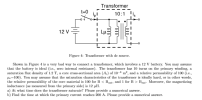 Transformer 10:1 his i 0 12 V Figure 4: Transformer with dc source. Shown in Figure 4 is a very bad way to connect a transformer, which involves a 12 V battery. You may assume that the battery is ideal (i.e., zero internal resistance). The transformer has 10 turns on the primary winding, a saturation flux density of 1.2 T, a core cross-sectional area (Ac) of 10-4 m², and a relative permeability of 100 (i.e., He=100). You may assume that...
Figure 1 Single line diagram b2 b3 b1 b4 grid Τι 13 A power system single line diagram is shown...
 Figure 1 Single line diagram b2 b3 b1 b4 grid Τι 13 A power system single line diagram is shown in Figure 1. The single line diagram shows a synchronous generator G connected to a large 50 Hz grid via its unit transformer T and a network of three transmission lines. Relevant details of the grid, transformer, generator and overhead lines are provided in Tables I,II,II & IV respectively. A double line to ground fault occurs at bus 3 Questions....
1. Why can the DSO only measure node voltages when the Function Generator is the power supply in ...
 1. Why can the DSO only measure node voltages when the Function Generator is the power supply in a circuit (unless it is using a current probe)? 2. Consider Figure 1. According to the calculations in the lab handout, if Z-1kΩ +/6914, then the phase difference (фи-фі) between u(t) and i (t) is 34.6". a. If this v(t) and i(t) were displayed on a DSO (v(t) being a node voltage and using a current probe for i(t) as shown in...
14) Which of the following is NOT a typical electrical component? A) Resistor B) Capacitor C)...
 14) Which of the following is NOT a typical electrical component? A) Resistor B) Capacitor C) Megatron Inductor E) Transformer D) 23) Convert 6.8 x 10⁻⁵ W to the closest standard metric prefix. A) 68 °W B) 0.68 uW C) 680 uW D) 6.8 uw 24) Convert 3.95 x 10⁻⁴ A to the closest standard metric prefix. A) 3.95 mA 39.5 mA 0.395 mA D 395 mA Convert the following: 25) 2 x 10⁻³ Amp = A) 2 microamps 2...
Course and Section cto EXPERIMENT ac series-Parallel Sinusoidal Circuits OBJECTIVES 1. Measure th...
 Course and Section cto EXPERIMENT ac series-Parallel Sinusoidal Circuits OBJECTIVES 1. Measure the currents of series-parallel R-L and R-C networks using sensing resistors 2. Demonstrate the Pythagorean relationship between the currents of the networks. 3. Measure the phase angles associated with the currents of the networks. 4. Calculate the input impedance of a parallel network using measured values EQUIPMENT REQUIRED Instruments Resistors 1-10-Q, 470-Ω, l-kM (14.W) Inductors 1-10-mH Capacitors 1-0.02-pF I-DMM 1--Oscilloscope 1-Audio oscillator or function generator 1--Frequency counter (if...
 Is N N Vo V's Vo Vs LOAD LOAD Figure 1 It has been shown in lectures that from the equality of power generation and power consumption, and as far as the average input/output voltages and currents are concerned, the buck and boost converters' operation in CCM (continuous current mode) are similar to the operation of the ideal AC transformers. So these converters may be considered as "ideal DC transformers". A buck converter operates with a duty cycle D 0.4,...
 Transformer 10:1 his i 0 12 V Figure 4: Transformer with dc source. Shown in Figure 4 is a very bad way to connect a transformer, which involves a 12 V battery. You may assume that the battery is ideal (i.e., zero internal resistance). The transformer has 10 turns on the primary winding, a saturation flux density of 1.2 T, a core cross-sectional area (Ac) of 10-4 m², and a relative permeability of 100 (i.e., He=100). You may assume that...
 Figure 1 Single line diagram b2 b3 b1 b4 grid Τι 13 A power system single line diagram is shown in Figure 1. The single line diagram shows a synchronous generator G connected to a large 50 Hz grid via its unit transformer T and a network of three transmission lines. Relevant details of the grid, transformer, generator and overhead lines are provided in Tables I,II,II & IV respectively. A double line to ground fault occurs at bus 3 Questions....
 1. Why can the DSO only measure node voltages when the Function Generator is the power supply in a circuit (unless it is using a current probe)? 2. Consider Figure 1. According to the calculations in the lab handout, if Z-1kΩ +/6914, then the phase difference (фи-фі) between u(t) and i (t) is 34.6". a. If this v(t) and i(t) were displayed on a DSO (v(t) being a node voltage and using a current probe for i(t) as shown in...
 14) Which of the following is NOT a typical electrical component? A) Resistor B) Capacitor C) Megatron Inductor E) Transformer D) 23) Convert 6.8 x 10⁻⁵ W to the closest standard metric prefix. A) 68 °W B) 0.68 uW C) 680 uW D) 6.8 uw 24) Convert 3.95 x 10⁻⁴ A to the closest standard metric prefix. A) 3.95 mA 39.5 mA 0.395 mA D 395 mA Convert the following: 25) 2 x 10⁻³ Amp = A) 2 microamps 2...
 Course and Section cto EXPERIMENT ac series-Parallel Sinusoidal Circuits OBJECTIVES 1. Measure the currents of series-parallel R-L and R-C networks using sensing resistors 2. Demonstrate the Pythagorean relationship between the currents of the networks. 3. Measure the phase angles associated with the currents of the networks. 4. Calculate the input impedance of a parallel network using measured values EQUIPMENT REQUIRED Instruments Resistors 1-10-Q, 470-Ω, l-kM (14.W) Inductors 1-10-mH Capacitors 1-0.02-pF I-DMM 1--Oscilloscope 1-Audio oscillator or function generator 1--Frequency counter (if...
Most questions answered within 3 hours.
-
Where is the error in this code sequence?
String s1 = "Hello";
String s2 = "ello";...
asked 10 months ago -
Financial data for Joel de Paris, Inc., for last year
follow:
Joel de Paris, Inc.
Balance...
asked 10 months ago -
Consider this reaction:
Al2(SO4)3 (aq)+ BaCl3
(aq) Al2Cl6 (aq)- +
3BaSO4(s) . What is the...
asked 10 months ago -
Suppose that Savneet is considering increasing her
recent random sample from 20 car rentals to 40...
asked 10 months ago -
Trucks arrive at an unloading terminal at an average rate of 120
per hour.
Trucks arrive...
asked 10 months ago -
Why are methanol and ethanol completely soluble in water while
octanol is not very little soluble....
asked 10 months ago -
A facilities manager at a university reads in a research report
that the mean amount of...
asked 10 months ago -
When the CuSO4 is rehydrated by adding water to the anhydrous
compound, is this an endothermic...
asked 10 months ago -
A ray of sunlight is passing from diamond into crown glass; the
angle of incidence is...
asked 10 months ago -
A block of mass 0.249 kg is placed on top of a light, vertical
spring of...
asked 10 months ago -
how do the kidneys compensate in the presences of acidosis
a) trigger hyperventilate
b) reserve acid...
asked 10 months ago -
Question 501 pts
The rental rate of capital to the firm increases. Which of the
following...
asked 10 months ago