 can someone explain this to e
step by step please?
can someone explain this to e
step by step please?
Homework Answers
Answer is C
Rate of formation of ammonia is 1.5 times rate of consumption of hydrogen.
Explaination
N2 + 3 H2 ====> 2 NH3
Divide the equation by 2
1/2 N2 + 1.5 H2 =====> NH3
Hence each mole of Ammonia will be produced when 1.5 mole of hydrogen consumptioned
Add Answer to:
can someone explain this to e
step by step please?
(b) (5 pts) Consider the reaction...
I'm not sure if I did this right as the numbers are negative? Can someone please...
 I'm not sure if I did this right as the numbers are negative?
Can someone please tell me if this is correct or if not what I did
wrong?
Be sure to answer all parts. Consider the reaction N2(g) + 3H2(g) 2NH3(g) Suppose that at a particular moment during the reaction, molecular hydrogen is reacting at the rate of -0.091 M/s. (a) At what rate is ammonia being formed? I Mis (b) At what rate is molecular nitrogen consumed? I...
I'm not sure if I did this right as the numbers are negative?
Can someone please tell me if this is correct or if not what I did
wrong?
Be sure to answer all parts. Consider the reaction N2(g) + 3H2(g) 2NH3(g) Suppose that at a particular moment during the reaction, molecular hydrogen is reacting at the rate of -0.091 M/s. (a) At what rate is ammonia being formed? I Mis (b) At what rate is molecular nitrogen consumed? I...
can someone please explain 3. For a reaction A + 2B → C the rate of...
 can someone please explain
3. For a reaction A + 2B → C the rate of reaction A[A]/A[t] is related to the rate in terms of B by A. A[B]/A[t] B. 2 A[B]/A[t] C. 12 A[B]/A[t] D. it is not possible to determine
can someone please explain
3. For a reaction A + 2B → C the rate of reaction A[A]/A[t] is related to the rate in terms of B by A. A[B]/A[t] B. 2 A[B]/A[t] C. 12 A[B]/A[t] D. it is not possible to determine
can someone explain step by step? thanks 7. The structure of styrene is shown below. The...
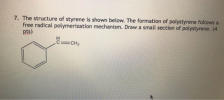 can someone explain step by step? thanks
7. The structure of styrene is shown below. The formation of polystyrene follows a free radical polymerization mechanism. Draw a small section of polystyrene. (4 pts) C=CH2
can someone explain step by step? thanks
7. The structure of styrene is shown below. The formation of polystyrene follows a free radical polymerization mechanism. Draw a small section of polystyrene. (4 pts) C=CH2
Hi, this is a sandmeyer reaction, can someone please write a reaction mechanism for this specific...
 Hi, this is a sandmeyer reaction, can someone please write a
reaction mechanism for this specific reaction?? Please draw all
arrows. Thanks! will rate :)
The Sandmeyer reaction: synthesis of o-iodobenzoic acid. LAB Experimental background. In the following lab, a Sandmeyer reaction will be used to convert anthranil o-iodobenzoic acid. Below is the overall reaction: orthop QOH aOH Q OH 0 QOH HCI NH3 CI NEN KI H20 H20 © NH NaNO2 anthranilic acid diazonium ion o-benzoic acid beds by...
Hi, this is a sandmeyer reaction, can someone please write a
reaction mechanism for this specific reaction?? Please draw all
arrows. Thanks! will rate :)
The Sandmeyer reaction: synthesis of o-iodobenzoic acid. LAB Experimental background. In the following lab, a Sandmeyer reaction will be used to convert anthranil o-iodobenzoic acid. Below is the overall reaction: orthop QOH aOH Q OH 0 QOH HCI NH3 CI NEN KI H20 H20 © NH NaNO2 anthranilic acid diazonium ion o-benzoic acid beds by...
Can someone please explain this question step by step. Any help is appreciated + 6 8....
 Can
someone please explain this question step by step. Any help is
appreciated
+ 6 8. Calculate ASo for the reaction at the right at 25 °c. 2NHe)3 Cl2g) N2)C 3(g)
Can
someone please explain this question step by step. Any help is
appreciated
+ 6 8. Calculate ASo for the reaction at the right at 25 °c. 2NHe)3 Cl2g) N2)C 3(g)
Can someone please discuss this mechanism explain it step by step Thank you
 Can someone please discuss this mechanism explain it step by
step
Thank you
Can someone please discuss this mechanism explain it step by
step
Thank you
Can someone please check my answers and aid in #12? 1. The amide nitrogen of glutamine:...
Can someone please check my answers and aid in #12? 1. The amide nitrogen of glutamine: A. represents a nontoxic transport form of ammonia. B. is a major source of ammonia for urinary excretion. C. is used in the synthesis of asparagine, purines, and pynimidines. D. can be recovered as ammonia by the action of glutaminase. E. all of the above are correct. 2- Which of the following statements about glutamate is NOT true: a It can be synthesized in...
A chemical reaction has reached equilibrium when A) the concentrations of reactants and products are equal. B) all...
 A chemical reaction has reached equilibrium when A) the concentrations of reactants and products are equal. B) all reactants have been converted to products. all products have been removed from the reaction mixture. D) the catalyst has been used up. E) the rate of the forward reaction equals the rate of the reverse reaction. 6) An equilibrium in which all the components are gases is a A) heterogeneous equilibrium. D) homogeneous B) liquid C) catalytic E) reversible 7) The equilibrium...
Can someone show step by step work and explain 4 & 5 for me please? I'd...
 Can someone show step by step work and explain 4 & 5 for me
please? I'd greatly appreciate it. Thanks!
4. Using Appendix C or another source, determine the standard free energy change (AGorkn) at 298 K for this reaction: 2 NO (g) O2 (g) 2 2 (g) AG 5. Given the following balanced reaction and the AHof and So values, calculate AGO at 25 oC for this reaction: 4 KCIO3 (s) heato 3 KCIO4 (s) KCl (s) -432.8 -436.7...
Can someone show step by step work and explain 4 & 5 for me
please? I'd greatly appreciate it. Thanks!
4. Using Appendix C or another source, determine the standard free energy change (AGorkn) at 298 K for this reaction: 2 NO (g) O2 (g) 2 2 (g) AG 5. Given the following balanced reaction and the AHof and So values, calculate AGO at 25 oC for this reaction: 4 KCIO3 (s) heato 3 KCIO4 (s) KCl (s) -432.8 -436.7...
Consider this reaction at equilibrium at a total pressure P1: 2SO2(g) + O2(g) 2SO3(g) Suppose the...
Consider this reaction at equilibrium at a total pressure P1: 2SO2(g) + O2(g) 2SO3(g) Suppose the volume of this system is compressed to one-half its initial volume and then equilibrium is reestablished. The new equilibrium total pressure will be A) twice P1 B) three times P1 C) 3.5 P1 D) less than twice P1 E) unchanged The answer is D, but would someone solve this question step-by-step?
 I'm not sure if I did this right as the numbers are negative?
Can someone please tell me if this is correct or if not what I did
wrong?
Be sure to answer all parts. Consider the reaction N2(g) + 3H2(g) 2NH3(g) Suppose that at a particular moment during the reaction, molecular hydrogen is reacting at the rate of -0.091 M/s. (a) At what rate is ammonia being formed? I Mis (b) At what rate is molecular nitrogen consumed? I...
I'm not sure if I did this right as the numbers are negative?
Can someone please tell me if this is correct or if not what I did
wrong?
Be sure to answer all parts. Consider the reaction N2(g) + 3H2(g) 2NH3(g) Suppose that at a particular moment during the reaction, molecular hydrogen is reacting at the rate of -0.091 M/s. (a) At what rate is ammonia being formed? I Mis (b) At what rate is molecular nitrogen consumed? I...
 can someone please explain
3. For a reaction A + 2B → C the rate of reaction A[A]/A[t] is related to the rate in terms of B by A. A[B]/A[t] B. 2 A[B]/A[t] C. 12 A[B]/A[t] D. it is not possible to determine
can someone please explain
3. For a reaction A + 2B → C the rate of reaction A[A]/A[t] is related to the rate in terms of B by A. A[B]/A[t] B. 2 A[B]/A[t] C. 12 A[B]/A[t] D. it is not possible to determine
 can someone explain step by step? thanks
7. The structure of styrene is shown below. The formation of polystyrene follows a free radical polymerization mechanism. Draw a small section of polystyrene. (4 pts) C=CH2
can someone explain step by step? thanks
7. The structure of styrene is shown below. The formation of polystyrene follows a free radical polymerization mechanism. Draw a small section of polystyrene. (4 pts) C=CH2
 Hi, this is a sandmeyer reaction, can someone please write a
reaction mechanism for this specific reaction?? Please draw all
arrows. Thanks! will rate :)
The Sandmeyer reaction: synthesis of o-iodobenzoic acid. LAB Experimental background. In the following lab, a Sandmeyer reaction will be used to convert anthranil o-iodobenzoic acid. Below is the overall reaction: orthop QOH aOH Q OH 0 QOH HCI NH3 CI NEN KI H20 H20 © NH NaNO2 anthranilic acid diazonium ion o-benzoic acid beds by...
Hi, this is a sandmeyer reaction, can someone please write a
reaction mechanism for this specific reaction?? Please draw all
arrows. Thanks! will rate :)
The Sandmeyer reaction: synthesis of o-iodobenzoic acid. LAB Experimental background. In the following lab, a Sandmeyer reaction will be used to convert anthranil o-iodobenzoic acid. Below is the overall reaction: orthop QOH aOH Q OH 0 QOH HCI NH3 CI NEN KI H20 H20 © NH NaNO2 anthranilic acid diazonium ion o-benzoic acid beds by...
 Can
someone please explain this question step by step. Any help is
appreciated
+ 6 8. Calculate ASo for the reaction at the right at 25 °c. 2NHe)3 Cl2g) N2)C 3(g)
Can
someone please explain this question step by step. Any help is
appreciated
+ 6 8. Calculate ASo for the reaction at the right at 25 °c. 2NHe)3 Cl2g) N2)C 3(g)
 Can someone please discuss this mechanism explain it step by
step
Thank you
Can someone please discuss this mechanism explain it step by
step
Thank you
 A chemical reaction has reached equilibrium when A) the concentrations of reactants and products are equal. B) all reactants have been converted to products. all products have been removed from the reaction mixture. D) the catalyst has been used up. E) the rate of the forward reaction equals the rate of the reverse reaction. 6) An equilibrium in which all the components are gases is a A) heterogeneous equilibrium. D) homogeneous B) liquid C) catalytic E) reversible 7) The equilibrium...
 Can someone show step by step work and explain 4 & 5 for me
please? I'd greatly appreciate it. Thanks!
4. Using Appendix C or another source, determine the standard free energy change (AGorkn) at 298 K for this reaction: 2 NO (g) O2 (g) 2 2 (g) AG 5. Given the following balanced reaction and the AHof and So values, calculate AGO at 25 oC for this reaction: 4 KCIO3 (s) heato 3 KCIO4 (s) KCl (s) -432.8 -436.7...
Can someone show step by step work and explain 4 & 5 for me
please? I'd greatly appreciate it. Thanks!
4. Using Appendix C or another source, determine the standard free energy change (AGorkn) at 298 K for this reaction: 2 NO (g) O2 (g) 2 2 (g) AG 5. Given the following balanced reaction and the AHof and So values, calculate AGO at 25 oC for this reaction: 4 KCIO3 (s) heato 3 KCIO4 (s) KCl (s) -432.8 -436.7...
Most questions answered within 3 hours.
-
Where is the error in this code sequence?
String s1 = "Hello";
String s2 = "ello";...
asked 10 months ago -
Financial data for Joel de Paris, Inc., for last year
follow:
Joel de Paris, Inc.
Balance...
asked 10 months ago -
Consider this reaction:
Al2(SO4)3 (aq)+ BaCl3
(aq) Al2Cl6 (aq)- +
3BaSO4(s) . What is the...
asked 10 months ago -
Suppose that Savneet is considering increasing her
recent random sample from 20 car rentals to 40...
asked 10 months ago -
Trucks arrive at an unloading terminal at an average rate of 120
per hour.
Trucks arrive...
asked 10 months ago -
Why are methanol and ethanol completely soluble in water while
octanol is not very little soluble....
asked 10 months ago -
A facilities manager at a university reads in a research report
that the mean amount of...
asked 10 months ago -
When the CuSO4 is rehydrated by adding water to the anhydrous
compound, is this an endothermic...
asked 10 months ago -
A ray of sunlight is passing from diamond into crown glass; the
angle of incidence is...
asked 10 months ago -
A block of mass 0.249 kg is placed on top of a light, vertical
spring of...
asked 10 months ago -
how do the kidneys compensate in the presences of acidosis
a) trigger hyperventilate
b) reserve acid...
asked 10 months ago -
Question 501 pts
The rental rate of capital to the firm increases. Which of the
following...
asked 10 months ago