
Homework Answers
Add Answer to:
can someone explain step by step? thanks
7. The structure of styrene is shown below. The...
Polystyrene can be polymerized from the starting monomer (styrene) pictured below. a. Anionic polymerization is one...
 Polystyrene can be polymerized from the starting monomer
(styrene) pictured below.
a. Anionic polymerization is one method of polymerization that
can be used to generate polystyrene from styrene. Explain what type
of initiator should be used for this reaction
and draw an example of a styrene monomer that has reacted with
initiator.
b. Using this anionic polymerization method and a starting
concentration of 1M styrene and 1mM initiator, what degree of
polymerization (Xn) would you expect if you use up...
Polystyrene can be polymerized from the starting monomer
(styrene) pictured below.
a. Anionic polymerization is one method of polymerization that
can be used to generate polystyrene from styrene. Explain what type
of initiator should be used for this reaction
and draw an example of a styrene monomer that has reacted with
initiator.
b. Using this anionic polymerization method and a starting
concentration of 1M styrene and 1mM initiator, what degree of
polymerization (Xn) would you expect if you use up...
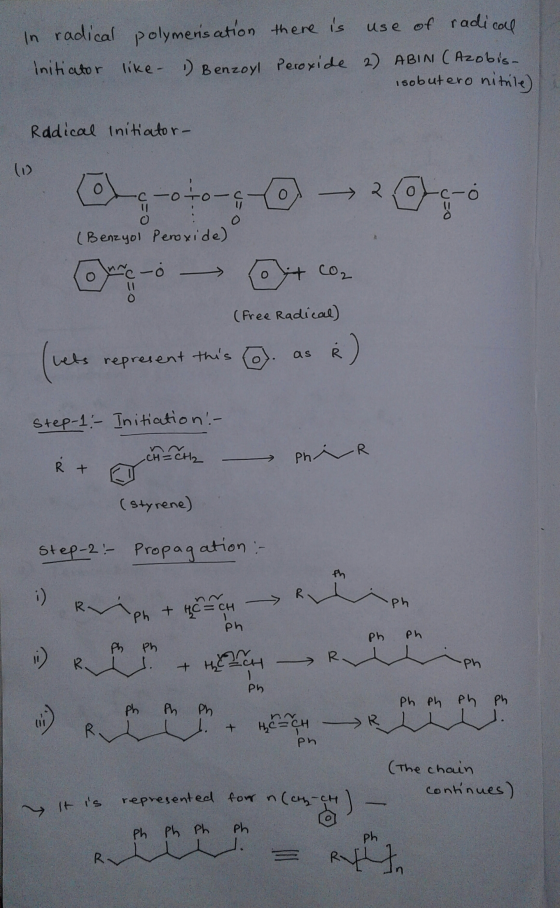
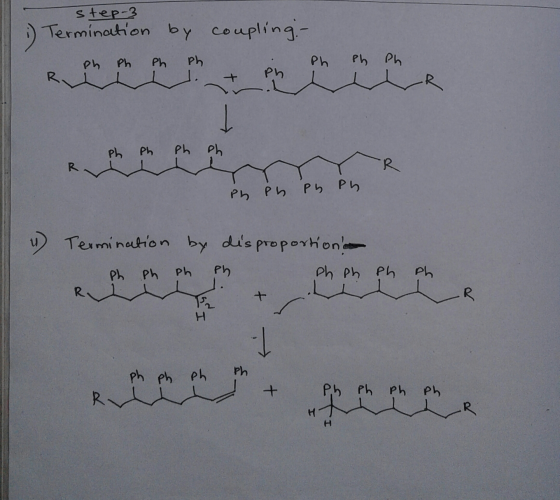
Free Radical Polymerization Mechanism - Draw the mechanism for the polystyrene-forming reaction with the reactants shown...
 Free Radical Polymerization Mechanism - Draw the mechanism for the polystyrene-forming reaction with the reactants shown below: a. Initiation b. Propagation c. Termination
0. A fragment of the polymer, Dacron, is shown below. Dacron is made by condensation polymerization...
 0. A fragment of the polymer, Dacron, is shown below. Dacron is made by condensation polymerization of 2 monomers that combine in-A-B-A-B-A-B- structure similar to nylon. a. Draw brackets around one polymer unit in the structure below. b. Draw the structures of 2 difunctional monomers A and B that would underg polymerization to produce this polymer A= x-R-X and B-y-R,-y Identify the small molecule byproduct of condensation. 4 pts o condensation c. Ax-R-x B- y-R'-y Byproduct A fragment of the...
i) Which of the following is not true about step-growth polymers? Formation of step-growth polymers usually...
i) Which of the following is not true about step-growth polymers? Formation of step-growth polymers usually results in the loss of a small molecule. Step-growth polymers are formed by the reaction of bifunctional molecules. Step-growth polymers can be formed by a free radical mechanism. Step-growth polymers are also known as condensation polymers. Step-growth polymers do not reach high molecular weight until the reaction has gone nearly to completion. ii) Which of the following are not termination methods in radical polymerization?...
Can someone solve by details please explain each step. Thanks Problem 5.9 2. Below is the...
 Can someone solve by details please explain each step.
Thanks
Problem 5.9 2. Below is the frequency response of a dynamic system Bode Diagram 40 20 100 160 135 45 45-- Frequency (radisec) a. What are the corner frequencies? .. b. How many poles in the system? c. How many zeros in the system? d. For the input signal shown in the Figure below find (at steady-state situation): i. The output signal amplitude. i. The output signal phase (in degrees...
Can someone solve by details please explain each step.
Thanks
Problem 5.9 2. Below is the frequency response of a dynamic system Bode Diagram 40 20 100 160 135 45 45-- Frequency (radisec) a. What are the corner frequencies? .. b. How many poles in the system? c. How many zeros in the system? d. For the input signal shown in the Figure below find (at steady-state situation): i. The output signal amplitude. i. The output signal phase (in degrees...
can someone explain this to e step by step please? (b) (5 pts) Consider the reaction...
 can someone explain this to e
step by step please?
(b) (5 pts) Consider the reaction in which ammonia is synthesized from nitrogen and hydrogen gases How is the rate of formation of ammonia related to the rate of consumption of hydrogen? a The rate of formation of ammonia is equal to the rate of consumption of hydrogen. b The rate of formation of ammonia is twice the rate of consumption of hydrogen. c The rate of formation of ammonia...
can someone explain this to e
step by step please?
(b) (5 pts) Consider the reaction in which ammonia is synthesized from nitrogen and hydrogen gases How is the rate of formation of ammonia related to the rate of consumption of hydrogen? a The rate of formation of ammonia is equal to the rate of consumption of hydrogen. b The rate of formation of ammonia is twice the rate of consumption of hydrogen. c The rate of formation of ammonia...
are these correct? if not, can you explain? thanks! 9. a) Draw the mechanism for formation...
 are these correct? if not, can
you explain? thanks!
9. a) Draw the mechanism for formation of the product shown. b) Draw the three resonance structures for the cation intermediate. (6 points total) HO-NO2 H2SO4 NO2 A mechanism: H-O-NO2 + H₂SO4 a H-O No2 t B) Resonance structures H NO2 H NO₂
are these correct? if not, can
you explain? thanks!
9. a) Draw the mechanism for formation of the product shown. b) Draw the three resonance structures for the cation intermediate. (6 points total) HO-NO2 H2SO4 NO2 A mechanism: H-O-NO2 + H₂SO4 a H-O No2 t B) Resonance structures H NO2 H NO₂
can you plz explain how to solve question 1&2? N-bomo soccinamide NBS)-usel speifilly for ally lic...
 can you plz explain how to solve question 1&2?
N-bomo soccinamide NBS)-usel speifilly for ally lic bonnction 1. (16 points) The molecule shown below, 3-ethyl-4-methylenehexane, is subjected to free-radical mono-bromination. a) How many products could be obtained? b) Draw the bond-line structure for the major product c) In the space below, provide the complete mechanism using the arrow notation, for th formation of the major product shown is part b above. HINT A steady and low concentration of bromine is...
can you plz explain how to solve question 1&2?
N-bomo soccinamide NBS)-usel speifilly for ally lic bonnction 1. (16 points) The molecule shown below, 3-ethyl-4-methylenehexane, is subjected to free-radical mono-bromination. a) How many products could be obtained? b) Draw the bond-line structure for the major product c) In the space below, provide the complete mechanism using the arrow notation, for th formation of the major product shown is part b above. HINT A steady and low concentration of bromine is...
7. The free radical reaction step depicted below is best classified as a. Initiation c. Termination...
 7. The free radical reaction step depicted below is best classified as a. Initiation c. Termination d. Regeneration 8. Which of the following IUPAC names correctly identifies the molecule shown below? a. (1R3S)-1-fluoro-3-ethylcyclopentane d. e. (1R,3R)-3-fluoro-1-ethylcyclopentane (1R,3S)-3-fluoro-1 None of the above 9. For the reaction coordinate shown below, which step of the reaction mechanism is the rate determining step (RDS)? reaction coordinate a. Step 1 b. Step 2 c. Step 3 d. Step 4 10 A molecule contains four chiral...
Can someone show step by step work and explain 4 & 5 for me please? I'd...
 Can someone show step by step work and explain 4 & 5 for me
please? I'd greatly appreciate it. Thanks!
4. Using Appendix C or another source, determine the standard free energy change (AGorkn) at 298 K for this reaction: 2 NO (g) O2 (g) 2 2 (g) AG 5. Given the following balanced reaction and the AHof and So values, calculate AGO at 25 oC for this reaction: 4 KCIO3 (s) heato 3 KCIO4 (s) KCl (s) -432.8 -436.7...
Can someone show step by step work and explain 4 & 5 for me
please? I'd greatly appreciate it. Thanks!
4. Using Appendix C or another source, determine the standard free energy change (AGorkn) at 298 K for this reaction: 2 NO (g) O2 (g) 2 2 (g) AG 5. Given the following balanced reaction and the AHof and So values, calculate AGO at 25 oC for this reaction: 4 KCIO3 (s) heato 3 KCIO4 (s) KCl (s) -432.8 -436.7...
 Polystyrene can be polymerized from the starting monomer
(styrene) pictured below.
a. Anionic polymerization is one method of polymerization that
can be used to generate polystyrene from styrene. Explain what type
of initiator should be used for this reaction
and draw an example of a styrene monomer that has reacted with
initiator.
b. Using this anionic polymerization method and a starting
concentration of 1M styrene and 1mM initiator, what degree of
polymerization (Xn) would you expect if you use up...
Polystyrene can be polymerized from the starting monomer
(styrene) pictured below.
a. Anionic polymerization is one method of polymerization that
can be used to generate polystyrene from styrene. Explain what type
of initiator should be used for this reaction
and draw an example of a styrene monomer that has reacted with
initiator.
b. Using this anionic polymerization method and a starting
concentration of 1M styrene and 1mM initiator, what degree of
polymerization (Xn) would you expect if you use up...
 Free Radical Polymerization Mechanism - Draw the mechanism for the polystyrene-forming reaction with the reactants shown below: a. Initiation b. Propagation c. Termination
 0. A fragment of the polymer, Dacron, is shown below. Dacron is made by condensation polymerization of 2 monomers that combine in-A-B-A-B-A-B- structure similar to nylon. a. Draw brackets around one polymer unit in the structure below. b. Draw the structures of 2 difunctional monomers A and B that would underg polymerization to produce this polymer A= x-R-X and B-y-R,-y Identify the small molecule byproduct of condensation. 4 pts o condensation c. Ax-R-x B- y-R'-y Byproduct A fragment of the...
 Can someone solve by details please explain each step.
Thanks
Problem 5.9 2. Below is the frequency response of a dynamic system Bode Diagram 40 20 100 160 135 45 45-- Frequency (radisec) a. What are the corner frequencies? .. b. How many poles in the system? c. How many zeros in the system? d. For the input signal shown in the Figure below find (at steady-state situation): i. The output signal amplitude. i. The output signal phase (in degrees...
Can someone solve by details please explain each step.
Thanks
Problem 5.9 2. Below is the frequency response of a dynamic system Bode Diagram 40 20 100 160 135 45 45-- Frequency (radisec) a. What are the corner frequencies? .. b. How many poles in the system? c. How many zeros in the system? d. For the input signal shown in the Figure below find (at steady-state situation): i. The output signal amplitude. i. The output signal phase (in degrees...
 can someone explain this to e
step by step please?
(b) (5 pts) Consider the reaction in which ammonia is synthesized from nitrogen and hydrogen gases How is the rate of formation of ammonia related to the rate of consumption of hydrogen? a The rate of formation of ammonia is equal to the rate of consumption of hydrogen. b The rate of formation of ammonia is twice the rate of consumption of hydrogen. c The rate of formation of ammonia...
can someone explain this to e
step by step please?
(b) (5 pts) Consider the reaction in which ammonia is synthesized from nitrogen and hydrogen gases How is the rate of formation of ammonia related to the rate of consumption of hydrogen? a The rate of formation of ammonia is equal to the rate of consumption of hydrogen. b The rate of formation of ammonia is twice the rate of consumption of hydrogen. c The rate of formation of ammonia...
 are these correct? if not, can
you explain? thanks!
9. a) Draw the mechanism for formation of the product shown. b) Draw the three resonance structures for the cation intermediate. (6 points total) HO-NO2 H2SO4 NO2 A mechanism: H-O-NO2 + H₂SO4 a H-O No2 t B) Resonance structures H NO2 H NO₂
are these correct? if not, can
you explain? thanks!
9. a) Draw the mechanism for formation of the product shown. b) Draw the three resonance structures for the cation intermediate. (6 points total) HO-NO2 H2SO4 NO2 A mechanism: H-O-NO2 + H₂SO4 a H-O No2 t B) Resonance structures H NO2 H NO₂
 can you plz explain how to solve question 1&2?
N-bomo soccinamide NBS)-usel speifilly for ally lic bonnction 1. (16 points) The molecule shown below, 3-ethyl-4-methylenehexane, is subjected to free-radical mono-bromination. a) How many products could be obtained? b) Draw the bond-line structure for the major product c) In the space below, provide the complete mechanism using the arrow notation, for th formation of the major product shown is part b above. HINT A steady and low concentration of bromine is...
can you plz explain how to solve question 1&2?
N-bomo soccinamide NBS)-usel speifilly for ally lic bonnction 1. (16 points) The molecule shown below, 3-ethyl-4-methylenehexane, is subjected to free-radical mono-bromination. a) How many products could be obtained? b) Draw the bond-line structure for the major product c) In the space below, provide the complete mechanism using the arrow notation, for th formation of the major product shown is part b above. HINT A steady and low concentration of bromine is...
 7. The free radical reaction step depicted below is best classified as a. Initiation c. Termination d. Regeneration 8. Which of the following IUPAC names correctly identifies the molecule shown below? a. (1R3S)-1-fluoro-3-ethylcyclopentane d. e. (1R,3R)-3-fluoro-1-ethylcyclopentane (1R,3S)-3-fluoro-1 None of the above 9. For the reaction coordinate shown below, which step of the reaction mechanism is the rate determining step (RDS)? reaction coordinate a. Step 1 b. Step 2 c. Step 3 d. Step 4 10 A molecule contains four chiral...
 Can someone show step by step work and explain 4 & 5 for me
please? I'd greatly appreciate it. Thanks!
4. Using Appendix C or another source, determine the standard free energy change (AGorkn) at 298 K for this reaction: 2 NO (g) O2 (g) 2 2 (g) AG 5. Given the following balanced reaction and the AHof and So values, calculate AGO at 25 oC for this reaction: 4 KCIO3 (s) heato 3 KCIO4 (s) KCl (s) -432.8 -436.7...
Can someone show step by step work and explain 4 & 5 for me
please? I'd greatly appreciate it. Thanks!
4. Using Appendix C or another source, determine the standard free energy change (AGorkn) at 298 K for this reaction: 2 NO (g) O2 (g) 2 2 (g) AG 5. Given the following balanced reaction and the AHof and So values, calculate AGO at 25 oC for this reaction: 4 KCIO3 (s) heato 3 KCIO4 (s) KCl (s) -432.8 -436.7...
Most questions answered within 3 hours.
-
Where is the error in this code sequence?
String s1 = "Hello";
String s2 = "ello";...
asked 10 months ago -
Financial data for Joel de Paris, Inc., for last year
follow:
Joel de Paris, Inc.
Balance...
asked 10 months ago -
Consider this reaction:
Al2(SO4)3 (aq)+ BaCl3
(aq) Al2Cl6 (aq)- +
3BaSO4(s) . What is the...
asked 10 months ago -
Suppose that Savneet is considering increasing her
recent random sample from 20 car rentals to 40...
asked 10 months ago -
Trucks arrive at an unloading terminal at an average rate of 120
per hour.
Trucks arrive...
asked 10 months ago -
Why are methanol and ethanol completely soluble in water while
octanol is not very little soluble....
asked 10 months ago -
A facilities manager at a university reads in a research report
that the mean amount of...
asked 10 months ago -
When the CuSO4 is rehydrated by adding water to the anhydrous
compound, is this an endothermic...
asked 10 months ago -
A ray of sunlight is passing from diamond into crown glass; the
angle of incidence is...
asked 10 months ago -
A block of mass 0.249 kg is placed on top of a light, vertical
spring of...
asked 10 months ago -
how do the kidneys compensate in the presences of acidosis
a) trigger hyperventilate
b) reserve acid...
asked 10 months ago -
Question 501 pts
The rental rate of capital to the firm increases. Which of the
following...
asked 10 months ago