![2 Using the time shifting properties, prove the following: g(t) sin - wo) - G(w+w.)] Ig(t +T) - g(1 - 1)]=G(w)sin Tw Using th](http://img.homeworklib.com/questions/db1c3ab0-4972-11eb-8405-35e43457c442.png?x-oss-process=image/resize,w_560)
Please answer questions step by step solution in details with clear handwriting, please.
Homework Answers


Add Answer to:
Please answer questions step by step solution in
details with clear handwriting, please.
2 Using the...
there is no img... Que 3 A bandpass signal g(t) of bandwidth B Hz centered at...
 there is no img...
Que 3 A bandpass signal g(t) of bandwidth B Hz centered at f 104 Hz is passed through the RC filter in Example 3.16 (Fig. 3.26a) with RC = 10-3. If over the passband, the variation of less than 2% in amplitude response and less than 1 % in time delay is considered to be distortionless transmission, determine what is the maximum allowable value of bandwidth B in order for g(t) to be transmitted through this...
there is no img...
Que 3 A bandpass signal g(t) of bandwidth B Hz centered at f 104 Hz is passed through the RC filter in Example 3.16 (Fig. 3.26a) with RC = 10-3. If over the passband, the variation of less than 2% in amplitude response and less than 1 % in time delay is considered to be distortionless transmission, determine what is the maximum allowable value of bandwidth B in order for g(t) to be transmitted through this...
I need the answer in details and solved step by step with clear handwriting please Reference:...
 I need the answer in details and solved step by step with clear
handwriting please
Reference: Posted Notes and textbook Chap1 For all circuits assume ideal opamp. Problem 1: Filter order a. Explain the effect of order on the filter characteristics (Draw transfer characteristics for two orders). b. How can you tell a filter order from T(s) function and from filter circuit? c. Explain how third and fourth order circuit can be implemented (show circuits)
I need the answer in details and solved step by step with clear
handwriting please
Reference: Posted Notes and textbook Chap1 For all circuits assume ideal opamp. Problem 1: Filter order a. Explain the effect of order on the filter characteristics (Draw transfer characteristics for two orders). b. How can you tell a filter order from T(s) function and from filter circuit? c. Explain how third and fourth order circuit can be implemented (show circuits)
Please answer in details For the signal 2a 6. g(t) t2 + a? Determine the essential...
 Please answer in details
For the signal 2a 6. g(t) t2 + a? Determine the essential bandwidth B Hz of g(t) such that the energy contained in the spectra component of g(t) of frequencies below B Hz is 99% of the signal energy Eg, Hint: Determine G) by applying the duality property to pair 3 of the Fourier Transforms' Table.
Please answer in details
For the signal 2a 6. g(t) t2 + a? Determine the essential bandwidth B Hz of g(t) such that the energy contained in the spectra component of g(t) of frequencies below B Hz is 99% of the signal energy Eg, Hint: Determine G) by applying the duality property to pair 3 of the Fourier Transforms' Table.
LMS project Using the notes discussed in class: Implementing the LMS Algorithm First generate some signals clear all c...
 LMS project Using the notes discussed in class: Implementing the LMS Algorithm First generate some signals clear all close al1: Generate signals for testing the LMS Algorithm 1000 Fs Sampling frequency Sample time 1/Fs 10000: = L Length of signal S Time vector (0:L-1) *T ; Sum of a 50 Hz sinusoid and a 120 Hz sinusoid 0.7 sin (2*pi*50*t); inuside X d+ 10 randn (size (t)); Sinusoids 5O0000000L plus noise fiqure (1) plot (Fs*t (1:150),x (1:1500)) title('Signal Corrupted with...
Can you please answer in simple steps: e to Question 2. (2a) Show that a filter...
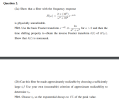 Can you please answer in simple steps:
e to Question 2. (2a) Show that a filter with the frequency response 2 x (104) HW) = w2 + 108 is physcially unrealizable. 2a Hint. Use the basic Fourier transform e-altl # for a > 0 and then the a2 +w2 time shifting property to obtain the inverse Fourier transform h(t) of H(w). Show that h(t) is noncausal. (2b) Can this filter be made approximately realizable by choosing a sufficiently large to?...
Can you please answer in simple steps:
e to Question 2. (2a) Show that a filter with the frequency response 2 x (104) HW) = w2 + 108 is physcially unrealizable. 2a Hint. Use the basic Fourier transform e-altl # for a > 0 and then the a2 +w2 time shifting property to obtain the inverse Fourier transform h(t) of H(w). Show that h(t) is noncausal. (2b) Can this filter be made approximately realizable by choosing a sufficiently large to?...
Can you please help me answer Task 2.b? Please show all work. fs=44100; no_pts=8192; t=([0:no_pts-1]')/fs; y1=sin(2...
 Can you please help me answer Task 2.b?
Please show all work.
fs=44100; no_pts=8192;
t=([0:no_pts-1]')/fs;
y1=sin(2*pi*1000*t);
figure;
plot(t,y1);
xlabel('t (second)')
ylabel('y(t)')
axis([0,.004,-1.2,1.2]) % constrain axis so you can actually see
the wave
sound(y1,fs); % play sound using windows driver.
%%
% Check the frequency domain signal. fr is the frequency vector and
f1 is the magnitude of F{y1}.
fr=([0:no_pts-1]')/no_pts*fs; %in Hz
fr=fr(1:no_pts/2); % single-sided spectrum
f1=abs(fft(y1)); % compute fft
f1=f1(1:no_pts/2)/fs;
%%
% F is the continuous time Fourier. (See derivation...
Can you please help me answer Task 2.b?
Please show all work.
fs=44100; no_pts=8192;
t=([0:no_pts-1]')/fs;
y1=sin(2*pi*1000*t);
figure;
plot(t,y1);
xlabel('t (second)')
ylabel('y(t)')
axis([0,.004,-1.2,1.2]) % constrain axis so you can actually see
the wave
sound(y1,fs); % play sound using windows driver.
%%
% Check the frequency domain signal. fr is the frequency vector and
f1 is the magnitude of F{y1}.
fr=([0:no_pts-1]')/no_pts*fs; %in Hz
fr=fr(1:no_pts/2); % single-sided spectrum
f1=abs(fft(y1)); % compute fft
f1=f1(1:no_pts/2)/fs;
%%
% F is the continuous time Fourier. (See derivation...
Answer this questions fully with clear handwriting.. do not copy answers from lther questions or ...
 answer this questions fully with clear handwriting.. do not
copy answers from lther questions or people... must have similar
given hints/answers
Problem II-B.2: Suppose the semi-horse shoe structure of the geometry illustrated in Fig.II-B.1 above, has the following numerical values for the entities marked: L = 10 cm; a 5 cm; w = 1 cm; h -0.5 cm. Further, ơ,-5x 10⁷ S/m; ơ,-3x 10⁴ S/m; and, ơ3 2x 10³ S/m. This metallic structure is used to heat 1 liter of...
answer this questions fully with clear handwriting.. do not
copy answers from lther questions or people... must have similar
given hints/answers
Problem II-B.2: Suppose the semi-horse shoe structure of the geometry illustrated in Fig.II-B.1 above, has the following numerical values for the entities marked: L = 10 cm; a 5 cm; w = 1 cm; h -0.5 cm. Further, ơ,-5x 10⁷ S/m; ơ,-3x 10⁴ S/m; and, ơ3 2x 10³ S/m. This metallic structure is used to heat 1 liter of...
Please finish these questions. Thank you Given find the Fourier transform of the following: (a) e dt 2T(2 1) 4 cos (2t) (Using properties of Fourier Transform to find) a) Suppose a signal m(t) is giv...
 Please finish these questions. Thank you
Given find the Fourier transform of the following: (a) e dt 2T(2 1) 4 cos (2t) (Using properties of Fourier Transform to find) a) Suppose a signal m(t) is given by m()-1+sin(2 fm) where fm-10 Hz. Sketch the signal m(t) in time domain b) Find the Fourier transform M(jo) of m(t) and sketch the magnitude of M(jo) c) If m(t) is amplitude modulated with a carrier signal by x(t)-m(t)cos(27r f,1) (where fe-1000 Hz), sketch...
Please finish these questions. Thank you
Given find the Fourier transform of the following: (a) e dt 2T(2 1) 4 cos (2t) (Using properties of Fourier Transform to find) a) Suppose a signal m(t) is given by m()-1+sin(2 fm) where fm-10 Hz. Sketch the signal m(t) in time domain b) Find the Fourier transform M(jo) of m(t) and sketch the magnitude of M(jo) c) If m(t) is amplitude modulated with a carrier signal by x(t)-m(t)cos(27r f,1) (where fe-1000 Hz), sketch...
1-Clear handwriting 2-Correct answer 3-Organized 4-answer all the questions Please Problem 2 On the circuit on...
 1-Clear handwriting
2-Correct answer
3-Organized
4-answer all the questions
Please
Problem 2 On the circuit on Figure P2, transi stor Q1 has a threshold voltage of Vt = 2 V and a transconductance parameter of k = 100 mA/V2. Note that Vcc = -Vee = 4.5 V. Moreover, capacitors C1, C2, and C3 can be assumed to be very large VDD 4.5.0 R3 25kQ R1 300kn C2 Vout C1 Rsig Q1 1k0 R2 200kn Vsig (R4 2kQ C3 -4.5V VSS...
1-Clear handwriting
2-Correct answer
3-Organized
4-answer all the questions
Please
Problem 2 On the circuit on Figure P2, transi stor Q1 has a threshold voltage of Vt = 2 V and a transconductance parameter of k = 100 mA/V2. Note that Vcc = -Vee = 4.5 V. Moreover, capacitors C1, C2, and C3 can be assumed to be very large VDD 4.5.0 R3 25kQ R1 300kn C2 Vout C1 Rsig Q1 1k0 R2 200kn Vsig (R4 2kQ C3 -4.5V VSS...
LMS project Using the notes discussed in class: Implementing the LMS Algorithm First generate some signals...
 LMS project Using the notes discussed in class: Implementing the LMS Algorithm First generate some signals clear all close al1: Generate signals for testing the LMS Algorithm 1000 Fs Sampling frequency Sample time 1/Fs 10000: = L Length of signal S Time vector (0:L-1) *T ; Sum of a 50 Hz sinusoid and a 120 Hz sinusoid 0.7 sin (2*pi*50*t); inuside X d+ 10 randn (size (t)); Sinusoids 5O0000000L plus noise fiqure (1) plot (Fs*t (1:150),x (1:1500)) title('Signal Corrupted with...
 there is no img...
Que 3 A bandpass signal g(t) of bandwidth B Hz centered at f 104 Hz is passed through the RC filter in Example 3.16 (Fig. 3.26a) with RC = 10-3. If over the passband, the variation of less than 2% in amplitude response and less than 1 % in time delay is considered to be distortionless transmission, determine what is the maximum allowable value of bandwidth B in order for g(t) to be transmitted through this...
there is no img...
Que 3 A bandpass signal g(t) of bandwidth B Hz centered at f 104 Hz is passed through the RC filter in Example 3.16 (Fig. 3.26a) with RC = 10-3. If over the passband, the variation of less than 2% in amplitude response and less than 1 % in time delay is considered to be distortionless transmission, determine what is the maximum allowable value of bandwidth B in order for g(t) to be transmitted through this...
 I need the answer in details and solved step by step with clear
handwriting please
Reference: Posted Notes and textbook Chap1 For all circuits assume ideal opamp. Problem 1: Filter order a. Explain the effect of order on the filter characteristics (Draw transfer characteristics for two orders). b. How can you tell a filter order from T(s) function and from filter circuit? c. Explain how third and fourth order circuit can be implemented (show circuits)
I need the answer in details and solved step by step with clear
handwriting please
Reference: Posted Notes and textbook Chap1 For all circuits assume ideal opamp. Problem 1: Filter order a. Explain the effect of order on the filter characteristics (Draw transfer characteristics for two orders). b. How can you tell a filter order from T(s) function and from filter circuit? c. Explain how third and fourth order circuit can be implemented (show circuits)
 Please answer in details
For the signal 2a 6. g(t) t2 + a? Determine the essential bandwidth B Hz of g(t) such that the energy contained in the spectra component of g(t) of frequencies below B Hz is 99% of the signal energy Eg, Hint: Determine G) by applying the duality property to pair 3 of the Fourier Transforms' Table.
Please answer in details
For the signal 2a 6. g(t) t2 + a? Determine the essential bandwidth B Hz of g(t) such that the energy contained in the spectra component of g(t) of frequencies below B Hz is 99% of the signal energy Eg, Hint: Determine G) by applying the duality property to pair 3 of the Fourier Transforms' Table.
 LMS project Using the notes discussed in class: Implementing the LMS Algorithm First generate some signals clear all close al1: Generate signals for testing the LMS Algorithm 1000 Fs Sampling frequency Sample time 1/Fs 10000: = L Length of signal S Time vector (0:L-1) *T ; Sum of a 50 Hz sinusoid and a 120 Hz sinusoid 0.7 sin (2*pi*50*t); inuside X d+ 10 randn (size (t)); Sinusoids 5O0000000L plus noise fiqure (1) plot (Fs*t (1:150),x (1:1500)) title('Signal Corrupted with...
 Can you please answer in simple steps:
e to Question 2. (2a) Show that a filter with the frequency response 2 x (104) HW) = w2 + 108 is physcially unrealizable. 2a Hint. Use the basic Fourier transform e-altl # for a > 0 and then the a2 +w2 time shifting property to obtain the inverse Fourier transform h(t) of H(w). Show that h(t) is noncausal. (2b) Can this filter be made approximately realizable by choosing a sufficiently large to?...
Can you please answer in simple steps:
e to Question 2. (2a) Show that a filter with the frequency response 2 x (104) HW) = w2 + 108 is physcially unrealizable. 2a Hint. Use the basic Fourier transform e-altl # for a > 0 and then the a2 +w2 time shifting property to obtain the inverse Fourier transform h(t) of H(w). Show that h(t) is noncausal. (2b) Can this filter be made approximately realizable by choosing a sufficiently large to?...
 Can you please help me answer Task 2.b?
Please show all work.
fs=44100; no_pts=8192;
t=([0:no_pts-1]')/fs;
y1=sin(2*pi*1000*t);
figure;
plot(t,y1);
xlabel('t (second)')
ylabel('y(t)')
axis([0,.004,-1.2,1.2]) % constrain axis so you can actually see
the wave
sound(y1,fs); % play sound using windows driver.
%%
% Check the frequency domain signal. fr is the frequency vector and
f1 is the magnitude of F{y1}.
fr=([0:no_pts-1]')/no_pts*fs; %in Hz
fr=fr(1:no_pts/2); % single-sided spectrum
f1=abs(fft(y1)); % compute fft
f1=f1(1:no_pts/2)/fs;
%%
% F is the continuous time Fourier. (See derivation...
Can you please help me answer Task 2.b?
Please show all work.
fs=44100; no_pts=8192;
t=([0:no_pts-1]')/fs;
y1=sin(2*pi*1000*t);
figure;
plot(t,y1);
xlabel('t (second)')
ylabel('y(t)')
axis([0,.004,-1.2,1.2]) % constrain axis so you can actually see
the wave
sound(y1,fs); % play sound using windows driver.
%%
% Check the frequency domain signal. fr is the frequency vector and
f1 is the magnitude of F{y1}.
fr=([0:no_pts-1]')/no_pts*fs; %in Hz
fr=fr(1:no_pts/2); % single-sided spectrum
f1=abs(fft(y1)); % compute fft
f1=f1(1:no_pts/2)/fs;
%%
% F is the continuous time Fourier. (See derivation...
 answer this questions fully with clear handwriting.. do not
copy answers from lther questions or people... must have similar
given hints/answers
Problem II-B.2: Suppose the semi-horse shoe structure of the geometry illustrated in Fig.II-B.1 above, has the following numerical values for the entities marked: L = 10 cm; a 5 cm; w = 1 cm; h -0.5 cm. Further, ơ,-5x 10⁷ S/m; ơ,-3x 10⁴ S/m; and, ơ3 2x 10³ S/m. This metallic structure is used to heat 1 liter of...
answer this questions fully with clear handwriting.. do not
copy answers from lther questions or people... must have similar
given hints/answers
Problem II-B.2: Suppose the semi-horse shoe structure of the geometry illustrated in Fig.II-B.1 above, has the following numerical values for the entities marked: L = 10 cm; a 5 cm; w = 1 cm; h -0.5 cm. Further, ơ,-5x 10⁷ S/m; ơ,-3x 10⁴ S/m; and, ơ3 2x 10³ S/m. This metallic structure is used to heat 1 liter of...
 Please finish these questions. Thank you
Given find the Fourier transform of the following: (a) e dt 2T(2 1) 4 cos (2t) (Using properties of Fourier Transform to find) a) Suppose a signal m(t) is given by m()-1+sin(2 fm) where fm-10 Hz. Sketch the signal m(t) in time domain b) Find the Fourier transform M(jo) of m(t) and sketch the magnitude of M(jo) c) If m(t) is amplitude modulated with a carrier signal by x(t)-m(t)cos(27r f,1) (where fe-1000 Hz), sketch...
Please finish these questions. Thank you
Given find the Fourier transform of the following: (a) e dt 2T(2 1) 4 cos (2t) (Using properties of Fourier Transform to find) a) Suppose a signal m(t) is given by m()-1+sin(2 fm) where fm-10 Hz. Sketch the signal m(t) in time domain b) Find the Fourier transform M(jo) of m(t) and sketch the magnitude of M(jo) c) If m(t) is amplitude modulated with a carrier signal by x(t)-m(t)cos(27r f,1) (where fe-1000 Hz), sketch...
 1-Clear handwriting
2-Correct answer
3-Organized
4-answer all the questions
Please
Problem 2 On the circuit on Figure P2, transi stor Q1 has a threshold voltage of Vt = 2 V and a transconductance parameter of k = 100 mA/V2. Note that Vcc = -Vee = 4.5 V. Moreover, capacitors C1, C2, and C3 can be assumed to be very large VDD 4.5.0 R3 25kQ R1 300kn C2 Vout C1 Rsig Q1 1k0 R2 200kn Vsig (R4 2kQ C3 -4.5V VSS...
1-Clear handwriting
2-Correct answer
3-Organized
4-answer all the questions
Please
Problem 2 On the circuit on Figure P2, transi stor Q1 has a threshold voltage of Vt = 2 V and a transconductance parameter of k = 100 mA/V2. Note that Vcc = -Vee = 4.5 V. Moreover, capacitors C1, C2, and C3 can be assumed to be very large VDD 4.5.0 R3 25kQ R1 300kn C2 Vout C1 Rsig Q1 1k0 R2 200kn Vsig (R4 2kQ C3 -4.5V VSS...
 LMS project Using the notes discussed in class: Implementing the LMS Algorithm First generate some signals clear all close al1: Generate signals for testing the LMS Algorithm 1000 Fs Sampling frequency Sample time 1/Fs 10000: = L Length of signal S Time vector (0:L-1) *T ; Sum of a 50 Hz sinusoid and a 120 Hz sinusoid 0.7 sin (2*pi*50*t); inuside X d+ 10 randn (size (t)); Sinusoids 5O0000000L plus noise fiqure (1) plot (Fs*t (1:150),x (1:1500)) title('Signal Corrupted with...
Most questions answered within 3 hours.
-
Where is the error in this code sequence?
String s1 = "Hello";
String s2 = "ello";...
asked 11 months ago -
Financial data for Joel de Paris, Inc., for last year
follow:
Joel de Paris, Inc.
Balance...
asked 11 months ago -
Consider this reaction:
Al2(SO4)3 (aq)+ BaCl3
(aq) Al2Cl6 (aq)- +
3BaSO4(s) . What is the...
asked 11 months ago -
Suppose that Savneet is considering increasing her
recent random sample from 20 car rentals to 40...
asked 11 months ago -
Trucks arrive at an unloading terminal at an average rate of 120
per hour.
Trucks arrive...
asked 11 months ago -
Why are methanol and ethanol completely soluble in water while
octanol is not very little soluble....
asked 11 months ago -
A facilities manager at a university reads in a research report
that the mean amount of...
asked 11 months ago -
When the CuSO4 is rehydrated by adding water to the anhydrous
compound, is this an endothermic...
asked 11 months ago -
A ray of sunlight is passing from diamond into crown glass; the
angle of incidence is...
asked 11 months ago -
A block of mass 0.249 kg is placed on top of a light, vertical
spring of...
asked 11 months ago -
how do the kidneys compensate in the presences of acidosis
a) trigger hyperventilate
b) reserve acid...
asked 11 months ago -
Question 501 pts
The rental rate of capital to the firm increases. Which of the
following...
asked 11 months ago