
Homework Answers

Add Answer to:
6.21 The mathematical model of a rotary mechanical system is represented by the differential equation ....
Consider the mechanical dynamics of a 2DOF rotary motion system shown below, where the torque is...
 Consider the mechanical dynamics of a 2DOF rotary motion system shown below, where the torque is applied to the right shaft but the angular position of the left shaft is to be controlled, k is the stiffness of the linear rotary spring and bi, b2 are the viscous friction coefficients of the ball bearings that support the left and right shafts respectively and act as linear viscous dampers with rotary motion. PLEASE show all mathematical steps explicitly. (I1=Iz=1kgm², bi=b2=0.9Nms/rad, k=4Nm/rad)...
Consider the mechanical dynamics of a 2DOF rotary motion system shown below, where the torque is...
 Consider the mechanical dynamics of a 2DOF rotary motion system shown below, where the torque is applied to the right shaft but the angular position of the left shaft is to be controlled, k is the stiffness of the linear rotary spring and b is the viscous friction coefficient of the ball bearing that supports the right shaft and acts as a linear viscous damper with rotary motion. The left shaft is only supported by the right shaft, so there...
Consider the mechanical dynamics of a 2DOF rotary motion system shown below, where the torque is...
 Consider the mechanical dynamics of a 2DOF rotary motion system shown below, where the torque is applied to the right shaft but the angular position of the left shaft is to be controlled, k is the stiffness of the linear rotary spring and b is the viscous friction coefficient of the ball bearing that supports the right shaft and acts as a linear viscous damper with rotary motion. The left shaft is only supported by the right shaft, so there...
Consider the mechanical dynamics of a 2DOF rotary motion system shown below, where the torque is...
 Consider the mechanical dynamics of a 2DOF rotary motion system shown below, where the torque is applied to the right shaft but the angular position of the left shaft is to be controlled, k is the stiffness of the linear rotary spring and b is the viscous friction coefficient of the ball bearing that supports the right shaft and acts as a linear viscous damper with rotary motion. The left shaft is only supported by the right shaft, so there...
Q5 The equation of the motion of the mechanical system shown in the following figure is...
 Q5 The equation of the motion of the mechanical system shown in the following figure is governed by the following differential equation d2 x dx m7+9+= -f(t) - 3kx dt2 dt where m, C and k are mass, damping coefficient and spring constant, respectively. Consider the system with m = 10 kg, c = 80 Ns/m, k = 50 N/m, and the system is at rest at time t = 0 s. f(t) is the external force acting on the...
Given the following differential equation, which represents the model of a physical system, determine (A) the...
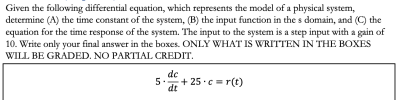 Given the following differential equation, which represents the model of a physical system, determine (A) the time constant of the system, (B) the input function in the s domain, and (C) the equation for the time response of the system. The input to the system is a step input with a gain of 10. Write only your final answer in the boxes. ONLY WHAT IS WRITTEN IN THE BOXES WILL BE GRADED. NO PARTIAL CREDIT. 5.46 +25.c =r(t)
The single d-o-f pitching motion of an airplane was shown to be represented by a second-order differential equation given by 3. where θ and δ, are in radians. Assuming a step input of the elevator...
 The single d-o-f pitching motion of an airplane was shown to be represented by a second-order differential equation given by 3. where θ and δ, are in radians. Assuming a step input of the elevator angle of 0.1 rad, plot the time response of 0 and estimate the rise time, peak overshoot, and settling time.
The single d-o-f pitching motion of an airplane was shown to be represented by a second-order differential equation given by 3. where θ and δ,...
The single d-o-f pitching motion of an airplane was shown to be represented by a second-order differential equation given by 3. where θ and δ, are in radians. Assuming a step input of the elevator angle of 0.1 rad, plot the time response of 0 and estimate the rise time, peak overshoot, and settling time.
The single d-o-f pitching motion of an airplane was shown to be represented by a second-order differential equation given by 3. where θ and δ,...
2. A two-mass translational mechanical system has the following mathematical model: mž +bi,+k, (*; - x)=f,0)...
 2. A two-mass translational mechanical system has the following mathematical model: mž +bi,+k, (*; - x)=f,0) m,ž, +b,X, +k, (x2 – x)+k,x, = 0 The displacements Xi and X2 are measured from their respective equilibrium positions. An external force falt) is applied to the system. Sketch a possible configuration of the two-mass mechanical system. Label all elements and show the positive convention for displacement in your sketch. (Hint verify the system model by applying Newton's laws.)
2 A robot-arm drive system for one joint can be represented by the differential equation dv...
 2 A robot-arm drive system for one joint can be represented by the differential equation dv kvt)k2y(t)+ kyi(t) dt position, and i(t) is the control-motor current velocity, y(t) Where v(t) Derive the state-space equation of the system a) (5 marks) b) By using Routh-Hurwitz criterion, determine the conditions for k,k2,and ky so that the system remains stable? (5 marks)
2 A robot-arm drive system for one joint can be represented by the differential equation dv kvt)k2y(t)+ kyi(t) dt position, and...
2 A robot-arm drive system for one joint can be represented by the differential equation dv kvt)k2y(t)+ kyi(t) dt position, and i(t) is the control-motor current velocity, y(t) Where v(t) Derive the state-space equation of the system a) (5 marks) b) By using Routh-Hurwitz criterion, determine the conditions for k,k2,and ky so that the system remains stable? (5 marks)
2 A robot-arm drive system for one joint can be represented by the differential equation dv kvt)k2y(t)+ kyi(t) dt position, and...
s) Given the following rotational mechanical system, hot relates the input variable T (applied torque) to...
 s) Given the following rotational mechanical system, hot relates the input variable T (applied torque) to the output a) Write the differential equation that re variable angular displacement) b) Convert the differential equatio c) Write the Transfer function of the system (I. w ent the differential equation to Laplace domain assuming initial conditions Zero Consider the following values for the parameters: J - 2 kg-m? (moment of inertial of the mass) D = 0.5 N-m-s/rad (coefficient of friction) K-1 N-m/rad...
 Consider the mechanical dynamics of a 2DOF rotary motion system shown below, where the torque is applied to the right shaft but the angular position of the left shaft is to be controlled, k is the stiffness of the linear rotary spring and bi, b2 are the viscous friction coefficients of the ball bearings that support the left and right shafts respectively and act as linear viscous dampers with rotary motion. PLEASE show all mathematical steps explicitly. (I1=Iz=1kgm², bi=b2=0.9Nms/rad, k=4Nm/rad)...
 Consider the mechanical dynamics of a 2DOF rotary motion system shown below, where the torque is applied to the right shaft but the angular position of the left shaft is to be controlled, k is the stiffness of the linear rotary spring and b is the viscous friction coefficient of the ball bearing that supports the right shaft and acts as a linear viscous damper with rotary motion. The left shaft is only supported by the right shaft, so there...
 Consider the mechanical dynamics of a 2DOF rotary motion system shown below, where the torque is applied to the right shaft but the angular position of the left shaft is to be controlled, k is the stiffness of the linear rotary spring and b is the viscous friction coefficient of the ball bearing that supports the right shaft and acts as a linear viscous damper with rotary motion. The left shaft is only supported by the right shaft, so there...
 Consider the mechanical dynamics of a 2DOF rotary motion system shown below, where the torque is applied to the right shaft but the angular position of the left shaft is to be controlled, k is the stiffness of the linear rotary spring and b is the viscous friction coefficient of the ball bearing that supports the right shaft and acts as a linear viscous damper with rotary motion. The left shaft is only supported by the right shaft, so there...
 Q5 The equation of the motion of the mechanical system shown in the following figure is governed by the following differential equation d2 x dx m7+9+= -f(t) - 3kx dt2 dt where m, C and k are mass, damping coefficient and spring constant, respectively. Consider the system with m = 10 kg, c = 80 Ns/m, k = 50 N/m, and the system is at rest at time t = 0 s. f(t) is the external force acting on the...
 Given the following differential equation, which represents the model of a physical system, determine (A) the time constant of the system, (B) the input function in the s domain, and (C) the equation for the time response of the system. The input to the system is a step input with a gain of 10. Write only your final answer in the boxes. ONLY WHAT IS WRITTEN IN THE BOXES WILL BE GRADED. NO PARTIAL CREDIT. 5.46 +25.c =r(t)
 The single d-o-f pitching motion of an airplane was shown to be represented by a second-order differential equation given by 3. where θ and δ, are in radians. Assuming a step input of the elevator angle of 0.1 rad, plot the time response of 0 and estimate the rise time, peak overshoot, and settling time.
The single d-o-f pitching motion of an airplane was shown to be represented by a second-order differential equation given by 3. where θ and δ,...
The single d-o-f pitching motion of an airplane was shown to be represented by a second-order differential equation given by 3. where θ and δ, are in radians. Assuming a step input of the elevator angle of 0.1 rad, plot the time response of 0 and estimate the rise time, peak overshoot, and settling time.
The single d-o-f pitching motion of an airplane was shown to be represented by a second-order differential equation given by 3. where θ and δ,...
 2. A two-mass translational mechanical system has the following mathematical model: mž +bi,+k, (*; - x)=f,0) m,ž, +b,X, +k, (x2 – x)+k,x, = 0 The displacements Xi and X2 are measured from their respective equilibrium positions. An external force falt) is applied to the system. Sketch a possible configuration of the two-mass mechanical system. Label all elements and show the positive convention for displacement in your sketch. (Hint verify the system model by applying Newton's laws.)
 2 A robot-arm drive system for one joint can be represented by the differential equation dv kvt)k2y(t)+ kyi(t) dt position, and i(t) is the control-motor current velocity, y(t) Where v(t) Derive the state-space equation of the system a) (5 marks) b) By using Routh-Hurwitz criterion, determine the conditions for k,k2,and ky so that the system remains stable? (5 marks)
2 A robot-arm drive system for one joint can be represented by the differential equation dv kvt)k2y(t)+ kyi(t) dt position, and...
2 A robot-arm drive system for one joint can be represented by the differential equation dv kvt)k2y(t)+ kyi(t) dt position, and i(t) is the control-motor current velocity, y(t) Where v(t) Derive the state-space equation of the system a) (5 marks) b) By using Routh-Hurwitz criterion, determine the conditions for k,k2,and ky so that the system remains stable? (5 marks)
2 A robot-arm drive system for one joint can be represented by the differential equation dv kvt)k2y(t)+ kyi(t) dt position, and...
 s) Given the following rotational mechanical system, hot relates the input variable T (applied torque) to the output a) Write the differential equation that re variable angular displacement) b) Convert the differential equatio c) Write the Transfer function of the system (I. w ent the differential equation to Laplace domain assuming initial conditions Zero Consider the following values for the parameters: J - 2 kg-m? (moment of inertial of the mass) D = 0.5 N-m-s/rad (coefficient of friction) K-1 N-m/rad...
Most questions answered within 3 hours.
-
Where is the error in this code sequence?
String s1 = "Hello";
String s2 = "ello";...
asked 11 months ago -
Financial data for Joel de Paris, Inc., for last year
follow:
Joel de Paris, Inc.
Balance...
asked 11 months ago -
Consider this reaction:
Al2(SO4)3 (aq)+ BaCl3
(aq) Al2Cl6 (aq)- +
3BaSO4(s) . What is the...
asked 11 months ago -
Suppose that Savneet is considering increasing her
recent random sample from 20 car rentals to 40...
asked 11 months ago -
Trucks arrive at an unloading terminal at an average rate of 120
per hour.
Trucks arrive...
asked 11 months ago -
Why are methanol and ethanol completely soluble in water while
octanol is not very little soluble....
asked 11 months ago -
A facilities manager at a university reads in a research report
that the mean amount of...
asked 11 months ago -
When the CuSO4 is rehydrated by adding water to the anhydrous
compound, is this an endothermic...
asked 11 months ago -
A ray of sunlight is passing from diamond into crown glass; the
angle of incidence is...
asked 11 months ago -
A block of mass 0.249 kg is placed on top of a light, vertical
spring of...
asked 11 months ago -
how do the kidneys compensate in the presences of acidosis
a) trigger hyperventilate
b) reserve acid...
asked 11 months ago -
Question 501 pts
The rental rate of capital to the firm increases. Which of the
following...
asked 11 months ago