
Homework Answers
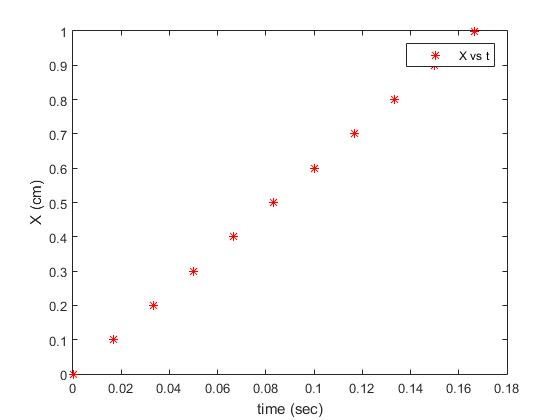
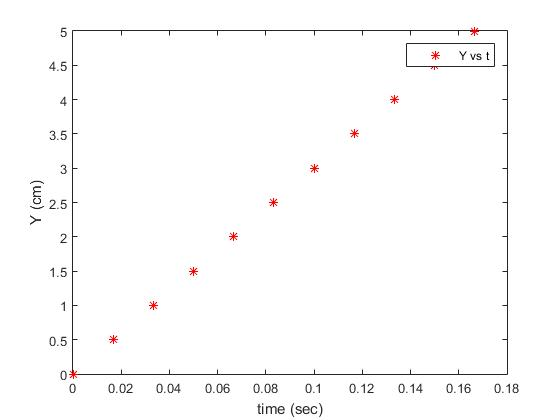
From graph, its clear that relation between x and y coordinate is

Since 60 pictures were taken per second hence time interval between two consecutive picture will be 1/60 sec. i.e.

In this same time interval, x coordinate change by 0.1 cm while y coordinate change by 0.5 cm i.e.
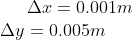
(a) Velocities

(b) Velocities in terms of i and j

Magnitude of velocity

In terms of magnitude and angle

therefore

(c) Momentum in i and j

In terms of magnitude and angle

Add Answer to:
Consider a 0.52 g puck that moves as shown in the graph above. Consider each point...
An object moves along the x axis during four separate trials. Graphs of position versus time for each trial (with the same scales on each axis) are shown in the figure. (Figure 1)
 Velocity from Graphs of Position versus Time An object moves along the x axis during four separate trials. Graphs of position versus time for each trial (with the same scales on each axis) are shown in the figure. (Figure 1) Part ADuring which trial or trials is the object's velocity not constant? Part B During which trial or trials is the magnitude of the average velocity the largest?
An object moves along the x axis during four separate trials. Graphs of position versus time...
 An object moves along the x axis during four separate trials.
Graphs of position versus time for each trial are shown in the
figure.
During which trial or
trials is the object's velocity not constant?
During which trial or
trials is the magnitude of the average velocity the
largest?
Please explain. Thanks.
An object moves along the x axis during four separate trials.
Graphs of position versus time for each trial are shown in the
figure.
During which trial or
trials is the object's velocity not constant?
During which trial or
trials is the magnitude of the average velocity the
largest?
Please explain. Thanks.
[1] CONSIDER THESE TWO Cases : 1. A ball moves in uniform circular motion. ...
[1] CONSIDER THESE TWO Cases : 1. A ball moves in uniform circular motion. (i) Sketch a two dimensional position plot of the functions x(t) and y(t). Extra credit: What type of plot is this? (5 points). (ii) On your plot, draw in five different velocity vectors at different times. (iii) Is there an acceleration ? Why or why not? 2. A ball moves in a straight line while its speed decreases. (i)...
1. A cannon fires a cannonball at an angle of 30° above horizontal. The initial velocity...
 1. A cannon fires a cannonball at an angle of 30° above horizontal. The initial velocity of the cannonball is 40 m/s. Assume the coordinate system in which x is horizontal and y is vertical. (a) What is the x-component of the initial velocity? '40 % cos ao (b) What is the y-component of the initial velocity? (c) Gravity causes a constant acceleration of 9.81 m/s. In what direction is this acceleration? (d) What affect will this acceleration have on...
The position vector of a point which moves in the x-y plane is given by: r...
The position vector of a point which moves in the x-y plane is given by: r = (- 0.2 t4 + 1.8 t3 + 1.1 t2) i + (- 0.4 t4 - 1.2 t) j where r is in meters and t is in seconds. Determine the angle between the velocity v and the acceleration a when t = 1.7 sec.
(15 pts) Consider the position-time graph shown in P 1.20. Explain why your choice is correct....
 (15 pts) Consider the position-time graph shown in P 1.20. Explain why your choice is correct. a. Over what time interval is the object's average velocity positive? b. Over what time interval is the object's average velocity negative? c. Over what time interval is the object's average velocity zero? I Write a short description of the motion of a real object for which FIGURE EX1.20 would be a realistic position-versus-time graph. x (mi) 20 0 1 2 3 45 FIGURE...
For each of the velocity-time graphs shown below, draw the corresponding acceleration- time graph. 2-0 0...
 For each of the velocity-time graphs shown below, draw the corresponding acceleration- time graph. 2-0 0 2 46 8 I time (s) i time (s) I i time (s) 0 0 0 2 4 6 8 0 2 468 time (s) time (s) time (s) A car moves along a line (the positive x-axis). Fill in the table below with the sign (t or-) of the velocity and acceleration of the car for each of the motions described. 2 Acceleration...
In multiple dimensions, specifying and objects position, displacement, velocity, and acceleration requires the use of vector...
In multiple dimensions, specifying and objects position, displacement, velocity, and acceleration requires the use of vector notation. As we will see in the coming chapters, other quantities such as force and momentum are also vectors. A vector quantity has both a magnitude and a direction. For example, a person can walk a distance of 6 meters at an angle of 30o. By convention the angle is specified from the positive x-axis (East) unless otherwise specified. While this notation is useful...
1. 2. 6. 4. Vectors A and B lie in an xy plane. A has magnitude...
 1.
2.
6.
4.
Vectors A and B lie in an xy plane. A has magnitude 5.2 and angle 121°; B has components B - -8.80 and By - -5.09. (a) What is 5A-B ? what is 4A x 38 in unit-vector notation ((b), (c) and (d) for i , j and k components respectively)? (e) what is the angle between the directions of A and 4A x 38 7 what is A + 3.00k in unit-vector notation (), (a)...
1.
2.
6.
4.
Vectors A and B lie in an xy plane. A has magnitude 5.2 and angle 121°; B has components B - -8.80 and By - -5.09. (a) What is 5A-B ? what is 4A x 38 in unit-vector notation ((b), (c) and (d) for i , j and k components respectively)? (e) what is the angle between the directions of A and 4A x 38 7 what is A + 3.00k in unit-vector notation (), (a)...
A rocket is fired at an angle from the top of a tower of height h0...
A rocket is fired at an angle from the top of a tower of height h0 = 40.0 m. Because of the design of the engines, its position coordinates are of the form x(t) = A + B t2 and y(t) = C + D t3, where A, B, C and D are constants. The acceleration of the rocket 3.00 s after firing is a = (7.00 i + 5.00 j) m/s2. Take the origin of coordinates to be at...
 An object moves along the x axis during four separate trials.
Graphs of position versus time for each trial are shown in the
figure.
During which trial or
trials is the object's velocity not constant?
During which trial or
trials is the magnitude of the average velocity the
largest?
Please explain. Thanks.
An object moves along the x axis during four separate trials.
Graphs of position versus time for each trial are shown in the
figure.
During which trial or
trials is the object's velocity not constant?
During which trial or
trials is the magnitude of the average velocity the
largest?
Please explain. Thanks.
 1. A cannon fires a cannonball at an angle of 30° above horizontal. The initial velocity of the cannonball is 40 m/s. Assume the coordinate system in which x is horizontal and y is vertical. (a) What is the x-component of the initial velocity? '40 % cos ao (b) What is the y-component of the initial velocity? (c) Gravity causes a constant acceleration of 9.81 m/s. In what direction is this acceleration? (d) What affect will this acceleration have on...
 (15 pts) Consider the position-time graph shown in P 1.20. Explain why your choice is correct. a. Over what time interval is the object's average velocity positive? b. Over what time interval is the object's average velocity negative? c. Over what time interval is the object's average velocity zero? I Write a short description of the motion of a real object for which FIGURE EX1.20 would be a realistic position-versus-time graph. x (mi) 20 0 1 2 3 45 FIGURE...
 For each of the velocity-time graphs shown below, draw the corresponding acceleration- time graph. 2-0 0 2 46 8 I time (s) i time (s) I i time (s) 0 0 0 2 4 6 8 0 2 468 time (s) time (s) time (s) A car moves along a line (the positive x-axis). Fill in the table below with the sign (t or-) of the velocity and acceleration of the car for each of the motions described. 2 Acceleration...
 1.
2.
6.
4.
Vectors A and B lie in an xy plane. A has magnitude 5.2 and angle 121°; B has components B - -8.80 and By - -5.09. (a) What is 5A-B ? what is 4A x 38 in unit-vector notation ((b), (c) and (d) for i , j and k components respectively)? (e) what is the angle between the directions of A and 4A x 38 7 what is A + 3.00k in unit-vector notation (), (a)...
1.
2.
6.
4.
Vectors A and B lie in an xy plane. A has magnitude 5.2 and angle 121°; B has components B - -8.80 and By - -5.09. (a) What is 5A-B ? what is 4A x 38 in unit-vector notation ((b), (c) and (d) for i , j and k components respectively)? (e) what is the angle between the directions of A and 4A x 38 7 what is A + 3.00k in unit-vector notation (), (a)...
Most questions answered within 3 hours.
-
Where is the error in this code sequence?
String s1 = "Hello";
String s2 = "ello";...
asked 10 months ago -
Financial data for Joel de Paris, Inc., for last year
follow:
Joel de Paris, Inc.
Balance...
asked 10 months ago -
Consider this reaction:
Al2(SO4)3 (aq)+ BaCl3
(aq) Al2Cl6 (aq)- +
3BaSO4(s) . What is the...
asked 10 months ago -
Suppose that Savneet is considering increasing her
recent random sample from 20 car rentals to 40...
asked 10 months ago -
Trucks arrive at an unloading terminal at an average rate of 120
per hour.
Trucks arrive...
asked 10 months ago -
Why are methanol and ethanol completely soluble in water while
octanol is not very little soluble....
asked 10 months ago -
A facilities manager at a university reads in a research report
that the mean amount of...
asked 10 months ago -
When the CuSO4 is rehydrated by adding water to the anhydrous
compound, is this an endothermic...
asked 10 months ago -
A ray of sunlight is passing from diamond into crown glass; the
angle of incidence is...
asked 10 months ago -
A block of mass 0.249 kg is placed on top of a light, vertical
spring of...
asked 10 months ago -
how do the kidneys compensate in the presences of acidosis
a) trigger hyperventilate
b) reserve acid...
asked 10 months ago -
Question 501 pts
The rental rate of capital to the firm increases. Which of the
following...
asked 10 months ago