Please help me with this ! Thank you
Homework Answers
Request Answer!
We need at least 10 more requests to produce the answer.
0 / 10 have requested this problem solution
The more requests, the faster the answer.
Add Answer to:
Please help me with this ! Thank you
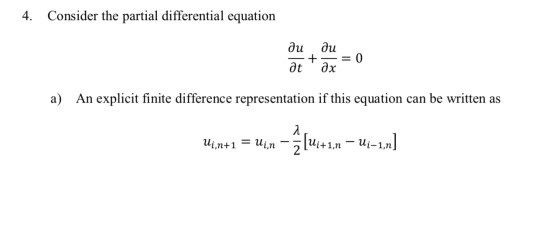
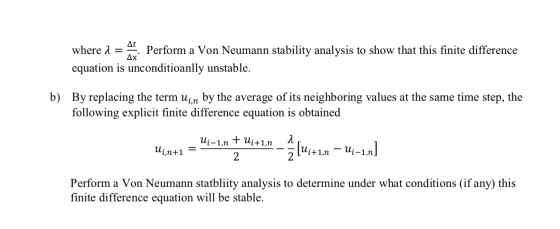
4. Consider the partial differential equation au au...
Consider the following partial differential equation. au, au ax? + = u ay? Identify A, B,...
 Consider the following partial differential equation. au, au ax? + = u ay? Identify A, B, and C in the above equation and use them to calculate the following. B2 - 4AC = -1 + u X Classify the given partial differential equation as hyperbolic, parabolic, or elliptic. O hyperbolic parabolic elliptic
QUESTION 4 [8 MARKS TOTAL] Q4 Hand calculations (see Workshops 21 and 22 for relevant content)...
 QUESTION 4 [8 MARKS TOTAL] Q4 Hand calculations (see Workshops 21 and 22 for relevant content) Consider the 1-D diffusion equation: Eqn 3 да d²q at Ox? Write the centered in space, Crank-Nicolson (CN) discretization of this equation. Consider just ONE Fourier mode of the representation of the error, and write it in the simplified form (defined at time level n, and node j) as Eqn (4) Using this Fourier mode, undertake a von Neumann stability analysis for the CN...
4. (50 pts) Consider the following partial differential equation: 1du au Ət22 Ətər2 (BC) u7,t) =...
 4. (50 pts) Consider the following partial differential equation: 1du au Ət22 Ətər2 (BC) u7,t) = 0 20,t) = 0 0 <t (IC) u(3,0) = 0 0 <r <a Follow the steps below to solve it: (a) (8 pts) Separate variables as u(x,t) = X(2)T(t) to derive the following differential equations for X and T, with an unknown parameter 1: T" - T' + XT = 0, X" + 1X = 0.
Need help on math modeling problems regarding linear partial differential equation 67.3. Suppose initially (t =...
 Need help on math modeling problems regarding linear partial
differential equation
67.3. Suppose initially (t = 0) that the traffic density is p = Do + Esin , where le « po. Determine p(x, t). 67.4. Consider Õpildt + copildx) = 0. Suppose we observe pi in a coordinate system moving at velocity v. Show that др. +(c dr 0. v) dx' Does p stay constant moving at the car velocity? 67.5. Based on a linear analysis, would you say...
Need help on math modeling problems regarding linear partial
differential equation
67.3. Suppose initially (t = 0) that the traffic density is p = Do + Esin , where le « po. Determine p(x, t). 67.4. Consider Õpildt + copildx) = 0. Suppose we observe pi in a coordinate system moving at velocity v. Show that др. +(c dr 0. v) dx' Does p stay constant moving at the car velocity? 67.5. Based on a linear analysis, would you say...
please provide me with full working solution. Any help is appreciated. thank you in advance Consider the diffusion equation, au(x,t u(x,t) Here u(x,t) > 0 is the concentration of some diffusing...
 please provide me with full working solution. Any help is
appreciated. thank you in advance
Consider the diffusion equation, au(x,t u(x,t) Here u(x,t) > 0 is the concentration of some diffusing substance, the spatial variable is x, time is t and D is a constant called the diffusivity with dimensions [LT-11. We will consider the diffusion equation on a finite spatial domain (0<x< 1) and an infinite time horizon (t > 0). To solve the diffusion equation we must include...
please provide me with full working solution. Any help is
appreciated. thank you in advance
Consider the diffusion equation, au(x,t u(x,t) Here u(x,t) > 0 is the concentration of some diffusing substance, the spatial variable is x, time is t and D is a constant called the diffusivity with dimensions [LT-11. We will consider the diffusion equation on a finite spatial domain (0<x< 1) and an infinite time horizon (t > 0). To solve the diffusion equation we must include...
Can't use math lab show workings Differential Equation The following ordinary differential equation is to be...
 Can't use math lab show workings
Differential Equation The following ordinary differential equation is to be solved using nu- merical methods. d + Bar = Ate - where A, 0,8 > 0 and x = x at t = 0. dt It is to be solved from t = 0 to t = 50.0. It has analytical solution r(t) = A te-al + A le-ale"), where A A B-a and A2 А (8 - a)2 Questions Answer the questions given...
Can't use math lab show workings
Differential Equation The following ordinary differential equation is to be solved using nu- merical methods. d + Bar = Ate - where A, 0,8 > 0 and x = x at t = 0. dt It is to be solved from t = 0 to t = 50.0. It has analytical solution r(t) = A te-al + A le-ale"), where A A B-a and A2 А (8 - a)2 Questions Answer the questions given...
Answer as much as possible please! thank you 4. Qualitative Behavior of Autonomous First Order Differential Equations: Consider the graphs of g(N) in the panels (a) - (d) in Figure 1. For each graph,...
 Answer as much as possible please! thank you
4. Qualitative Behavior of Autonomous First Order Differential Equations: Consider the graphs of g(N) in the panels (a) - (d) in Figure 1. For each graph, identify all equilibrium points and classify them as either stable or unstable. Then, for each panel, make a graph of N(t) vs. t for 0<1<oo with the given conditions: (a) N(0)-1; N(0)-3. (b) N(O) 0.5; N(O)2 (c) N(O) 1.5; N(0)3 (d) N(0)0; N(O)1.5 Assume that N2...
Answer as much as possible please! thank you
4. Qualitative Behavior of Autonomous First Order Differential Equations: Consider the graphs of g(N) in the panels (a) - (d) in Figure 1. For each graph, identify all equilibrium points and classify them as either stable or unstable. Then, for each panel, make a graph of N(t) vs. t for 0<1<oo with the given conditions: (a) N(0)-1; N(0)-3. (b) N(O) 0.5; N(O)2 (c) N(O) 1.5; N(0)3 (d) N(0)0; N(O)1.5 Assume that N2...
this is numerical analysis. Please do a and b 4. Consider the ordinary differential equation 1'(x)...
 this is numerical analysis. Please do a and b
4. Consider the ordinary differential equation 1'(x) = f(x, y(x)), y(ro) = Yo. (1) (a) Use numerical integration to derive the trapezoidal method for the above with uniform step size h. (You don't have to give the truncation error.) (b) Given below is a multistep method for solving (1) (with uniform step size h): bo +1 = 34 – 2n=1 + h (362. Yn) = f(n=1, 4n-1)) What is the truncation...
this is numerical analysis. Please do a and b
4. Consider the ordinary differential equation 1'(x) = f(x, y(x)), y(ro) = Yo. (1) (a) Use numerical integration to derive the trapezoidal method for the above with uniform step size h. (You don't have to give the truncation error.) (b) Given below is a multistep method for solving (1) (with uniform step size h): bo +1 = 34 – 2n=1 + h (362. Yn) = f(n=1, 4n-1)) What is the truncation...
4. (5 marks) Consider the partial differential equation (1) for 1 € (0,2) and t >...
 4. (5 marks) Consider the partial differential equation (1) for 1 € (0,2) and t > 0, with boundary conditions u(0, 1) = 0 ur(2, 1) = 0. Which of the following are solutions to the PDE and boundary conditions? In each case explain your answer. Note that initial conditions are not given. (Hint: it is not necessary to solve the problem above. (a) -3)*** e ular, 1) = Žen sin [(---) --] ~[(---) ;-)e-(1-1) e+(1-3)*(/2°1 u(3,t) - Cu COS...
please answer immediately thank you 4. [-/1 Points] DETAILS SCALCCC4 7.1.006. Consider the following differential equation....
 please answer immediately
thank you
4. [-/1 Points] DETAILS SCALCCC4 7.1.006. Consider the following differential equation. ry + y = 5 (a) Show that every member of the family of functions y = (51n(x) + C)/x is a solution of the differential equation. (Do this on paper. Your instructor may ask you to turn in this work.) (b) Illustrate part (a) by graphing several members of the family of solutions on a common screen. (Do this on paper. Your instructor...
please answer immediately
thank you
4. [-/1 Points] DETAILS SCALCCC4 7.1.006. Consider the following differential equation. ry + y = 5 (a) Show that every member of the family of functions y = (51n(x) + C)/x is a solution of the differential equation. (Do this on paper. Your instructor may ask you to turn in this work.) (b) Illustrate part (a) by graphing several members of the family of solutions on a common screen. (Do this on paper. Your instructor...
 Consider the following partial differential equation. au, au ax? + = u ay? Identify A, B, and C in the above equation and use them to calculate the following. B2 - 4AC = -1 + u X Classify the given partial differential equation as hyperbolic, parabolic, or elliptic. O hyperbolic parabolic elliptic
 QUESTION 4 [8 MARKS TOTAL] Q4 Hand calculations (see Workshops 21 and 22 for relevant content) Consider the 1-D diffusion equation: Eqn 3 да d²q at Ox? Write the centered in space, Crank-Nicolson (CN) discretization of this equation. Consider just ONE Fourier mode of the representation of the error, and write it in the simplified form (defined at time level n, and node j) as Eqn (4) Using this Fourier mode, undertake a von Neumann stability analysis for the CN...
 4. (50 pts) Consider the following partial differential equation: 1du au Ət22 Ətər2 (BC) u7,t) = 0 20,t) = 0 0 <t (IC) u(3,0) = 0 0 <r <a Follow the steps below to solve it: (a) (8 pts) Separate variables as u(x,t) = X(2)T(t) to derive the following differential equations for X and T, with an unknown parameter 1: T" - T' + XT = 0, X" + 1X = 0.
 Need help on math modeling problems regarding linear partial
differential equation
67.3. Suppose initially (t = 0) that the traffic density is p = Do + Esin , where le « po. Determine p(x, t). 67.4. Consider Õpildt + copildx) = 0. Suppose we observe pi in a coordinate system moving at velocity v. Show that др. +(c dr 0. v) dx' Does p stay constant moving at the car velocity? 67.5. Based on a linear analysis, would you say...
Need help on math modeling problems regarding linear partial
differential equation
67.3. Suppose initially (t = 0) that the traffic density is p = Do + Esin , where le « po. Determine p(x, t). 67.4. Consider Õpildt + copildx) = 0. Suppose we observe pi in a coordinate system moving at velocity v. Show that др. +(c dr 0. v) dx' Does p stay constant moving at the car velocity? 67.5. Based on a linear analysis, would you say...
 please provide me with full working solution. Any help is
appreciated. thank you in advance
Consider the diffusion equation, au(x,t u(x,t) Here u(x,t) > 0 is the concentration of some diffusing substance, the spatial variable is x, time is t and D is a constant called the diffusivity with dimensions [LT-11. We will consider the diffusion equation on a finite spatial domain (0<x< 1) and an infinite time horizon (t > 0). To solve the diffusion equation we must include...
please provide me with full working solution. Any help is
appreciated. thank you in advance
Consider the diffusion equation, au(x,t u(x,t) Here u(x,t) > 0 is the concentration of some diffusing substance, the spatial variable is x, time is t and D is a constant called the diffusivity with dimensions [LT-11. We will consider the diffusion equation on a finite spatial domain (0<x< 1) and an infinite time horizon (t > 0). To solve the diffusion equation we must include...
 Can't use math lab show workings
Differential Equation The following ordinary differential equation is to be solved using nu- merical methods. d + Bar = Ate - where A, 0,8 > 0 and x = x at t = 0. dt It is to be solved from t = 0 to t = 50.0. It has analytical solution r(t) = A te-al + A le-ale"), where A A B-a and A2 А (8 - a)2 Questions Answer the questions given...
Can't use math lab show workings
Differential Equation The following ordinary differential equation is to be solved using nu- merical methods. d + Bar = Ate - where A, 0,8 > 0 and x = x at t = 0. dt It is to be solved from t = 0 to t = 50.0. It has analytical solution r(t) = A te-al + A le-ale"), where A A B-a and A2 А (8 - a)2 Questions Answer the questions given...
 Answer as much as possible please! thank you
4. Qualitative Behavior of Autonomous First Order Differential Equations: Consider the graphs of g(N) in the panels (a) - (d) in Figure 1. For each graph, identify all equilibrium points and classify them as either stable or unstable. Then, for each panel, make a graph of N(t) vs. t for 0<1<oo with the given conditions: (a) N(0)-1; N(0)-3. (b) N(O) 0.5; N(O)2 (c) N(O) 1.5; N(0)3 (d) N(0)0; N(O)1.5 Assume that N2...
Answer as much as possible please! thank you
4. Qualitative Behavior of Autonomous First Order Differential Equations: Consider the graphs of g(N) in the panels (a) - (d) in Figure 1. For each graph, identify all equilibrium points and classify them as either stable or unstable. Then, for each panel, make a graph of N(t) vs. t for 0<1<oo with the given conditions: (a) N(0)-1; N(0)-3. (b) N(O) 0.5; N(O)2 (c) N(O) 1.5; N(0)3 (d) N(0)0; N(O)1.5 Assume that N2...
 this is numerical analysis. Please do a and b
4. Consider the ordinary differential equation 1'(x) = f(x, y(x)), y(ro) = Yo. (1) (a) Use numerical integration to derive the trapezoidal method for the above with uniform step size h. (You don't have to give the truncation error.) (b) Given below is a multistep method for solving (1) (with uniform step size h): bo +1 = 34 – 2n=1 + h (362. Yn) = f(n=1, 4n-1)) What is the truncation...
this is numerical analysis. Please do a and b
4. Consider the ordinary differential equation 1'(x) = f(x, y(x)), y(ro) = Yo. (1) (a) Use numerical integration to derive the trapezoidal method for the above with uniform step size h. (You don't have to give the truncation error.) (b) Given below is a multistep method for solving (1) (with uniform step size h): bo +1 = 34 – 2n=1 + h (362. Yn) = f(n=1, 4n-1)) What is the truncation...
 4. (5 marks) Consider the partial differential equation (1) for 1 € (0,2) and t > 0, with boundary conditions u(0, 1) = 0 ur(2, 1) = 0. Which of the following are solutions to the PDE and boundary conditions? In each case explain your answer. Note that initial conditions are not given. (Hint: it is not necessary to solve the problem above. (a) -3)*** e ular, 1) = Žen sin [(---) --] ~[(---) ;-)e-(1-1) e+(1-3)*(/2°1 u(3,t) - Cu COS...
 please answer immediately
thank you
4. [-/1 Points] DETAILS SCALCCC4 7.1.006. Consider the following differential equation. ry + y = 5 (a) Show that every member of the family of functions y = (51n(x) + C)/x is a solution of the differential equation. (Do this on paper. Your instructor may ask you to turn in this work.) (b) Illustrate part (a) by graphing several members of the family of solutions on a common screen. (Do this on paper. Your instructor...
please answer immediately
thank you
4. [-/1 Points] DETAILS SCALCCC4 7.1.006. Consider the following differential equation. ry + y = 5 (a) Show that every member of the family of functions y = (51n(x) + C)/x is a solution of the differential equation. (Do this on paper. Your instructor may ask you to turn in this work.) (b) Illustrate part (a) by graphing several members of the family of solutions on a common screen. (Do this on paper. Your instructor...
Most questions answered within 3 hours.
-
Where is the error in this code sequence?
String s1 = "Hello";
String s2 = "ello";...
asked 10 months ago -
Financial data for Joel de Paris, Inc., for last year
follow:
Joel de Paris, Inc.
Balance...
asked 10 months ago -
Consider this reaction:
Al2(SO4)3 (aq)+ BaCl3
(aq) Al2Cl6 (aq)- +
3BaSO4(s) . What is the...
asked 10 months ago -
Suppose that Savneet is considering increasing her
recent random sample from 20 car rentals to 40...
asked 10 months ago -
Trucks arrive at an unloading terminal at an average rate of 120
per hour.
Trucks arrive...
asked 10 months ago -
Why are methanol and ethanol completely soluble in water while
octanol is not very little soluble....
asked 10 months ago -
A facilities manager at a university reads in a research report
that the mean amount of...
asked 10 months ago -
When the CuSO4 is rehydrated by adding water to the anhydrous
compound, is this an endothermic...
asked 10 months ago -
A ray of sunlight is passing from diamond into crown glass; the
angle of incidence is...
asked 10 months ago -
A block of mass 0.249 kg is placed on top of a light, vertical
spring of...
asked 10 months ago -
how do the kidneys compensate in the presences of acidosis
a) trigger hyperventilate
b) reserve acid...
asked 10 months ago -
Question 501 pts
The rental rate of capital to the firm increases. Which of the
following...
asked 10 months ago