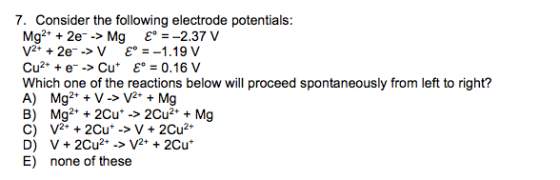
Please explain the steps on how to solve this problem, I already have the answer.
Homework Answers
Spontainity is judged by the gibbs free energy of a reaction. If the value is positive then the reaction is non spontaneous and if its value is negative then the reaction is spontaneous in nature. And ΔG° = -nFE° where E is the emf of the cell reaction at standard conditions.
If the value of EMF of the cell is positive only then the Gibbs free energy is negative therefore we need to find the combination which provides the EMF to be a positive value.
A. Mg2+ is reduced and V is oxidised.
E = E of cathode - E of anode = E (reduction) _E(oxidation)
= -2.37 - (-1.19)= -1.18 V
B. Mg2+ is reduced and Cu+ is oxidised.
E = -2.37 - ( 0.16) = - 2.53 V
C. Cu + is oxidised and V2+ is reduced.
E = -1.19 -(0.16) = - 1.35 V
D. Cu2+ is reduced and V is oxidised
E = 0.16 - ( -1.19) = 1.35 V
So only part D has positive value of Emf so it will give a negative value of ΔG so that the reaction can be spontaneous.
So answer is D only.
I hope you understand the numerical. Kindly provide us with a feedback.
Add Answer to:
Please explain the steps on how to solve this problem, I already
have the answer.
7....
Please show all work step by step and final answer. Using tabulated standard reduction potentials from...
 Please show all work step by step and final answer.
Using tabulated standard reduction potentials from your text, calculate the standard cell potential, Eºcell (always positive for a galvanic cell), based on the following reaction: Cu2+(aq) + Mg(s) = Mg2+ (aq) + Cu(s) Eºcell = cf Table A5.5, p A24 Zumdahl "Chemical Principles" 8th ed. 1pts Submit Answer Tries 0/5 A galvanic cell based on the above reaction is constructed according to the generic sketch of a galvanic cell shown...
Please show all work step by step and final answer.
Using tabulated standard reduction potentials from your text, calculate the standard cell potential, Eºcell (always positive for a galvanic cell), based on the following reaction: Cu2+(aq) + Mg(s) = Mg2+ (aq) + Cu(s) Eºcell = cf Table A5.5, p A24 Zumdahl "Chemical Principles" 8th ed. 1pts Submit Answer Tries 0/5 A galvanic cell based on the above reaction is constructed according to the generic sketch of a galvanic cell shown...
can you answer questions 7,8,9,10 Question 7 (10 points) ✓ Saved (7) For a galvanic cell...
 can you answer questions 7,8,9,10
Question 7 (10 points) ✓ Saved (7) For a galvanic cell notation: (-) Mg/Mg2+ (aq) // Cu2+ (aq) / Cu (+). which of the following is fully correct? (a) Mg2+ is oxidized to Mg, and Cu2+ (aq) is reduced to Cu O (b) Mg2+ is reduced to Mg, and Cu2+ (aq) is oxidized to Cu (c) Mg is oxidized to Mg2+, and Cu²+ (aq) is reduced to Cu (d) Mg is reduced to Mg2+, and...
can you answer questions 7,8,9,10
Question 7 (10 points) ✓ Saved (7) For a galvanic cell notation: (-) Mg/Mg2+ (aq) // Cu2+ (aq) / Cu (+). which of the following is fully correct? (a) Mg2+ is oxidized to Mg, and Cu2+ (aq) is reduced to Cu O (b) Mg2+ is reduced to Mg, and Cu2+ (aq) is oxidized to Cu (c) Mg is oxidized to Mg2+, and Cu²+ (aq) is reduced to Cu (d) Mg is reduced to Mg2+, and...
please help and answer all questions 4. What is the cell potential for Mn Mn2||Co2|Co, based...
 please help and answer all questions
4. What is the cell potential for Mn Mn2||Co2|Co, based on the standard potentials? (2 pts) Mn(s) +Co+2 (aq) → Co(s) + Mn+2(aq) 5. A Student constructed a Mg Mg2||Ag|Ag cell and measured a cell potential of 3.17 V. Calculate the cell potential of the Mg Mg2 half reaction. (2 pts) Mg(s) + 2Ag (aq) - 2Ag(s) + Mg(aq) 6. Will silver metal react spontaneously with HCl(aq) to produce H:()? Explain. (2 pts) 2Ag(8)...
please help and answer all questions
4. What is the cell potential for Mn Mn2||Co2|Co, based on the standard potentials? (2 pts) Mn(s) +Co+2 (aq) → Co(s) + Mn+2(aq) 5. A Student constructed a Mg Mg2||Ag|Ag cell and measured a cell potential of 3.17 V. Calculate the cell potential of the Mg Mg2 half reaction. (2 pts) Mg(s) + 2Ag (aq) - 2Ag(s) + Mg(aq) 6. Will silver metal react spontaneously with HCl(aq) to produce H:()? Explain. (2 pts) 2Ag(8)...
For all of the following experiments, under standard conditions, which species could be spontaneously produced? A...
 For all of the following
experiments, under standard conditions, which species could be
spontaneously produced?
A lead wire is placed in a solution containing
Cu2+
yes no Cu
yes no PbO2
yes no No reaction
Crystals of I2 are added to a solution of
NaCl.
yes no I-
yes no No reaction
yes no Cl2
A silver wire is placed in a solution containing
Cu2+
no yes Cu
no yes No reaction
no yes Ag+
Half-Reaction 8° (V) Half-Reaction 8° (V) 2.87 1.99 1.82 1.78 1.70 1.69 1.68 1.60...
For all of the following
experiments, under standard conditions, which species could be
spontaneously produced?
A lead wire is placed in a solution containing
Cu2+
yes no Cu
yes no PbO2
yes no No reaction
Crystals of I2 are added to a solution of
NaCl.
yes no I-
yes no No reaction
yes no Cl2
A silver wire is placed in a solution containing
Cu2+
no yes Cu
no yes No reaction
no yes Ag+
Half-Reaction 8° (V) Half-Reaction 8° (V) 2.87 1.99 1.82 1.78 1.70 1.69 1.68 1.60...
Candidate l: Zn(s) | Zn2+(aq,0.500 M) I Cu2+(aq, 1.00 M) Cu(s) Candidate 2: Pb(s) | Pb2+(aq,...
 Candidate l: Zn(s) | Zn2+(aq,0.500 M) I Cu2+(aq, 1.00 M) Cu(s) Candidate 2: Pb(s) | Pb2+(aq, 0.500 M) || Cu2+(aq, 1.00 M) Cu(s) Candidate 3: Mg(s) | Mg2+(aq, 0.500 M) | Pb2+(aq, 1.00 M)| Pb(s) (a) 6 pts) Choose one of the candidate voltaic cells #1, #2, or #3. Draw a schematic cell diagram for the candidate voltaic cell of choice. Clearly label anode, cathode, electrodes, ions and their concentrations, salt bridge, and the flow of electrons. (b) (5 pts)...
Cell Potential and Equilibrium Standard reduction potentials The equilibrium constant, K, for a redox reaction is...
 Cell Potential and Equilibrium Standard reduction potentials The equilibrium constant, K, for a redox reaction is related to the standard cell potential, Ecel, by the equation Reduction half-reaction (V) Ag+ (aq) + e-→Ag(s) Cu2+ (aq) + 2e-→Cu(s) 0.34 Sn (a) 4e-Sn(s 0.15 2H' (aq) + 2e-→H2 (g) Ni2+ (aq) + 2e-→Ni(s)-0.26 Fe2+ (aq) + 2e-→Fe(s)-0.45 Zn2+ (aq) + 2e-→Zn(s)-0.76 Al3+ (aq) +3e-→Al(s) -1.66 Mg2+ (aq) + 2e-→Mg(s) -2.37 0.80 n FEcell where n is the number of moles of electrons...
with the information and tables provided, can you help me answer questions 2,3,4,and 5? thank you!...
 with the information and tables provided, can you help me
answer questions 2,3,4,and 5? thank you!
DATA ANALYSIS - ONLINE SIMULATION DATA Record your collected data here. Black Red E (V) Cu Zn -1.10 Cu Sn -0.48 Cu Mg -2.71 Cu Ag 0.46 QUALITY OF DATA This section awards marks based on the quality of your Ell values. Quality of data Your standard cell potentials are in the expected order. EXPECTED DATA The expected data is given below. Use the...
with the information and tables provided, can you help me
answer questions 2,3,4,and 5? thank you!
DATA ANALYSIS - ONLINE SIMULATION DATA Record your collected data here. Black Red E (V) Cu Zn -1.10 Cu Sn -0.48 Cu Mg -2.71 Cu Ag 0.46 QUALITY OF DATA This section awards marks based on the quality of your Ell values. Quality of data Your standard cell potentials are in the expected order. EXPECTED DATA The expected data is given below. Use the...
1. How do I read the half reaction table? 2. If im asked for the best...
 1. How do I read the half reaction table?
2. If im asked for the best reducing agent from Cu+, Ag+, F2, and
Fe3+, where do I look first in the table? before the arrow or after
the arrow?
3. Sometimes a value that has originally a positive (V) from the
table it will have the negative sign in a homework problem, and
viceversa, so the question is, how do I use the positive and
negative signs in respect to...
1. How do I read the half reaction table?
2. If im asked for the best reducing agent from Cu+, Ag+, F2, and
Fe3+, where do I look first in the table? before the arrow or after
the arrow?
3. Sometimes a value that has originally a positive (V) from the
table it will have the negative sign in a homework problem, and
viceversa, so the question is, how do I use the positive and
negative signs in respect to...
could someone please answer and explain the questions please!! #’s 7,8,9,13,14,17,18,19,20 please and thank you What...
 could someone please answer and explain the questions please!!
#’s 7,8,9,13,14,17,18,19,20
please and thank you
What is the oxidation number for the underlined manganese (A)1 (B)2 (C)4(D)(E)7 When balancing the below half-reaction in 8. Which of the following is true concerning a 1. vanic cc A) Oxidation occurs at the cathode and is (B) Oxidation occurs at the anode and is where anions move towards 2. acidic sol electrons are added to ution, where anions move towards side of.the.cquation. where...
could someone please answer and explain the questions please!!
#’s 7,8,9,13,14,17,18,19,20
please and thank you
What is the oxidation number for the underlined manganese (A)1 (B)2 (C)4(D)(E)7 When balancing the below half-reaction in 8. Which of the following is true concerning a 1. vanic cc A) Oxidation occurs at the cathode and is (B) Oxidation occurs at the anode and is where anions move towards 2. acidic sol electrons are added to ution, where anions move towards side of.the.cquation. where...
please help the standrad reduction provided down What is the calculated value of the cell potential...
 please help the standrad reduction provided down
What is the calculated value of the cell potential at 298K for an electrochemical cell with the following reaction, when the Cu2+ concentration is 9.24x10 + M and the Cr3+ concentration is 1.47 M? 3Cu2+ (aq) + 2Cr(s) Answer: 3Cu(s) + 2Cr +(aq) v The cell reaction as written above is spontaneous for the concentrations given: What is the calculated value of the cell potential at 298K for an electrochemical cell with the...
please help the standrad reduction provided down
What is the calculated value of the cell potential at 298K for an electrochemical cell with the following reaction, when the Cu2+ concentration is 9.24x10 + M and the Cr3+ concentration is 1.47 M? 3Cu2+ (aq) + 2Cr(s) Answer: 3Cu(s) + 2Cr +(aq) v The cell reaction as written above is spontaneous for the concentrations given: What is the calculated value of the cell potential at 298K for an electrochemical cell with the...
 Please show all work step by step and final answer.
Using tabulated standard reduction potentials from your text, calculate the standard cell potential, Eºcell (always positive for a galvanic cell), based on the following reaction: Cu2+(aq) + Mg(s) = Mg2+ (aq) + Cu(s) Eºcell = cf Table A5.5, p A24 Zumdahl "Chemical Principles" 8th ed. 1pts Submit Answer Tries 0/5 A galvanic cell based on the above reaction is constructed according to the generic sketch of a galvanic cell shown...
Please show all work step by step and final answer.
Using tabulated standard reduction potentials from your text, calculate the standard cell potential, Eºcell (always positive for a galvanic cell), based on the following reaction: Cu2+(aq) + Mg(s) = Mg2+ (aq) + Cu(s) Eºcell = cf Table A5.5, p A24 Zumdahl "Chemical Principles" 8th ed. 1pts Submit Answer Tries 0/5 A galvanic cell based on the above reaction is constructed according to the generic sketch of a galvanic cell shown...
 can you answer questions 7,8,9,10
Question 7 (10 points) ✓ Saved (7) For a galvanic cell notation: (-) Mg/Mg2+ (aq) // Cu2+ (aq) / Cu (+). which of the following is fully correct? (a) Mg2+ is oxidized to Mg, and Cu2+ (aq) is reduced to Cu O (b) Mg2+ is reduced to Mg, and Cu2+ (aq) is oxidized to Cu (c) Mg is oxidized to Mg2+, and Cu²+ (aq) is reduced to Cu (d) Mg is reduced to Mg2+, and...
can you answer questions 7,8,9,10
Question 7 (10 points) ✓ Saved (7) For a galvanic cell notation: (-) Mg/Mg2+ (aq) // Cu2+ (aq) / Cu (+). which of the following is fully correct? (a) Mg2+ is oxidized to Mg, and Cu2+ (aq) is reduced to Cu O (b) Mg2+ is reduced to Mg, and Cu2+ (aq) is oxidized to Cu (c) Mg is oxidized to Mg2+, and Cu²+ (aq) is reduced to Cu (d) Mg is reduced to Mg2+, and...
 please help and answer all questions
4. What is the cell potential for Mn Mn2||Co2|Co, based on the standard potentials? (2 pts) Mn(s) +Co+2 (aq) → Co(s) + Mn+2(aq) 5. A Student constructed a Mg Mg2||Ag|Ag cell and measured a cell potential of 3.17 V. Calculate the cell potential of the Mg Mg2 half reaction. (2 pts) Mg(s) + 2Ag (aq) - 2Ag(s) + Mg(aq) 6. Will silver metal react spontaneously with HCl(aq) to produce H:()? Explain. (2 pts) 2Ag(8)...
please help and answer all questions
4. What is the cell potential for Mn Mn2||Co2|Co, based on the standard potentials? (2 pts) Mn(s) +Co+2 (aq) → Co(s) + Mn+2(aq) 5. A Student constructed a Mg Mg2||Ag|Ag cell and measured a cell potential of 3.17 V. Calculate the cell potential of the Mg Mg2 half reaction. (2 pts) Mg(s) + 2Ag (aq) - 2Ag(s) + Mg(aq) 6. Will silver metal react spontaneously with HCl(aq) to produce H:()? Explain. (2 pts) 2Ag(8)...
 For all of the following
experiments, under standard conditions, which species could be
spontaneously produced?
A lead wire is placed in a solution containing
Cu2+
yes no Cu
yes no PbO2
yes no No reaction
Crystals of I2 are added to a solution of
NaCl.
yes no I-
yes no No reaction
yes no Cl2
A silver wire is placed in a solution containing
Cu2+
no yes Cu
no yes No reaction
no yes Ag+
Half-Reaction 8° (V) Half-Reaction 8° (V) 2.87 1.99 1.82 1.78 1.70 1.69 1.68 1.60...
For all of the following
experiments, under standard conditions, which species could be
spontaneously produced?
A lead wire is placed in a solution containing
Cu2+
yes no Cu
yes no PbO2
yes no No reaction
Crystals of I2 are added to a solution of
NaCl.
yes no I-
yes no No reaction
yes no Cl2
A silver wire is placed in a solution containing
Cu2+
no yes Cu
no yes No reaction
no yes Ag+
Half-Reaction 8° (V) Half-Reaction 8° (V) 2.87 1.99 1.82 1.78 1.70 1.69 1.68 1.60...
 Candidate l: Zn(s) | Zn2+(aq,0.500 M) I Cu2+(aq, 1.00 M) Cu(s) Candidate 2: Pb(s) | Pb2+(aq, 0.500 M) || Cu2+(aq, 1.00 M) Cu(s) Candidate 3: Mg(s) | Mg2+(aq, 0.500 M) | Pb2+(aq, 1.00 M)| Pb(s) (a) 6 pts) Choose one of the candidate voltaic cells #1, #2, or #3. Draw a schematic cell diagram for the candidate voltaic cell of choice. Clearly label anode, cathode, electrodes, ions and their concentrations, salt bridge, and the flow of electrons. (b) (5 pts)...
 Cell Potential and Equilibrium Standard reduction potentials The equilibrium constant, K, for a redox reaction is related to the standard cell potential, Ecel, by the equation Reduction half-reaction (V) Ag+ (aq) + e-→Ag(s) Cu2+ (aq) + 2e-→Cu(s) 0.34 Sn (a) 4e-Sn(s 0.15 2H' (aq) + 2e-→H2 (g) Ni2+ (aq) + 2e-→Ni(s)-0.26 Fe2+ (aq) + 2e-→Fe(s)-0.45 Zn2+ (aq) + 2e-→Zn(s)-0.76 Al3+ (aq) +3e-→Al(s) -1.66 Mg2+ (aq) + 2e-→Mg(s) -2.37 0.80 n FEcell where n is the number of moles of electrons...
 with the information and tables provided, can you help me
answer questions 2,3,4,and 5? thank you!
DATA ANALYSIS - ONLINE SIMULATION DATA Record your collected data here. Black Red E (V) Cu Zn -1.10 Cu Sn -0.48 Cu Mg -2.71 Cu Ag 0.46 QUALITY OF DATA This section awards marks based on the quality of your Ell values. Quality of data Your standard cell potentials are in the expected order. EXPECTED DATA The expected data is given below. Use the...
with the information and tables provided, can you help me
answer questions 2,3,4,and 5? thank you!
DATA ANALYSIS - ONLINE SIMULATION DATA Record your collected data here. Black Red E (V) Cu Zn -1.10 Cu Sn -0.48 Cu Mg -2.71 Cu Ag 0.46 QUALITY OF DATA This section awards marks based on the quality of your Ell values. Quality of data Your standard cell potentials are in the expected order. EXPECTED DATA The expected data is given below. Use the...
 1. How do I read the half reaction table?
2. If im asked for the best reducing agent from Cu+, Ag+, F2, and
Fe3+, where do I look first in the table? before the arrow or after
the arrow?
3. Sometimes a value that has originally a positive (V) from the
table it will have the negative sign in a homework problem, and
viceversa, so the question is, how do I use the positive and
negative signs in respect to...
1. How do I read the half reaction table?
2. If im asked for the best reducing agent from Cu+, Ag+, F2, and
Fe3+, where do I look first in the table? before the arrow or after
the arrow?
3. Sometimes a value that has originally a positive (V) from the
table it will have the negative sign in a homework problem, and
viceversa, so the question is, how do I use the positive and
negative signs in respect to...
 could someone please answer and explain the questions please!!
#’s 7,8,9,13,14,17,18,19,20
please and thank you
What is the oxidation number for the underlined manganese (A)1 (B)2 (C)4(D)(E)7 When balancing the below half-reaction in 8. Which of the following is true concerning a 1. vanic cc A) Oxidation occurs at the cathode and is (B) Oxidation occurs at the anode and is where anions move towards 2. acidic sol electrons are added to ution, where anions move towards side of.the.cquation. where...
could someone please answer and explain the questions please!!
#’s 7,8,9,13,14,17,18,19,20
please and thank you
What is the oxidation number for the underlined manganese (A)1 (B)2 (C)4(D)(E)7 When balancing the below half-reaction in 8. Which of the following is true concerning a 1. vanic cc A) Oxidation occurs at the cathode and is (B) Oxidation occurs at the anode and is where anions move towards 2. acidic sol electrons are added to ution, where anions move towards side of.the.cquation. where...
 please help the standrad reduction provided down
What is the calculated value of the cell potential at 298K for an electrochemical cell with the following reaction, when the Cu2+ concentration is 9.24x10 + M and the Cr3+ concentration is 1.47 M? 3Cu2+ (aq) + 2Cr(s) Answer: 3Cu(s) + 2Cr +(aq) v The cell reaction as written above is spontaneous for the concentrations given: What is the calculated value of the cell potential at 298K for an electrochemical cell with the...
please help the standrad reduction provided down
What is the calculated value of the cell potential at 298K for an electrochemical cell with the following reaction, when the Cu2+ concentration is 9.24x10 + M and the Cr3+ concentration is 1.47 M? 3Cu2+ (aq) + 2Cr(s) Answer: 3Cu(s) + 2Cr +(aq) v The cell reaction as written above is spontaneous for the concentrations given: What is the calculated value of the cell potential at 298K for an electrochemical cell with the...
Most questions answered within 3 hours.
-
Where is the error in this code sequence?
String s1 = "Hello";
String s2 = "ello";...
asked 10 months ago -
Financial data for Joel de Paris, Inc., for last year
follow:
Joel de Paris, Inc.
Balance...
asked 10 months ago -
Consider this reaction:
Al2(SO4)3 (aq)+ BaCl3
(aq) Al2Cl6 (aq)- +
3BaSO4(s) . What is the...
asked 10 months ago -
Suppose that Savneet is considering increasing her
recent random sample from 20 car rentals to 40...
asked 10 months ago -
Trucks arrive at an unloading terminal at an average rate of 120
per hour.
Trucks arrive...
asked 10 months ago -
Why are methanol and ethanol completely soluble in water while
octanol is not very little soluble....
asked 10 months ago -
A facilities manager at a university reads in a research report
that the mean amount of...
asked 10 months ago -
When the CuSO4 is rehydrated by adding water to the anhydrous
compound, is this an endothermic...
asked 10 months ago -
A ray of sunlight is passing from diamond into crown glass; the
angle of incidence is...
asked 10 months ago -
A block of mass 0.249 kg is placed on top of a light, vertical
spring of...
asked 10 months ago -
how do the kidneys compensate in the presences of acidosis
a) trigger hyperventilate
b) reserve acid...
asked 10 months ago -
Question 501 pts
The rental rate of capital to the firm increases. Which of the
following...
asked 10 months ago