
Homework Answers
Add Answer to:
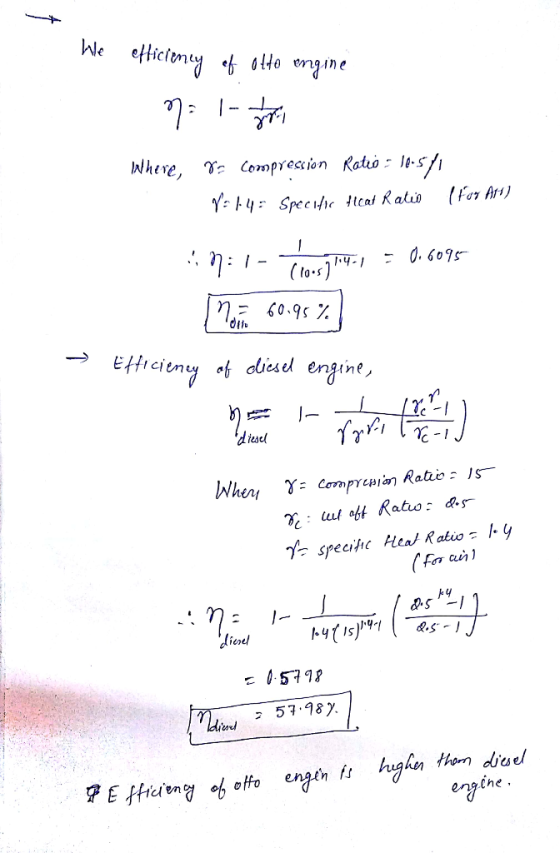
Problem (10 points) Compute the thermodynamie efficiencies of an Otto engine having a compression ratio of...
3. A diesel engine operates with a compression ratio of 20 and a cutoff ratio of...
 3. A diesel engine operates with a compression ratio of 20 and a cutoff ratio of 2. Air enters the engine at 80°F and 14.7 psi. Assume an Air-Standard analysis in the calculations to follow. (a) (10 points) Find the conversion efficiency of the engine. (b) (10 points) Find the specific net work of each cycle in BTU/lbm (c) (5 points) Find the volume of the cylinder if 0.03 Ibm of air is drawn in each cycle at bottom dead...
1. Consider the air-standard Otto cycle with a compression ratio r = 12 and a minimum...
1. Consider the air-standard Otto cycle with a compression ratio r = 12 and a minimum temperature and pressure of T=300K and P=1bar and a maximum temperature of 1200K. Find the thermal efficiency and compare to the cold air efficiency. 2. For the Otto cycle above calculate the thermal efficiency if the maximum temperature is now, 1400, 1600, and 1800 K. Comment on the trend. 3. For the Diesel cycle with a compression ratio of 18, a minimum temperature and...
assuming : T1 = 298°k p1= 101Kpa compression ratio 8.8 air fuel ratio = 15 displcement...
 assuming :
T1 = 298°k
p1= 101Kpa
compression ratio 8.8
air fuel ratio = 15
displcement 242 cu in.
6cylinder
Step 5: Otto/Diesel Cycle Approximation, Conduct a thermodynamic analysis (temp and pressure at each state) using the appropriate idealized cycle (Otto or Diesel) and cold air standard assumptions. State 1 should be approximately ambient (unless turbo/supercharged) and state 2 can be found using your compression ratio and isentropic relationships. State 3 carn be found using the heat input from Step...
assuming :
T1 = 298°k
p1= 101Kpa
compression ratio 8.8
air fuel ratio = 15
displcement 242 cu in.
6cylinder
Step 5: Otto/Diesel Cycle Approximation, Conduct a thermodynamic analysis (temp and pressure at each state) using the appropriate idealized cycle (Otto or Diesel) and cold air standard assumptions. State 1 should be approximately ambient (unless turbo/supercharged) and state 2 can be found using your compression ratio and isentropic relationships. State 3 carn be found using the heat input from Step...
Q7. Apart from raising the compression ratio of an idealised Otto engine, how else can the...
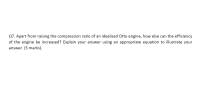 Q7. Apart from raising the compression ratio of an idealised Otto engine, how else can the efficiency of the engine be increased? Explain your answer using an appropriate equation to illustrate your answer. (5 marks).
(12 points) An ideal Otto cycle operates with a compression ratio of 10. At the beginning...
 (12 points) An ideal Otto cycle operates with a compression ratio of 10. At the beginning of the compression process, the air is at 101 kPa and 27°C. During the constant volume heat addition process, 790 kJ/kg of heat is transferred to the air. Accounting for variable specific heats with temperature, determine: the maximum temperature during the cycle 1266.862 °C the maximum pressure during the cycle 6239.424 kPa the specific net work output 475.495481 kJ/kg the mean effective pressure (MEP)...
4. A4.6 L spark ignition engine operates on the ideal Otto cycle with a compression ratio of 10. At the beginning of the compression process the air is at 107 kPa and 21 C. The maximum cycle temp...
 4. A4.6 L spark ignition engine operates on the ideal Otto cycle with a compression ratio of 10. At the beginning of the compression process the air is at 107 kPa and 21 C. The maximum cycle temperature is 1116°C. Accounting for variable specific heats, determine: (a) the heat addition per cycle in kJ. Ans: 3.368 kJ (b) the net work per cycle in kJ. Ans: 1.907 kJ (c) the mean effective pressure in kPa. Ans: 460.6 kPa (d) the...
The weight of a diesel engine is directly proportional to the compression ratio (W=kr) because extra...
The weight of a diesel engine is directly proportional to the compression ratio (W=kr) because extra metal must be used to strengthen the engine for the higher pressures. Examine the net specific work produced by a diesel engine per unit of weight as the pressure ratio is varied and the specific hear input remains fixed. Do this for several heat inputs and proportionality constraints k. Are there any optimal combinations of k and specific heat inputs?
Problem 6. Compute the brake mean effective pressure of a four-cylinder, two-stroke engine, 100 mm bore...
 Problem 6. Compute the brake mean effective pressure of a four-cylinder, two-stroke engine, 100 mm bore 125 mm stroke when it develops a torque of 490 Nm. Problem = 7. Find the brake thermal efficiency of an engine which consumes 7 kg of fuel in 20 minutes and develops a brake power of 65kW. The fuel has heating value of 42000 kJ/kg. Problem # 8. Find the mean piston speed of a diesel engine running at 1500 rpm. The engine...
Problem 3. (20) An air Otto cycle has compression ratio of 10. At the beginning of...
 Problem 3. (20) An air Otto cycle has compression ratio of 10. At the beginning of the compression process, pressure is 1 bar and temperature is 300 K. The maximum temperature in the cycle is 2500 K. Cp=718 J/kg/K. k=1.4. Air is ideal gas. Find: (1) Sketch the process on a T-s diagram and a P-v diagram. (2+2) (2) Temperature at cach point from Ti to T4 in K. (12) (3) The net work per unit of air in kJ/kg....
A diesel engine with a compression ratio of 14.5 starts the compression stroke with air at...
A diesel engine with a compression ratio of 14.5 starts the compression stroke with air at 101 kPa and 42ºC. Fuel with a heating value of 43,260 kJ/kg is used with a fuel/air ratio of 0.03 kg fuel/kg air. At full throttle the airflow to engine is measured to be 0.1 m3/s and 5% of the fuel does not burn due to poor fuel-air mixing. Model the engine as airstandard with variable specific heats, draw the cycle on a P-V...
 3. A diesel engine operates with a compression ratio of 20 and a cutoff ratio of 2. Air enters the engine at 80°F and 14.7 psi. Assume an Air-Standard analysis in the calculations to follow. (a) (10 points) Find the conversion efficiency of the engine. (b) (10 points) Find the specific net work of each cycle in BTU/lbm (c) (5 points) Find the volume of the cylinder if 0.03 Ibm of air is drawn in each cycle at bottom dead...
 assuming :
T1 = 298°k
p1= 101Kpa
compression ratio 8.8
air fuel ratio = 15
displcement 242 cu in.
6cylinder
Step 5: Otto/Diesel Cycle Approximation, Conduct a thermodynamic analysis (temp and pressure at each state) using the appropriate idealized cycle (Otto or Diesel) and cold air standard assumptions. State 1 should be approximately ambient (unless turbo/supercharged) and state 2 can be found using your compression ratio and isentropic relationships. State 3 carn be found using the heat input from Step...
assuming :
T1 = 298°k
p1= 101Kpa
compression ratio 8.8
air fuel ratio = 15
displcement 242 cu in.
6cylinder
Step 5: Otto/Diesel Cycle Approximation, Conduct a thermodynamic analysis (temp and pressure at each state) using the appropriate idealized cycle (Otto or Diesel) and cold air standard assumptions. State 1 should be approximately ambient (unless turbo/supercharged) and state 2 can be found using your compression ratio and isentropic relationships. State 3 carn be found using the heat input from Step...
 Q7. Apart from raising the compression ratio of an idealised Otto engine, how else can the efficiency of the engine be increased? Explain your answer using an appropriate equation to illustrate your answer. (5 marks).
 (12 points) An ideal Otto cycle operates with a compression ratio of 10. At the beginning of the compression process, the air is at 101 kPa and 27°C. During the constant volume heat addition process, 790 kJ/kg of heat is transferred to the air. Accounting for variable specific heats with temperature, determine: the maximum temperature during the cycle 1266.862 °C the maximum pressure during the cycle 6239.424 kPa the specific net work output 475.495481 kJ/kg the mean effective pressure (MEP)...
 4. A4.6 L spark ignition engine operates on the ideal Otto cycle with a compression ratio of 10. At the beginning of the compression process the air is at 107 kPa and 21 C. The maximum cycle temperature is 1116°C. Accounting for variable specific heats, determine: (a) the heat addition per cycle in kJ. Ans: 3.368 kJ (b) the net work per cycle in kJ. Ans: 1.907 kJ (c) the mean effective pressure in kPa. Ans: 460.6 kPa (d) the...
 Problem 6. Compute the brake mean effective pressure of a four-cylinder, two-stroke engine, 100 mm bore 125 mm stroke when it develops a torque of 490 Nm. Problem = 7. Find the brake thermal efficiency of an engine which consumes 7 kg of fuel in 20 minutes and develops a brake power of 65kW. The fuel has heating value of 42000 kJ/kg. Problem # 8. Find the mean piston speed of a diesel engine running at 1500 rpm. The engine...
 Problem 3. (20) An air Otto cycle has compression ratio of 10. At the beginning of the compression process, pressure is 1 bar and temperature is 300 K. The maximum temperature in the cycle is 2500 K. Cp=718 J/kg/K. k=1.4. Air is ideal gas. Find: (1) Sketch the process on a T-s diagram and a P-v diagram. (2+2) (2) Temperature at cach point from Ti to T4 in K. (12) (3) The net work per unit of air in kJ/kg....
Most questions answered within 3 hours.
-
Where is the error in this code sequence?
String s1 = "Hello";
String s2 = "ello";...
asked 10 months ago -
Financial data for Joel de Paris, Inc., for last year
follow:
Joel de Paris, Inc.
Balance...
asked 10 months ago -
Consider this reaction:
Al2(SO4)3 (aq)+ BaCl3
(aq) Al2Cl6 (aq)- +
3BaSO4(s) . What is the...
asked 10 months ago -
Suppose that Savneet is considering increasing her
recent random sample from 20 car rentals to 40...
asked 10 months ago -
Trucks arrive at an unloading terminal at an average rate of 120
per hour.
Trucks arrive...
asked 10 months ago -
Why are methanol and ethanol completely soluble in water while
octanol is not very little soluble....
asked 10 months ago -
A facilities manager at a university reads in a research report
that the mean amount of...
asked 10 months ago -
When the CuSO4 is rehydrated by adding water to the anhydrous
compound, is this an endothermic...
asked 10 months ago -
A ray of sunlight is passing from diamond into crown glass; the
angle of incidence is...
asked 10 months ago -
A block of mass 0.249 kg is placed on top of a light, vertical
spring of...
asked 10 months ago -
how do the kidneys compensate in the presences of acidosis
a) trigger hyperventilate
b) reserve acid...
asked 10 months ago -
Question 501 pts
The rental rate of capital to the firm increases. Which of the
following...
asked 10 months ago