
Homework Answers
Add Answer to:
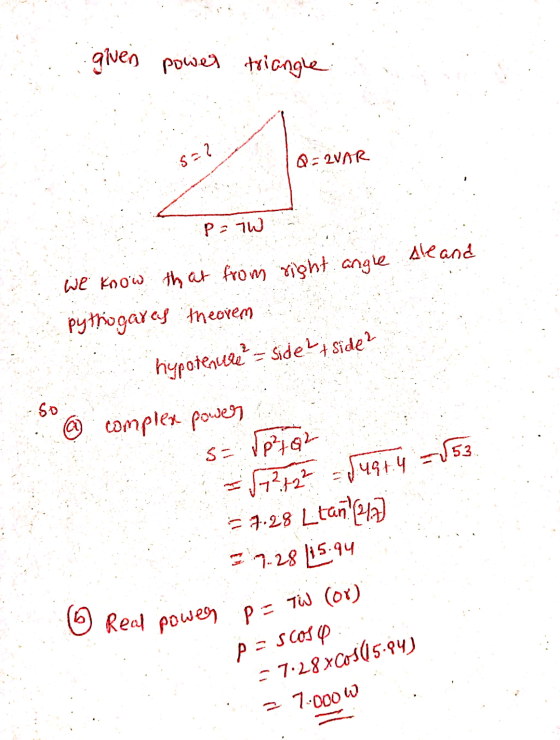
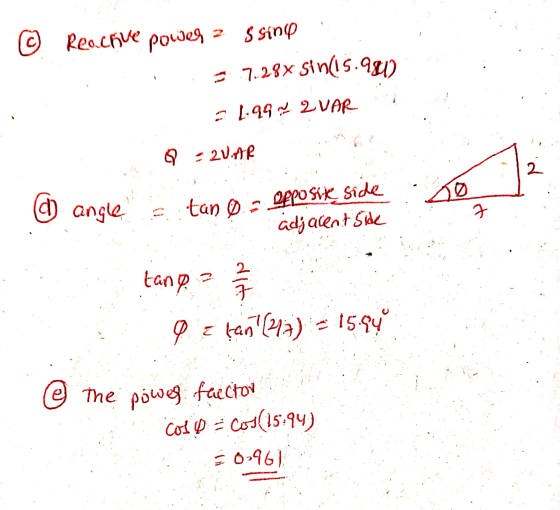
For the following power triangle in figure 7 2 VAR 7W a. What is the complex...
For the following voltage and current phasors, calculate the complex power, apparent power, real power, and...
 For the following voltage and current phasors, calculate the complex power, apparent power, real power, and reactive power. Determine whether the power factor is leading or lagging. V = 260 230 Vrms, I0.5260 Arms The value of apparent power is VA The value of real power is W. VAR. The value of reactive power is The power factor is Click to select B
For the system shown in Figure 2: a) Find IS. b) Find the average power delivered...
 For the system shown in Figure 2: a) Find
IS. b) Find the average power delivered to each element. c) Find
the reactive power for each element. d) Find the apparent power for
each element. e) Find PT, QT, ST. f) Sketch the power triangle.
Figure 2 g) Find the power factor seen by the source E.
Problem 2 For the system shown in Figure 2: a) Find Is. R3 b) Find the average power delivered to each element c)...
For the system shown in Figure 2: a) Find
IS. b) Find the average power delivered to each element. c) Find
the reactive power for each element. d) Find the apparent power for
each element. e) Find PT, QT, ST. f) Sketch the power triangle.
Figure 2 g) Find the power factor seen by the source E.
Problem 2 For the system shown in Figure 2: a) Find Is. R3 b) Find the average power delivered to each element c)...
Q3. from a 240 V, 50 Hz supply as shown in the Figure 3. 24020 Vrms...
 Q3. from a 240 V, 50 Hz supply as shown in the Figure 3. 24020 Vrms Inductive load with 0.6 lagging Load current 50 A Ohle Capacitor to be connected for power factor improvement Figure 3: a) Assuming that the capacitor shown in the figure is disconnected, calculate the load real (PL), reactive(Q1), and apparent power(SL) (5 marks) b) Draw the load power triangle and indicate real (P.) reactive (Q.), apparent (SL) power, and power factor angle (@.) (5 marks)...
answers next to questionsneed work to see how to get them 4. CH 10 In the...
 answers next to questionsneed work to see how to get them
4. CH 10 In the circuit below determine giving the units: The total impedance of the circuit (20+j5 )2 b. The current in the circuit (5.821 Z-14.0362 A) The total complex power ( 698.5214.0362 VA) The power factor angle and the power factor ( 14.0352, PF= 0.970143) The power dissipated in resistor R 677.65 W The reactive power in the capacitor 338.824 VAr The reactive power in the inductor...
answers next to questionsneed work to see how to get them
4. CH 10 In the circuit below determine giving the units: The total impedance of the circuit (20+j5 )2 b. The current in the circuit (5.821 Z-14.0362 A) The total complex power ( 698.5214.0362 VA) The power factor angle and the power factor ( 14.0352, PF= 0.970143) The power dissipated in resistor R 677.65 W The reactive power in the capacitor 338.824 VAr The reactive power in the inductor...
(8 points) In the quitessential electric power system in the figure, a voltmeter reads the same...
 (8 points) In the quitessential electric power system in the figure, a voltmeter reads the same at the source and at the load, 125 volts. At the source, an ammeter reads 40 amps. The source sees a inductive circuit. The cable (feeder) has a resistance of 0.0631302 ohms and a reactance of 1.2046 ohms. (a) What is the power factor angle, in degrees, at the source; (b) What is the active power delivered by the source; (C) What is the...
Experiment # 8-Prelab Measurement of Single Phase AC Power by Wattmeter 8.1.The measured current in Figure...
 Experiment # 8-Prelab Measurement of Single Phase AC Power by Wattmeter 8.1.The measured current in Figure 8.3 is 10 A and the measured power is 900 W. Consider that the wattmeter is ideal (doesn't change the voltage and current through the load) and determine: a) The resistance of the motor coil (R); b) The inductance of the motor coil (L); c) The power factor of the motor coil (cosp) d) The complex power (S); e) The reactive power (Q): f...
Given the single phase power system shown in Figure 2, determine the following (use 240 V_base...
 Given the single phase power system shown in Figure 2, determine the following (use 240 V_base and 30 kVA S_ base for the system at Bus 1): a) Draw the per-unit circuit b) Determine the per-unit impedances and per-unit source voltage c) Calculate the load current in both per-unit and in amperes at Bus 3 d) Calculate the apparent power, real power, reactive power and power factor at Bus 1
Q1. AC Power Calculation 1. For the following voltage and current phasors, calculate the complex power,...
 Q1. AC Power Calculation 1. For the following voltage and current phasors, calculate the complex power, apparent power, real power, and reactive power. Specify whether the pf is leading or lagging. (a) V = 120/ 30 V rms, 1 = 6.2/ - 25 A rms (b)V= 220/30 mms, 1 = 0.50/60 Arms (c) V = 250/- 10 Vrms, I = 6.21 - 25 Arms (d)V= 110/30°Vrms, 1 = 0.40/-70'Arms (e) P = 100kW, pf = 0.88 lagging
6.28 Consider the simplified electric power system shown in Figure 6.17 for which the power- flow...
 6.28 Consider the simplified electric power system shown in Figure 6.17 for which the power- flow solution can be obtained without resorting to iterative techniques. (a) Compute the elements of the bus admittance matrix Ybus. (b) Calculate the phase angle δ, by using the real power equation at bus 2 (voltage-controlled bus). (c) Determine IV and os by using both the real and reactive power equations at bus 3 (load bus). (d) Find the real power generated at bus 1...
Question 1: Consider a 3 phase hydropower generator feeding power into the grid bus, which is held at line voltage of 26kV. The internal reactance is 0.8pu for a rated power of 30MVA. (a) Choose...
 Question 1: Consider a 3 phase hydropower generator feeding power into the grid bus, which is held at line voltage of 26kV. The internal reactance is 0.8pu for a rated power of 30MVA. (a) Choose as base value So.3-30MVA and Vo.Lu-26k V and calculate the per-unit (b) Assume the generator initially runs overexcited with E-1.3 pu and a real power values for the power and grid voltage output of Pe 0.32pu. Compute the reactive power and the apparent power output...
 For the following voltage and current phasors, calculate the complex power, apparent power, real power, and reactive power. Determine whether the power factor is leading or lagging. V = 260 230 Vrms, I0.5260 Arms The value of apparent power is VA The value of real power is W. VAR. The value of reactive power is The power factor is Click to select B
 For the system shown in Figure 2: a) Find
IS. b) Find the average power delivered to each element. c) Find
the reactive power for each element. d) Find the apparent power for
each element. e) Find PT, QT, ST. f) Sketch the power triangle.
Figure 2 g) Find the power factor seen by the source E.
Problem 2 For the system shown in Figure 2: a) Find Is. R3 b) Find the average power delivered to each element c)...
For the system shown in Figure 2: a) Find
IS. b) Find the average power delivered to each element. c) Find
the reactive power for each element. d) Find the apparent power for
each element. e) Find PT, QT, ST. f) Sketch the power triangle.
Figure 2 g) Find the power factor seen by the source E.
Problem 2 For the system shown in Figure 2: a) Find Is. R3 b) Find the average power delivered to each element c)...
 Q3. from a 240 V, 50 Hz supply as shown in the Figure 3. 24020 Vrms Inductive load with 0.6 lagging Load current 50 A Ohle Capacitor to be connected for power factor improvement Figure 3: a) Assuming that the capacitor shown in the figure is disconnected, calculate the load real (PL), reactive(Q1), and apparent power(SL) (5 marks) b) Draw the load power triangle and indicate real (P.) reactive (Q.), apparent (SL) power, and power factor angle (@.) (5 marks)...
 answers next to questionsneed work to see how to get them
4. CH 10 In the circuit below determine giving the units: The total impedance of the circuit (20+j5 )2 b. The current in the circuit (5.821 Z-14.0362 A) The total complex power ( 698.5214.0362 VA) The power factor angle and the power factor ( 14.0352, PF= 0.970143) The power dissipated in resistor R 677.65 W The reactive power in the capacitor 338.824 VAr The reactive power in the inductor...
answers next to questionsneed work to see how to get them
4. CH 10 In the circuit below determine giving the units: The total impedance of the circuit (20+j5 )2 b. The current in the circuit (5.821 Z-14.0362 A) The total complex power ( 698.5214.0362 VA) The power factor angle and the power factor ( 14.0352, PF= 0.970143) The power dissipated in resistor R 677.65 W The reactive power in the capacitor 338.824 VAr The reactive power in the inductor...
 (8 points) In the quitessential electric power system in the figure, a voltmeter reads the same at the source and at the load, 125 volts. At the source, an ammeter reads 40 amps. The source sees a inductive circuit. The cable (feeder) has a resistance of 0.0631302 ohms and a reactance of 1.2046 ohms. (a) What is the power factor angle, in degrees, at the source; (b) What is the active power delivered by the source; (C) What is the...
 Experiment # 8-Prelab Measurement of Single Phase AC Power by Wattmeter 8.1.The measured current in Figure 8.3 is 10 A and the measured power is 900 W. Consider that the wattmeter is ideal (doesn't change the voltage and current through the load) and determine: a) The resistance of the motor coil (R); b) The inductance of the motor coil (L); c) The power factor of the motor coil (cosp) d) The complex power (S); e) The reactive power (Q): f...
 Given the single phase power system shown in Figure 2, determine the following (use 240 V_base and 30 kVA S_ base for the system at Bus 1): a) Draw the per-unit circuit b) Determine the per-unit impedances and per-unit source voltage c) Calculate the load current in both per-unit and in amperes at Bus 3 d) Calculate the apparent power, real power, reactive power and power factor at Bus 1
 Q1. AC Power Calculation 1. For the following voltage and current phasors, calculate the complex power, apparent power, real power, and reactive power. Specify whether the pf is leading or lagging. (a) V = 120/ 30 V rms, 1 = 6.2/ - 25 A rms (b)V= 220/30 mms, 1 = 0.50/60 Arms (c) V = 250/- 10 Vrms, I = 6.21 - 25 Arms (d)V= 110/30°Vrms, 1 = 0.40/-70'Arms (e) P = 100kW, pf = 0.88 lagging
 6.28 Consider the simplified electric power system shown in Figure 6.17 for which the power- flow solution can be obtained without resorting to iterative techniques. (a) Compute the elements of the bus admittance matrix Ybus. (b) Calculate the phase angle δ, by using the real power equation at bus 2 (voltage-controlled bus). (c) Determine IV and os by using both the real and reactive power equations at bus 3 (load bus). (d) Find the real power generated at bus 1...
 Question 1: Consider a 3 phase hydropower generator feeding power into the grid bus, which is held at line voltage of 26kV. The internal reactance is 0.8pu for a rated power of 30MVA. (a) Choose as base value So.3-30MVA and Vo.Lu-26k V and calculate the per-unit (b) Assume the generator initially runs overexcited with E-1.3 pu and a real power values for the power and grid voltage output of Pe 0.32pu. Compute the reactive power and the apparent power output...
Most questions answered within 3 hours.
-
Where is the error in this code sequence?
String s1 = "Hello";
String s2 = "ello";...
asked 10 months ago -
Financial data for Joel de Paris, Inc., for last year
follow:
Joel de Paris, Inc.
Balance...
asked 10 months ago -
Consider this reaction:
Al2(SO4)3 (aq)+ BaCl3
(aq) Al2Cl6 (aq)- +
3BaSO4(s) . What is the...
asked 10 months ago -
Suppose that Savneet is considering increasing her
recent random sample from 20 car rentals to 40...
asked 10 months ago -
Trucks arrive at an unloading terminal at an average rate of 120
per hour.
Trucks arrive...
asked 10 months ago -
Why are methanol and ethanol completely soluble in water while
octanol is not very little soluble....
asked 10 months ago -
A facilities manager at a university reads in a research report
that the mean amount of...
asked 10 months ago -
When the CuSO4 is rehydrated by adding water to the anhydrous
compound, is this an endothermic...
asked 10 months ago -
A ray of sunlight is passing from diamond into crown glass; the
angle of incidence is...
asked 10 months ago -
A block of mass 0.249 kg is placed on top of a light, vertical
spring of...
asked 10 months ago -
how do the kidneys compensate in the presences of acidosis
a) trigger hyperventilate
b) reserve acid...
asked 10 months ago -
Question 501 pts
The rental rate of capital to the firm increases. Which of the
following...
asked 10 months ago