Fresh orange juice contains approximately 10.0 wt% solids (sugar, citric acid and other indigenous ingredients) and...
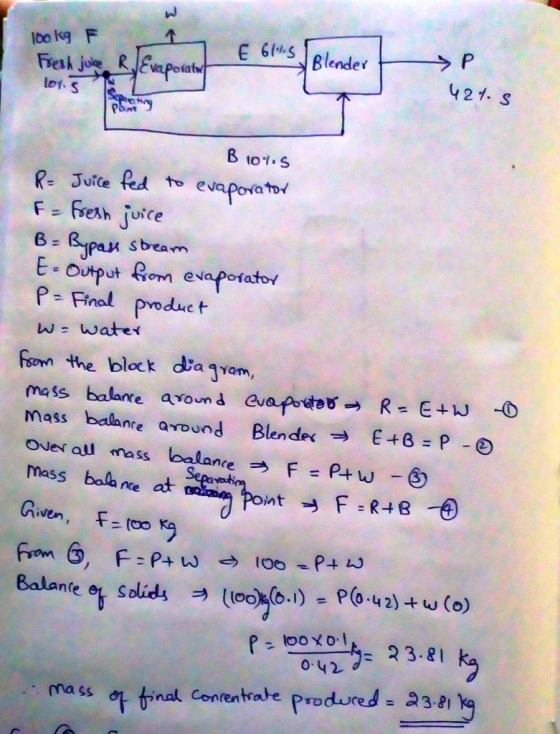
Fresh orange juice contains approximately 10.0 wt% solids (sugar, citric acid and other indigenous ingredients) and frozen concentrate contains approximately 42.0 wt% solids. The frozen concentrate is obtained by evaporating water from the fresh juice to produce a mixture that is approximately 61.0 wt% solids. However, so that the flavor of the concentrate will closely approximate that of fresh juice, the concentrate from the evaporator is blended with fresh orange juice (and other minor additives) to produce a final concentrate that is approximately 42.0 wt% solids. Assume a basis of 100.0 kg of fresh juice fed to the process.
What is the mass of final concentrate produced? kg
What is the fraction of fresh juice that bypasses the
evaporator?
Homework Answers
 Please
hit LIKE if you like my answer and feel free to ask queries, if
any. Thank You!!
Please
hit LIKE if you like my answer and feel free to ask queries, if
any. Thank You!!
Add Answer to:
Fresh orange juice contains approximately 10.0 wt% solids
(sugar, citric acid and other indigenous ingredients) and...
Fresh graph juice contains 12.0 wt% solids and the balance water, and concentrated graph juice contains...
Fresh graph juice contains 12.0 wt% solids and the balance water, and concentrated graph juice contains 42.0 wt% solids. Initially a single evaporation process was used for the concentration, but volatile constituents of the juice escaped with the water, leaving the concentrate with a flat taste The current process overcomes this problem by bypassing the evaporator with a fraction of the fresh juice. The juice that enters the evaporator is concentrated to 58 wt% solids, and the evaporator product stream...
Fresh orange juice containing 75.0 wt% water and the balance solids is concentrated in an evaporator....
Fresh orange juice containing 75.0 wt% water and the balance solids is concentrated in an evaporator. In order to improve the taste of the orange juice, a fraction of the feed stream is diverted around the evaporator as a bypass stream and mixed with the outlet stream from the evaporator. The combined product stream (= outlet stream from evaporator + bypass) contains 65 wt% solids and the balance water. Ninety percent of the water in the feed entering the evaporator...
Fresh orange juice contains 12.0 wt% solid and the water, and concentrated orange juice contain 42.0...
Fresh orange juice contains 12.0 wt% solid and the water, and concentrated orange juice contain 42.0 wt% solids. Initially a single evaporation process was used for the concentration, but volatile constituents of the juice escaped with the water, leaving the concentrate with a flat taste. The current process overcomes this problem by bypassing the evaporator with a fraction of the fresh juice. The juice that enters the evaporator is concentrated to 58 wt% solids, and the evaporator product stream is...
please solve this questuon Fresh orange juice contains 13% solids and rest water. It is concentrated...
 please solve this questuon
Fresh orange juice contains 13% solids and rest water. It is concentrated to contain 45% solids. In the present process, the evaporator is bypassed with a fraction of fresh juice. Juice that enters the evaporator is concentrated to 60% solids and is mixed with bypass juice to achieve the desired final concentration. Calculate the amount of final juice per kg of fresh juice fed to the process and the fraction of the feed in percentage that...
please solve this questuon
Fresh orange juice contains 13% solids and rest water. It is concentrated to contain 45% solids. In the present process, the evaporator is bypassed with a fraction of fresh juice. Juice that enters the evaporator is concentrated to 60% solids and is mixed with bypass juice to achieve the desired final concentration. Calculate the amount of final juice per kg of fresh juice fed to the process and the fraction of the feed in percentage that...
 please solve this questuon
Fresh orange juice contains 13% solids and rest water. It is concentrated to contain 45% solids. In the present process, the evaporator is bypassed with a fraction of fresh juice. Juice that enters the evaporator is concentrated to 60% solids and is mixed with bypass juice to achieve the desired final concentration. Calculate the amount of final juice per kg of fresh juice fed to the process and the fraction of the feed in percentage that...
please solve this questuon
Fresh orange juice contains 13% solids and rest water. It is concentrated to contain 45% solids. In the present process, the evaporator is bypassed with a fraction of fresh juice. Juice that enters the evaporator is concentrated to 60% solids and is mixed with bypass juice to achieve the desired final concentration. Calculate the amount of final juice per kg of fresh juice fed to the process and the fraction of the feed in percentage that...
Most questions answered within 3 hours.
-
Where is the error in this code sequence?
String s1 = "Hello";
String s2 = "ello";...
asked 10 months ago -
Financial data for Joel de Paris, Inc., for last year
follow:
Joel de Paris, Inc.
Balance...
asked 10 months ago -
Consider this reaction:
Al2(SO4)3 (aq)+ BaCl3
(aq) Al2Cl6 (aq)- +
3BaSO4(s) . What is the...
asked 10 months ago -
Suppose that Savneet is considering increasing her
recent random sample from 20 car rentals to 40...
asked 10 months ago -
Trucks arrive at an unloading terminal at an average rate of 120
per hour.
Trucks arrive...
asked 10 months ago -
Why are methanol and ethanol completely soluble in water while
octanol is not very little soluble....
asked 10 months ago -
A facilities manager at a university reads in a research report
that the mean amount of...
asked 10 months ago -
When the CuSO4 is rehydrated by adding water to the anhydrous
compound, is this an endothermic...
asked 10 months ago -
A ray of sunlight is passing from diamond into crown glass; the
angle of incidence is...
asked 10 months ago -
A block of mass 0.249 kg is placed on top of a light, vertical
spring of...
asked 10 months ago -
how do the kidneys compensate in the presences of acidosis
a) trigger hyperventilate
b) reserve acid...
asked 10 months ago -
Question 501 pts
The rental rate of capital to the firm increases. Which of the
following...
asked 10 months ago