Briefly explain your answers to the following questions. A mutation (Mutation A) in the lac operon...
Briefly explain your answers to the following questions.
A mutation (Mutation A) in the lac operon of E. coli leads to an
inability to ferment lactose, and the
expression of the operon is always off. Introduction into the
mutant of an F' factor containing the wild
type lac operon does NOT restore the ability to ferment lactose,
i.e., there is no expression of the operon
from the plasmid either.
a. What is the probable nature of Mutation A? Is the mutation cis-
or trans-acting?
b. A second site (in another gene) mutation (Mutation B) in the
original mutant strain causes a change of
phenotype to constitutive expression of the operon. What kind of
second site mutation could account for
this?
c. If Mutation B were genetically isolated in a fresh strain
(i.e., it is the only mutation in this strain), what
lac phenotype would you expect? Is the mutation cis- or
trans-acting?
d. Another mutation is found (Mutation C) that leads to
constitutive expression of the lac operon. To
your surprise, Mutation C genetically maps within the first
structural gene of the operon, the z gene
coding for beta-galactosidase. Nevertheless, the beta-galactosidase
synthesized in this mutant is full
length and exhibits normal activity. Suggest an explanation for the
constitutive phenotype of Mutation
C. (Hint: recall the regulatory features of other catabolic operons
such as gal and ara.)
Homework Answers
A. It is dominant mutation.
It is trans-acting . Example of this mutation could be Is-. This mutation changes the repressor so that it can no longer bind the inducer.
B. It is dominant trans-acting mutation that lead to constitutive expression of operon. Example of this mutation could be lac Id- mutation. Repressor is a homotetramer. A mixture of normal and defective subunits can be non-functional causing the constitutive like the lac I- phenotype.
C. It will lead to constitutive expression and it is trans-acting in nature as it will effect both the operons.
D. Mutation in structural gene z lead to constitutive expression of the operon and within the z gene there lies the operator site so there might be mutation at this place that does not allow binding of a normal repressor molecule with operator.
Add Answer to:
Briefly explain your answers to the following questions.
A mutation (Mutation A) in the lac operon...
Imagine you are carrying out research on the lac operon. You isolate six mutations in the...
 Imagine you are carrying out research on the lac
operon. You isolate six mutations in the lac operon by
measuring the amount of beta-galactosidase made in mutant cell line
under three different conditions: no lactose/no glucose; lactose
only; and lactose/glucose. Your results are shown in the table.
Strain
No Lactose, No Glucose
Lactose
Lactose, Glucose
Wild-type
None
High
Low
Mutant 1
None
None
None
Mutant 2
None
None
None
Mutant 3
None
Low
Low
Mutant 4
None
Low
Low
Mutant...
Imagine you are carrying out research on the lac
operon. You isolate six mutations in the lac operon by
measuring the amount of beta-galactosidase made in mutant cell line
under three different conditions: no lactose/no glucose; lactose
only; and lactose/glucose. Your results are shown in the table.
Strain
No Lactose, No Glucose
Lactose
Lactose, Glucose
Wild-type
None
High
Low
Mutant 1
None
None
None
Mutant 2
None
None
None
Mutant 3
None
Low
Low
Mutant 4
None
Low
Low
Mutant...
help with this genetic problem You have a mutant E.coli with a lac operon (lacMuT) which...
 help with this genetic problem
You have a mutant E.coli with a lac operon (lacMuT) which is not responding to lactose control You create an F episomal plasmid with the wild-type lac operon (lacW) and transform it into your mutant E. coli Genotype Mutant (lac) Mutant (lac Merizygote (lacMUT+ lacMUT)No Merizygote (lalacYes Lactose Added? Beta-galactosidase activity 100% 100% 100% 200% MUT Yes MUT MUT Is the mutation in the lacl trans-factor or the lacO cis-element? Describe the likely mutation and...
help with this genetic problem
You have a mutant E.coli with a lac operon (lacMuT) which is not responding to lactose control You create an F episomal plasmid with the wild-type lac operon (lacW) and transform it into your mutant E. coli Genotype Mutant (lac) Mutant (lac Merizygote (lacMUT+ lacMUT)No Merizygote (lalacYes Lactose Added? Beta-galactosidase activity 100% 100% 100% 200% MUT Yes MUT MUT Is the mutation in the lacl trans-factor or the lacO cis-element? Describe the likely mutation and...
A constitutive mutant is a strain that had a mutation in an operon leading to that...
A constitutive mutant is a strain that had a mutation in an operon leading to that strain continuously making protein (or continuous gene expression). This operon is inducible in the wild type strain (no mutation) and therefore regulated. What would be two possible explanations on how an inducible operon would become constitutive? (hints: think about the different mechanisms of induction and then consider what would happen is these components had mutations) With regard to the Lac operon, if a bacterium goes from a...
You are asked to develop a demonstration to show how the lac operon works. You decide...
 You are asked to develop a demonstration to show how the
lac operon works. You decide to use X-gal and IPTG to
determine if the enzyme ?-galactosidase is active. X-gal is a
lactose analog that turns blue when metabolized by ?-galactosidase,
but it does not induce the lac operon. IPTG is an inducer
of the lac operon, but is not metabolized by ?-galactosidase.
a. (2pts) Which of the following would you expect to bind to
?-galactosidase. Circle all that apply....
You are asked to develop a demonstration to show how the
lac operon works. You decide to use X-gal and IPTG to
determine if the enzyme ?-galactosidase is active. X-gal is a
lactose analog that turns blue when metabolized by ?-galactosidase,
but it does not induce the lac operon. IPTG is an inducer
of the lac operon, but is not metabolized by ?-galactosidase.
a. (2pts) Which of the following would you expect to bind to
?-galactosidase. Circle all that apply....
Three different strains of E. coli carry a mutation in the lac operon and/or laci gene....
 Three different strains of E. coli carry a mutation in the lac operon and/or laci gene. The production of B-galactosidase (+ present or - absent) is measured when lactose is present and absent from the medium. Assume the mutations involve only 1, 0, or Z. A merodiploid is constructed for each of the three strains. The plasmid carries a wild type lac operon and lacl gene. The production of functional B-galactosidase (+ present or - absent) is measured when lactose...
You have systematically mutagenized the lac operon in E. coli to produce a mutation that disrupts...
You have systematically mutagenized the lac operon in E. coli to produce a mutation that disrupts the function of each of the following elements: a. the promoter for LacI (P(I)) b. the LacI gene c. CRP binding site d. the promoter for the lac operon (P(lac)) e. the operator sequence f. a mutation in lacZ that disrupts the coding region but does not disrupt transcription g. a mutation in lacZ that blocks transcription For each of the above mutations, what...
4. Nutritional status, mutation, and expression of the lac operon. For each of the following conditions,...
 4. Nutritional status, mutation, and expression of the lac operon. For each of the following conditions, indicate how much (a lot, a little, or none) of the lacZ gene (z-gene) product, beta- galactosidase, is being synthesized. NUTRITIONAL STATUS OF THE BACTERIA +lactose/-glucose +lactose/+glucose -lactose/+glucose genetic status normal (no mutation) mutation a mutation b mutationc important: these are nor the same mutations as the ones in your class handout mutation a: a mutation in the start codon for the lacA (A-gene)...
Most of what we know about the lac operon in E. coli has come from the...
Most of what we know about the lac operon in E. coli has come from the genetic analysis of various mutants. Below is a list of mutants for regions of the operon. A + superscript indicates no mutation and normal function of that region, - indicates a knock out and no function of that region, c indicates the mutation resulted in constitutive action of that region. The effect of the mutation is determined by expression of the lacZ gene as...
The lac operon contains a DNA sequence known as the lac promoter (P or P+ for...
The lac operon contains a DNA sequence known as the lac promoter (P or P+ for wild type; P– for mutant (RNA polymerase does not bind)) that serves as the RNA polymerase binding site. The lac operon also contains a DNA sequence known as the Lac operator (O or O+ for wild type; O– or Oc for mutant (lac repressor cannot bind)) which is the binding site for lac repressor. The lac repressor, a protein, is encoded by the lac...
Assign. 25 Practice Problem 81 - Copy2 Imagine you are carrying out research on the lac...
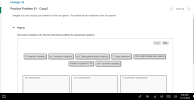 Assign. 25 Practice Problem 81 - Copy2 Imagine you are carrying out research on the lac operon. You isolate seven mutations in the lac operon. Part A Sort each mutation into the bin that best predicts its expression pattern. Reset Help 0° operator mutation lac repressor mutation lacz beta-galactosidase mutation | 尸 super-repressor CAP CAMP binding site mutation mutation in gene for CAP lacP (promoter mutation) Low expression No expression Constitutive expression 2:46 AM ) i ai d 11/11/2018
 Imagine you are carrying out research on the lac
operon. You isolate six mutations in the lac operon by
measuring the amount of beta-galactosidase made in mutant cell line
under three different conditions: no lactose/no glucose; lactose
only; and lactose/glucose. Your results are shown in the table.
Strain
No Lactose, No Glucose
Lactose
Lactose, Glucose
Wild-type
None
High
Low
Mutant 1
None
None
None
Mutant 2
None
None
None
Mutant 3
None
Low
Low
Mutant 4
None
Low
Low
Mutant...
Imagine you are carrying out research on the lac
operon. You isolate six mutations in the lac operon by
measuring the amount of beta-galactosidase made in mutant cell line
under three different conditions: no lactose/no glucose; lactose
only; and lactose/glucose. Your results are shown in the table.
Strain
No Lactose, No Glucose
Lactose
Lactose, Glucose
Wild-type
None
High
Low
Mutant 1
None
None
None
Mutant 2
None
None
None
Mutant 3
None
Low
Low
Mutant 4
None
Low
Low
Mutant...
 help with this genetic problem
You have a mutant E.coli with a lac operon (lacMuT) which is not responding to lactose control You create an F episomal plasmid with the wild-type lac operon (lacW) and transform it into your mutant E. coli Genotype Mutant (lac) Mutant (lac Merizygote (lacMUT+ lacMUT)No Merizygote (lalacYes Lactose Added? Beta-galactosidase activity 100% 100% 100% 200% MUT Yes MUT MUT Is the mutation in the lacl trans-factor or the lacO cis-element? Describe the likely mutation and...
help with this genetic problem
You have a mutant E.coli with a lac operon (lacMuT) which is not responding to lactose control You create an F episomal plasmid with the wild-type lac operon (lacW) and transform it into your mutant E. coli Genotype Mutant (lac) Mutant (lac Merizygote (lacMUT+ lacMUT)No Merizygote (lalacYes Lactose Added? Beta-galactosidase activity 100% 100% 100% 200% MUT Yes MUT MUT Is the mutation in the lacl trans-factor or the lacO cis-element? Describe the likely mutation and...
 You are asked to develop a demonstration to show how the
lac operon works. You decide to use X-gal and IPTG to
determine if the enzyme ?-galactosidase is active. X-gal is a
lactose analog that turns blue when metabolized by ?-galactosidase,
but it does not induce the lac operon. IPTG is an inducer
of the lac operon, but is not metabolized by ?-galactosidase.
a. (2pts) Which of the following would you expect to bind to
?-galactosidase. Circle all that apply....
You are asked to develop a demonstration to show how the
lac operon works. You decide to use X-gal and IPTG to
determine if the enzyme ?-galactosidase is active. X-gal is a
lactose analog that turns blue when metabolized by ?-galactosidase,
but it does not induce the lac operon. IPTG is an inducer
of the lac operon, but is not metabolized by ?-galactosidase.
a. (2pts) Which of the following would you expect to bind to
?-galactosidase. Circle all that apply....
 Three different strains of E. coli carry a mutation in the lac operon and/or laci gene. The production of B-galactosidase (+ present or - absent) is measured when lactose is present and absent from the medium. Assume the mutations involve only 1, 0, or Z. A merodiploid is constructed for each of the three strains. The plasmid carries a wild type lac operon and lacl gene. The production of functional B-galactosidase (+ present or - absent) is measured when lactose...
 4. Nutritional status, mutation, and expression of the lac operon. For each of the following conditions, indicate how much (a lot, a little, or none) of the lacZ gene (z-gene) product, beta- galactosidase, is being synthesized. NUTRITIONAL STATUS OF THE BACTERIA +lactose/-glucose +lactose/+glucose -lactose/+glucose genetic status normal (no mutation) mutation a mutation b mutationc important: these are nor the same mutations as the ones in your class handout mutation a: a mutation in the start codon for the lacA (A-gene)...
 Assign. 25 Practice Problem 81 - Copy2 Imagine you are carrying out research on the lac operon. You isolate seven mutations in the lac operon. Part A Sort each mutation into the bin that best predicts its expression pattern. Reset Help 0° operator mutation lac repressor mutation lacz beta-galactosidase mutation | 尸 super-repressor CAP CAMP binding site mutation mutation in gene for CAP lacP (promoter mutation) Low expression No expression Constitutive expression 2:46 AM ) i ai d 11/11/2018
Most questions answered within 3 hours.
-
Where is the error in this code sequence?
String s1 = "Hello";
String s2 = "ello";...
asked 10 months ago -
Financial data for Joel de Paris, Inc., for last year
follow:
Joel de Paris, Inc.
Balance...
asked 10 months ago -
Consider this reaction:
Al2(SO4)3 (aq)+ BaCl3
(aq) Al2Cl6 (aq)- +
3BaSO4(s) . What is the...
asked 10 months ago -
Suppose that Savneet is considering increasing her
recent random sample from 20 car rentals to 40...
asked 10 months ago -
Trucks arrive at an unloading terminal at an average rate of 120
per hour.
Trucks arrive...
asked 10 months ago -
Why are methanol and ethanol completely soluble in water while
octanol is not very little soluble....
asked 10 months ago -
A facilities manager at a university reads in a research report
that the mean amount of...
asked 10 months ago -
When the CuSO4 is rehydrated by adding water to the anhydrous
compound, is this an endothermic...
asked 10 months ago -
A ray of sunlight is passing from diamond into crown glass; the
angle of incidence is...
asked 10 months ago -
A block of mass 0.249 kg is placed on top of a light, vertical
spring of...
asked 10 months ago -
how do the kidneys compensate in the presences of acidosis
a) trigger hyperventilate
b) reserve acid...
asked 10 months ago -
Question 501 pts
The rental rate of capital to the firm increases. Which of the
following...
asked 10 months ago