![Problem 5. Consider operators B and C, whose matrix representations in some basis are: ſo 10] [1ool 1 0 1 C=o oo Too-1 0 1 0](http://img.homeworklib.com/questions/aa6a9740-4edc-11eb-b602-8f26c38c9791.png?x-oss-process=image/resize,w_560)
Homework Answers
Solution:
(a)
Since  is diagonal, we are in the
basis and the diagonal elements are the
eigenvalues, we have
is diagonal, we are in the
basis and the diagonal elements are the
eigenvalues, we have  .
.
(b)
The corresponding eigenvectors are:
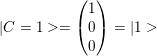
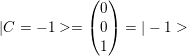
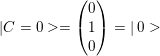
(c)


(d)
We have




Add Answer to:
consider a simple harmonic oscilator and its normalised
eigenstates
Problem 5. Consider operators B and C,...
Question 3 Consider the one-dimensional harmonic oscillator, and denote its properly normalised e...
 ONLY (e) (f) NEEDED THANK YOU :)
Question 3 Consider the one-dimensional harmonic oscillator, and denote its properly normalised energy eigenstates by { | n〉, n = 0, 1, 2, 3, . . .). Define the state where α is a complex number, and C is a normalisation constant. (a) Use a Campbell-Baker-Hausdorff relation (or otherwise) to show that In other words, | α > is an eigenstate of the (non-Hermitian) lowering operator with (complex) eigenvalue α. (b) During lectures...
ONLY (e) (f) NEEDED THANK YOU :)
Question 3 Consider the one-dimensional harmonic oscillator, and denote its properly normalised energy eigenstates by { | n〉, n = 0, 1, 2, 3, . . .). Define the state where α is a complex number, and C is a normalisation constant. (a) Use a Campbell-Baker-Hausdorff relation (or otherwise) to show that In other words, | α > is an eigenstate of the (non-Hermitian) lowering operator with (complex) eigenvalue α. (b) During lectures...
2. (8 points) Consider an electron in a hydrogen atom with 1. There are three possible...
 2. (8 points) Consider an electron in a hydrogen atom with 1. There are three possible eigen- states of the operator L2, given by 11, m) 11,1), 11,0), and 11,-1). (a) Recall that the raising/lower operators are given by L±-L, ±ill. Also recall the rela- tionship Use this relationship to determine the 3x3 matrix representation of Ly (using a basis com- prised of eigenstates of L). (b) What are the eigenvalues and associated eigenstates of the operator Ly? (c) If...
1. Consider one-dimensional harmonic oscillator H w(aaand its energy eigenstates are denoted as ln) , n...
 1. Consider one-dimensional harmonic oscillator H w(aaand its energy eigenstates are denoted as ln) , n E No. The state of system is given by n-0 (a) Find Z. (b) Calculate the von Neumann entropy. (c) Evaluate mean energy.
(a) There are a set of eigenstates ๒n) for the Hermitian operator A with non-degenerate eigenvalues...
 (a) There are a set of eigenstates ๒n) for the Hermitian operator A with non-degenerate eigenvalues an and a state |ψ Σ¡c; Write down the equation relating the states |>n), the operator A and the eigenvalues a 1. ,n ii. Using Dirac notation explain the requirement for an operator to be Hermitian iii. Explain the relation between the eigenvalues of an operator and the measured iv. For to be properly normalised show the condition required for the values V. Express...
(a) There are a set of eigenstates ๒n) for the Hermitian operator A with non-degenerate eigenvalues...
 (a) There are a set of eigenstates ๒n) for the Hermitian operator A with non-degenerate eigenvalues an and a state |ψ Σ¡c; Write down the equation relating the states |>n), the operator A and the eigenvalues a 1. ,n ii. Using Dirac notation explain the requirement for an operator to be Hermitian iii. Explain the relation between the eigenvalues of an operator and the measured iv. For to be properly normalised show the condition required for the values V. Express...
1. More on Spin-1/2 system: (10 points) The rising and lowering operators for a spin-1/2 system...
 1. More on Spin-1/2 system: (10 points) The rising and lowering operators for a spin-1/2 system are defined as: S+ S + iSy and S S iSy, respectively. They satisfy the following properties: Š+㈩-0, Š+|-)-치+), s-I+) = 최-), s-I-》 = 0, where lt) are the usual eigenstates of the S, operator. a) Invert the definitions of S+ and ś, to express Sa and Šy in terms of St and S. b) Find the matrix representations of Š+ and Š in...
A particle with mass m is in a one dimensional simple harmonic oscillator potential. At timet0 it is described by the superposition state where Vo, 1 and Vz are normalised energy eigenfunctions of th...
 A particle with mass m is in a one dimensional simple harmonic oscillator potential. At timet0 it is described by the superposition state where Vo, 1 and Vz are normalised energy eigenfunctions of the harmonic oscillator potential corresponding to energies Eo, E1 and E2 (a) Show that the wavefunction is normalised (b) If an observation of energy is made, what is the most likely value of energy and with what probability would it be obtained? (c) If the experiment is...
Problem 5. (30 points) Consider a Harmonic oscillator with H that H=(ata + 1 / 2)ho,...
 Problem 5. (30 points) Consider a Harmonic oscillator with H that H=(ata + 1 / 2)ho, where a=dma)X + i (a) (4 points) Show P, and a x 2h 2h 2moh P. Show also 2moh that [a, a]-l. (b) (6 points) Starting from the commuters la, HJand la', A), where H-H(h) show that the eigenvalues of Hare e,=(n+1/2) for n-0, 1,2, Show also that alm)-nln-l), and a l). (( points) Find the normalized ground state wavefunction by projecting alo)-0 on...
1. n) are harmonic oscillator energy eigenstates. 10). А[2)- (a) Find Alo), Áli), and A12). (Ans:...
 1. n) are harmonic oscillator energy eigenstates. 10). А[2)- (a) Find Alo), Áli), and A12). (Ans: Alo)-0. Α1) V211).) (b) Consider a quantum state given by where a is a real number with 0 a 1. Calculate (ψ1e1ψ) and 2a2)/2mu.) that Δ ris at its minimum. (Ans: (as)2-A(3-6a2 + 4a4)/2mw. ns: ha (1-a2)/mw. (c) Find (Ar)2ー(v' U)-(圳刘の2, what is the value of a such a = V3/2.)
1. n) are harmonic oscillator energy eigenstates. 10). А[2)- (a) Find Alo), Áli),...
1. n) are harmonic oscillator energy eigenstates. 10). А[2)- (a) Find Alo), Áli), and A12). (Ans: Alo)-0. Α1) V211).) (b) Consider a quantum state given by where a is a real number with 0 a 1. Calculate (ψ1e1ψ) and 2a2)/2mu.) that Δ ris at its minimum. (Ans: (as)2-A(3-6a2 + 4a4)/2mw. ns: ha (1-a2)/mw. (c) Find (Ar)2ー(v' U)-(圳刘の2, what is the value of a such a = V3/2.)
1. n) are harmonic oscillator energy eigenstates. 10). А[2)- (a) Find Alo), Áli),...
A particle with mass m is in a one-dimensional simple harmonic oscillator potential. At time t = 0 it is described by the state where lo and l) are normalised energy eigenfunctions corresponding to e...
 A particle with mass m is in a one-dimensional simple harmonic oscillator potential. At time t = 0 it is described by the state where lo and l) are normalised energy eigenfunctions corresponding to energies E and Ey and b and c are real constants. (a) Find b and c so that (x) is as large as possible. b) Write down the wavefunction of this particle at a time t later c)Caleulate (x) for the particle at time t (d)...
 ONLY (e) (f) NEEDED THANK YOU :)
Question 3 Consider the one-dimensional harmonic oscillator, and denote its properly normalised energy eigenstates by { | n〉, n = 0, 1, 2, 3, . . .). Define the state where α is a complex number, and C is a normalisation constant. (a) Use a Campbell-Baker-Hausdorff relation (or otherwise) to show that In other words, | α > is an eigenstate of the (non-Hermitian) lowering operator with (complex) eigenvalue α. (b) During lectures...
ONLY (e) (f) NEEDED THANK YOU :)
Question 3 Consider the one-dimensional harmonic oscillator, and denote its properly normalised energy eigenstates by { | n〉, n = 0, 1, 2, 3, . . .). Define the state where α is a complex number, and C is a normalisation constant. (a) Use a Campbell-Baker-Hausdorff relation (or otherwise) to show that In other words, | α > is an eigenstate of the (non-Hermitian) lowering operator with (complex) eigenvalue α. (b) During lectures...
 2. (8 points) Consider an electron in a hydrogen atom with 1. There are three possible eigen- states of the operator L2, given by 11, m) 11,1), 11,0), and 11,-1). (a) Recall that the raising/lower operators are given by L±-L, ±ill. Also recall the rela- tionship Use this relationship to determine the 3x3 matrix representation of Ly (using a basis com- prised of eigenstates of L). (b) What are the eigenvalues and associated eigenstates of the operator Ly? (c) If...
 1. Consider one-dimensional harmonic oscillator H w(aaand its energy eigenstates are denoted as ln) , n E No. The state of system is given by n-0 (a) Find Z. (b) Calculate the von Neumann entropy. (c) Evaluate mean energy.
 (a) There are a set of eigenstates ๒n) for the Hermitian operator A with non-degenerate eigenvalues an and a state |ψ Σ¡c; Write down the equation relating the states |>n), the operator A and the eigenvalues a 1. ,n ii. Using Dirac notation explain the requirement for an operator to be Hermitian iii. Explain the relation between the eigenvalues of an operator and the measured iv. For to be properly normalised show the condition required for the values V. Express...
 (a) There are a set of eigenstates ๒n) for the Hermitian operator A with non-degenerate eigenvalues an and a state |ψ Σ¡c; Write down the equation relating the states |>n), the operator A and the eigenvalues a 1. ,n ii. Using Dirac notation explain the requirement for an operator to be Hermitian iii. Explain the relation between the eigenvalues of an operator and the measured iv. For to be properly normalised show the condition required for the values V. Express...
 1. More on Spin-1/2 system: (10 points) The rising and lowering operators for a spin-1/2 system are defined as: S+ S + iSy and S S iSy, respectively. They satisfy the following properties: Š+㈩-0, Š+|-)-치+), s-I+) = 최-), s-I-》 = 0, where lt) are the usual eigenstates of the S, operator. a) Invert the definitions of S+ and ś, to express Sa and Šy in terms of St and S. b) Find the matrix representations of Š+ and Š in...
 A particle with mass m is in a one dimensional simple harmonic oscillator potential. At timet0 it is described by the superposition state where Vo, 1 and Vz are normalised energy eigenfunctions of the harmonic oscillator potential corresponding to energies Eo, E1 and E2 (a) Show that the wavefunction is normalised (b) If an observation of energy is made, what is the most likely value of energy and with what probability would it be obtained? (c) If the experiment is...
 Problem 5. (30 points) Consider a Harmonic oscillator with H that H=(ata + 1 / 2)ho, where a=dma)X + i (a) (4 points) Show P, and a x 2h 2h 2moh P. Show also 2moh that [a, a]-l. (b) (6 points) Starting from the commuters la, HJand la', A), where H-H(h) show that the eigenvalues of Hare e,=(n+1/2) for n-0, 1,2, Show also that alm)-nln-l), and a l). (( points) Find the normalized ground state wavefunction by projecting alo)-0 on...
 1. n) are harmonic oscillator energy eigenstates. 10). А[2)- (a) Find Alo), Áli), and A12). (Ans: Alo)-0. Α1) V211).) (b) Consider a quantum state given by where a is a real number with 0 a 1. Calculate (ψ1e1ψ) and 2a2)/2mu.) that Δ ris at its minimum. (Ans: (as)2-A(3-6a2 + 4a4)/2mw. ns: ha (1-a2)/mw. (c) Find (Ar)2ー(v' U)-(圳刘の2, what is the value of a such a = V3/2.)
1. n) are harmonic oscillator energy eigenstates. 10). А[2)- (a) Find Alo), Áli),...
1. n) are harmonic oscillator energy eigenstates. 10). А[2)- (a) Find Alo), Áli), and A12). (Ans: Alo)-0. Α1) V211).) (b) Consider a quantum state given by where a is a real number with 0 a 1. Calculate (ψ1e1ψ) and 2a2)/2mu.) that Δ ris at its minimum. (Ans: (as)2-A(3-6a2 + 4a4)/2mw. ns: ha (1-a2)/mw. (c) Find (Ar)2ー(v' U)-(圳刘の2, what is the value of a such a = V3/2.)
1. n) are harmonic oscillator energy eigenstates. 10). А[2)- (a) Find Alo), Áli),...
 A particle with mass m is in a one-dimensional simple harmonic oscillator potential. At time t = 0 it is described by the state where lo and l) are normalised energy eigenfunctions corresponding to energies E and Ey and b and c are real constants. (a) Find b and c so that (x) is as large as possible. b) Write down the wavefunction of this particle at a time t later c)Caleulate (x) for the particle at time t (d)...
Most questions answered within 3 hours.
-
Where is the error in this code sequence?
String s1 = "Hello";
String s2 = "ello";...
asked 10 months ago -
Financial data for Joel de Paris, Inc., for last year
follow:
Joel de Paris, Inc.
Balance...
asked 10 months ago -
Consider this reaction:
Al2(SO4)3 (aq)+ BaCl3
(aq) Al2Cl6 (aq)- +
3BaSO4(s) . What is the...
asked 10 months ago -
Suppose that Savneet is considering increasing her
recent random sample from 20 car rentals to 40...
asked 10 months ago -
Trucks arrive at an unloading terminal at an average rate of 120
per hour.
Trucks arrive...
asked 10 months ago -
Why are methanol and ethanol completely soluble in water while
octanol is not very little soluble....
asked 10 months ago -
A facilities manager at a university reads in a research report
that the mean amount of...
asked 10 months ago -
When the CuSO4 is rehydrated by adding water to the anhydrous
compound, is this an endothermic...
asked 10 months ago -
A ray of sunlight is passing from diamond into crown glass; the
angle of incidence is...
asked 10 months ago -
A block of mass 0.249 kg is placed on top of a light, vertical
spring of...
asked 10 months ago -
how do the kidneys compensate in the presences of acidosis
a) trigger hyperventilate
b) reserve acid...
asked 10 months ago -
Question 501 pts
The rental rate of capital to the firm increases. Which of the
following...
asked 10 months ago