
Homework Answers
no of moles of AgNO3 = molaity * volume in L
= 0.0028*0.13
= 0.000364moles
no of moles of NaCN = molarity * volume in L
= 0.12*0.23 = 0.0276moles
Ag^+(aq) + 2CN^- ----------------->[ Ag(CN)2]^-
I 0.000364 0.0276 0
C -0.000364 2*-0.000364 0.000364
E 0 0.026872 0.000364
Kf = [Ag(CN)2]^-/[Ag^+][CN^-]^2
5.6*10^18 = 0.000364/x*(0.026872)^2
x = 0.000364/(5.6*10^18)(0.026872)^2 = 9*10^-20
[Ag^+] = 9*10^-20/0.13 = 6.92*10^-19 M
Add Answer to:
A 130.0 mL sample of a solution that is 2.8time 10^-3 M in AgNO, is mixed...
A 130.0 −mL sample of a solution that is 2.7×10⁻³M in AgNO3 is mixed with a...
A 130.0 −mL sample of a solution that is 2.7×10⁻³M in AgNO3 is mixed with a 220.0 −mL sample of a solution that is 0.11 M in NaCN. After the solution reaches equilibrium, what concentration of Ag+(aq) remains? The Kf value of Ag(CN)2− is 1×10²¹. Express your answer using two significant figures.
Part A A 110.0-mL sample of a solution that is 2.7 x 10- M in AgNO,...
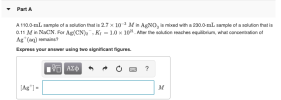 Part A A 110.0-mL sample of a solution that is 2.7 x 10- M in AgNO, is mixed with a 230.0-mL sample of a solution that is 0.11 M in NaCN. For Ag(CN)2,Kf = 1.0 x 10²¹ After the solution reaches equilibrium, what concentration of Ag+ (aq) remains? Express your answer using two significant figures. IVO ACV O O ? [Ag +) =
A 115.0 −mL sample of a solution that is 2.9×10⁻³ M in AgNO3 is mixed with...
A 115.0 −mL sample of a solution that is 2.9×10⁻³ M in AgNO3 is mixed with a 225.0 −mL sample of a solution that is 0.11 M in NaCN. After the solution reaches equilibrium, what concentration of Ag+(aq) remains?
You mix a 140.0 −mL sample of a solution that is 0.0146 M in NiCl2 with...
You mix a 140.0 −mL sample of a solution that is 0.0146 M in NiCl2 with a 175.0 −mL sample of a solution that is 0.250 M in NH3. Part A After the solution reaches equilibrium, what concentration of Ni2+(aq) remains? The value of Kf for Ni(NH3)62+ is 2.0×10^8 Express the concentration to two significant figures and include the appropriate units.
A solution is made that is 1.5×10⁻³ M in Zn(NO3)2 and 0.160 M in NH3. After...
A solution is made that is 1.5×10⁻³ M in Zn(NO3)2 and 0.160 M in NH3. After the solution reaches equilibrium, what concentration of Zn2+(aq) remains? Express your answer using two significant figures
A solution is made that is 1.4×10⁻³ M in Zn(NO3)2 and 0.150 M in NH3. After...
A solution is made that is 1.4×10⁻³ M in Zn(NO3)2 and 0.150 M in NH3. After the solution reaches equilibrium, what concentration of Zn2+(aq) remains? Express your answer using two significant figures.
Review Constants Periodic Table You mix a 120.0-ml sample of a solution that is 0.0134 M...
 Review Constants Periodic Table You mix a 120.0-ml sample of a solution that is 0.0134 M in NiCl, with a 195.0-ml sample of a solution that is 0.500 Min NH You may want to reference Pages 778 - 783) Section 17.7 while completing this problem Part A After the solution reaches equilibrium, what concentration of Ni2+ (aq) remains? The value of K for Ni(NH4)2 | 2.0 x 10*. Express the concentration to two significant figures and include the appropriate units....
18. A 200.0-mL sample of a 0.0015 M copper(II) nitrate solution is mixed with a 250.0-mL...
18. A 200.0-mL sample of a 0.0015 M copper(II) nitrate solution is mixed with a 250.0-mL sample of 0.20 M NH3. After the solution reaches equilibrium, what concentration of copper(II) ion remains? You will have to look up the appropriate complex formation constant.
14. 30.0 mL of 0.150 M KASO, is mixed with 20.0 mL of 2.00 M AgNO,...
 14. 30.0 mL of 0.150 M KASO, is mixed with 20.0 mL of 2.00 M AgNO, and a precipitate forms. What are the equilibrium (Ag+] and [AsOd") in the resulting solution?
4. You added 0.05 mL of 0.10 M AgNO, to 4.0 mL of 2.0 M NaCl,...
 4. You added 0.05 mL of 0.10 M AgNO, to 4.0 mL of 2.0 M NaCl, and formed a saturated solution of AgCl (s): AgCl (s) 7 Ag+ (aq)+CF (aq) K=Ksp Using this saturated solution as the test solution you set up the following cell AgAg (test solution after reaction)||Ag (1.0M) Ag and measured Ecell = 0.61 V. (a) Using the measured value of Ecell and Eq (15), calculate the equilibrium (Ag l (i.e. of the test solution after reaction)....
 Part A A 110.0-mL sample of a solution that is 2.7 x 10- M in AgNO, is mixed with a 230.0-mL sample of a solution that is 0.11 M in NaCN. For Ag(CN)2,Kf = 1.0 x 10²¹ After the solution reaches equilibrium, what concentration of Ag+ (aq) remains? Express your answer using two significant figures. IVO ACV O O ? [Ag +) =
 Review Constants Periodic Table You mix a 120.0-ml sample of a solution that is 0.0134 M in NiCl, with a 195.0-ml sample of a solution that is 0.500 Min NH You may want to reference Pages 778 - 783) Section 17.7 while completing this problem Part A After the solution reaches equilibrium, what concentration of Ni2+ (aq) remains? The value of K for Ni(NH4)2 | 2.0 x 10*. Express the concentration to two significant figures and include the appropriate units....
 14. 30.0 mL of 0.150 M KASO, is mixed with 20.0 mL of 2.00 M AgNO, and a precipitate forms. What are the equilibrium (Ag+] and [AsOd") in the resulting solution?
 4. You added 0.05 mL of 0.10 M AgNO, to 4.0 mL of 2.0 M NaCl, and formed a saturated solution of AgCl (s): AgCl (s) 7 Ag+ (aq)+CF (aq) K=Ksp Using this saturated solution as the test solution you set up the following cell AgAg (test solution after reaction)||Ag (1.0M) Ag and measured Ecell = 0.61 V. (a) Using the measured value of Ecell and Eq (15), calculate the equilibrium (Ag l (i.e. of the test solution after reaction)....
Most questions answered within 3 hours.
-
Where is the error in this code sequence?
String s1 = "Hello";
String s2 = "ello";...
asked 10 months ago -
Financial data for Joel de Paris, Inc., for last year
follow:
Joel de Paris, Inc.
Balance...
asked 10 months ago -
Consider this reaction:
Al2(SO4)3 (aq)+ BaCl3
(aq) Al2Cl6 (aq)- +
3BaSO4(s) . What is the...
asked 10 months ago -
Suppose that Savneet is considering increasing her
recent random sample from 20 car rentals to 40...
asked 10 months ago -
Trucks arrive at an unloading terminal at an average rate of 120
per hour.
Trucks arrive...
asked 10 months ago -
Why are methanol and ethanol completely soluble in water while
octanol is not very little soluble....
asked 10 months ago -
A facilities manager at a university reads in a research report
that the mean amount of...
asked 10 months ago -
When the CuSO4 is rehydrated by adding water to the anhydrous
compound, is this an endothermic...
asked 10 months ago -
A ray of sunlight is passing from diamond into crown glass; the
angle of incidence is...
asked 10 months ago -
A block of mass 0.249 kg is placed on top of a light, vertical
spring of...
asked 10 months ago -
how do the kidneys compensate in the presences of acidosis
a) trigger hyperventilate
b) reserve acid...
asked 10 months ago -
Question 501 pts
The rental rate of capital to the firm increases. Which of the
following...
asked 10 months ago