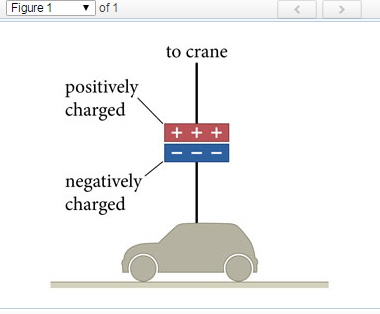
A salvage yard operator wants to make an electric force linkage for his wrecker crane as a safety device, so that when a vehicle being lifted is too massive, it will break the linkage before the force exerted by the vehicle topples the crane. His plan is to attach two metal plates to the crane cable as shown in (Figure 1) and connect the plates to the crane's power system. There is to be a positive charge on one plate and a negative charge on the other, so that the two stick together because of the attractive electric force. Discharge is prevented by spraying a layer of plastic on each plate. He needs to know what diameter to make the plates so that they come apart when the vehicle being lifted has a mass greater than 6100 kg . On the micro level, the electric force is between a surface atom carrying surplus positive charge on one plate and a surface atom carrying surplus negative charge on the other plate. The electric force for each atom pair has a magnitude of 2.3 × 10^?12 N, and each atom occupies an area of 3 × 10?21 m^2.
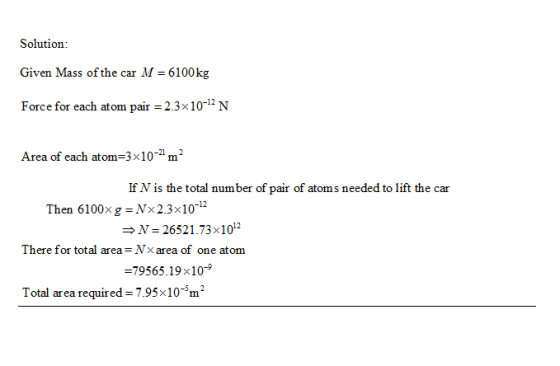
Calculate the necessary area.
Homework Answers
Add Answer to:
A salvage yard operator wants to make an electric force linkage
for his wrecker crane as...
please answer all the parts of the question. a, b, c, and d. 5. Below are...
 please answer all the parts of the question.
a, b, c, and d.
5. Below are two parallel conducting plates, each carrying an equal quantity of excess charge of opposite type. The plates are separated by 2.0 m. Between the pair of plates are two positively charged objects, the object on the left carries 1.0 C of excess charge, the object on the right carries 2.0 m HC. The electric field strength between the plates is uniform, and approximately 10...
please answer all the parts of the question.
a, b, c, and d.
5. Below are two parallel conducting plates, each carrying an equal quantity of excess charge of opposite type. The plates are separated by 2.0 m. Between the pair of plates are two positively charged objects, the object on the left carries 1.0 C of excess charge, the object on the right carries 2.0 m HC. The electric field strength between the plates is uniform, and approximately 10...
3) If the Capacitance of an object is C so if it is charged by moving...
 3) If the Capacitance of an object is C so if it is charged by moving charge q from the negative to positive terminal the voltage is Remember voltage is ElectricalPotential(Volts) = Energy(Joules) charge(Coulombs) a. Calculate the energy required if a capacitor of capacitance C is charged up to a total charge Q, remembering that the voltage changes as we are adding charge. b. Consider a parallel plate capacitor of large area A and small plate separation t. Assume the...
3.1 Pre-lab In the lab on electric potential and electric field lines, you noted that charged...
 3.1 Pre-lab In the lab on electric potential and electric field lines, you noted that charged par- ticles produce electric fields and these electric fields, in turn, act on charged par- ticles. However, you then proceeded to produce an electric field geometry using conductors held at a particular electric potential. What happened to the electric charges? Electric charge and electric potential are closely related to each other. Putting charge on a conductor raises its electric potential. It is usually much...
Points: 1 13) Is it possible to have a zero electric potential between two positive charges...
 Points: 1 13) Is it possible to have a zero electric potential between two positive charges along the line joining the two charges? A) Yes, if the two charges are equal in magnitude. B) No, a zero electric potential cannot exist between the two charges. C) Yes, regardless of the magnitude of the two charges. D) cannot be determined without knowing the separation between the two charges E) cannot be determined without knowing the magnitude of the charges Points: 3...
Question 8 (3 Points) This assignment is set up for sequential assessment. Complete each question and...
 Question 8 (3 Points) This assignment is set up for sequential assessment. Complete each question and submit the answer before moving on to the next question. Correct answers for each question will be made available once the maximum number of attempts have been made for each submission. Parallel Plate Capacitor Separation de A plater + -Q A plate area Vater As shown in the above figure, each plate of a parallel plate capacitor has an area of A = 0.032...
3. Fill the blanks and the Proof - J.J. Thomson's experiment to fine the charge-to-mass ratio of the tt) (25 po...
 3. Fill the blanks and the Proof - J.J. Thomson's experiment to fine the charge-to-mass ratio of the tt) (25 points) electron (i.e. e/m; The first is the experiment of Joseph John Thomson, who first demonstrated that atoms are actually composed of aggregates of charged particles. Prior to his work, it was believed that atoms were the fundamental building blocks of matter. The first evidence contrary to this notion came when people began studying the properties of atoms in large...
Many cells in the human body maintain an electric potential difference across their cellular membranes, typically...
 Many cells in the human body maintain an electric potential difference across their cellular membranes, typically through the use ion-specific pumps and channels that generate an excess of negative charges on the inside of the cellular membrane and an excess of positive charges on the outside. Let us estimate the total energy stored in the human body by this type of charge separation. Part a Different cells can have vastly different cell sizes; but as an approximation, let us assume...
Consider a cylindrical capacitor like that shown in Fig. 24.6. Let d = rb − ra...
 Consider a cylindrical capacitor like that shown in Fig. 24.6. Let d = rb − ra be the spacing between the inner and outer conductors. (a) Let the radii of the two conductors be only slightly different, so that d << ra. Show that the result derived in Example 24.4 (Section 24.1) for the capacitance of a cylindrical capacitor then reduces to Eq. (24.2), the equation for the capacitance of a parallel-plate capacitor, with A being the surface area of...
As shown in the figure, an electron is fired with a speed of 3.73 x 10...
 As shown in the figure, an electron is fired with a speed of 3.73 x 10 m/s through a hole in one of the two parallel plates and into the region between the plates separated by a distance of 0.24 m. There is a magnetic field in the region between the plates and, as shown, it is directed into the plane of the page (perpendicular to the velocity of the electron). Determine the magnitude of the magnetic field so that...
help :( (diagrams 2,3,4 are included here ) QUESTION 7 A box is at rest on...
 help :(
(diagrams 2,3,4 are included here )
QUESTION 7 A box is at rest on a horizontal, frictionless table. Horizontal force F1 points along the positive x-axis; when it is the only force acting on the box, the box accelerates at 6.75 m/s. Force F3 is also horizontal; it has magnitude 2.85F, and acts at an angle 22.6° to the direction of F1. If forces F1 and F3 act on the box at the same time, find the magnitude...
help :(
(diagrams 2,3,4 are included here )
QUESTION 7 A box is at rest on a horizontal, frictionless table. Horizontal force F1 points along the positive x-axis; when it is the only force acting on the box, the box accelerates at 6.75 m/s. Force F3 is also horizontal; it has magnitude 2.85F, and acts at an angle 22.6° to the direction of F1. If forces F1 and F3 act on the box at the same time, find the magnitude...
 please answer all the parts of the question.
a, b, c, and d.
5. Below are two parallel conducting plates, each carrying an equal quantity of excess charge of opposite type. The plates are separated by 2.0 m. Between the pair of plates are two positively charged objects, the object on the left carries 1.0 C of excess charge, the object on the right carries 2.0 m HC. The electric field strength between the plates is uniform, and approximately 10...
please answer all the parts of the question.
a, b, c, and d.
5. Below are two parallel conducting plates, each carrying an equal quantity of excess charge of opposite type. The plates are separated by 2.0 m. Between the pair of plates are two positively charged objects, the object on the left carries 1.0 C of excess charge, the object on the right carries 2.0 m HC. The electric field strength between the plates is uniform, and approximately 10...
 3) If the Capacitance of an object is C so if it is charged by moving charge q from the negative to positive terminal the voltage is Remember voltage is ElectricalPotential(Volts) = Energy(Joules) charge(Coulombs) a. Calculate the energy required if a capacitor of capacitance C is charged up to a total charge Q, remembering that the voltage changes as we are adding charge. b. Consider a parallel plate capacitor of large area A and small plate separation t. Assume the...
 3.1 Pre-lab In the lab on electric potential and electric field lines, you noted that charged par- ticles produce electric fields and these electric fields, in turn, act on charged par- ticles. However, you then proceeded to produce an electric field geometry using conductors held at a particular electric potential. What happened to the electric charges? Electric charge and electric potential are closely related to each other. Putting charge on a conductor raises its electric potential. It is usually much...
 Points: 1 13) Is it possible to have a zero electric potential between two positive charges along the line joining the two charges? A) Yes, if the two charges are equal in magnitude. B) No, a zero electric potential cannot exist between the two charges. C) Yes, regardless of the magnitude of the two charges. D) cannot be determined without knowing the separation between the two charges E) cannot be determined without knowing the magnitude of the charges Points: 3...
 Question 8 (3 Points) This assignment is set up for sequential assessment. Complete each question and submit the answer before moving on to the next question. Correct answers for each question will be made available once the maximum number of attempts have been made for each submission. Parallel Plate Capacitor Separation de A plater + -Q A plate area Vater As shown in the above figure, each plate of a parallel plate capacitor has an area of A = 0.032...
 3. Fill the blanks and the Proof - J.J. Thomson's experiment to fine the charge-to-mass ratio of the tt) (25 points) electron (i.e. e/m; The first is the experiment of Joseph John Thomson, who first demonstrated that atoms are actually composed of aggregates of charged particles. Prior to his work, it was believed that atoms were the fundamental building blocks of matter. The first evidence contrary to this notion came when people began studying the properties of atoms in large...
 Many cells in the human body maintain an electric potential difference across their cellular membranes, typically through the use ion-specific pumps and channels that generate an excess of negative charges on the inside of the cellular membrane and an excess of positive charges on the outside. Let us estimate the total energy stored in the human body by this type of charge separation. Part a Different cells can have vastly different cell sizes; but as an approximation, let us assume...
 Consider a cylindrical capacitor like that shown in Fig. 24.6. Let d = rb − ra be the spacing between the inner and outer conductors. (a) Let the radii of the two conductors be only slightly different, so that d << ra. Show that the result derived in Example 24.4 (Section 24.1) for the capacitance of a cylindrical capacitor then reduces to Eq. (24.2), the equation for the capacitance of a parallel-plate capacitor, with A being the surface area of...
 As shown in the figure, an electron is fired with a speed of 3.73 x 10 m/s through a hole in one of the two parallel plates and into the region between the plates separated by a distance of 0.24 m. There is a magnetic field in the region between the plates and, as shown, it is directed into the plane of the page (perpendicular to the velocity of the electron). Determine the magnitude of the magnetic field so that...
 help :(
(diagrams 2,3,4 are included here )
QUESTION 7 A box is at rest on a horizontal, frictionless table. Horizontal force F1 points along the positive x-axis; when it is the only force acting on the box, the box accelerates at 6.75 m/s. Force F3 is also horizontal; it has magnitude 2.85F, and acts at an angle 22.6° to the direction of F1. If forces F1 and F3 act on the box at the same time, find the magnitude...
help :(
(diagrams 2,3,4 are included here )
QUESTION 7 A box is at rest on a horizontal, frictionless table. Horizontal force F1 points along the positive x-axis; when it is the only force acting on the box, the box accelerates at 6.75 m/s. Force F3 is also horizontal; it has magnitude 2.85F, and acts at an angle 22.6° to the direction of F1. If forces F1 and F3 act on the box at the same time, find the magnitude...
Most questions answered within 3 hours.
-
Where is the error in this code sequence?
String s1 = "Hello";
String s2 = "ello";...
asked 10 months ago -
Financial data for Joel de Paris, Inc., for last year
follow:
Joel de Paris, Inc.
Balance...
asked 10 months ago -
Consider this reaction:
Al2(SO4)3 (aq)+ BaCl3
(aq) Al2Cl6 (aq)- +
3BaSO4(s) . What is the...
asked 10 months ago -
Suppose that Savneet is considering increasing her
recent random sample from 20 car rentals to 40...
asked 10 months ago -
Trucks arrive at an unloading terminal at an average rate of 120
per hour.
Trucks arrive...
asked 10 months ago -
Why are methanol and ethanol completely soluble in water while
octanol is not very little soluble....
asked 10 months ago -
A facilities manager at a university reads in a research report
that the mean amount of...
asked 10 months ago -
When the CuSO4 is rehydrated by adding water to the anhydrous
compound, is this an endothermic...
asked 10 months ago -
A ray of sunlight is passing from diamond into crown glass; the
angle of incidence is...
asked 10 months ago -
A block of mass 0.249 kg is placed on top of a light, vertical
spring of...
asked 10 months ago -
how do the kidneys compensate in the presences of acidosis
a) trigger hyperventilate
b) reserve acid...
asked 10 months ago -
Question 501 pts
The rental rate of capital to the firm increases. Which of the
following...
asked 10 months ago