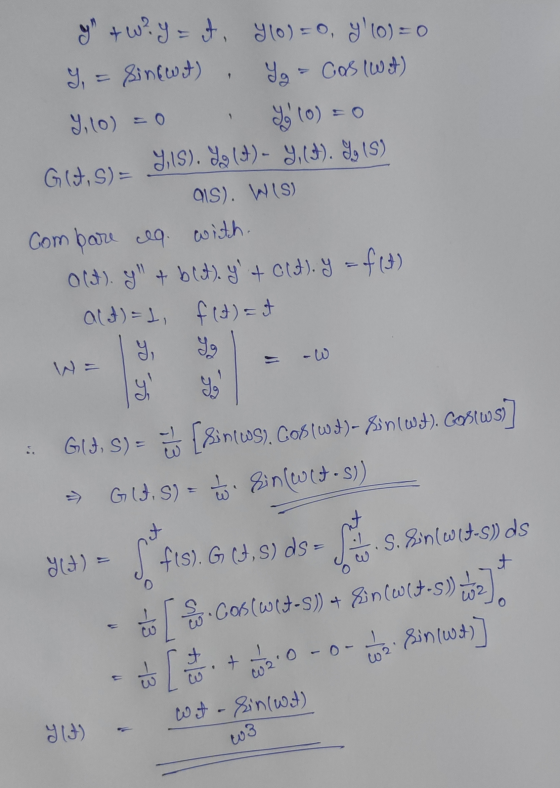
Find the solution using the Green function

Find the solution using the Green function
Homework Answers
A student attempts to make a solution fluoresce green light using an infrared light source. Will...
 A student attempts to make a solution fluoresce green light using an infrared light source. Will this work? Explain.
Green's function 2 The Green function (10 P) The Fourier transform plays a tantamount role in the theory of inhomog...
 Green's function
2 The Green function (10 P) The Fourier transform plays a tantamount role in the theory of inhomogeneous, linear differential equations. If as was shown in the lecture - G is a so called fundamental solution of the differential equation CG(z,z') = δ(z-z') one may calculate a particular solution for an inhomogeneity g by convolution G is called Green function. Since the Fourier transform maps derivatives to multiplications, it simplifies the calcu- lation of the Green function to...
Green's function
2 The Green function (10 P) The Fourier transform plays a tantamount role in the theory of inhomogeneous, linear differential equations. If as was shown in the lecture - G is a so called fundamental solution of the differential equation CG(z,z') = δ(z-z') one may calculate a particular solution for an inhomogeneity g by convolution G is called Green function. Since the Fourier transform maps derivatives to multiplications, it simplifies the calcu- lation of the Green function to...
4. (40%) using the graphical method find the solution for the following problem. Verify this solution using the KKT...
 4. (40%) using the graphical method find the solution for the following problem. Verify this solution using the KKT requirements. Plot the gradients of the objective function and the active constraints at the optimal point MinfcX,y)- (x-3)2 (Y-3) s.t 9:X+2Y-6s 92: 2X+Y-6s0
4. (40%) using the graphical method find the solution for the following problem. Verify this solution using the KKT requirements. Plot the gradients of the objective function and the active constraints at the optimal point MinfcX,y)- (x-3)2 (Y-3)...
4. (40%) using the graphical method find the solution for the following problem. Verify this solution using the KKT requirements. Plot the gradients of the objective function and the active constraints at the optimal point MinfcX,y)- (x-3)2 (Y-3) s.t 9:X+2Y-6s 92: 2X+Y-6s0
4. (40%) using the graphical method find the solution for the following problem. Verify this solution using the KKT requirements. Plot the gradients of the objective function and the active constraints at the optimal point MinfcX,y)- (x-3)2 (Y-3)...
d) Find the Laplace transform of the following function: f (t = 0 to +09) eat dt e) Find the equivalent solution of (d) using MATLAB method(s) (find 2 methods). d) Find the Laplace transform...
 d) Find the Laplace transform of the following function: f (t = 0 to +09) eat dt e) Find the equivalent solution of (d) using MATLAB method(s) (find 2 methods).
d) Find the Laplace transform of the following function: f (t = 0 to +09) eat dt e) Find the equivalent solution of (d) using MATLAB method(s) (find 2 methods).
d) Find the Laplace transform of the following function: f (t = 0 to +09) eat dt e) Find the equivalent solution of (d) using MATLAB method(s) (find 2 methods).
The Green function G(x, a') for a particle in an attractive one dimensional potential V(x) _λδ(x) satisfies the following equation (a) Solve for the Green function G(x,'). (b) Show that G div...
 The Green function G(x, a') for a particle in an attractive one dimensional potential V(x) _λδ(x) satisfies the following equation (a) Solve for the Green function G(x,'). (b) Show that G diverges (a simple pole) at a particular energy Eo and find its value.
The Green function G(x, a') for a particle in an attractive one dimensional potential V(x) _λδ(x) satisfies the following equation (a) Solve for the Green function G(x,'). (b) Show that G diverges (a simple pole) at...
The Green function G(x, a') for a particle in an attractive one dimensional potential V(x) _λδ(x) satisfies the following equation (a) Solve for the Green function G(x,'). (b) Show that G diverges (a simple pole) at a particular energy Eo and find its value.
The Green function G(x, a') for a particle in an attractive one dimensional potential V(x) _λδ(x) satisfies the following equation (a) Solve for the Green function G(x,'). (b) Show that G diverges (a simple pole) at...
Using backward induction, what is the solution to the same? RED GREEN CAT DOG CAT DOG...
 Using backward induction, what is the solution to the same? RED GREEN CAT DOG CAT DOG HIGH LOW HIGH LOW HIGH LOW HIGH LOW (5, 2, 2) (4, 2, 1) (3, 1, 2) (3, 2, 1) (4,2,3) (4,1,2) (3,3,3) (2, 1, 4) Red-dog - high O А O А Red-dog-high B Red-dog - low Ос Red-cat - high O D Red-cat-low Ο Ε Green-dog - high דר Green-dog - low G Green-cat-high ОН Green - cat-low
Last attempt please help!! ft) satisfies the integral equation: CO Find the solution of the integral equation using Fourier transforms. Your answer should be expressed as a function of t using the cor...
 Last attempt please help!!
ft) satisfies the integral equation: CO Find the solution of the integral equation using Fourier transforms. Your answer should be expressed as a function of t using the correct syntax. f(t)- Skipped
ft) satisfies the integral equation: CO Find the solution of the integral equation using Fourier transforms. Your answer should be expressed as a function of t using the correct syntax. f(t)- Skipped
Last attempt please help!!
ft) satisfies the integral equation: CO Find the solution of the integral equation using Fourier transforms. Your answer should be expressed as a function of t using the correct syntax. f(t)- Skipped
ft) satisfies the integral equation: CO Find the solution of the integral equation using Fourier transforms. Your answer should be expressed as a function of t using the correct syntax. f(t)- Skipped
yellow red green orange purple blue Select the color of the solution using the indicator thymol...
 yellow red green orange purple blue Select the color of the solution using the indicator thymol blue. When you first add indicator to your Na2CO3 solution, the color is blue When you reached the first equivalence point when moles of acid equals moles of base, the color is orange x. When you weren't paying attention and added too much HCl, the color is purple lx. When you really weren't paying attention and reached the second equivalence point, which is NOT...
f(t) satisfies the integral equation: 4 Co Find the solution of the integral equation using Fourier transforms. Your answer should be expressed as a function of t using the correct syntax. f(t)- Skip...
 f(t) satisfies the integral equation: 4 Co Find the solution of the integral equation using Fourier transforms. Your answer should be expressed as a function of t using the correct syntax. f(t)- Skipped
f(t) satisfies the integral equation: 4 Co Find the solution of the integral equation using Fourier transforms. Your answer should be expressed as a function of t using the correct syntax. f(t)- Skipped
f(t) satisfies the integral equation: 4 Co Find the solution of the integral equation using Fourier transforms. Your answer should be expressed as a function of t using the correct syntax. f(t)- Skipped
Solve the non homegenous IBVP Useing the Fourier transformation and Green function
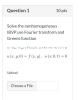 Solve the nonhomogeneous IBVP Using the Fourier transformation and Green function
 A student attempts to make a solution fluoresce green light using an infrared light source. Will this work? Explain.
 Green's function
2 The Green function (10 P) The Fourier transform plays a tantamount role in the theory of inhomogeneous, linear differential equations. If as was shown in the lecture - G is a so called fundamental solution of the differential equation CG(z,z') = δ(z-z') one may calculate a particular solution for an inhomogeneity g by convolution G is called Green function. Since the Fourier transform maps derivatives to multiplications, it simplifies the calcu- lation of the Green function to...
Green's function
2 The Green function (10 P) The Fourier transform plays a tantamount role in the theory of inhomogeneous, linear differential equations. If as was shown in the lecture - G is a so called fundamental solution of the differential equation CG(z,z') = δ(z-z') one may calculate a particular solution for an inhomogeneity g by convolution G is called Green function. Since the Fourier transform maps derivatives to multiplications, it simplifies the calcu- lation of the Green function to...
 4. (40%) using the graphical method find the solution for the following problem. Verify this solution using the KKT requirements. Plot the gradients of the objective function and the active constraints at the optimal point MinfcX,y)- (x-3)2 (Y-3) s.t 9:X+2Y-6s 92: 2X+Y-6s0
4. (40%) using the graphical method find the solution for the following problem. Verify this solution using the KKT requirements. Plot the gradients of the objective function and the active constraints at the optimal point MinfcX,y)- (x-3)2 (Y-3)...
4. (40%) using the graphical method find the solution for the following problem. Verify this solution using the KKT requirements. Plot the gradients of the objective function and the active constraints at the optimal point MinfcX,y)- (x-3)2 (Y-3) s.t 9:X+2Y-6s 92: 2X+Y-6s0
4. (40%) using the graphical method find the solution for the following problem. Verify this solution using the KKT requirements. Plot the gradients of the objective function and the active constraints at the optimal point MinfcX,y)- (x-3)2 (Y-3)...
 d) Find the Laplace transform of the following function: f (t = 0 to +09) eat dt e) Find the equivalent solution of (d) using MATLAB method(s) (find 2 methods).
d) Find the Laplace transform of the following function: f (t = 0 to +09) eat dt e) Find the equivalent solution of (d) using MATLAB method(s) (find 2 methods).
d) Find the Laplace transform of the following function: f (t = 0 to +09) eat dt e) Find the equivalent solution of (d) using MATLAB method(s) (find 2 methods).
 The Green function G(x, a') for a particle in an attractive one dimensional potential V(x) _λδ(x) satisfies the following equation (a) Solve for the Green function G(x,'). (b) Show that G diverges (a simple pole) at a particular energy Eo and find its value.
The Green function G(x, a') for a particle in an attractive one dimensional potential V(x) _λδ(x) satisfies the following equation (a) Solve for the Green function G(x,'). (b) Show that G diverges (a simple pole) at...
The Green function G(x, a') for a particle in an attractive one dimensional potential V(x) _λδ(x) satisfies the following equation (a) Solve for the Green function G(x,'). (b) Show that G diverges (a simple pole) at a particular energy Eo and find its value.
The Green function G(x, a') for a particle in an attractive one dimensional potential V(x) _λδ(x) satisfies the following equation (a) Solve for the Green function G(x,'). (b) Show that G diverges (a simple pole) at...
 Using backward induction, what is the solution to the same? RED GREEN CAT DOG CAT DOG HIGH LOW HIGH LOW HIGH LOW HIGH LOW (5, 2, 2) (4, 2, 1) (3, 1, 2) (3, 2, 1) (4,2,3) (4,1,2) (3,3,3) (2, 1, 4) Red-dog - high O А O А Red-dog-high B Red-dog - low Ос Red-cat - high O D Red-cat-low Ο Ε Green-dog - high דר Green-dog - low G Green-cat-high ОН Green - cat-low
 Last attempt please help!!
ft) satisfies the integral equation: CO Find the solution of the integral equation using Fourier transforms. Your answer should be expressed as a function of t using the correct syntax. f(t)- Skipped
ft) satisfies the integral equation: CO Find the solution of the integral equation using Fourier transforms. Your answer should be expressed as a function of t using the correct syntax. f(t)- Skipped
Last attempt please help!!
ft) satisfies the integral equation: CO Find the solution of the integral equation using Fourier transforms. Your answer should be expressed as a function of t using the correct syntax. f(t)- Skipped
ft) satisfies the integral equation: CO Find the solution of the integral equation using Fourier transforms. Your answer should be expressed as a function of t using the correct syntax. f(t)- Skipped
 yellow red green orange purple blue Select the color of the solution using the indicator thymol blue. When you first add indicator to your Na2CO3 solution, the color is blue When you reached the first equivalence point when moles of acid equals moles of base, the color is orange x. When you weren't paying attention and added too much HCl, the color is purple lx. When you really weren't paying attention and reached the second equivalence point, which is NOT...
 f(t) satisfies the integral equation: 4 Co Find the solution of the integral equation using Fourier transforms. Your answer should be expressed as a function of t using the correct syntax. f(t)- Skipped
f(t) satisfies the integral equation: 4 Co Find the solution of the integral equation using Fourier transforms. Your answer should be expressed as a function of t using the correct syntax. f(t)- Skipped
f(t) satisfies the integral equation: 4 Co Find the solution of the integral equation using Fourier transforms. Your answer should be expressed as a function of t using the correct syntax. f(t)- Skipped
Most questions answered within 3 hours.
-
Where is the error in this code sequence?
String s1 = "Hello";
String s2 = "ello";...
asked 10 months ago -
Financial data for Joel de Paris, Inc., for last year
follow:
Joel de Paris, Inc.
Balance...
asked 10 months ago -
Consider this reaction:
Al2(SO4)3 (aq)+ BaCl3
(aq) Al2Cl6 (aq)- +
3BaSO4(s) . What is the...
asked 10 months ago -
Suppose that Savneet is considering increasing her
recent random sample from 20 car rentals to 40...
asked 10 months ago -
Trucks arrive at an unloading terminal at an average rate of 120
per hour.
Trucks arrive...
asked 10 months ago -
Why are methanol and ethanol completely soluble in water while
octanol is not very little soluble....
asked 10 months ago -
A facilities manager at a university reads in a research report
that the mean amount of...
asked 10 months ago -
When the CuSO4 is rehydrated by adding water to the anhydrous
compound, is this an endothermic...
asked 10 months ago -
A ray of sunlight is passing from diamond into crown glass; the
angle of incidence is...
asked 10 months ago -
A block of mass 0.249 kg is placed on top of a light, vertical
spring of...
asked 10 months ago -
how do the kidneys compensate in the presences of acidosis
a) trigger hyperventilate
b) reserve acid...
asked 10 months ago -
Question 501 pts
The rental rate of capital to the firm increases. Which of the
following...
asked 10 months ago