Solve the non homegenous IBVP Useing the Fourier transformation and Green function
Solve the nonhomogeneous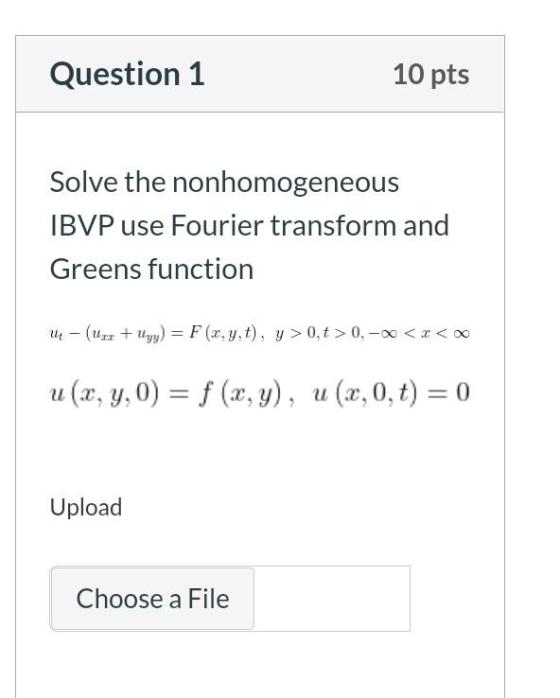 IBVP Using the Fourier transformation and Green function
Homework Answers
Request Answer!
We need at least 9 more requests to produce the answer.
1 / 10 have requested this problem solution
The more requests, the faster the answer.
Add Answer to:
Solve the non homegenous IBVP Useing the Fourier transformation and Green function
Green's function 2 The Green function (10 P) The Fourier transform plays a tantamount role in the theory of inhomog...
 Green's function
2 The Green function (10 P) The Fourier transform plays a tantamount role in the theory of inhomogeneous, linear differential equations. If as was shown in the lecture - G is a so called fundamental solution of the differential equation CG(z,z') = δ(z-z') one may calculate a particular solution for an inhomogeneity g by convolution G is called Green function. Since the Fourier transform maps derivatives to multiplications, it simplifies the calcu- lation of the Green function to...
Green's function
2 The Green function (10 P) The Fourier transform plays a tantamount role in the theory of inhomogeneous, linear differential equations. If as was shown in the lecture - G is a so called fundamental solution of the differential equation CG(z,z') = δ(z-z') one may calculate a particular solution for an inhomogeneity g by convolution G is called Green function. Since the Fourier transform maps derivatives to multiplications, it simplifies the calcu- lation of the Green function to...
Apply method of images and Fourier transformation to solve the following boundary value problem f...
 Apply method of images and Fourier transformation to solve the following boundary value problem for the heat equation in the quarter plane, ut = 8uzz, cos 2 u(r,0 Uz (0, t) = 0, (10) lim u(x, t)=0
Apply method of images and Fourier transformation to solve the following boundary value problem for the heat equation in the quarter plane, ut = 8uzz, cos 2 u(r,0 Uz (0, t) = 0, (10) lim u(x, t)=0
Apply method of images and Fourier transformation to solve the following boundary value problem for the heat equation in the quarter plane, ut = 8uzz, cos 2 u(r,0 Uz (0, t) = 0, (10) lim u(x, t)=0
(a) Find the Fourier transform of the following function (b) Using Fourier transforms, solve the wave...
(a) Find the Fourier transform of the following function (b) Using Fourier transforms, solve the wave equation , -∞<x<∞ t>0 and bounded as ∞ f(r)e We were unable to transcribe this imageu(r, 0)e 4(r.0) =0 , t ur. We were unable to transcribe this image f(r)e u(r, 0)e 4(r.0) =0 , t ur.
In this problem we explore using Fourier series to solve nonhomogeneous boundary value problems. ...
In this problem we explore using Fourier series to solve nonhomogeneous boundary value problems. For un type un, for derivatives use the prime notation u′n,u′′n,…. Solve the heat equation ∂2u∂x2+2e−4t=∂u∂t,00 u(0,t)=0,u(5,t)=0,t>0 u(x,0)=3,0
Fourier transformation
Find the fourier sine and cosine transformation for f(x)=e^-x hence show that they are equal to 0.5πe^-m
Solve by Green function: y'' + y = tsin t
Solve by Green function: y'' + y = tsin t
Solve using the Fourier Transform Method. 2.24) Solve Laplace's equation in a strip using Fourier transforms:...
 Solve using the Fourier Transform Method.
2.24) Solve Laplace's equation in a strip using Fourier transforms: u,)+ e-lal, u(x, L) = 0, u(x, y)0 as0o.
Solve using the Fourier Transform Method.
2.24) Solve Laplace's equation in a strip using Fourier transforms: u,)+ e-lal, u(x, L) = 0, u(x, y)0 as0o.
1. Use the Fourier Transform to solve the following problem with W1 21 (a) Find the Fourier Trans...
 1. Use the Fourier Transform to solve the following problem with W1 21 (a) Find the Fourier Transform of u by applying F to the equation and initial condition; denote this function U(w, t). (b) Find u u(z, t) by taking the inverse transform of the U(w, t) you found in part (a).
1. Use the Fourier Transform to solve the following problem with W1 21 (a) Find the Fourier Transform of u by applying F to the equation and...
1. Use the Fourier Transform to solve the following problem with W1 21 (a) Find the Fourier Transform of u by applying F to the equation and initial condition; denote this function U(w, t). (b) Find u u(z, t) by taking the inverse transform of the U(w, t) you found in part (a).
1. Use the Fourier Transform to solve the following problem with W1 21 (a) Find the Fourier Transform of u by applying F to the equation and...
please solve problem step by step Find a half-range Fourier Cosine Series to represent the function...
 please solve problem step by step
Find a half-range Fourier Cosine Series to represent the function f(t) = 4-t.
please solve problem step by step
Find a half-range Fourier Cosine Series to represent the function f(t) = 4-t.
Solve for Vx using source transformation. 2 (15 points) Solve for using source transformation. 2Ω 8Ω...
 Solve for Vx using source transformation.
2 (15 points) Solve for using source transformation. 2Ω 8Ω 12 V 6Ω Circuit 1
Solve for Vx using source transformation.
2 (15 points) Solve for using source transformation. 2Ω 8Ω 12 V 6Ω Circuit 1
 Green's function
2 The Green function (10 P) The Fourier transform plays a tantamount role in the theory of inhomogeneous, linear differential equations. If as was shown in the lecture - G is a so called fundamental solution of the differential equation CG(z,z') = δ(z-z') one may calculate a particular solution for an inhomogeneity g by convolution G is called Green function. Since the Fourier transform maps derivatives to multiplications, it simplifies the calcu- lation of the Green function to...
Green's function
2 The Green function (10 P) The Fourier transform plays a tantamount role in the theory of inhomogeneous, linear differential equations. If as was shown in the lecture - G is a so called fundamental solution of the differential equation CG(z,z') = δ(z-z') one may calculate a particular solution for an inhomogeneity g by convolution G is called Green function. Since the Fourier transform maps derivatives to multiplications, it simplifies the calcu- lation of the Green function to...
 Apply method of images and Fourier transformation to solve the following boundary value problem for the heat equation in the quarter plane, ut = 8uzz, cos 2 u(r,0 Uz (0, t) = 0, (10) lim u(x, t)=0
Apply method of images and Fourier transformation to solve the following boundary value problem for the heat equation in the quarter plane, ut = 8uzz, cos 2 u(r,0 Uz (0, t) = 0, (10) lim u(x, t)=0
Apply method of images and Fourier transformation to solve the following boundary value problem for the heat equation in the quarter plane, ut = 8uzz, cos 2 u(r,0 Uz (0, t) = 0, (10) lim u(x, t)=0
 Solve using the Fourier Transform Method.
2.24) Solve Laplace's equation in a strip using Fourier transforms: u,)+ e-lal, u(x, L) = 0, u(x, y)0 as0o.
Solve using the Fourier Transform Method.
2.24) Solve Laplace's equation in a strip using Fourier transforms: u,)+ e-lal, u(x, L) = 0, u(x, y)0 as0o.
 1. Use the Fourier Transform to solve the following problem with W1 21 (a) Find the Fourier Transform of u by applying F to the equation and initial condition; denote this function U(w, t). (b) Find u u(z, t) by taking the inverse transform of the U(w, t) you found in part (a).
1. Use the Fourier Transform to solve the following problem with W1 21 (a) Find the Fourier Transform of u by applying F to the equation and...
1. Use the Fourier Transform to solve the following problem with W1 21 (a) Find the Fourier Transform of u by applying F to the equation and initial condition; denote this function U(w, t). (b) Find u u(z, t) by taking the inverse transform of the U(w, t) you found in part (a).
1. Use the Fourier Transform to solve the following problem with W1 21 (a) Find the Fourier Transform of u by applying F to the equation and...
 please solve problem step by step
Find a half-range Fourier Cosine Series to represent the function f(t) = 4-t.
please solve problem step by step
Find a half-range Fourier Cosine Series to represent the function f(t) = 4-t.
 Solve for Vx using source transformation.
2 (15 points) Solve for using source transformation. 2Ω 8Ω 12 V 6Ω Circuit 1
Solve for Vx using source transformation.
2 (15 points) Solve for using source transformation. 2Ω 8Ω 12 V 6Ω Circuit 1
Most questions answered within 3 hours.
-
Where is the error in this code sequence?
String s1 = "Hello";
String s2 = "ello";...
asked 11 months ago -
Financial data for Joel de Paris, Inc., for last year
follow:
Joel de Paris, Inc.
Balance...
asked 11 months ago -
Consider this reaction:
Al2(SO4)3 (aq)+ BaCl3
(aq) Al2Cl6 (aq)- +
3BaSO4(s) . What is the...
asked 11 months ago -
Suppose that Savneet is considering increasing her
recent random sample from 20 car rentals to 40...
asked 11 months ago -
Trucks arrive at an unloading terminal at an average rate of 120
per hour.
Trucks arrive...
asked 11 months ago -
Why are methanol and ethanol completely soluble in water while
octanol is not very little soluble....
asked 11 months ago -
A facilities manager at a university reads in a research report
that the mean amount of...
asked 11 months ago -
When the CuSO4 is rehydrated by adding water to the anhydrous
compound, is this an endothermic...
asked 11 months ago -
A ray of sunlight is passing from diamond into crown glass; the
angle of incidence is...
asked 11 months ago -
A block of mass 0.249 kg is placed on top of a light, vertical
spring of...
asked 11 months ago -
how do the kidneys compensate in the presences of acidosis
a) trigger hyperventilate
b) reserve acid...
asked 11 months ago -
Question 501 pts
The rental rate of capital to the firm increases. Which of the
following...
asked 11 months ago