
Homework Answers
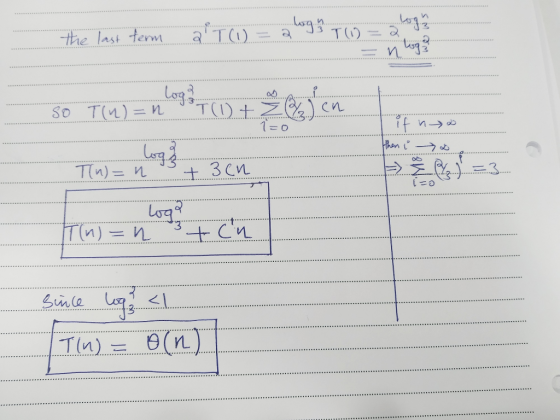
Let’s start with the recurrence relation, T(n) = 2 * T(n/3)+cn, and try to get it in a closed form.where T’ stands for time, and therefore T(n) is a function of time that takes in input of size ‘n’.
T(n) = 2T(n/3)+cn
we will find the Recursion depth that is How long (how many iterations) it takes until the sub problem has constant size.
The detailed solution is explained in the image given below:
![(n)=21(3) ten... ||(143) =q1(733) T1123 . =QT(n/a) + ch / = [at(13/3) +.] tc. =41(14) +33 (n cu 42T (ap) + cha to catch = BI(](http://img.homeworklib.com/questions/759b64a0-510b-11eb-9763-1d881797ef4d.png?x-oss-process=image/resize,w_560)
Add Answer to:
Use the iteration technique to find a Big-Oh bound for the recurrence relation belov Note you...
Dont use master theorm and find tight Big-O bound for the following recurrence:
 Dont use master theorm and find tight Big-O bound for the
following recurrence:
If n = 0 2* S(17n/10]) ifn >0 S(n) =
If n = 0 2* S(17n/10]) ifn >0 S(n) =
Dont use master theorm and find tight Big-O bound for the
following recurrence:
If n = 0 2* S(17n/10]) ifn >0 S(n) =
If n = 0 2* S(17n/10]) ifn >0 S(n) =
Find the best big O bound you can on T(n) if it satisfies the recurrence T(n)...
Find the best big O bound you can on T(n) if it satisfies the recurrence T(n) ≤ T(n/4) + T(n/2) + n, with T(n) = 1 if n < 4.
Solve exactly using the iteration method the following recurrence T(n) = 2T(n/2) + 6n, with T(8)...
 Solve exactly using the iteration method the following
recurrence T(n) = 2T(n/2) + 6n, with T(8) = 12. You may assume that
n is a power of two.
Please explain your answer.
(a) (20 points) Solve exactly using the iteration method the following recurrence T(n) - 2T(n/2) + 6n, with T(8)-12. You may assume that n is a power of two.
Solve exactly using the iteration method the following
recurrence T(n) = 2T(n/2) + 6n, with T(8) = 12. You may assume that
n is a power of two.
Please explain your answer.
(a) (20 points) Solve exactly using the iteration method the following recurrence T(n) - 2T(n/2) + 6n, with T(8)-12. You may assume that n is a power of two.
Solve the following recurrence relation without using the master method! report the big O 1. T(n)...
Solve the following recurrence relation without using the master method! report the big O 1. T(n) = 2T(n/2) =n^2 2. T(n) = 5T(n/4) + sqrt(n)
Problem 1 [15pts. Recall how we solved recurrence relation to find the Big-O (first you need...
 Problem 1 [15pts. Recall how we solved recurrence relation to find the Big-O (first you need to find closed-form formula). Use same method (expand-guess-verify) to figure out Big-O of this relation. (You can skip last step "verify", which is usually done by math induction). T (1) 1 T(n) T(n-1)+5
Solve the recurrence relation T(n)=T(n1/2)+1 and give a Θ bound. Assume that T (n) is constant for sufficiently small n....
Solve the recurrence relation T(n)=T(n1/2)+1 and give a Θ bound. Assume that T (n) is constant for sufficiently small n. Can you show a verification of the recurrence relation? I've not been able to solve the verification part so far note: n1/2 is square root(n)
Given the sequence defined with the recurrence relation:
 Given the sequence defined with the recurrence relation:$$ \begin{array}{l} a_{0}=2 \\ a_{k}=4 a_{k-1}+5 \text { for } n \geq 0 \end{array} $$A. (3 marks) Terms of Sequence Calculate \(a_{1}, a_{2}, a_{3}\) Keep your intermediate answers as you will need them in the next questionsB. ( 7 marks) Iteration Using iteration, solve the recurrence relation when \(n \geq 0\) (i.e. find an analytic formula for \(a_{n}\) ). Simplify your answer as much as possible, showing your work. In particular, your final...
please use power series x2 equationx2 -3)y" n+2xy' 0 then the recurrence relation is given by...
 please use power series
x2 equationx2 -3)y" n+2xy' 0 then the recurrence relation is given by Cn+23(+2) s a power series solution to the differential thisecu0You do not need to calculate this),Given recurrence relation find the general the general solution to this differential you include the "nth" term in your solution.
please use power series
x2 equationx2 -3)y" n+2xy' 0 then the recurrence relation is given by Cn+23(+2) s a power series solution to the differential thisecu0You do not need to calculate this),Given recurrence relation find the general the general solution to this differential you include the "nth" term in your solution.
1Recurrences. a)Solve the following recurrence. You may assume any convenient form for n. T(1) = 0....
1Recurrences. a)Solve the following recurrence. You may assume any convenient form for n. T(1) = 0. T(n) = T(n/2)+1, n>1 b)Consider the following recurrence relation: T(1) = 4 T(n) = T(n-1) +4 Argue using mathematical induction that T(n) = 4n Note that you must induction to establish the solution.
Compute the recurrence relation, T(n), for the following function, solve it, and give a e bound....
 Compute the recurrence relation, T(n), for the following function, solve it, and give a e bound. Justify your answer public static double myPower(double r, int n) if (n1){ return 1 } else if (n % 2 == 0) { double tmp myPower (r, n/2); return tmp tmp; } else{ myPower (r, (n 1)/2); return }
 Dont use master theorm and find tight Big-O bound for the
following recurrence:
If n = 0 2* S(17n/10]) ifn >0 S(n) =
If n = 0 2* S(17n/10]) ifn >0 S(n) =
Dont use master theorm and find tight Big-O bound for the
following recurrence:
If n = 0 2* S(17n/10]) ifn >0 S(n) =
If n = 0 2* S(17n/10]) ifn >0 S(n) =
 Solve exactly using the iteration method the following
recurrence T(n) = 2T(n/2) + 6n, with T(8) = 12. You may assume that
n is a power of two.
Please explain your answer.
(a) (20 points) Solve exactly using the iteration method the following recurrence T(n) - 2T(n/2) + 6n, with T(8)-12. You may assume that n is a power of two.
Solve exactly using the iteration method the following
recurrence T(n) = 2T(n/2) + 6n, with T(8) = 12. You may assume that
n is a power of two.
Please explain your answer.
(a) (20 points) Solve exactly using the iteration method the following recurrence T(n) - 2T(n/2) + 6n, with T(8)-12. You may assume that n is a power of two.
 Problem 1 [15pts. Recall how we solved recurrence relation to find the Big-O (first you need to find closed-form formula). Use same method (expand-guess-verify) to figure out Big-O of this relation. (You can skip last step "verify", which is usually done by math induction). T (1) 1 T(n) T(n-1)+5
 please use power series
x2 equationx2 -3)y" n+2xy' 0 then the recurrence relation is given by Cn+23(+2) s a power series solution to the differential thisecu0You do not need to calculate this),Given recurrence relation find the general the general solution to this differential you include the "nth" term in your solution.
please use power series
x2 equationx2 -3)y" n+2xy' 0 then the recurrence relation is given by Cn+23(+2) s a power series solution to the differential thisecu0You do not need to calculate this),Given recurrence relation find the general the general solution to this differential you include the "nth" term in your solution.
 Compute the recurrence relation, T(n), for the following function, solve it, and give a e bound. Justify your answer public static double myPower(double r, int n) if (n1){ return 1 } else if (n % 2 == 0) { double tmp myPower (r, n/2); return tmp tmp; } else{ myPower (r, (n 1)/2); return }
Most questions answered within 3 hours.
-
Where is the error in this code sequence?
String s1 = "Hello";
String s2 = "ello";...
asked 10 months ago -
Financial data for Joel de Paris, Inc., for last year
follow:
Joel de Paris, Inc.
Balance...
asked 10 months ago -
Consider this reaction:
Al2(SO4)3 (aq)+ BaCl3
(aq) Al2Cl6 (aq)- +
3BaSO4(s) . What is the...
asked 10 months ago -
Suppose that Savneet is considering increasing her
recent random sample from 20 car rentals to 40...
asked 10 months ago -
Trucks arrive at an unloading terminal at an average rate of 120
per hour.
Trucks arrive...
asked 10 months ago -
Why are methanol and ethanol completely soluble in water while
octanol is not very little soluble....
asked 10 months ago -
A facilities manager at a university reads in a research report
that the mean amount of...
asked 10 months ago -
When the CuSO4 is rehydrated by adding water to the anhydrous
compound, is this an endothermic...
asked 10 months ago -
A ray of sunlight is passing from diamond into crown glass; the
angle of incidence is...
asked 10 months ago -
A block of mass 0.249 kg is placed on top of a light, vertical
spring of...
asked 10 months ago -
how do the kidneys compensate in the presences of acidosis
a) trigger hyperventilate
b) reserve acid...
asked 10 months ago -
Question 501 pts
The rental rate of capital to the firm increases. Which of the
following...
asked 10 months ago