Which of the following terms provides more specific information? Class Domain Genus Phylum
Which of the following terms provides more specific information?
|
Class |
||
|
Domain |
||
|
Genus |
||
|
Phylum |
Homework Answers
From the given data, the order of scientific classification is as follows:
- Kingdom
- Phylum or Division
- Class
- Order
- Family
- Genus
- Species
Among these the species is the lowest division, whereas the kingdom is the highest and broad division of scientific classification. The Genus is the term, which provides more specific information about an organism from the given options.
Thus, the correct option is (C) genus.
Add Answer to:
Which of the following terms
provides more specific information?
Class
Domain
Genus
Phylum
Specimen #9: Volvox globator Magnification: Type of Scope Used: Microscope Domain Kingdom Phylum Class Genus NA...
 Specimen #9: Volvox globator Magnification: Type of Scope Used: Microscope Domain Kingdom Phylum Class Genus NA Species Common Name Phylogenetic Lineage Size of Specimen 250mm
Cnidarians what is the kingdom, phylum ,class ,genus/species ? (2-3 sentence) evolutionary adaptation provides an advantage...
Cnidarians what is the kingdom, phylum ,class ,genus/species ? (2-3 sentence) evolutionary adaptation provides an advantage to taxon.explain particular traits. (3-4 sentence )
Which of the following correctly ranks taxonomic groups from largest to smallest? Class, Family, Species, Genus...
 Which of the following correctly ranks taxonomic groups from largest to smallest? Class, Family, Species, Genus Phylum, Family, Order, Species Kingdom, Genus, Family, Species Domain, Phylum, Family, Genus Question 31 (2 points) The partial negative charge in a water molecule occurs because hydrogen donates an electron to oxygen non-polar covalent bonding of O and H electrons spend more time around than H oxygen atoms form hybrid orbitals
A. Domain B. Kingdom C. Phylum D. Genus or Common name E. Are you looking at...
 A. Domain B. Kingdom C. Phylum D. Genus or Common name E. Are you looking at the gametophyte or sporophyte?
Describe the characteristics of each of the following taxonomic categories: Domain Eukarya Kingdom Plantae Phylum Cycadophyta...
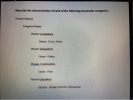 Describe the characteristics of each of the following taxonomic categories: Domain Eukarya Kingdom Plantae Phylum Cycadophyta Genera: Cycas, Zamia Phylum Ginkgophyta Genus: Ginkgo Phylum Coniferophyta Genus: Pinus Phylum Gneotphyat Gernera: Gnetum. Ephedra, Welwitschia
D) phylum, kingdom, order, class, species, family, and genus. E) phylum, family, class, order, kingdom, genus,...
 D) phylum, kingdom, order, class, species, family, and genus. E) phylum, family, class, order, kingdom, genus, and species. 9) Ecology is best defined as the study of A. populations. B. the rate of population changes. C. communities. D. how populations are restricted by environmental resistance. organisms as they interact with other organisms and with their physical surroundings. 10) An ecosystem contains A. only the biotic (living) components of the environment. B. only the abiotic (nonliving) components of the environment. C....
The following questions are from Chapters 11 - 14 of the textbook and the class notes...
 The following questions are from Chapters 11 - 14 of the textbook and the class notes 75. Which of the following is a correct sequence? a) Domain, Kingdom, Class, Order, Phylum, Family, Genus, Species b) Domain, Kingdom, Phylum, Class, Order, Family, Genus, Species c) Domain, Phylum, Kingdom, Class, Order, Family, Genus, Species d) Kingdom, Domain, Class, Order, Phylum, Family, Genus, Species 76. Prokaryotes with rRNA most similar to eukaryotes are members of which of the following Domains a. Cyanobacteria b....
QUESTION 1 Taxonomic classification: Phylum, Class, Order, Family, Genus, Species. Write to the lowest taxonomic level...
QUESTION 1 Taxonomic classification: Phylum, Class, Order, Family, Genus, Species. Write to the lowest taxonomic level possible for the Organisms below. See example. Organisms: 1. Freshwater mussels 2. Mung beans 3. Snails 4. Crayfish 5. Common house mouse Example: Bold jumping spider Phylum: Arthropoda Class: Arachnida Order: Araneae Family: Salticidae Genus: Phidippus Species: audax
QUESTION 2 Select all the TRUE statements. The most general classification or ranking is Domain and...
 QUESTION 2 Select all the TRUE statements. The most general classification or ranking is Domain and the least is Species. In terms of classification phylum is more specific than species. Scientific names are made up of the name of the genus and the name of the species of which the Genus but not the species must be capitalized. Nomenclature refers to the orderly arrangement of organisms, while classification refers to the assigning of scientific names Natural selection is nature randomly...
Name the only phylum of primitive animal species which possess no notable body symmetry, have no...
Name the only phylum of primitive animal species which possess no notable body symmetry, have no true “tissue” and rely on a simplified water canal body plan Porifera c. Annelida Cnidaria d. Mollusca Which of the following is NOT a genus of the “great apes”, those that increased have cognition and live a less arboreal (tree dwelling) lifestyle than other primate species? Genus Pan c. Genus Homo Genus Gibbon d. Genus Pongo What major class of vertebrates have a...
 Specimen #9: Volvox globator Magnification: Type of Scope Used: Microscope Domain Kingdom Phylum Class Genus NA Species Common Name Phylogenetic Lineage Size of Specimen 250mm
 Which of the following correctly ranks taxonomic groups from largest to smallest? Class, Family, Species, Genus Phylum, Family, Order, Species Kingdom, Genus, Family, Species Domain, Phylum, Family, Genus Question 31 (2 points) The partial negative charge in a water molecule occurs because hydrogen donates an electron to oxygen non-polar covalent bonding of O and H electrons spend more time around than H oxygen atoms form hybrid orbitals
 A. Domain B. Kingdom C. Phylum D. Genus or Common name E. Are you looking at the gametophyte or sporophyte?
 Describe the characteristics of each of the following taxonomic categories: Domain Eukarya Kingdom Plantae Phylum Cycadophyta Genera: Cycas, Zamia Phylum Ginkgophyta Genus: Ginkgo Phylum Coniferophyta Genus: Pinus Phylum Gneotphyat Gernera: Gnetum. Ephedra, Welwitschia
 D) phylum, kingdom, order, class, species, family, and genus. E) phylum, family, class, order, kingdom, genus, and species. 9) Ecology is best defined as the study of A. populations. B. the rate of population changes. C. communities. D. how populations are restricted by environmental resistance. organisms as they interact with other organisms and with their physical surroundings. 10) An ecosystem contains A. only the biotic (living) components of the environment. B. only the abiotic (nonliving) components of the environment. C....
 The following questions are from Chapters 11 - 14 of the textbook and the class notes 75. Which of the following is a correct sequence? a) Domain, Kingdom, Class, Order, Phylum, Family, Genus, Species b) Domain, Kingdom, Phylum, Class, Order, Family, Genus, Species c) Domain, Phylum, Kingdom, Class, Order, Family, Genus, Species d) Kingdom, Domain, Class, Order, Phylum, Family, Genus, Species 76. Prokaryotes with rRNA most similar to eukaryotes are members of which of the following Domains a. Cyanobacteria b....
 QUESTION 2 Select all the TRUE statements. The most general classification or ranking is Domain and the least is Species. In terms of classification phylum is more specific than species. Scientific names are made up of the name of the genus and the name of the species of which the Genus but not the species must be capitalized. Nomenclature refers to the orderly arrangement of organisms, while classification refers to the assigning of scientific names Natural selection is nature randomly...
Most questions answered within 3 hours.
-
Where is the error in this code sequence?
String s1 = "Hello";
String s2 = "ello";...
asked 11 months ago -
Financial data for Joel de Paris, Inc., for last year
follow:
Joel de Paris, Inc.
Balance...
asked 11 months ago -
Consider this reaction:
Al2(SO4)3 (aq)+ BaCl3
(aq) Al2Cl6 (aq)- +
3BaSO4(s) . What is the...
asked 11 months ago -
Suppose that Savneet is considering increasing her
recent random sample from 20 car rentals to 40...
asked 11 months ago -
Trucks arrive at an unloading terminal at an average rate of 120
per hour.
Trucks arrive...
asked 11 months ago -
Why are methanol and ethanol completely soluble in water while
octanol is not very little soluble....
asked 11 months ago -
A facilities manager at a university reads in a research report
that the mean amount of...
asked 11 months ago -
When the CuSO4 is rehydrated by adding water to the anhydrous
compound, is this an endothermic...
asked 11 months ago -
A ray of sunlight is passing from diamond into crown glass; the
angle of incidence is...
asked 11 months ago -
A block of mass 0.249 kg is placed on top of a light, vertical
spring of...
asked 11 months ago -
how do the kidneys compensate in the presences of acidosis
a) trigger hyperventilate
b) reserve acid...
asked 11 months ago -
Question 501 pts
The rental rate of capital to the firm increases. Which of the
following...
asked 11 months ago