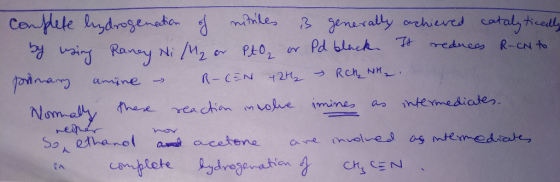
Which are involved with the complete hydrogenation of acetonitrile? Ethanol, Acetone, neither, or both?
Which are involved with the complete hydrogenation of acetonitrile?
Ethanol, Acetone, neither, or both?
Homework Answers
In case of any doubt please feel free to ask and comment down
below and please do rate if you found the answer helpful.
Thank you.
Add Answer to:
Which are involved with the complete hydrogenation of
acetonitrile?
Ethanol, Acetone, neither, or both?
Which is NOT a polar aprotic solvent? (A)acetone (B) acetonitrile (C)DMF&nb
Which is NOT a polar aprotic solvent? (A)acetone (B) acetonitrile (C)DMF (D)methanol
Draw both the SN1 (AgNO3 in ethanol) and the SN2 (NaI in acetone) mechanisms (include intermediates,...
Draw both the SN1 (AgNO3 in ethanol) and the SN2 (NaI in acetone) mechanisms (include intermediates, arrows etc.) for each of the following alkyl halides. 1) bromocyclohexane, 2) t-butyl chloride, 3) crotyl chloride, 4) benzyl chloride
1- Fill in the following blanks to complete the statement about Ethanol. For Ethanol, the IMFs...
1- Fill in the following blanks to complete the statement about Ethanol. For Ethanol, the IMFs were ____ (strong/weak) so the evaporation was _____ (slow/fast) and resulted in a _____(small/large) ΔT. 2- Fill in the following blanks to complete the statement about Acetone. For Acetone, the IMFs were ____ (strong/weak) so the evaporation was _____ (slow/fast) and resulted in a _____(small/large) ΔT.
Complete the mechanism for the following reaction of acetone dissolved in dry ethanol bubbled with HCl(g)...
 Complete the mechanism for the following reaction of acetone
dissolved in dry ethanol bubbled with HCl(g) by adding any missing
atoms, bonds, charges, nonbonding electrons and curved arrows.
Select the name that best describes the final product. and Select
the choice that best describes the product formed in the reaction
(1 gem-diol, 2 gem-diol, hemicetal or acetal)
Complete the mechanism for the following reaction of acetone
dissolved in dry ethanol bubbled with HCl(g) by adding any missing
atoms, bonds, charges, nonbonding electrons and curved arrows.
Select the name that best describes the final product. and Select
the choice that best describes the product formed in the reaction
(1 gem-diol, 2 gem-diol, hemicetal or acetal)
Which one is better to use to extract beta-carotene from carrot acetone or ethanol? is there...
Which one is better to use to extract beta-carotene from carrot acetone or ethanol? is there a better solvent to use to extract beta-carotene, if so, what is it?
A mixture containing 240 kg ethanol and 301.6 Kg acetone is flashed at 1 atm. The...
 A mixture containing 240 kg ethanol and 301.6 Kg acetone is flashed at 1 atm. The feed rate is 541.6 kg/hr. a. Calculate the fractional vaporization required to obtain 66 mole % of ethanol in the liquid product stream leaving the bottom of the flash tank. b. Find the operating temperature which will achieve this separation. C. What are the compositions (mole %) in the product streams? d. Calculate the L/min of acetone in the vapor stream leaving the top...
Which subtrate produces NADH the fastest between Ethanol, Methanol, Isopropanol and Acetone? What does this imply...
Which subtrate produces NADH the fastest between Ethanol, Methanol, Isopropanol and Acetone? What does this imply about how well each substrate binds to the enzyme ADH?
Which compound (water, acetone, ethanol, hexane, decane, or 1-decanol) do you think will be the least...
Which compound (water, acetone, ethanol, hexane, decane, or 1-decanol) do you think will be the least volatile and explain why. You must discuss intermolecular forces in your explanation.
2.Consider Table 13.3 (Page 18 of 7/9Slides)and determine which solvents (among water, acetone, methanol, ethanol, hexane,...
2.Consider Table 13.3 (Page 18 of 7/9Slides)and determine which solvents (among water, acetone, methanol, ethanol, hexane, toluene, and carbon tetrachloride) would dissolve the following solutes. In each case, specify the type of solvent-solute intermolecular forces:[3] a.Acetic acid (CH3COOH) b.Sodium nitrate (NaNO3) c.Olive oil Table 13. Common Polar Solvents Common Nonpolar Solvents Water (H2 O) Hexane (C6H14) Acetone (CH3COCH3) Diethyl ether (CH3CH2OCH2CH3) Methanol (CH3OH) Toluene (C7H8) Ethanol (CH3CH2OH) Carbon tetrachloride (CCl4)
Which compound/s (water, acetone, ethanol, hexane, decane, 1-decanol, sodium chloride, and/or iodine) do you think will...
Which compound/s (water, acetone, ethanol, hexane, decane, 1-decanol, sodium chloride, and/or iodine) do you think will be soluble in hexane and explain why. You must discuss intermolecular forces in your explanation.
 Complete the mechanism for the following reaction of acetone
dissolved in dry ethanol bubbled with HCl(g) by adding any missing
atoms, bonds, charges, nonbonding electrons and curved arrows.
Select the name that best describes the final product. and Select
the choice that best describes the product formed in the reaction
(1 gem-diol, 2 gem-diol, hemicetal or acetal)
Complete the mechanism for the following reaction of acetone
dissolved in dry ethanol bubbled with HCl(g) by adding any missing
atoms, bonds, charges, nonbonding electrons and curved arrows.
Select the name that best describes the final product. and Select
the choice that best describes the product formed in the reaction
(1 gem-diol, 2 gem-diol, hemicetal or acetal)
 A mixture containing 240 kg ethanol and 301.6 Kg acetone is flashed at 1 atm. The feed rate is 541.6 kg/hr. a. Calculate the fractional vaporization required to obtain 66 mole % of ethanol in the liquid product stream leaving the bottom of the flash tank. b. Find the operating temperature which will achieve this separation. C. What are the compositions (mole %) in the product streams? d. Calculate the L/min of acetone in the vapor stream leaving the top...
Most questions answered within 3 hours.
-
Where is the error in this code sequence?
String s1 = "Hello";
String s2 = "ello";...
asked 10 months ago -
Financial data for Joel de Paris, Inc., for last year
follow:
Joel de Paris, Inc.
Balance...
asked 10 months ago -
Consider this reaction:
Al2(SO4)3 (aq)+ BaCl3
(aq) Al2Cl6 (aq)- +
3BaSO4(s) . What is the...
asked 10 months ago -
Suppose that Savneet is considering increasing her
recent random sample from 20 car rentals to 40...
asked 10 months ago -
Trucks arrive at an unloading terminal at an average rate of 120
per hour.
Trucks arrive...
asked 10 months ago -
Why are methanol and ethanol completely soluble in water while
octanol is not very little soluble....
asked 10 months ago -
A facilities manager at a university reads in a research report
that the mean amount of...
asked 10 months ago -
When the CuSO4 is rehydrated by adding water to the anhydrous
compound, is this an endothermic...
asked 10 months ago -
A ray of sunlight is passing from diamond into crown glass; the
angle of incidence is...
asked 10 months ago -
A block of mass 0.249 kg is placed on top of a light, vertical
spring of...
asked 10 months ago -
how do the kidneys compensate in the presences of acidosis
a) trigger hyperventilate
b) reserve acid...
asked 10 months ago -
Question 501 pts
The rental rate of capital to the firm increases. Which of the
following...
asked 10 months ago