
Homework Answers

Add Answer to:
Balance the following in acidic conditions: I_2(l) + SO_2(g) rightarrow I^-(aq) + SO_4^2-(aq)
Balance the reaction in acidic conditions Pbo_2(8) + I^-(aq) rightarrow Pb^2+(aq) + I_2(s) I_2(s) rightarrow I^-(aq)
 Balance the reaction
in acidic conditions
Pbo_2(8) + I^-(aq) rightarrow Pb^2+(aq) + I_2(s) I_2(s) rightarrow I^-(aq)
Balance the reaction
in acidic conditions
Pbo_2(8) + I^-(aq) rightarrow Pb^2+(aq) + I_2(s) I_2(s) rightarrow I^-(aq)
Balance the following redox reactions under both acidic and basic conditions I_2O_5(s) + CO(g) rightarrow I_2(s)...
 Balance the following redox reactions under both acidic and basic conditions I_2O_5(s) + CO(g) rightarrow I_2(s) + CO_2 (g) IO^- _3 + H_3AsO_3(aq) rightarrow H_3AsO_4(aq) + I_2(s) PbSO_4(s) + Br_2(I) rightarrow Pb(s) +SO^-2 _4(aq) +BrO^- _3(aq)
Complete and balance the following equations I_2 (s) + OC^- (ag) rightarrow IO_3^- (aq) + Cl^-...
 Complete and balance the following
equations
I_2 (s) + OC^- (ag) rightarrow IO_3^- (aq) + Cl^- (aq) (acidic solution) Express your answer as a chemical equation. Identify all of the phases in your answer.
Complete and balance the following
equations
I_2 (s) + OC^- (ag) rightarrow IO_3^- (aq) + Cl^- (aq) (acidic solution) Express your answer as a chemical equation. Identify all of the phases in your answer.
Fc^2+ (aq) + Mo_3^- (aq) rightarrow Fe^3+ (aq) + No(g) acidic solution.
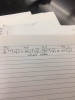 Fc^2+ (aq) + Mo_3^- (aq) rightarrow Fe^3+ (aq) + No(g) acidic solution.
Balance the 1/2 reaction using the 1/2 rxn method: MnO_4^- (aq) rightarrow MrvO_2(aq) (basic) Skip 4d...
 Balance the 1/2 reaction using the 1/2 rxn method: MnO_4^- (aq) rightarrow MrvO_2(aq) (basic) Skip 4d Balance the Redox Equat. using, the 1/2 rxn method (acidic conditions): H_2C_2O_4(aq) + MnO_4^-(aq) rightarrow Mn^2+(aq) + CO_2(g)
1. Balance the following redox reaction in acidic conditions; KMnO4 (aq) + NO (g) → MnO2...
1. Balance the following redox reaction in acidic conditions; KMnO4 (aq) + NO (g) → MnO2 (s) + NO2(g) (Please show every step when balancing this redox reaction in acidic condition, thanks.) 2. Which chemical has more entropy and explain why. Linear polyethylene (s) or hyperbranched polyethylene (s)
H_2(g) + I_2(g) rightarrow 2HI(g) Initial concentration [H_2] = 2: [I_2] = 2: [HI] = 3...
 H_2(g) + I_2(g) rightarrow 2HI(g) Initial concentration [H_2] = 2: [I_2] = 2: [HI] = 3 Kc = 55.17 Is the system at equilibrium? If not, which direction should equilibrium shift? What is equilibrium concentration of each species? 55.17 == [3 + 2X]^2/[2 - X]^2 X = ? Relative strength of acid and base: The stronger the acid, the weaker its conjugate base The stronger the base, the weaker its conjugate acid
2. Balance the following reaction under acidic conditions. Cl2(aq) + Br2(1) BrO3-(aq) + Cl-(aq)
 2. Balance the following reaction under acidic conditions. Cl2(aq) + Br2(1) BrO3-(aq) + Cl-(aq)
Identify the changes in oxidation states in the following equations Mg(s) + FeSO_4(aq) rightarrow Fe(s) +...
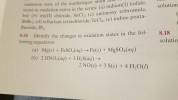 Identify the changes in oxidation states in the following equations Mg(s) + FeSO_4(aq) rightarrow Fe(s) + Mg SO_4(aq) 2 HNO_3(aq) + 3H_2S(aq) rightarrow 2NO(s) + 3S(s) + 4 H_2O(l)
1. Consider the following unbalanced redox reaction: ClO4−(aq) + I−(aq) → Cl−(aq) + HIO(aq) (a) Balance...
1. Consider the following unbalanced redox reaction: ClO4−(aq) + I−(aq) → Cl−(aq) + HIO(aq) (a) Balance the corresponding half reactions in acidic conditions using the lowest possible whole number coefficients. (Enter coefficients for one and zero. Blanks will be marked incorrect.) ClO4−(aq) + H2O(l) + OH−(aq) + H+(aq) + e− → Cl−(aq) + H2O(l) + OH−(aq) + H+(aq) + e− Tries 0/3 I−(aq) + H2O(l) + OH−(aq) + H+(aq) + e− → HIO(aq) + H2O(l) + OH−(aq) + H+(aq) + e− Tries 0/3 (b) Using the results from part (a), balance the full reaction in acidic conditions with...
 Balance the reaction
in acidic conditions
Pbo_2(8) + I^-(aq) rightarrow Pb^2+(aq) + I_2(s) I_2(s) rightarrow I^-(aq)
Balance the reaction
in acidic conditions
Pbo_2(8) + I^-(aq) rightarrow Pb^2+(aq) + I_2(s) I_2(s) rightarrow I^-(aq)
 Balance the following redox reactions under both acidic and basic conditions I_2O_5(s) + CO(g) rightarrow I_2(s) + CO_2 (g) IO^- _3 + H_3AsO_3(aq) rightarrow H_3AsO_4(aq) + I_2(s) PbSO_4(s) + Br_2(I) rightarrow Pb(s) +SO^-2 _4(aq) +BrO^- _3(aq)
 Complete and balance the following
equations
I_2 (s) + OC^- (ag) rightarrow IO_3^- (aq) + Cl^- (aq) (acidic solution) Express your answer as a chemical equation. Identify all of the phases in your answer.
Complete and balance the following
equations
I_2 (s) + OC^- (ag) rightarrow IO_3^- (aq) + Cl^- (aq) (acidic solution) Express your answer as a chemical equation. Identify all of the phases in your answer.
 Fc^2+ (aq) + Mo_3^- (aq) rightarrow Fe^3+ (aq) + No(g) acidic solution.
 Balance the 1/2 reaction using the 1/2 rxn method: MnO_4^- (aq) rightarrow MrvO_2(aq) (basic) Skip 4d Balance the Redox Equat. using, the 1/2 rxn method (acidic conditions): H_2C_2O_4(aq) + MnO_4^-(aq) rightarrow Mn^2+(aq) + CO_2(g)
 H_2(g) + I_2(g) rightarrow 2HI(g) Initial concentration [H_2] = 2: [I_2] = 2: [HI] = 3 Kc = 55.17 Is the system at equilibrium? If not, which direction should equilibrium shift? What is equilibrium concentration of each species? 55.17 == [3 + 2X]^2/[2 - X]^2 X = ? Relative strength of acid and base: The stronger the acid, the weaker its conjugate base The stronger the base, the weaker its conjugate acid
 2. Balance the following reaction under acidic conditions. Cl2(aq) + Br2(1) BrO3-(aq) + Cl-(aq)
 Identify the changes in oxidation states in the following equations Mg(s) + FeSO_4(aq) rightarrow Fe(s) + Mg SO_4(aq) 2 HNO_3(aq) + 3H_2S(aq) rightarrow 2NO(s) + 3S(s) + 4 H_2O(l)
Most questions answered within 3 hours.
-
Where is the error in this code sequence?
String s1 = "Hello";
String s2 = "ello";...
asked 11 months ago -
Financial data for Joel de Paris, Inc., for last year
follow:
Joel de Paris, Inc.
Balance...
asked 11 months ago -
Consider this reaction:
Al2(SO4)3 (aq)+ BaCl3
(aq) Al2Cl6 (aq)- +
3BaSO4(s) . What is the...
asked 11 months ago -
Suppose that Savneet is considering increasing her
recent random sample from 20 car rentals to 40...
asked 11 months ago -
Trucks arrive at an unloading terminal at an average rate of 120
per hour.
Trucks arrive...
asked 11 months ago -
Why are methanol and ethanol completely soluble in water while
octanol is not very little soluble....
asked 11 months ago -
A facilities manager at a university reads in a research report
that the mean amount of...
asked 11 months ago -
When the CuSO4 is rehydrated by adding water to the anhydrous
compound, is this an endothermic...
asked 11 months ago -
A ray of sunlight is passing from diamond into crown glass; the
angle of incidence is...
asked 11 months ago -
A block of mass 0.249 kg is placed on top of a light, vertical
spring of...
asked 11 months ago -
how do the kidneys compensate in the presences of acidosis
a) trigger hyperventilate
b) reserve acid...
asked 11 months ago -
Question 501 pts
The rental rate of capital to the firm increases. Which of the
following...
asked 11 months ago