

Homework Answers
Add Answer to:
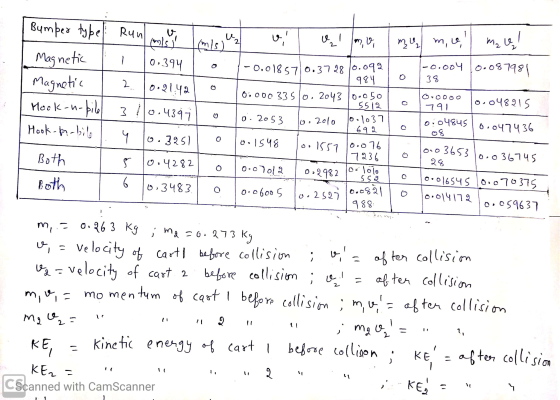
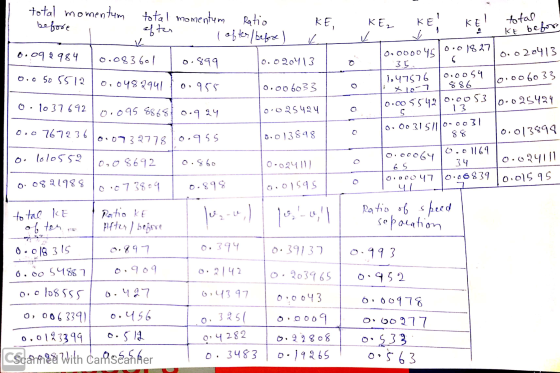
Mass of Cart 1: 0.263 kg Mass of Cart 2:0.273 kg Run # Velocity Cart 2...
Name Date 9-10) A 165 pound student grudgingly climbs one flight of stairs (4.32 m) in...
 Name Date 9-10) A 165 pound student grudgingly climbs one flight of stairs (4.32 m) in a time of 15.50 seconds to make it to a physics test. How much work has the student done in climbing steps, and what is the student's average power output? (4.45 N 1 lb) Work Power = 11-12) A collision occurred between 2 carts. Use the data below to complete the charts. Mass of cart 1 Mass of cart 2 Velocity of cart 2...
0 m/s 2 m/s Initial Velocity Initial Velocity 0 O m/s 2 m/s Mass: 2 kg...
 0 m/s 2 m/s Initial Velocity Initial Velocity 0 O m/s 2 m/s Mass: 2 kg Mass: 2 kg Elastic Case 1: Red and Blue Carts with Equal Mass Set the initial blue cart velocity to 0 m/s. Set the red and blue carts' mass values to the same value. Run the simulation and record the mass and velocity values. Before Collision After Collision Vred = m/s Vred = m/s Vblue = m/s mRed = kg m Blue = kg...
A 5 kg cart moving at a velocity 2 m/s in the +x-direction collides completely inelastically...
A 5 kg cart moving at a velocity 2 m/s in the +x-direction collides completely inelastically (i.e. they stick) with a second cart of mass 1.5 kg which is initially moving at a velocity of 10 m/s in the +y-direction. What is the total initial kinetic energy? J. What is the total x-component of momentum just before the collision? Kg m/s. What is the total y-component of momentum just before the collision? Kg m/s. What is the total x-component of momentum just after...
Cart 1, with m1= 5.5 kg, is moving on a frictionless linear air track at an...
Cart 1, with m1= 5.5 kg, is moving on a frictionless linear air track at an initial speed of 1.7 m/s. It undergoes an elastic collision with an initially stationary cart 2, with m2, an unknown mass. After the collision, cart 1 continues in its original direction at 0.6 m/s. 1) The horizontal component of the momentum is conserved for A. cart 1. B. cart 2. C. the system of cart 1 and cart 2. D. Momentum is not conserved...
2.5 m/s2.5 m/s Initial Velocity Initial Velocity 0 1 m/s 0 3 m/s Mass: 1 kg...
 2.5 m/s2.5 m/s Initial Velocity Initial Velocity 0 1 m/s 0 3 m/s Mass: 1 kg Mass: 3 kg Inelastic Case 2: Blue Cart Moving Slower than the Red Cart Set the initial blue cart velocity to less than the red cart velocity. Position the blue cart in the middle of the track. Use different mass values. Run the simulation and record the mass and velocity values. Before Collision After Collision m/s m/s m/s mRed kg m Blue kg Table...
A 0.10 kg cart (cart 1) moves with a speed of 0.40 m/s on a frictionless...
A 0.10 kg cart (cart 1) moves with a speed of 0.40 m/s on a frictionless air track and collides with a stationary cart (cart 2) whose mass is 0.30 kg. The two carts stick together after the collision. put 0 m/s for the velocity of (cart 2) What is given? What is the formula for momentum? Is momentum conserved in this collision? Is kinetic energy conserved in this collision? What is the initial momentum of cart 1? What is...
If a 0.25 kg cart moving to the right with a velocity of +0.31 m/s collides...
If a 0.25 kg cart moving to the right with a velocity of +0.31 m/s collides inelastically with a 0.5 kg cart traveling to the left with a velocity of -0.22 m/s, what is the total momentum of the system before the collision?
Reminder: No collision is truly elastic! assume cart 1 has mass 234 g and initial velocity...
Reminder: No collision is truly elastic! assume cart 1 has mass 234 g and initial velocity +v10 = 7.6 m/s, and cart 2 has mass 897 g. Assume the track is frictionless, and after the "elastic" collision cart 1 is moving at v1 = -4.362 m/s and cart 2 is moving at v2 = 3.035 m/s. What percentage of the original linear momentum was "lost" due to external forces? (Remember: linear momentum is a vector!) i am not asking for...
4. Two carts collide and stick together in a lab experiment. Cart 1 has a mass...
4. Two carts collide and stick together in a lab experiment. Cart 1 has a mass of 550 g and a speed before the collision of 2.5 m/s. Cart 2 has a mass of 320 g and a speed of -4.1 m/s. Consider the 2 carts to be the system. A. What is the total momentum of the system before the collision? B. What is the velocity of the 2 carts after the collision? C. If the collision takes 0.15s,...
4. Two carts collide and stick together in a lab experiment. Cart 1 has a mass...
4. Two carts collide and stick together in a lab experiment. Cart 1 has a mass of 550 g and a speed before the collision of 2.5 m/s. Cart 2 has a mass of 320 g and a speed of -4.1 m/s. Consider the 2 carts to be the system. A. What is the total momentum of the system before the collision? B. What is the velocity of the 2 carts after the collision? C. If the collision takes 0.15s,...
 Name Date 9-10) A 165 pound student grudgingly climbs one flight of stairs (4.32 m) in a time of 15.50 seconds to make it to a physics test. How much work has the student done in climbing steps, and what is the student's average power output? (4.45 N 1 lb) Work Power = 11-12) A collision occurred between 2 carts. Use the data below to complete the charts. Mass of cart 1 Mass of cart 2 Velocity of cart 2...
 0 m/s 2 m/s Initial Velocity Initial Velocity 0 O m/s 2 m/s Mass: 2 kg Mass: 2 kg Elastic Case 1: Red and Blue Carts with Equal Mass Set the initial blue cart velocity to 0 m/s. Set the red and blue carts' mass values to the same value. Run the simulation and record the mass and velocity values. Before Collision After Collision Vred = m/s Vred = m/s Vblue = m/s mRed = kg m Blue = kg...
 2.5 m/s2.5 m/s Initial Velocity Initial Velocity 0 1 m/s 0 3 m/s Mass: 1 kg Mass: 3 kg Inelastic Case 2: Blue Cart Moving Slower than the Red Cart Set the initial blue cart velocity to less than the red cart velocity. Position the blue cart in the middle of the track. Use different mass values. Run the simulation and record the mass and velocity values. Before Collision After Collision m/s m/s m/s mRed kg m Blue kg Table...
Most questions answered within 3 hours.
-
Where is the error in this code sequence?
String s1 = "Hello";
String s2 = "ello";...
asked 11 months ago -
Financial data for Joel de Paris, Inc., for last year
follow:
Joel de Paris, Inc.
Balance...
asked 11 months ago -
Consider this reaction:
Al2(SO4)3 (aq)+ BaCl3
(aq) Al2Cl6 (aq)- +
3BaSO4(s) . What is the...
asked 11 months ago -
Suppose that Savneet is considering increasing her
recent random sample from 20 car rentals to 40...
asked 11 months ago -
Trucks arrive at an unloading terminal at an average rate of 120
per hour.
Trucks arrive...
asked 11 months ago -
Why are methanol and ethanol completely soluble in water while
octanol is not very little soluble....
asked 11 months ago -
A facilities manager at a university reads in a research report
that the mean amount of...
asked 11 months ago -
When the CuSO4 is rehydrated by adding water to the anhydrous
compound, is this an endothermic...
asked 11 months ago -
A ray of sunlight is passing from diamond into crown glass; the
angle of incidence is...
asked 11 months ago -
A block of mass 0.249 kg is placed on top of a light, vertical
spring of...
asked 11 months ago -
how do the kidneys compensate in the presences of acidosis
a) trigger hyperventilate
b) reserve acid...
asked 11 months ago -
Question 501 pts
The rental rate of capital to the firm increases. Which of the
following...
asked 11 months ago