
Homework Answers
Add Answer to:
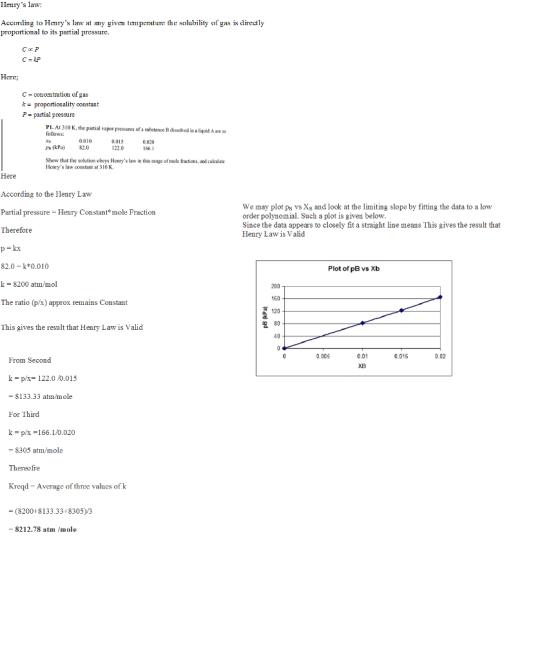
At 310 K, the partial vapor pressures of a substance B dissolved in a liquid A...
The total vapor pressure of an ideal-dilute liquid mixture of acetone and chloroform with a mole...
The total vapor pressure of an ideal-dilute liquid mixture of acetone and chloroform with a mole fraction of acetone of 0.0500 is 45.08 kPa at 308 K. (a) Use Raoult's law to determine the partial vapor pressure of acetone for the mixture, given that the vapor pressure of pure acetone is 46.26 kPa at 308 K. (b) Hence calculate the partial vapor pressure of chloroform for the mixture. (c) Determine the Henry's law constant of chloroform at this temperature. (d}...
9. At 50°C, a liquid solution composed of A (with a mole fraction of 0.28) and...
 9. At 50°C, a liquid solution composed of A (with a mole fraction of 0.28) and B has a total vapor pressure of 182 torr and a partial pressure of A of 62 torr. The vapor pressure of pure liquid A is 254 torr and that of pure liquid B is 169 torr. (a) Calculate the activity and the activity coefficient of each component of the liquid based on the Raoult's Law. (b) Calculate the Henry's law constant of A...
6. At 60°C, pure substance A has a vapor pressure of 380 mmHg and pure substance...
6. At 60°C, pure substance A has a vapor pressure of 380 mmHg and pure substance B of 140 mmHg. The mole fraction XB=0.15 is in the range of validity of Henry's law. The partial pressure of B at XB=0.1 is 20 mmHg. (a) What is the vapor partial pressure PB at XB=0.15? Answer: PB=30 mmHg. (b) What would PB be at XB=0.15 if the solution were ideal? Answer: PB=21 mmHg. (c) What is the activity coefficient of B, γB,...
2. Raoult’s law is defined as follows: Partial Pressure = Vapor Pressure • Mole fraction This...
2. Raoult’s law is defined as follows: Partial Pressure = Vapor Pressure • Mole fraction This equation predicts… A. How well a salt dissolves in a liquid B. How much higher the partial pressure will be when a salt is dissolved in a liquid C. How much lower the partial pressure will be when a salt is dissolved in a liquid D. How much higher the vapor pressure of a liquid becomes when it enters a phase transition.
At 300 K, the vapor pressure of pure liquid A and B is 200 mmHg and...
 At 300 K, the vapor pressure of pure liquid A and B is 200 mmHg and 450 mmHg, respectively. If the total pressure of the mixture A and B is 350 mmHg and the assumption that the solution is ideal, calculate: (a) Mole fraction of A and B in liquid phase and vapor phase, (b) The activity and activity coefficient of A and B in the solution, and (c) The mixing free energy, Agm, and the mixing entropy, Asm, of...
Find the mole fractions in the liquid mixture and in the vapor phase
At 100 ?C the vapor pressures of hexane and octane are 1836 and 354 torr, respectively. A certain liquid mixture of these two compounds has a vapor pressure of 666torr at 100 ?C. Find the mole fractions in the liquid mixture and in the vapor phase. Assume an ideal solution.
2. (60 pts.) The vapor pressures of pure species A and pure species B in the...
 2. (60 pts.) The vapor pressures of pure species A and pure species B in the solid and in the liquid phase are given by the following integrated Clausius-Clapeyron equations: Pure solid A: 2800K In(p) = 9 - Pure liquid A: In(p) = 7 - 2000K Pure solid B: In(p) = 5-2 2600K T Pure liquid B: In(p) = 3 - - 1000K where p is the vapor pressure in torr and T is the temperature in K. All latent...
4. At 300 K, the vapor pressure of pure liquid A and B is 200 mmHg...
 4. At 300 K, the vapor pressure of pure liquid A and B is 200 mmHg and 450 mmHg, respectively. If the total pressure of the mixture A and B is 350 mmHg and the assumption that the solution is ideal, calculate: (a) Mole fraction of A and B in liquid phase and vapor phase, (b) The activity and activity coefficient of A and B in the solution, and (c) The mixing free energy, Agm, and the mixing entropy, Asm,...
if the vapor pressures of hexane and heptane are 787 and 302 torr at 343 K,...
if the vapor pressures of hexane and heptane are 787 and 302 torr at 343 K, the mole fraction of hexane in the vapor phase exceeds 40% when the mole fraction of heptane in the liquid phase is 60%...t/f
7.By measuring the equilibrium between liquid and vapor phases of a solution at 30°C at 1.00...
 7.By measuring the equilibrium between liquid and vapor phases of a solution at 30°C at 1.00 atm, it was found that XA 0.220 when yA 0.314. Calculate the activities and activity coefficients of both components in this solution on the Raoult's law basis. The vapor pressures of the pure components at this temperature are: pA 73.0 kPa and ps = 92.1 kPa. (XA is the mole fraction in the liquid and yA the mole fraction in the vapor.)
 9. At 50°C, a liquid solution composed of A (with a mole fraction of 0.28) and B has a total vapor pressure of 182 torr and a partial pressure of A of 62 torr. The vapor pressure of pure liquid A is 254 torr and that of pure liquid B is 169 torr. (a) Calculate the activity and the activity coefficient of each component of the liquid based on the Raoult's Law. (b) Calculate the Henry's law constant of A...
 At 300 K, the vapor pressure of pure liquid A and B is 200 mmHg and 450 mmHg, respectively. If the total pressure of the mixture A and B is 350 mmHg and the assumption that the solution is ideal, calculate: (a) Mole fraction of A and B in liquid phase and vapor phase, (b) The activity and activity coefficient of A and B in the solution, and (c) The mixing free energy, Agm, and the mixing entropy, Asm, of...
 2. (60 pts.) The vapor pressures of pure species A and pure species B in the solid and in the liquid phase are given by the following integrated Clausius-Clapeyron equations: Pure solid A: 2800K In(p) = 9 - Pure liquid A: In(p) = 7 - 2000K Pure solid B: In(p) = 5-2 2600K T Pure liquid B: In(p) = 3 - - 1000K where p is the vapor pressure in torr and T is the temperature in K. All latent...
 4. At 300 K, the vapor pressure of pure liquid A and B is 200 mmHg and 450 mmHg, respectively. If the total pressure of the mixture A and B is 350 mmHg and the assumption that the solution is ideal, calculate: (a) Mole fraction of A and B in liquid phase and vapor phase, (b) The activity and activity coefficient of A and B in the solution, and (c) The mixing free energy, Agm, and the mixing entropy, Asm,...
 7.By measuring the equilibrium between liquid and vapor phases of a solution at 30°C at 1.00 atm, it was found that XA 0.220 when yA 0.314. Calculate the activities and activity coefficients of both components in this solution on the Raoult's law basis. The vapor pressures of the pure components at this temperature are: pA 73.0 kPa and ps = 92.1 kPa. (XA is the mole fraction in the liquid and yA the mole fraction in the vapor.)
Most questions answered within 3 hours.
-
Where is the error in this code sequence?
String s1 = "Hello";
String s2 = "ello";...
asked 11 months ago -
Financial data for Joel de Paris, Inc., for last year
follow:
Joel de Paris, Inc.
Balance...
asked 11 months ago -
Consider this reaction:
Al2(SO4)3 (aq)+ BaCl3
(aq) Al2Cl6 (aq)- +
3BaSO4(s) . What is the...
asked 11 months ago -
Suppose that Savneet is considering increasing her
recent random sample from 20 car rentals to 40...
asked 11 months ago -
Trucks arrive at an unloading terminal at an average rate of 120
per hour.
Trucks arrive...
asked 11 months ago -
Why are methanol and ethanol completely soluble in water while
octanol is not very little soluble....
asked 11 months ago -
A facilities manager at a university reads in a research report
that the mean amount of...
asked 11 months ago -
When the CuSO4 is rehydrated by adding water to the anhydrous
compound, is this an endothermic...
asked 11 months ago -
A ray of sunlight is passing from diamond into crown glass; the
angle of incidence is...
asked 11 months ago -
A block of mass 0.249 kg is placed on top of a light, vertical
spring of...
asked 11 months ago -
how do the kidneys compensate in the presences of acidosis
a) trigger hyperventilate
b) reserve acid...
asked 11 months ago -
Question 501 pts
The rental rate of capital to the firm increases. Which of the
following...
asked 11 months ago