Which information do you need to be able to extend a System Sequence Diagram to a...
Which information do you need to be able to extend a System Sequence Diagram to a Sequence Diagram?
Homework Answers
A System sequence diagram visualizes a use case, while a sequence diagram visualizes a method of a class.
The elements participating (exchanging messages) in a system sequence diagram are Actors and Systems. The messages exchanged by these elements could be any type depending on the systems (from web service calls to data input from a human).
The elements participating in a sequence diagram are objects (instances of various classes). The messages exchanged by these elements are method invocations.
First you would analyze and document the use cases. Each use case describes a main business task required. The system use case diagram is part of this activity.
Later you come to design each subsystem, namely each element participating in the system use case diagram. You draw one or more class diagrams depicting the classes participating to the solution. Then you would draw a sequence diagram for the most important (or difficult to understand) methods.
Add Answer to:
Which information do you need to be able to extend a System
Sequence Diagram to a...
(1) Sequence diagrams represent (a) exactly what the use case diagram represents. (b) the...
(1) Sequence diagrams represent (a) exactly what the use case diagram represents. (b) the sequence for a scenario of a use case. (c) exactly what the class diagram represents. (d) the sequences that connect multiple use cases together. (2) Actors in a sequence diagram typically interact with (a) Boundary objects (b) Entity objects (c) Any type of object (d) Control objects (3) Are sequence and communication diagrams different from one another? ...
I need help with making a high-level analysis class diagram for the following system. You are...
I need help with making a high-level analysis class diagram for the following system. You are the system analyst on project to develop a web site for the pet spa and hotel franchise in New York City. The franchise currently provides services for dogs only. Customers should be able to make online appointments for walking, grooming, day care, and hotel services. Reservations can be for same day service or made in advance. Customers are required to register, provide a credit...
you are asked to do a detailed design using class diagram, modeling interactions and behaviour for...
you are asked to do a detailed design using class diagram, modeling interactions and behaviour for a part of a library system. This part can be described as a use case: checkout an library item. In this use case, a librarian use the system to check out an item for a legitimate borrower. The system need to check the borrower’s record first and then update the library data, the borrower’s record etc. Note that the Example 4.12 of the textbook...
What is the mechanism by which telomerase is able to extend the 3’ end of chromosomes?...
What is the mechanism by which telomerase is able to extend the 3’ end of chromosomes? Professor gave some hints: Repetitive sequences of Telomere and Telomerase is a complex of enzymes in RNA template.
Why do we need to back up system before penetration testing: Question 13 options: Be able...
Why do we need to back up system before penetration testing: Question 13 options: Be able to restore system after the study Be able to attack the system Be able to obtain user account None of the above
What do you need to know to determine if you can be able to treat a...
What do you need to know to determine if you can be able to treat a disease with genetic modifications?
Using python (able to run in thonny), create a point of sale system that has a...
Using python (able to run in thonny), create a point of sale system that has a class diagram for 12 major classes in the program, an architecture diagram showing major systems, a sequence diagram for 1 of the objects that realize one of the use cases, and a rough sketch of the UI of the system. There should be 12 use cases fully elaborated.
Objective Practice creating use-case and sequence diagrams. . Mini case study: a computer email system Consider...
 Objective Practice creating use-case and sequence diagrams. . Mini case study: a computer email system Consider a computer email system with the following actors: user, server, and virus checker A. (3 points) Explain the relevance of each actor, in brief. B. (4 points) The computer email system has some use-cases; one of them is to “get an email.” List four additional use cases at a comparable level of abstraction. Summarize the purpose of each use case with a sentence. C....
Represent the depicted simple ordering system in terms of the class diagrams, sequence diagram(s)...
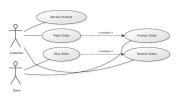 Represent the depicted simple ordering system in terms of the
class diagrams, sequence diagram(s), and activity diagram(s) for
the following use case diagram utilizing a tool such as Visio:
Represent the depicted simple ordering system in terms of the
class diagrams, sequence diagram(s), and activity diagram(s) for
the following use case diagram utilizing a tool such as Visio:
Design a system, which lights twelve LEDs in a cyclic sequence. Each LED lights for three...
Design a system, which lights twelve LEDs in a cyclic sequence. Each LED lights for three seconds then goes off. You should: i. State any assumptions made in your design. ii. Give a complete block diagram of the system. iii. Give brief explanation on how the system works.
 Objective Practice creating use-case and sequence diagrams. . Mini case study: a computer email system Consider a computer email system with the following actors: user, server, and virus checker A. (3 points) Explain the relevance of each actor, in brief. B. (4 points) The computer email system has some use-cases; one of them is to “get an email.” List four additional use cases at a comparable level of abstraction. Summarize the purpose of each use case with a sentence. C....
 Represent the depicted simple ordering system in terms of the
class diagrams, sequence diagram(s), and activity diagram(s) for
the following use case diagram utilizing a tool such as Visio:
Represent the depicted simple ordering system in terms of the
class diagrams, sequence diagram(s), and activity diagram(s) for
the following use case diagram utilizing a tool such as Visio:
Most questions answered within 3 hours.
-
Where is the error in this code sequence?
String s1 = "Hello";
String s2 = "ello";...
asked 10 months ago -
Financial data for Joel de Paris, Inc., for last year
follow:
Joel de Paris, Inc.
Balance...
asked 10 months ago -
Consider this reaction:
Al2(SO4)3 (aq)+ BaCl3
(aq) Al2Cl6 (aq)- +
3BaSO4(s) . What is the...
asked 10 months ago -
Suppose that Savneet is considering increasing her
recent random sample from 20 car rentals to 40...
asked 10 months ago -
Trucks arrive at an unloading terminal at an average rate of 120
per hour.
Trucks arrive...
asked 10 months ago -
Why are methanol and ethanol completely soluble in water while
octanol is not very little soluble....
asked 10 months ago -
A facilities manager at a university reads in a research report
that the mean amount of...
asked 10 months ago -
When the CuSO4 is rehydrated by adding water to the anhydrous
compound, is this an endothermic...
asked 10 months ago -
A ray of sunlight is passing from diamond into crown glass; the
angle of incidence is...
asked 10 months ago -
A block of mass 0.249 kg is placed on top of a light, vertical
spring of...
asked 10 months ago -
how do the kidneys compensate in the presences of acidosis
a) trigger hyperventilate
b) reserve acid...
asked 10 months ago -
Question 501 pts
The rental rate of capital to the firm increases. Which of the
following...
asked 10 months ago