Consider the harmonic oscillator. Is it possible to measure the exact kinetic energy and exact potential...
-
Consider the harmonic oscillator. Is it possible to measure the exact kinetic energy and exact potential energy simultaneously? Prove this mathematically.
Homework Answers
With the help of the conservation of energy priciplwe we can
find the kinetic and potential energy simultaneosly.
We know that the
total mechanical energy = Kinetic+ potential energy =
Constant
therfore the total mechanical energy remain constant
Hence when we calcualate the kinetic or potential energy at a
instant then automatically we get the other value.
For eg. A pendulum moving back and forth.
So when pendulum is moving up its kinetic energy dimnishes and
potential energy increases and vice- versa.
Add Answer to:
Consider the
harmonic oscillator. Is it possible to measure the exact kinetic
energy and exact potential...
For a simple harmonic oscillator determine a total energy b the kinetic energy and potential energy...
For a simple harmonic oscillator determine a total energy b the kinetic energy and potential energy at half amplitud x=A/2
It can be shown that for a linear harmonic oscillator the expectation value of the potential energy is equal to the expectation value of the kinetic energy, and the expectation values for r and p are...
 It can be shown that for a linear harmonic oscillator the
expectation value of the potential energy is equal to the
expectation value of the kinetic energy, and the expectation values
for r and p are clearly both zeros (0) Show that in the lowest
energy state Ain agreement with the uncertainty principle (b)
Confirm that for the higher states (Ax)(Ap) > h/2 .
Problemi 4. ( 8 pts) It can be shown that for a linear harmonic oscillator the...
It can be shown that for a linear harmonic oscillator the
expectation value of the potential energy is equal to the
expectation value of the kinetic energy, and the expectation values
for r and p are clearly both zeros (0) Show that in the lowest
energy state Ain agreement with the uncertainty principle (b)
Confirm that for the higher states (Ax)(Ap) > h/2 .
Problemi 4. ( 8 pts) It can be shown that for a linear harmonic oscillator the...
The potential energy for a 3-D spherically symmetric harmonic oscillator is V kr an (a) Write dow...
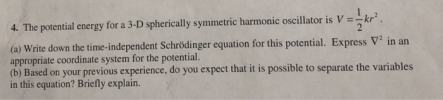 The potential energy for a 3-D spherically symmetric harmonic oscillator is V kr an (a) Write down the time-independent Schrödinger equation for this potential. Express V in appropriate coordinate system for the potential. (b) Based on your previous experience, do you expect that it is possible to separate the variables in this equation? Briefly explain.
The potential energy for a 3-D spherically symmetric harmonic oscillator is V kr an (a) Write down the time-independent Schrödinger equation for this potential. Express...
The potential energy for a 3-D spherically symmetric harmonic oscillator is V kr an (a) Write down the time-independent Schrödinger equation for this potential. Express V in appropriate coordinate system for the potential. (b) Based on your previous experience, do you expect that it is possible to separate the variables in this equation? Briefly explain.
The potential energy for a 3-D spherically symmetric harmonic oscillator is V kr an (a) Write down the time-independent Schrödinger equation for this potential. Express...
Question 3: A particle is in the ground state (po) of a simple harmonic oscillator potential....
 Question 3: A particle is in the ground state (po) of a simple harmonic oscillator potential. (a) Determine Φ(p,t). (b) Classically, the kinetic energy cannot exceed the total mechanical energy of the particle, so w. You measure the momentum of the particle. What is the probability that you will measure a value outside of the classically allowed range? 2 Reminders: foo e-a2+br dr=v/Te4a where a is real and positive. The error e edt and can be calculated numerically function is...
Consider a particle subjected to a harmonic oscillator potential of the form x)m. The allowed values...
 Consider a particle subjected to a harmonic oscillator potential of the form x)m. The allowed values of energy for the simple harmonic oscillator is (a) What is the energy corresponding to the ground state (3 points)? (b) What is the energy separation between the ground state and the first excited state (3 points)? (c) The selection rule allows only those transitions for which the quantum number changes by 1. What is the energy of photon necessary to make the transition...
7 Harmonic oscillator in "energy space" Consider the harmonic oscillator in "energy space", i.e., in terms...
 7 Harmonic oscillator in "energy space" Consider the harmonic oscillator in "energy space", i.e., in terms of the basis of eigenvectors n) of the harmonic oscillator Hamiltonian, with Hn) -hwn1/2)]n). We computed these in terms of wavefunctions in position space, ie. pn(x)-(zln), but we can also work purely in terms of the abstract energy eigenvectors in Dirac notation. PS9.pdf 1. You computed the matrix elements 〈nleln) on an earlier problem set. Now find (nn) for general n,n' 2. Find the...
1. Consider a one-dimensional simple harmonic oscillator. We know that the total energy (E) has values:...
 1. Consider a one-dimensional simple harmonic oscillator. We know that the total energy (E) has values: Here the angular frequency (o) corresponds to the freshman physics value of [spring constant/massja and (n) can be 0, 1,2, any non-negative integer. We know that the total energy is a measurable, observable quantity. The total energy includes the kinetic energy and the potential energy. Please explain whether or not the kinetic energy and the potential energy can both be measured at the same...
consider a physical system 1. Consider a one-dimensional simple harmonic oscillator. a. Using +mw 2h mw...
 consider a physical system
1. Consider a one-dimensional simple harmonic oscillator. a. Using +mw 2h mw ip ip mw evaluate (mlixln) (mlpln), (m+pxn) mn)(mpn b. Check that the virial theorem holds for the expectation values of the kinetic and P) the potential energy taken with respect to an energy eigenstate, i.e, the potential energy taken with respect to an energy eigenstate, 1e, V 2m 2
consider a physical system
1. Consider a one-dimensional simple harmonic oscillator. a. Using +mw 2h mw ip ip mw evaluate (mlixln) (mlpln), (m+pxn) mn)(mpn b. Check that the virial theorem holds for the expectation values of the kinetic and P) the potential energy taken with respect to an energy eigenstate, i.e, the potential energy taken with respect to an energy eigenstate, 1e, V 2m 2
Please do this problem about quantum mechanic harmonic oscillator and show all your steps thank you. Q1. Consider a particle of mass m moving in a one-dimensional harmonic oscillator potential. 1....
 Please do this problem about quantum mechanic harmonic
oscillator and show all your steps thank you.
Q1. Consider a particle of mass m moving in a one-dimensional harmonic oscillator potential. 1. Calculate the product of uncertainties in position and momentum for the particle in 2. Compare the result of (a) with the uncertainty product when the particle is in its the fifth excited state, ie. (OxơP)5. lowest energy state.
Q1. Consider a particle of mass m moving in a one-dimensional...
Please do this problem about quantum mechanic harmonic
oscillator and show all your steps thank you.
Q1. Consider a particle of mass m moving in a one-dimensional harmonic oscillator potential. 1. Calculate the product of uncertainties in position and momentum for the particle in 2. Compare the result of (a) with the uncertainty product when the particle is in its the fifth excited state, ie. (OxơP)5. lowest energy state.
Q1. Consider a particle of mass m moving in a one-dimensional...
Assume that the Harmonic Oscillator potential is being perturbed by an additional term that is quadratic...
 Assume that the Harmonic Oscillator potential is being perturbed by an additional term that is quadratic inx: Hy = an mw?x?; l«l< 1 Calculate the energy to the first non-zero correction using the Perturbation approach. Use ladder operatorst How does this result compare with the exact one?
 It can be shown that for a linear harmonic oscillator the
expectation value of the potential energy is equal to the
expectation value of the kinetic energy, and the expectation values
for r and p are clearly both zeros (0) Show that in the lowest
energy state Ain agreement with the uncertainty principle (b)
Confirm that for the higher states (Ax)(Ap) > h/2 .
Problemi 4. ( 8 pts) It can be shown that for a linear harmonic oscillator the...
It can be shown that for a linear harmonic oscillator the
expectation value of the potential energy is equal to the
expectation value of the kinetic energy, and the expectation values
for r and p are clearly both zeros (0) Show that in the lowest
energy state Ain agreement with the uncertainty principle (b)
Confirm that for the higher states (Ax)(Ap) > h/2 .
Problemi 4. ( 8 pts) It can be shown that for a linear harmonic oscillator the...
 The potential energy for a 3-D spherically symmetric harmonic oscillator is V kr an (a) Write down the time-independent Schrödinger equation for this potential. Express V in appropriate coordinate system for the potential. (b) Based on your previous experience, do you expect that it is possible to separate the variables in this equation? Briefly explain.
The potential energy for a 3-D spherically symmetric harmonic oscillator is V kr an (a) Write down the time-independent Schrödinger equation for this potential. Express...
The potential energy for a 3-D spherically symmetric harmonic oscillator is V kr an (a) Write down the time-independent Schrödinger equation for this potential. Express V in appropriate coordinate system for the potential. (b) Based on your previous experience, do you expect that it is possible to separate the variables in this equation? Briefly explain.
The potential energy for a 3-D spherically symmetric harmonic oscillator is V kr an (a) Write down the time-independent Schrödinger equation for this potential. Express...
 Question 3: A particle is in the ground state (po) of a simple harmonic oscillator potential. (a) Determine Φ(p,t). (b) Classically, the kinetic energy cannot exceed the total mechanical energy of the particle, so w. You measure the momentum of the particle. What is the probability that you will measure a value outside of the classically allowed range? 2 Reminders: foo e-a2+br dr=v/Te4a where a is real and positive. The error e edt and can be calculated numerically function is...
 Consider a particle subjected to a harmonic oscillator potential of the form x)m. The allowed values of energy for the simple harmonic oscillator is (a) What is the energy corresponding to the ground state (3 points)? (b) What is the energy separation between the ground state and the first excited state (3 points)? (c) The selection rule allows only those transitions for which the quantum number changes by 1. What is the energy of photon necessary to make the transition...
 7 Harmonic oscillator in "energy space" Consider the harmonic oscillator in "energy space", i.e., in terms of the basis of eigenvectors n) of the harmonic oscillator Hamiltonian, with Hn) -hwn1/2)]n). We computed these in terms of wavefunctions in position space, ie. pn(x)-(zln), but we can also work purely in terms of the abstract energy eigenvectors in Dirac notation. PS9.pdf 1. You computed the matrix elements 〈nleln) on an earlier problem set. Now find (nn) for general n,n' 2. Find the...
 1. Consider a one-dimensional simple harmonic oscillator. We know that the total energy (E) has values: Here the angular frequency (o) corresponds to the freshman physics value of [spring constant/massja and (n) can be 0, 1,2, any non-negative integer. We know that the total energy is a measurable, observable quantity. The total energy includes the kinetic energy and the potential energy. Please explain whether or not the kinetic energy and the potential energy can both be measured at the same...
 consider a physical system
1. Consider a one-dimensional simple harmonic oscillator. a. Using +mw 2h mw ip ip mw evaluate (mlixln) (mlpln), (m+pxn) mn)(mpn b. Check that the virial theorem holds for the expectation values of the kinetic and P) the potential energy taken with respect to an energy eigenstate, i.e, the potential energy taken with respect to an energy eigenstate, 1e, V 2m 2
consider a physical system
1. Consider a one-dimensional simple harmonic oscillator. a. Using +mw 2h mw ip ip mw evaluate (mlixln) (mlpln), (m+pxn) mn)(mpn b. Check that the virial theorem holds for the expectation values of the kinetic and P) the potential energy taken with respect to an energy eigenstate, i.e, the potential energy taken with respect to an energy eigenstate, 1e, V 2m 2
 Please do this problem about quantum mechanic harmonic
oscillator and show all your steps thank you.
Q1. Consider a particle of mass m moving in a one-dimensional harmonic oscillator potential. 1. Calculate the product of uncertainties in position and momentum for the particle in 2. Compare the result of (a) with the uncertainty product when the particle is in its the fifth excited state, ie. (OxơP)5. lowest energy state.
Q1. Consider a particle of mass m moving in a one-dimensional...
Please do this problem about quantum mechanic harmonic
oscillator and show all your steps thank you.
Q1. Consider a particle of mass m moving in a one-dimensional harmonic oscillator potential. 1. Calculate the product of uncertainties in position and momentum for the particle in 2. Compare the result of (a) with the uncertainty product when the particle is in its the fifth excited state, ie. (OxơP)5. lowest energy state.
Q1. Consider a particle of mass m moving in a one-dimensional...
 Assume that the Harmonic Oscillator potential is being perturbed by an additional term that is quadratic inx: Hy = an mw?x?; l«l< 1 Calculate the energy to the first non-zero correction using the Perturbation approach. Use ladder operatorst How does this result compare with the exact one?
Most questions answered within 3 hours.
-
Where is the error in this code sequence?
String s1 = "Hello";
String s2 = "ello";...
asked 10 months ago -
Financial data for Joel de Paris, Inc., for last year
follow:
Joel de Paris, Inc.
Balance...
asked 10 months ago -
Consider this reaction:
Al2(SO4)3 (aq)+ BaCl3
(aq) Al2Cl6 (aq)- +
3BaSO4(s) . What is the...
asked 10 months ago -
Suppose that Savneet is considering increasing her
recent random sample from 20 car rentals to 40...
asked 10 months ago -
Trucks arrive at an unloading terminal at an average rate of 120
per hour.
Trucks arrive...
asked 10 months ago -
Why are methanol and ethanol completely soluble in water while
octanol is not very little soluble....
asked 10 months ago -
A facilities manager at a university reads in a research report
that the mean amount of...
asked 10 months ago -
When the CuSO4 is rehydrated by adding water to the anhydrous
compound, is this an endothermic...
asked 10 months ago -
A ray of sunlight is passing from diamond into crown glass; the
angle of incidence is...
asked 10 months ago -
A block of mass 0.249 kg is placed on top of a light, vertical
spring of...
asked 10 months ago -
how do the kidneys compensate in the presences of acidosis
a) trigger hyperventilate
b) reserve acid...
asked 10 months ago -
Question 501 pts
The rental rate of capital to the firm increases. Which of the
following...
asked 10 months ago