for the reaction abc + d <---> ab + cd, the change in Hrxn= -75 kj/mol,...
for the reaction abc + d <---> ab + cd, the change in Hrxn= -75 kj/mol, and Ea(fwd) is 235 kj/mol. assuming one step reaction, caluclate Ea(rev)
Homework Answers
Ea for reverse reaction = 235 + 75 = 310 KJ / mol
abc + d <---> ab + cd Hrxn= -75 kj/mol
by given data forward reaction is exothermic. so reverse reaction should be endothermic. so forward activation energy + released energy = activation energy for backward reaction
Add Answer to:
for the reaction abc + d <---> ab + cd, the change in
Hrxn= -75 kj/mol,...
Enter your answer in the provided box. For the reaction ABC+D=AB + CD AH' =-65 kJ/mol...
 Enter your answer in the provided box. For the reaction ABC+D=AB + CD AH' =-65 kJ/mol and Ea(fwd) = 305 kJ/mol. rxn Assuming a one-step reaction, calculate Ea(rev)- kJ/mol
For the reaction A2 + B2 → 2AB, Ea(fwd) = 105 kJ/mol and Ea(rev) = 77...
For the reaction A2 + B2 → 2AB, Ea(fwd) = 105 kJ/mol and Ea(rev) = 77 kJ/mol. Assuming the reaction occurs in one step, calculate ΔH°rxn 123 kJ/mol 28 kJ/mol 253 kJ/mol 182 kJ/mol 337 kJ/mol
The potential energy profile for the one step reaction AB + CD + AC +BD is...
 The potential energy profile for the one step reaction AB + CD + AC +BD is shown. The energies are given in units of kJ/mol. What are the values of E, and AE for the REVERSE reaction? 100 80 60 Potential energy 40 20 0 Reaction progress O Ea = 80 kJ/mol and AE = -20 kJ/mol Ea - 60 kJ/mol and AE --20 kJ/mol Ea - 100 kJ/mol and AE = 20 kJ/mol Ea = 80 kJ/mol and AE...
2AB , E, (fwd ) 303 kJ/mol and Erev) 34 kJ/mol. Assuming the reaction occurs in...
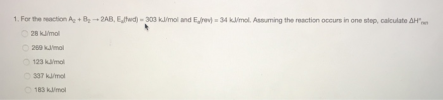 2AB , E, (fwd ) 303 kJ/mol and Erev) 34 kJ/mol. Assuming the reaction occurs in one step, calculate AH 1, For the reaction A2 +Bo nen 28 kJ/mol 269 kJ/mol 123 kJ/mol 337 kJ/mol 183 kJ/mol
in the vessel? 16.56 For the reaction A(g)+ B(g) AB(g), how collisions between A and B...
 in the vessel? 16.56 For the reaction A(g)+ B(g) AB(g), how collisions between A and B are possible if 1.01 mol of A(g) and 2.12 mol of B(g) are present in the vessel? many unique 16.57 At 25°C, what is the fraction of collisions with energy equal to or greater than an activation energy of 100. kJ/mol? 16.58 If the temperature in Problem 16.57 is increased to 50.°C by what factor does the fraction of collisions with energy equal to...
The change in Hrxn for the reaction C8H8 + 10 O2 = 8 CO2 + 4...
The change in Hrxn for the reaction C8H8 + 10 O2 = 8 CO2 + 4 H2O is -4395 kJ/mol. Knowing this, as well as the standard enthalpies of formation below, calculate the standard enthalpy of formation of Styrene in kJ/mol. change in Hf[CO2 (g)] = -393.5 kJ/mol change in Hf[H2O (l)] = -285.8 kJ/mol
For the equilibrium reaction 2SO2(g) + O2(g) 2SO3(g), delta Hrxn = -198 kJ/mol. Which one of...
 For the equilibrium reaction 2SO2(g) + O2(g) 2SO3(g), delta Hrxn = -198 kJ/mol. Which one of these factors would cause the equilibrium constent to increases? Decrease the temperature. Add SO2 gas Remove O2 gas Add a catalyst. None of these Consider this reaction at equilibrium If the volume of the system is compressed at constent temperature, what change will occure in the position of the equilibrium?
The potential energy profile for the one step reaction AB+CDAC+ BD is shown. The energies are...
 The potential energy profile for the one step reaction AB+CDAC+ BD is shown. The energies are given in units of kJ/mol. What are the values of E, and AE for the REVERSE reaction? 100 80 60 Potential energy 40 20 0 Reaction progress Ea = 60 kJ/mol and AE =-20 kJ/mol O Ea = 80 kJ/mol and AE = 20 kJ/mol Ea = 80 kJ/mol and AE = -20 kJ/mol Ea = 100 kJ/mol and AE = 20 kJ/mol
D. The data below is for the reaction sequence A- Elementary step A, H/kJ mol A-...
 D. The data below is for the reaction sequence A- Elementary step A, H/kJ mol A- B B- C C D B- C- E /kJ mol Hint: Use the data to prepare a graph of the reaction profile and then answer the questions below. Your graph should be properly labelled and drawn to scale. Potential Energy Reaction progress (a) Whichof the following steps has the smallest rate constant? AB Bc (b) Which of the following steps has the largest rate...
Calculate the approximate enthalpy change, ?Hrxn, for the combustion of one mole of methane a shown...
Calculate the approximate enthalpy change, ?Hrxn, for the combustion of one mole of methane a shown in the balanced chemical equation: CH4+2O2?2H2O+CO2 Use the values you calculated in Parts A, B, C, and D, keeping in mind the stoichiometric coefficients. delta H CH4=1656 kJ/mol delta H O2=498 kJ/mol delta H H2O=-928 kJ/mol delta H CO2=-1598 kJ/mol
 Enter your answer in the provided box. For the reaction ABC+D=AB + CD AH' =-65 kJ/mol and Ea(fwd) = 305 kJ/mol. rxn Assuming a one-step reaction, calculate Ea(rev)- kJ/mol
 The potential energy profile for the one step reaction AB + CD + AC +BD is shown. The energies are given in units of kJ/mol. What are the values of E, and AE for the REVERSE reaction? 100 80 60 Potential energy 40 20 0 Reaction progress O Ea = 80 kJ/mol and AE = -20 kJ/mol Ea - 60 kJ/mol and AE --20 kJ/mol Ea - 100 kJ/mol and AE = 20 kJ/mol Ea = 80 kJ/mol and AE...
 2AB , E, (fwd ) 303 kJ/mol and Erev) 34 kJ/mol. Assuming the reaction occurs in one step, calculate AH 1, For the reaction A2 +Bo nen 28 kJ/mol 269 kJ/mol 123 kJ/mol 337 kJ/mol 183 kJ/mol
 in the vessel? 16.56 For the reaction A(g)+ B(g) AB(g), how collisions between A and B are possible if 1.01 mol of A(g) and 2.12 mol of B(g) are present in the vessel? many unique 16.57 At 25°C, what is the fraction of collisions with energy equal to or greater than an activation energy of 100. kJ/mol? 16.58 If the temperature in Problem 16.57 is increased to 50.°C by what factor does the fraction of collisions with energy equal to...
 For the equilibrium reaction 2SO2(g) + O2(g) 2SO3(g), delta Hrxn = -198 kJ/mol. Which one of these factors would cause the equilibrium constent to increases? Decrease the temperature. Add SO2 gas Remove O2 gas Add a catalyst. None of these Consider this reaction at equilibrium If the volume of the system is compressed at constent temperature, what change will occure in the position of the equilibrium?
 The potential energy profile for the one step reaction AB+CDAC+ BD is shown. The energies are given in units of kJ/mol. What are the values of E, and AE for the REVERSE reaction? 100 80 60 Potential energy 40 20 0 Reaction progress Ea = 60 kJ/mol and AE =-20 kJ/mol O Ea = 80 kJ/mol and AE = 20 kJ/mol Ea = 80 kJ/mol and AE = -20 kJ/mol Ea = 100 kJ/mol and AE = 20 kJ/mol
 D. The data below is for the reaction sequence A- Elementary step A, H/kJ mol A- B B- C C D B- C- E /kJ mol Hint: Use the data to prepare a graph of the reaction profile and then answer the questions below. Your graph should be properly labelled and drawn to scale. Potential Energy Reaction progress (a) Whichof the following steps has the smallest rate constant? AB Bc (b) Which of the following steps has the largest rate...
Most questions answered within 3 hours.
-
Where is the error in this code sequence?
String s1 = "Hello";
String s2 = "ello";...
asked 11 months ago -
Financial data for Joel de Paris, Inc., for last year
follow:
Joel de Paris, Inc.
Balance...
asked 11 months ago -
Consider this reaction:
Al2(SO4)3 (aq)+ BaCl3
(aq) Al2Cl6 (aq)- +
3BaSO4(s) . What is the...
asked 11 months ago -
Suppose that Savneet is considering increasing her
recent random sample from 20 car rentals to 40...
asked 11 months ago -
Trucks arrive at an unloading terminal at an average rate of 120
per hour.
Trucks arrive...
asked 11 months ago -
Why are methanol and ethanol completely soluble in water while
octanol is not very little soluble....
asked 11 months ago -
A facilities manager at a university reads in a research report
that the mean amount of...
asked 11 months ago -
When the CuSO4 is rehydrated by adding water to the anhydrous
compound, is this an endothermic...
asked 11 months ago -
A ray of sunlight is passing from diamond into crown glass; the
angle of incidence is...
asked 11 months ago -
A block of mass 0.249 kg is placed on top of a light, vertical
spring of...
asked 11 months ago -
how do the kidneys compensate in the presences of acidosis
a) trigger hyperventilate
b) reserve acid...
asked 11 months ago -
Question 501 pts
The rental rate of capital to the firm increases. Which of the
following...
asked 11 months ago