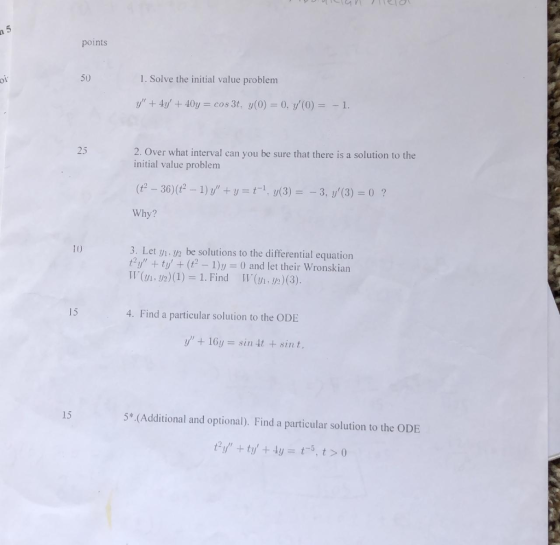
Could you solve all the problems, please? Thank you
Homework Answers
 As
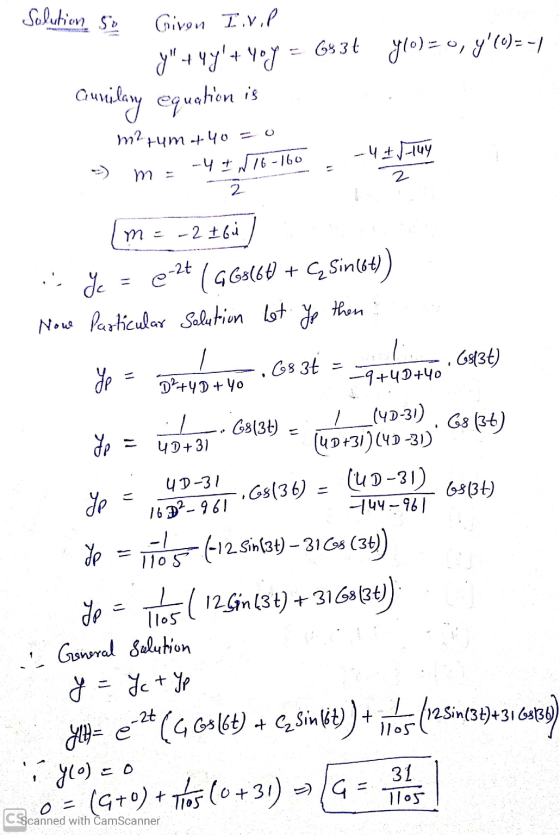
by HOMEWORKLIB RULES i solved one question here.
As
by HOMEWORKLIB RULES i solved one question here.
I hope it will help you...
Add Answer to:
Could you solve all the problems, please? Thank you
D ie 15 points 50 1. Solve...
find Y1=, Y2=, and W(t)= (1 point) Find the function yi of t which is the...
 find Y1=, Y2=, and W(t)=
(1 point) Find the function yi of t which is the solution of 25y" – 40y' + 12y = 0 y(0) = 1, yf(0) = 0. with initial conditions Yi = Find the function y2 of t which is the solution of 25y" – 40y' + 12y = 0 with initial conditions Y2 = Find the Wronskian W(t) = W(y1, y2). W(t) = Remark: You can find W by direct computation and use Abel's theorem...
find Y1=, Y2=, and W(t)=
(1 point) Find the function yi of t which is the solution of 25y" – 40y' + 12y = 0 y(0) = 1, yf(0) = 0. with initial conditions Yi = Find the function y2 of t which is the solution of 25y" – 40y' + 12y = 0 with initial conditions Y2 = Find the Wronskian W(t) = W(y1, y2). W(t) = Remark: You can find W by direct computation and use Abel's theorem...
Hello These are a math problems that need to solve by MATLAB as code Thank you...
 Hello
These are a math problems that need to solve by MATLAB as
code
Thank you !
Initial Value Problem #1: Consider the following first order ODE: dy-p-3 from to 2.2 with y() I (a) Solve with Euler's explicit method using h04. (b) Solve with the midpoint method using h 0.4. (c) Solve with the classical fourth-order Runge-Kutta method using 0.4 analytical solution of the ODE is,·? solution and the numerical solution at the points where the numerical solution is...
Hello
These are a math problems that need to solve by MATLAB as
code
Thank you !
Initial Value Problem #1: Consider the following first order ODE: dy-p-3 from to 2.2 with y() I (a) Solve with Euler's explicit method using h04. (b) Solve with the midpoint method using h 0.4. (c) Solve with the classical fourth-order Runge-Kutta method using 0.4 analytical solution of the ODE is,·? solution and the numerical solution at the points where the numerical solution is...
1. [5 Consider the IVP rty(t) + 2 sin(t)y(t) = tan(t) y(5)=2 Does a unique solution of the IVP ex...
 pls do all questions.
thanx
1. [5 Consider the IVP rty(t) + 2 sin(t)y(t) = tan(t) y(5)=2 Does a unique solution of the IVP exist? Do not solve the IVP but fully justify you answer. What is the IOE? 2. 4 Consider the ODE Using undetermined coefficients, what is an approprite guess for the coefficient (s) in yp but fully justify you answer. ? Do not solve for 3. [10] Solve the IVP. Use any approach you like y(x) 6y'(x)...
pls do all questions.
thanx
1. [5 Consider the IVP rty(t) + 2 sin(t)y(t) = tan(t) y(5)=2 Does a unique solution of the IVP exist? Do not solve the IVP but fully justify you answer. What is the IOE? 2. 4 Consider the ODE Using undetermined coefficients, what is an approprite guess for the coefficient (s) in yp but fully justify you answer. ? Do not solve for 3. [10] Solve the IVP. Use any approach you like y(x) 6y'(x)...
4. [15 pts.] For 2y' = -tan(t)(y2 – 1) (a) find the general solution (solve for...
 4. [15 pts.] For 2y' = -tan(t)(y2 – 1) (a) find the general solution (solve for y(t)); (b) solve an initial value problem y(0) = -1/3 (state the domain of definition of the solution).
1. Find the particular solution of the differential equation dydx+ycos(x)=2cos(x)dydx+ycos(x)=2cos(x) satisfying the initial condition y(0)=4y(0)=4. 2. Solve...
 1. Find the particular solution of the differential
equation
dydx+ycos(x)=2cos(x)dydx+ycos(x)=2cos(x)
satisfying the initial condition y(0)=4y(0)=4.
2. Solve the following initial value problem:
8dydt+y=32t8dydt+y=32t
with y(0)=6.y(0)=6.
(1 point) Find the particular solution of the differential equation dy + y cos(x) = 2 cos(z) satisfying the initial condition y(0) = 4. Answer: y= 2+2e^(-sin(x)) Your answer should be a function of x. (1 point) Solve the following initial value problem: dy ty 8 at +y= 32t with y(0) = 6. (Find y as...
1. Find the particular solution of the differential
equation
dydx+ycos(x)=2cos(x)dydx+ycos(x)=2cos(x)
satisfying the initial condition y(0)=4y(0)=4.
2. Solve the following initial value problem:
8dydt+y=32t8dydt+y=32t
with y(0)=6.y(0)=6.
(1 point) Find the particular solution of the differential equation dy + y cos(x) = 2 cos(z) satisfying the initial condition y(0) = 4. Answer: y= 2+2e^(-sin(x)) Your answer should be a function of x. (1 point) Solve the following initial value problem: dy ty 8 at +y= 32t with y(0) = 6. (Find y as...
1. Compute the Wronskian for the following functions. Then use the Wronskian to determine whether the...
 1. Compute the Wronskian for the following functions. Then use the Wronskian to determine whether the functions are linearly independant or linearly dependant. a) {(tan2x - sec2 x),3 (b) le,e,e) 2. Use variation of parameters to find a general solution to 2y" -4ry 6y3 1 given that y 2 and y2- 3 are linearly independant solutions of the associated homogeneous equation. (Hint: be careful the equations are in the right form.) Find a particular solution for each of the following...
(1 point) In this exercise you will solve the initial value problem 1 +x2' (1) Let Ci and C2 be a...
 (1 point) In this exercise you will solve the initial value problem 1 +x2' (1) Let Ci and C2 be arbitrary constants. The general solution to the related homogeneous differential equation " - 4y+4y 0 is the function C2 NOTE: The order in which you enter the answers is important, that is, CJU) + Gg(x)ヂGg(x) + CN 2) The particular solution yo(x) to the differential equation y" +4ys of the form yo) -yi) u)x) and (x) = 2x (3) The...
3 Consider the ordinary differential equation: ty +3tyy 0. e) (2 points) Find the Wronskian Wly,...
 3 Consider the ordinary differential equation: ty +3tyy 0. e) (2 points) Find the Wronskian Wly, yal(t). f) (2 points) Calculate e I podt and compare it to Wl vlt). What do you observe? Does y1(t) = t-1 and y2(t) = t-11nt represent a fundamental set of solutions? g) (2 points) Why? h) (2 points) Find the general solution of ty" +3ty'y 0 İ) (4 points) Solve the initial value problem t2y't3ty'+y = 0, t > 0 with y(1) =...
Consider the ordinary differential equation: t2y" + 3ty' +y = 0. 1 (3 points) e) Use...
 Consider the ordinary differential equation: t2y" + 3ty' +y = 0. 1 (3 points) e) Use Abel's formula to find the Wronskian of any two solutions of this equation and W[y1,y2](t). What do you observe? compare it to = t1 and y2(t) = t-1 nt represent a fundamental set of solu f) (2 points) Determine if y1 (t) tions (2 points) Find the general solution of t2y" +3ty' +y = 0. g) Solve the initial value problem t2y" + 3ty/...
alpha = 3 beta =2 Can you solve it in a hour please Thank you very...
 alpha = 3
beta =2 Can you solve it in a hour please Thank you very
much.
1. Consider the following initial-value problem. y' = e(1+B)t ln(1 + y2), 0<t<1 y (0) = a +1 a) ( 15p.) Determine the existence and uniqueness of the solution. b) (15p.) Use Euler's method with h = 0.25 to approximate the solution at t=0.5. {
alpha = 3
beta =2 Can you solve it in a hour please Thank you very
much.
1. Consider the following initial-value problem. y' = e(1+B)t ln(1 + y2), 0<t<1 y (0) = a +1 a) ( 15p.) Determine the existence and uniqueness of the solution. b) (15p.) Use Euler's method with h = 0.25 to approximate the solution at t=0.5. {
 find Y1=, Y2=, and W(t)=
(1 point) Find the function yi of t which is the solution of 25y" – 40y' + 12y = 0 y(0) = 1, yf(0) = 0. with initial conditions Yi = Find the function y2 of t which is the solution of 25y" – 40y' + 12y = 0 with initial conditions Y2 = Find the Wronskian W(t) = W(y1, y2). W(t) = Remark: You can find W by direct computation and use Abel's theorem...
find Y1=, Y2=, and W(t)=
(1 point) Find the function yi of t which is the solution of 25y" – 40y' + 12y = 0 y(0) = 1, yf(0) = 0. with initial conditions Yi = Find the function y2 of t which is the solution of 25y" – 40y' + 12y = 0 with initial conditions Y2 = Find the Wronskian W(t) = W(y1, y2). W(t) = Remark: You can find W by direct computation and use Abel's theorem...
 Hello
These are a math problems that need to solve by MATLAB as
code
Thank you !
Initial Value Problem #1: Consider the following first order ODE: dy-p-3 from to 2.2 with y() I (a) Solve with Euler's explicit method using h04. (b) Solve with the midpoint method using h 0.4. (c) Solve with the classical fourth-order Runge-Kutta method using 0.4 analytical solution of the ODE is,·? solution and the numerical solution at the points where the numerical solution is...
Hello
These are a math problems that need to solve by MATLAB as
code
Thank you !
Initial Value Problem #1: Consider the following first order ODE: dy-p-3 from to 2.2 with y() I (a) Solve with Euler's explicit method using h04. (b) Solve with the midpoint method using h 0.4. (c) Solve with the classical fourth-order Runge-Kutta method using 0.4 analytical solution of the ODE is,·? solution and the numerical solution at the points where the numerical solution is...
 pls do all questions.
thanx
1. [5 Consider the IVP rty(t) + 2 sin(t)y(t) = tan(t) y(5)=2 Does a unique solution of the IVP exist? Do not solve the IVP but fully justify you answer. What is the IOE? 2. 4 Consider the ODE Using undetermined coefficients, what is an approprite guess for the coefficient (s) in yp but fully justify you answer. ? Do not solve for 3. [10] Solve the IVP. Use any approach you like y(x) 6y'(x)...
pls do all questions.
thanx
1. [5 Consider the IVP rty(t) + 2 sin(t)y(t) = tan(t) y(5)=2 Does a unique solution of the IVP exist? Do not solve the IVP but fully justify you answer. What is the IOE? 2. 4 Consider the ODE Using undetermined coefficients, what is an approprite guess for the coefficient (s) in yp but fully justify you answer. ? Do not solve for 3. [10] Solve the IVP. Use any approach you like y(x) 6y'(x)...
 4. [15 pts.] For 2y' = -tan(t)(y2 – 1) (a) find the general solution (solve for y(t)); (b) solve an initial value problem y(0) = -1/3 (state the domain of definition of the solution).
 1. Find the particular solution of the differential
equation
dydx+ycos(x)=2cos(x)dydx+ycos(x)=2cos(x)
satisfying the initial condition y(0)=4y(0)=4.
2. Solve the following initial value problem:
8dydt+y=32t8dydt+y=32t
with y(0)=6.y(0)=6.
(1 point) Find the particular solution of the differential equation dy + y cos(x) = 2 cos(z) satisfying the initial condition y(0) = 4. Answer: y= 2+2e^(-sin(x)) Your answer should be a function of x. (1 point) Solve the following initial value problem: dy ty 8 at +y= 32t with y(0) = 6. (Find y as...
1. Find the particular solution of the differential
equation
dydx+ycos(x)=2cos(x)dydx+ycos(x)=2cos(x)
satisfying the initial condition y(0)=4y(0)=4.
2. Solve the following initial value problem:
8dydt+y=32t8dydt+y=32t
with y(0)=6.y(0)=6.
(1 point) Find the particular solution of the differential equation dy + y cos(x) = 2 cos(z) satisfying the initial condition y(0) = 4. Answer: y= 2+2e^(-sin(x)) Your answer should be a function of x. (1 point) Solve the following initial value problem: dy ty 8 at +y= 32t with y(0) = 6. (Find y as...
 1. Compute the Wronskian for the following functions. Then use the Wronskian to determine whether the functions are linearly independant or linearly dependant. a) {(tan2x - sec2 x),3 (b) le,e,e) 2. Use variation of parameters to find a general solution to 2y" -4ry 6y3 1 given that y 2 and y2- 3 are linearly independant solutions of the associated homogeneous equation. (Hint: be careful the equations are in the right form.) Find a particular solution for each of the following...
 (1 point) In this exercise you will solve the initial value problem 1 +x2' (1) Let Ci and C2 be arbitrary constants. The general solution to the related homogeneous differential equation " - 4y+4y 0 is the function C2 NOTE: The order in which you enter the answers is important, that is, CJU) + Gg(x)ヂGg(x) + CN 2) The particular solution yo(x) to the differential equation y" +4ys of the form yo) -yi) u)x) and (x) = 2x (3) The...
 3 Consider the ordinary differential equation: ty +3tyy 0. e) (2 points) Find the Wronskian Wly, yal(t). f) (2 points) Calculate e I podt and compare it to Wl vlt). What do you observe? Does y1(t) = t-1 and y2(t) = t-11nt represent a fundamental set of solutions? g) (2 points) Why? h) (2 points) Find the general solution of ty" +3ty'y 0 İ) (4 points) Solve the initial value problem t2y't3ty'+y = 0, t > 0 with y(1) =...
 Consider the ordinary differential equation: t2y" + 3ty' +y = 0. 1 (3 points) e) Use Abel's formula to find the Wronskian of any two solutions of this equation and W[y1,y2](t). What do you observe? compare it to = t1 and y2(t) = t-1 nt represent a fundamental set of solu f) (2 points) Determine if y1 (t) tions (2 points) Find the general solution of t2y" +3ty' +y = 0. g) Solve the initial value problem t2y" + 3ty/...
 alpha = 3
beta =2 Can you solve it in a hour please Thank you very
much.
1. Consider the following initial-value problem. y' = e(1+B)t ln(1 + y2), 0<t<1 y (0) = a +1 a) ( 15p.) Determine the existence and uniqueness of the solution. b) (15p.) Use Euler's method with h = 0.25 to approximate the solution at t=0.5. {
alpha = 3
beta =2 Can you solve it in a hour please Thank you very
much.
1. Consider the following initial-value problem. y' = e(1+B)t ln(1 + y2), 0<t<1 y (0) = a +1 a) ( 15p.) Determine the existence and uniqueness of the solution. b) (15p.) Use Euler's method with h = 0.25 to approximate the solution at t=0.5. {
Most questions answered within 3 hours.
-
Where is the error in this code sequence?
String s1 = "Hello";
String s2 = "ello";...
asked 10 months ago -
Financial data for Joel de Paris, Inc., for last year
follow:
Joel de Paris, Inc.
Balance...
asked 10 months ago -
Consider this reaction:
Al2(SO4)3 (aq)+ BaCl3
(aq) Al2Cl6 (aq)- +
3BaSO4(s) . What is the...
asked 10 months ago -
Suppose that Savneet is considering increasing her
recent random sample from 20 car rentals to 40...
asked 10 months ago -
Trucks arrive at an unloading terminal at an average rate of 120
per hour.
Trucks arrive...
asked 10 months ago -
Why are methanol and ethanol completely soluble in water while
octanol is not very little soluble....
asked 10 months ago -
A facilities manager at a university reads in a research report
that the mean amount of...
asked 10 months ago -
When the CuSO4 is rehydrated by adding water to the anhydrous
compound, is this an endothermic...
asked 10 months ago -
A ray of sunlight is passing from diamond into crown glass; the
angle of incidence is...
asked 10 months ago -
A block of mass 0.249 kg is placed on top of a light, vertical
spring of...
asked 10 months ago -
how do the kidneys compensate in the presences of acidosis
a) trigger hyperventilate
b) reserve acid...
asked 10 months ago -
Question 501 pts
The rental rate of capital to the firm increases. Which of the
following...
asked 10 months ago