Someone in the 36 percent tax bracket can earn 9 percent annually on her investments in...
-
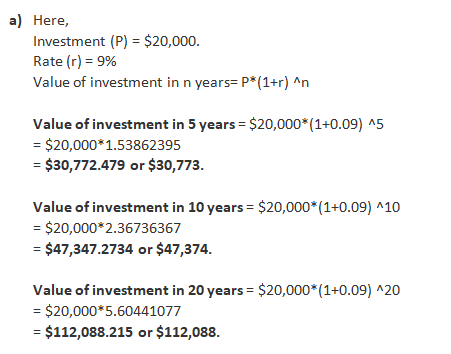
Someone in the 36 percent tax bracket can earn 9 percent annually on her investments in a tax-exempt IRA account. What will be the value of a one-time $20,000 investment in 5 years? 10 years? 20 years? You may use Appendix C to answer the questions. Do not round intermediate calculations. Round your answers to the nearest dollar.
in 5 years: $
in 10 years: $
in 20 years: $
-
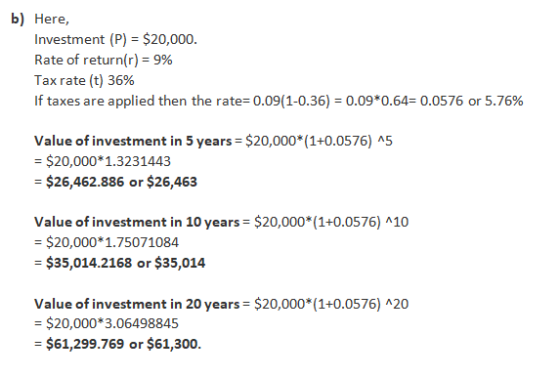
Suppose the preceding 9 percent return is taxable rather than tax-deferred and the taxes are paid annually. What will be the after-tax value of her $20,000 investment after 5, 10, and 20 years? Do not round intermediate calculations. Round your answers to the nearest dollar.
in 5 years: $
in 10 years: $
in 20 years: $
Homework Answers
Add Answer to:
Someone in the 36 percent tax bracket can earn 9 percent
annually on her investments in...
Problem 2-02 a. Someone in the 36 percent tax bracket can earn 8 percent annually on...
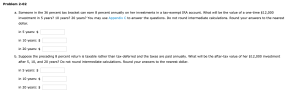 Problem 2-02 a. Someone in the 36 percent tax bracket can earn 8 percent annually on her investments in a tax-exempt IRA account. What will be the value of a one-time $12,000 investment in 5 years? 10 years? 20 years? You may use Appendix C to answer the questions. Do not round intermediate calculations. Round your answers to the nearest dollar. in 5 years: $ in 10 years: $ in 20 years: $ b. Suppose the preceding 8 percent return...
Komiko Tanaka invests $22,500 in LymaBean, Inc. LymaBean does not pay any dividends. Komiko projects that her investmen...
 Komiko Tanaka invests $22,500 in LymaBean, Inc. LymaBean does not pay any dividends. Komiko projects that her investment will generate a 10 percent before-tax rate of return. She plans to invest for the long term. a. How much cash will Komiko retain, after-taxes, if she holds the investment for 5 years and then she sells it when the long-term capital gains rate is 15 percent? (Do not round intermediate calculations. Round your final answer to the nearest whole dollar amount.)...
Jennifer is in the 25% federal income tax bracket and the 3% state income tax bracket....
Jennifer is in the 25% federal income tax bracket and the 3% state income tax bracket. If Jennifer purchases a municipal bond yielding 4.25%, what is her after-tax equivalent yield if the bond income is exempt from both federal and state taxes? 5.84% 5% 7.55% 8. A bond has a YTM of 6.5%, a modified duration of 16.9 years, a duration of 18 years and a 30 year maturity. By what percentage will the bond's price change if market interest...
Question 3 Assume you are in the 20 percent tax bracket and purchase a 5.0 percent...
Question 3 Assume you are in the 20 percent tax bracket and purchase a 5.0 percent municipal bond. Calculate the taxable equivalent yield for this investment. Convert your answer to a percent, then round to 2 decimal places (i.e. 1.25 2.44, 0.09, 12.44). Do not include the "%" sign in your response. Question 4 Assume that three years ago you purchased a corporate bond that pays 6.0 percent. The purchase price was $1110. What is the annual dollar amount of...
Dahlia is in the 32 percent tax rate bracket and has purchased the following shares of Microsoft common stock over the...
 Dahlia is in the 32 percent tax rate bracket and has purchased the following shares of Microsoft common stock over the years Date Purchased Shares Basis /10/2008 540$23,760 4/20/2009 1/29/2010 640 24,064 11/02/2012 390 16,848 440 21,912 If Dahlia sells 1,220 shares of Microsoft for $78,080 on December 20, 2018, what is her capital gain or loss in each of the following assumptions? (Do not round intermediate calculations.) b. She uses the specific identification method and she wants to minimize...
0 Required information The following information applies to the questions displayed below In 2018, Nina contributes 8 percent of her $83,000 annual salary to her 401(k) account. She expects to...
 0 Required information The following information applies to the questions displayed below In 2018, Nina contributes 8 percent of her $83,000 annual salary to her 401(k) account. She expects to earn a 10 percent before-tax rate of return. Assuming she leaves this (and any employer contributions) in the account until she retires in 20 years, what is Nina's after-tax accumulation from her 2018 contributions to her 401(k) account? (Use Table 3. Table 4 (Round your intermediate calculations and final answers...
In 2018, Nina contributes 14 percent of her $111,000 annual salary to her 401(k) account. She...
In 2018, Nina contributes 14 percent of her $111,000 annual salary to her 401(k) account. She expects to earn a 9 percent before-tax rate of return. Assuming she leaves this (and any employer contributions) in the account until she retires in 20 years, what is Nina’s after-tax accumulation from her 2018 contributions to her 401(k) account? (Use Table 3, Table 4.) (Round your intermediate calculations and final answers to the nearest whole dollar amount.) a. Assume Nina’s marginal tax rate...
Komiko Tanaka invests $24,500 in LymaBean, Inc. LymaBean does not pay any dividends. Komiko projects that...
Komiko Tanaka invests $24,500 in LymaBean, Inc. LymaBean does not pay any dividends. Komiko projects that her investment will generate a 10 percent before-tax rate of return. She plans to invest for the long term. a. How much cash will Komiko retain, after-taxes, if she holds the investment for 5 years and then she sells it when the long-term capital gains rate is 15 percent? (Do not round intermediate calculations. Round your final answer to the nearest whole dollar amount.)...
Komiko Tanaka invests $23,500 in LymaBean, Inc. LymaBean does not pay any dividends. Komiko projects that...
Komiko Tanaka invests $23,500 in LymaBean, Inc. LymaBean does not pay any dividends. Komiko projects that her investment will generate a 10 percent before-tax rate of return. She plans to invest for the long term. a. How much cash will Komiko retain, after-taxes, if she holds the investment for 5 years and then she sells it when the long-term capital gains rate is 15 percent? (Do not round intermediate calculations. Round your final answer to the nearest whole dollar amount.)...
Komiko Tanaka invests $21,000 in LymaBean, Inc. LymaBean does not pay any dividends. Komiko projects that...
 Komiko Tanaka invests $21,000 in LymaBean, Inc. LymaBean does not pay any dividends. Komiko projects that her investment will generate a 10 percent before tax rate of return. She plans to invest for the long term. a. How much cash willkomiko retain after-taxes she holds the investment for 5 years and then she sells it when the long-term capital gains rate is 15 percent? (Do not round intermediate calculations. Round your final answer to the nearest whole dollar amount.) Cash...
 Problem 2-02 a. Someone in the 36 percent tax bracket can earn 8 percent annually on her investments in a tax-exempt IRA account. What will be the value of a one-time $12,000 investment in 5 years? 10 years? 20 years? You may use Appendix C to answer the questions. Do not round intermediate calculations. Round your answers to the nearest dollar. in 5 years: $ in 10 years: $ in 20 years: $ b. Suppose the preceding 8 percent return...
 Komiko Tanaka invests $22,500 in LymaBean, Inc. LymaBean does not pay any dividends. Komiko projects that her investment will generate a 10 percent before-tax rate of return. She plans to invest for the long term. a. How much cash will Komiko retain, after-taxes, if she holds the investment for 5 years and then she sells it when the long-term capital gains rate is 15 percent? (Do not round intermediate calculations. Round your final answer to the nearest whole dollar amount.)...
 Dahlia is in the 32 percent tax rate bracket and has purchased the following shares of Microsoft common stock over the years Date Purchased Shares Basis /10/2008 540$23,760 4/20/2009 1/29/2010 640 24,064 11/02/2012 390 16,848 440 21,912 If Dahlia sells 1,220 shares of Microsoft for $78,080 on December 20, 2018, what is her capital gain or loss in each of the following assumptions? (Do not round intermediate calculations.) b. She uses the specific identification method and she wants to minimize...
 0 Required information The following information applies to the questions displayed below In 2018, Nina contributes 8 percent of her $83,000 annual salary to her 401(k) account. She expects to earn a 10 percent before-tax rate of return. Assuming she leaves this (and any employer contributions) in the account until she retires in 20 years, what is Nina's after-tax accumulation from her 2018 contributions to her 401(k) account? (Use Table 3. Table 4 (Round your intermediate calculations and final answers...
 Komiko Tanaka invests $21,000 in LymaBean, Inc. LymaBean does not pay any dividends. Komiko projects that her investment will generate a 10 percent before tax rate of return. She plans to invest for the long term. a. How much cash willkomiko retain after-taxes she holds the investment for 5 years and then she sells it when the long-term capital gains rate is 15 percent? (Do not round intermediate calculations. Round your final answer to the nearest whole dollar amount.) Cash...
Most questions answered within 3 hours.
-
Where is the error in this code sequence?
String s1 = "Hello";
String s2 = "ello";...
asked 11 months ago -
Financial data for Joel de Paris, Inc., for last year
follow:
Joel de Paris, Inc.
Balance...
asked 11 months ago -
Consider this reaction:
Al2(SO4)3 (aq)+ BaCl3
(aq) Al2Cl6 (aq)- +
3BaSO4(s) . What is the...
asked 11 months ago -
Suppose that Savneet is considering increasing her
recent random sample from 20 car rentals to 40...
asked 11 months ago -
Trucks arrive at an unloading terminal at an average rate of 120
per hour.
Trucks arrive...
asked 11 months ago -
Why are methanol and ethanol completely soluble in water while
octanol is not very little soluble....
asked 11 months ago -
A facilities manager at a university reads in a research report
that the mean amount of...
asked 11 months ago -
When the CuSO4 is rehydrated by adding water to the anhydrous
compound, is this an endothermic...
asked 11 months ago -
A ray of sunlight is passing from diamond into crown glass; the
angle of incidence is...
asked 11 months ago -
A block of mass 0.249 kg is placed on top of a light, vertical
spring of...
asked 11 months ago -
how do the kidneys compensate in the presences of acidosis
a) trigger hyperventilate
b) reserve acid...
asked 11 months ago -
Question 501 pts
The rental rate of capital to the firm increases. Which of the
following...
asked 11 months ago