Let A and B be two messages and H() be a hash function that is defined...
Let A and B be two messages and H() be a hash function that is defined on their message space. If A=B, then H(A) = H(B). (This property is a direct consequence of the definition of “function”.) If H(A) = H(B) is it true that A=B? Explain your answer.
Homework Answers
Request Answer!
We need at least 10 more requests to produce the answer.
0 / 10 have requested this problem solution
The more requests, the faster the answer.
Add Answer to:
Let A and B be two messages and H() be a hash function that is
defined...
Demonstrate how you can construct an Iterative Hash h function using the Merkle- Damgard Design. Use...
 Demonstrate how you can construct an Iterative Hash h function using the Merkle- Damgard Design. Use as your compression function f:{0, 1}^v times {0, 1}^b rightarrow {0, 1}^v, AES with 512-bit keys. Explain what the values of v and b will be in your compression function and where in the block cipher (AES) are you using the blocks of the message you want to hash. Using the iterative hash function you just create above, show how a digest for a...
Question 1 A hash function takes a ____________ length input and returns a _________ length output...
Question 1 A hash function takes a ____________ length input and returns a _________ length output variable / fixed fixed / variable variable / variable fixed / fixed Question 2 What is the one way property of cryptographic hash functions? h:hash value, M: message easy to compute h from f(M) easy to compute M from h hard to compute h from f(M) simple structure of the function f Question 3 There're two type of collision resistance : weak and strong...
1. Let h be a hash function mapping U to indexes (0...m -1]. Assume that |U|...
 1. Let h be a hash function mapping U to indexes (0...m -1]. Assume that |U| m2 Could an adversary could pick a set K of m/2 keys from U which are all mapped into the same cell? What is the value of ΣzyEKFh(x,y) in this case ? Fh(x,y) is the function defined in the slides on the section discussing Universal Families of Hash functions.
Topic: Intro to Cryptography Collision-resistant hash function Let (Gen1, H1) and (Gen2, H2) be two hash...
 Topic: Intro to Cryptography
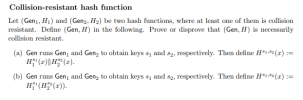
Collision-resistant hash function Let (Gen1, H1) and (Gen2, H2) be two hash functions, where at least one of them is collision resistant. Define (Gen, H) in the following. Prove or disprove that (Gen, H) is necessarily collision resistant. (a) Gen runs Gen, and Gen, to obtain keys 81 and 82, respectively. Then define H$1,82 (2) := H (2)| HP (). (b) Gen runs Gen, and Gen, to obtain keys and s2, respectively. Then define H81,82 ()...
Topic: Intro to Cryptography
Collision-resistant hash function Let (Gen1, H1) and (Gen2, H2) be two hash functions, where at least one of them is collision resistant. Define (Gen, H) in the following. Prove or disprove that (Gen, H) is necessarily collision resistant. (a) Gen runs Gen, and Gen, to obtain keys 81 and 82, respectively. Then define H$1,82 (2) := H (2)| HP (). (b) Gen runs Gen, and Gen, to obtain keys and s2, respectively. Then define H81,82 ()...
Let h: R+ +R be a function defined by h(t) = vt. Determine if the function...
 Let h: R+ +R be a function defined by h(t) = vt. Determine if the function is surjective. Prove your conclusion either with an appropriate proof or counterexample.
4. Let S be the set of continuous function f: [0;1) ! R. Let R be...
 4. Let S be the set of continuous function f: [0;1) ! R. Let R be the relation defined on S by (f; g) 2 Rif(x) is O(g(x)). (a) Is R reflexive? (b) Is R antisymmetric? (c) is R symmetric? (d) is R transitive? Explain your answer in details. Use the definition of big-O to justify your answer if you think R has a certain property or give a counter example if you think R does not have a certain...
Given the hash function: H(key) = key/2; Hash table size = 7 and index = H(key)%...
Given the hash function: H(key) = key/2; Hash table size = 7 and index = H(key)% Hash table size Show how the hash table below looks after adding the following (key, value) pairs, (illustrate your strategy for collision handling) (3000, “A”) (3232, “B”) (1223, “C”) (4569, “K”) (6767, “F”) (1234, “P”) (2324, “F”) (3422, “G”) (1231, “R”) index Key Value 0 1 2 3 4 5
^b Given input( 66, 28, 43, 29, 44, 69, 19) and a hash function h(x) =...
 ^b
Given input( 66, 28, 43, 29, 44, 69, 19) and a hash function h(x) = x mod 10, show the resulting hash table 1) Using Separate Chaining 2) Using Linear Probing 3) Using Quadratic Probing 4) Starting with the following hash function: h2(x) 7- (x mod 7), applv Rehash ary course slides ing as described in the prim Rehashing Increases the size of the hash table when load factor becomes "too high" (defined by a cutoff) - Anticipating that...
^b
Given input( 66, 28, 43, 29, 44, 69, 19) and a hash function h(x) = x mod 10, show the resulting hash table 1) Using Separate Chaining 2) Using Linear Probing 3) Using Quadratic Probing 4) Starting with the following hash function: h2(x) 7- (x mod 7), applv Rehash ary course slides ing as described in the prim Rehashing Increases the size of the hash table when load factor becomes "too high" (defined by a cutoff) - Anticipating that...
Let 'M' denote the hash table size. Consider the following four different hash table implementations: a....
 Let 'M' denote the hash table size. Consider the following four different hash table implementations: a. Implementation (I) uses chaining, and the hash function is hash(x)x mod M. Assume that this implementation maintains a sorted list of the elements (from biggest to smallest) for each chain. b. Implementation (II) uses open addressing by Linear probing, and the hash function is ht(x) - (hash(x) + f(i)) mod M, where hash(x)x mod M, and f(i)- c. Implementation (III) uses open addressing by...
Use Definition 7.1.1. DEFINITION 7.1.1 Laplace Transform Let f be a function defined for t ≥...
 Use Definition 7.1.1.
DEFINITION 7.1.1 Laplace Transform Let f be a function defined for
t ≥ 0. Then the integral ℒ{f(t)} = ∞ e−stf(t) dt 0 is said to be
the Laplace transform of f, provided that the integral converges.
Find ℒ{f(t)}. (Write your answer as a function of s.) ℒ{f(t)} = (s
> 0)
Use Definition 7.1.1. DEFINITION 7.1.1 Laplace Transform et f be a function defined for t2 0. Then the integral is said to be the Laplace...
Use Definition 7.1.1.
DEFINITION 7.1.1 Laplace Transform Let f be a function defined for
t ≥ 0. Then the integral ℒ{f(t)} = ∞ e−stf(t) dt 0 is said to be
the Laplace transform of f, provided that the integral converges.
Find ℒ{f(t)}. (Write your answer as a function of s.) ℒ{f(t)} = (s
> 0)
Use Definition 7.1.1. DEFINITION 7.1.1 Laplace Transform et f be a function defined for t2 0. Then the integral is said to be the Laplace...
 Demonstrate how you can construct an Iterative Hash h function using the Merkle- Damgard Design. Use as your compression function f:{0, 1}^v times {0, 1}^b rightarrow {0, 1}^v, AES with 512-bit keys. Explain what the values of v and b will be in your compression function and where in the block cipher (AES) are you using the blocks of the message you want to hash. Using the iterative hash function you just create above, show how a digest for a...
 1. Let h be a hash function mapping U to indexes (0...m -1]. Assume that |U| m2 Could an adversary could pick a set K of m/2 keys from U which are all mapped into the same cell? What is the value of ΣzyEKFh(x,y) in this case ? Fh(x,y) is the function defined in the slides on the section discussing Universal Families of Hash functions.
 Topic: Intro to Cryptography
Collision-resistant hash function Let (Gen1, H1) and (Gen2, H2) be two hash functions, where at least one of them is collision resistant. Define (Gen, H) in the following. Prove or disprove that (Gen, H) is necessarily collision resistant. (a) Gen runs Gen, and Gen, to obtain keys 81 and 82, respectively. Then define H$1,82 (2) := H (2)| HP (). (b) Gen runs Gen, and Gen, to obtain keys and s2, respectively. Then define H81,82 ()...
Topic: Intro to Cryptography
Collision-resistant hash function Let (Gen1, H1) and (Gen2, H2) be two hash functions, where at least one of them is collision resistant. Define (Gen, H) in the following. Prove or disprove that (Gen, H) is necessarily collision resistant. (a) Gen runs Gen, and Gen, to obtain keys 81 and 82, respectively. Then define H$1,82 (2) := H (2)| HP (). (b) Gen runs Gen, and Gen, to obtain keys and s2, respectively. Then define H81,82 ()...
 Let h: R+ +R be a function defined by h(t) = vt. Determine if the function is surjective. Prove your conclusion either with an appropriate proof or counterexample.
 4. Let S be the set of continuous function f: [0;1) ! R. Let R be the relation defined on S by (f; g) 2 Rif(x) is O(g(x)). (a) Is R reflexive? (b) Is R antisymmetric? (c) is R symmetric? (d) is R transitive? Explain your answer in details. Use the definition of big-O to justify your answer if you think R has a certain property or give a counter example if you think R does not have a certain...
 ^b
Given input( 66, 28, 43, 29, 44, 69, 19) and a hash function h(x) = x mod 10, show the resulting hash table 1) Using Separate Chaining 2) Using Linear Probing 3) Using Quadratic Probing 4) Starting with the following hash function: h2(x) 7- (x mod 7), applv Rehash ary course slides ing as described in the prim Rehashing Increases the size of the hash table when load factor becomes "too high" (defined by a cutoff) - Anticipating that...
^b
Given input( 66, 28, 43, 29, 44, 69, 19) and a hash function h(x) = x mod 10, show the resulting hash table 1) Using Separate Chaining 2) Using Linear Probing 3) Using Quadratic Probing 4) Starting with the following hash function: h2(x) 7- (x mod 7), applv Rehash ary course slides ing as described in the prim Rehashing Increases the size of the hash table when load factor becomes "too high" (defined by a cutoff) - Anticipating that...
 Let 'M' denote the hash table size. Consider the following four different hash table implementations: a. Implementation (I) uses chaining, and the hash function is hash(x)x mod M. Assume that this implementation maintains a sorted list of the elements (from biggest to smallest) for each chain. b. Implementation (II) uses open addressing by Linear probing, and the hash function is ht(x) - (hash(x) + f(i)) mod M, where hash(x)x mod M, and f(i)- c. Implementation (III) uses open addressing by...
 Use Definition 7.1.1.
DEFINITION 7.1.1 Laplace Transform Let f be a function defined for
t ≥ 0. Then the integral ℒ{f(t)} = ∞ e−stf(t) dt 0 is said to be
the Laplace transform of f, provided that the integral converges.
Find ℒ{f(t)}. (Write your answer as a function of s.) ℒ{f(t)} = (s
> 0)
Use Definition 7.1.1. DEFINITION 7.1.1 Laplace Transform et f be a function defined for t2 0. Then the integral is said to be the Laplace...
Use Definition 7.1.1.
DEFINITION 7.1.1 Laplace Transform Let f be a function defined for
t ≥ 0. Then the integral ℒ{f(t)} = ∞ e−stf(t) dt 0 is said to be
the Laplace transform of f, provided that the integral converges.
Find ℒ{f(t)}. (Write your answer as a function of s.) ℒ{f(t)} = (s
> 0)
Use Definition 7.1.1. DEFINITION 7.1.1 Laplace Transform et f be a function defined for t2 0. Then the integral is said to be the Laplace...
Most questions answered within 3 hours.
-
Where is the error in this code sequence?
String s1 = "Hello";
String s2 = "ello";...
asked 10 months ago -
Financial data for Joel de Paris, Inc., for last year
follow:
Joel de Paris, Inc.
Balance...
asked 10 months ago -
Consider this reaction:
Al2(SO4)3 (aq)+ BaCl3
(aq) Al2Cl6 (aq)- +
3BaSO4(s) . What is the...
asked 10 months ago -
Suppose that Savneet is considering increasing her
recent random sample from 20 car rentals to 40...
asked 10 months ago -
Trucks arrive at an unloading terminal at an average rate of 120
per hour.
Trucks arrive...
asked 10 months ago -
Why are methanol and ethanol completely soluble in water while
octanol is not very little soluble....
asked 10 months ago -
A facilities manager at a university reads in a research report
that the mean amount of...
asked 10 months ago -
When the CuSO4 is rehydrated by adding water to the anhydrous
compound, is this an endothermic...
asked 10 months ago -
A ray of sunlight is passing from diamond into crown glass; the
angle of incidence is...
asked 10 months ago -
A block of mass 0.249 kg is placed on top of a light, vertical
spring of...
asked 10 months ago -
how do the kidneys compensate in the presences of acidosis
a) trigger hyperventilate
b) reserve acid...
asked 10 months ago -
Question 501 pts
The rental rate of capital to the firm increases. Which of the
following...
asked 10 months ago