How much energy is released when a positron and aan electron collide? Show all work for...
How much energy is released when a positron and aan electron collide? Show all work for full credit.
Homework Answers
It depends on how fast the particles are
moving. For example, suppose the electron
and positron are headed for each other with
a momentum of 10 MeV/c for one and -10 MeV/c
for the other, then they each have
energy, sqrt(10^2 + 0.511^2) = 1.12 MeV and so the
total energy released is 2.24 MeV.
The point is, you add the energies which include not
just rest mass, but kinetic energy also. This pricinple
is important in linear colliders where electron positron
annihilation is used to get very large energies used to
then create heavy particles.
A total of 1.022 MeV since both the electron and positron have a mass of .511MeV. This energy comes in the form of two or three gamma ray photons depending on the relative spins of the electron and positron.
total is 1022 keV or 1.64e-13 Joules, and it is released
in the form of two high energy photons.
"when annihilation occurs in an open field, a lot of energy is
given out, destroying any objects nearby" is not true, not for a
single pair.
A total of 1.022 MeV since both the electron and positron have a mass of .511MeV. This energy comes in the form of two or three gamma ray photons depending on the relative spins of the electron and positron.
It depends on how fast the particles are
moving. For example, suppose the electron
and positron are headed for each other with
a momentum of 10 MeV/c for one and -10 MeV/c
for the other, then they each have
energy, sqrt(10^2 + 0.511^2) = 1.12 MeV and so the
total energy released is 2.24 MeV.
The point is, you add the energies which include not
just rest mass, but kinetic energy also. This pricinple
is important in linear colliders where electron positron
annihilation is used to get very large energies used to
then create heavy particles.
Add Answer to:
How much energy is released when a positron and aan electron
collide? Show all work for...
A positron is the antiparticle of the electron. Suppose an electron and a positron collide and...
 A positron is the antiparticle of the electron. Suppose an electron and a positron collide and annihilate each other. How much energy is released? The electron and positron each have a mass of 9.1 x 10⁻³¹ kg.
when a electron and positron collide their minute masses are completely converted to energy. this is...
when a electron and positron collide their minute masses are completely converted to energy. this is example of 1. antimatter 2. combustion alpha decay
CREDIT Show all work for partial credit. 1) How much heat energy is released when 1000....
 CREDIT Show all work for partial credit. 1) How much heat energy is released when 1000. g of methane gas (CH4) is completely reacted with excess O2 according to the following equation? (up to 8 pts) Hint: you will need to convert from g- mol energy CH& Cg)+202 (g) CO2 (g ) + 2 H20 (I)+890.4 kJ
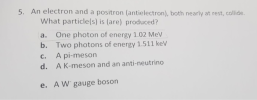
Show your solution 5. An electron and a positron (antielectron), both nearly at rest, collide. What...
 Show your solution
5. An electron and a positron (antielectron), both nearly at rest, collide. What particle(s) is (are) produced? a. One photon of energy 1.02 Mev b. Two photons of energy 1.511 keV c. A pi-meson d. A K-meson and an anti-neutrino e. A W gauge boson
Show your solution
5. An electron and a positron (antielectron), both nearly at rest, collide. What particle(s) is (are) produced? a. One photon of energy 1.02 Mev b. Two photons of energy 1.511 keV c. A pi-meson d. A K-meson and an anti-neutrino e. A W gauge boson
An electron and a positron, each moving at 3.0 x 10^5m/s, collide head on, disappear, and...
An electron and a positron, each moving at 3.0 x 10^5m/s, collide head on, disappear, and produce two photons moving in opposite directions, each with the same energy and momentum. Determine the energy and momentum of each photon (show your units)
How much total kinetic energy will an electron-positron pair have if produced by a 3.64 MeV...
How much total kinetic energy will an electron-positron pair have if produced by a 3.64 MeV photon? In MeV
Part A How much total kinetic energy will an electron-positron pair have if produced by a...
Part A How much total kinetic energy will an electron-positron pair have if produced by a 3.69 MeV photon? Express your answer using three significant figures.
An electron and a positron each have a mass of 9.11 × 10⁻³¹ kg. They collide...
 An electron and a positron each have a mass of 9.11 ×
10-31 kg. They collide and both vanish, with only
electromagnetic radiation appearing after the collision. If each
particle is moving at a speed of 0.42c relative to the
laboratory before the collision, determine the energy of the
electromagnetic radiation.
Particles before annihilation Burst of EM radiation after annihilation
An electron and a positron each have a mass of 9.11 ×
10-31 kg. They collide and both vanish, with only
electromagnetic radiation appearing after the collision. If each
particle is moving at a speed of 0.42c relative to the
laboratory before the collision, determine the energy of the
electromagnetic radiation.
Particles before annihilation Burst of EM radiation after annihilation
Extra Credit: (MUST SHOW WORK!!) How much total ATP will be produced by the electron transport...
 Extra Credit: (MUST SHOW WORK!!) How much total ATP will be produced by the electron transport chain when you completely metabolize 38 molecules of the disaccharide MALTOSE (glucose+glucose)?
The electron affinity is the energy released when an electron is added to a neutral atom...
 The electron affinity is the energy released when an electron is added to a neutral atom to make a 1- anion. The table below shows the electron affinities for the 2nd period (row) elements. The value reported is the amount of energy released when an electron is added to a neutral atom. If no energy is released the anion is not stable and that is reported. Explain the overall trend of electron affinity increasing as you move left to right...
 A positron is the antiparticle of the electron. Suppose an electron and a positron collide and annihilate each other. How much energy is released? The electron and positron each have a mass of 9.1 x 10⁻³¹ kg.
 CREDIT Show all work for partial credit. 1) How much heat energy is released when 1000. g of methane gas (CH4) is completely reacted with excess O2 according to the following equation? (up to 8 pts) Hint: you will need to convert from g- mol energy CH& Cg)+202 (g) CO2 (g ) + 2 H20 (I)+890.4 kJ
 Show your solution
5. An electron and a positron (antielectron), both nearly at rest, collide. What particle(s) is (are) produced? a. One photon of energy 1.02 Mev b. Two photons of energy 1.511 keV c. A pi-meson d. A K-meson and an anti-neutrino e. A W gauge boson
Show your solution
5. An electron and a positron (antielectron), both nearly at rest, collide. What particle(s) is (are) produced? a. One photon of energy 1.02 Mev b. Two photons of energy 1.511 keV c. A pi-meson d. A K-meson and an anti-neutrino e. A W gauge boson
 An electron and a positron each have a mass of 9.11 ×
10-31 kg. They collide and both vanish, with only
electromagnetic radiation appearing after the collision. If each
particle is moving at a speed of 0.42c relative to the
laboratory before the collision, determine the energy of the
electromagnetic radiation.
Particles before annihilation Burst of EM radiation after annihilation
An electron and a positron each have a mass of 9.11 ×
10-31 kg. They collide and both vanish, with only
electromagnetic radiation appearing after the collision. If each
particle is moving at a speed of 0.42c relative to the
laboratory before the collision, determine the energy of the
electromagnetic radiation.
Particles before annihilation Burst of EM radiation after annihilation
 Extra Credit: (MUST SHOW WORK!!) How much total ATP will be produced by the electron transport chain when you completely metabolize 38 molecules of the disaccharide MALTOSE (glucose+glucose)?
 The electron affinity is the energy released when an electron is added to a neutral atom to make a 1- anion. The table below shows the electron affinities for the 2nd period (row) elements. The value reported is the amount of energy released when an electron is added to a neutral atom. If no energy is released the anion is not stable and that is reported. Explain the overall trend of electron affinity increasing as you move left to right...
Most questions answered within 3 hours.
-
Where is the error in this code sequence?
String s1 = "Hello";
String s2 = "ello";...
asked 10 months ago -
Financial data for Joel de Paris, Inc., for last year
follow:
Joel de Paris, Inc.
Balance...
asked 10 months ago -
Consider this reaction:
Al2(SO4)3 (aq)+ BaCl3
(aq) Al2Cl6 (aq)- +
3BaSO4(s) . What is the...
asked 10 months ago -
Suppose that Savneet is considering increasing her
recent random sample from 20 car rentals to 40...
asked 10 months ago -
Trucks arrive at an unloading terminal at an average rate of 120
per hour.
Trucks arrive...
asked 10 months ago -
Why are methanol and ethanol completely soluble in water while
octanol is not very little soluble....
asked 10 months ago -
A facilities manager at a university reads in a research report
that the mean amount of...
asked 10 months ago -
When the CuSO4 is rehydrated by adding water to the anhydrous
compound, is this an endothermic...
asked 10 months ago -
A ray of sunlight is passing from diamond into crown glass; the
angle of incidence is...
asked 10 months ago -
A block of mass 0.249 kg is placed on top of a light, vertical
spring of...
asked 10 months ago -
how do the kidneys compensate in the presences of acidosis
a) trigger hyperventilate
b) reserve acid...
asked 10 months ago -
Question 501 pts
The rental rate of capital to the firm increases. Which of the
following...
asked 10 months ago