when a electron and positron collide their minute masses are completely converted to energy. this is...
when a electron and positron collide their minute
masses are completely converted to energy. this is example of
1. antimatter 2. combustion alpha decay
Homework Answers

Add Answer to:
when a electron and positron collide their minute
masses are completely converted to energy. this is...
When a positron and an electron annihilate one another, the resulting mass is completely converted to...
When a positron and an electron annihilate one another, the resulting mass is completely converted to energy. Calculate the energy associated with this process in kJ/mol. (I got 9.861 x 10^7 kJ per mol of reactant and that is wrong.)
A positron is the antiparticle of the electron. Suppose an electron and a positron collide and...
 A positron is the antiparticle of the electron. Suppose an electron and a positron collide and annihilate each other. How much energy is released? The electron and positron each have a mass of 9.1 x 10⁻³¹ kg.
How much energy is released when a positron and aan electron collide? Show all work for...
How much energy is released when a positron and aan electron collide? Show all work for full credit.
An electron and a positron, each moving at 3.0 x 10^5m/s, collide head on, disappear, and...
An electron and a positron, each moving at 3.0 x 10^5m/s, collide head on, disappear, and produce two photons moving in opposite directions, each with the same energy and momentum. Determine the energy and momentum of each photon (show your units)
An electron and a positron each have a mass of 9.11 × 10⁻³¹ kg. They collide...
 An electron and a positron each have a mass of 9.11 ×
10-31 kg. They collide and both vanish, with only
electromagnetic radiation appearing after the collision. If each
particle is moving at a speed of 0.42c relative to the
laboratory before the collision, determine the energy of the
electromagnetic radiation.
Particles before annihilation Burst of EM radiation after annihilation
An electron and a positron each have a mass of 9.11 ×
10-31 kg. They collide and both vanish, with only
electromagnetic radiation appearing after the collision. If each
particle is moving at a speed of 0.42c relative to the
laboratory before the collision, determine the energy of the
electromagnetic radiation.
Particles before annihilation Burst of EM radiation after annihilation
2. Electron-positron annihilation A positron with kinetic energy equal to twice its rest mass energy is incident on an...
 2. Electron-positron annihilation A positron with kinetic energy equal to twice its rest mass energy is incident on an electron at rest The positron and electron annihilate creating two photons. One photon goes off at an angle of 30 with respect to the incident positron. Compute the energies of the two photons and find the direction in which the second photon travels
2. Electron-positron annihilation A positron with kinetic energy equal to twice its rest mass energy is incident on...
2. Electron-positron annihilation A positron with kinetic energy equal to twice its rest mass energy is incident on an electron at rest The positron and electron annihilate creating two photons. One photon goes off at an angle of 30 with respect to the incident positron. Compute the energies of the two photons and find the direction in which the second photon travels
2. Electron-positron annihilation A positron with kinetic energy equal to twice its rest mass energy is incident on...
Show your solution 5. An electron and a positron (antielectron), both nearly at rest, collide. What...
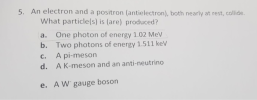 Show your solution
5. An electron and a positron (antielectron), both nearly at rest, collide. What particle(s) is (are) produced? a. One photon of energy 1.02 Mev b. Two photons of energy 1.511 keV c. A pi-meson d. A K-meson and an anti-neutrino e. A W gauge boson
Show your solution
5. An electron and a positron (antielectron), both nearly at rest, collide. What particle(s) is (are) produced? a. One photon of energy 1.02 Mev b. Two photons of energy 1.511 keV c. A pi-meson d. A K-meson and an anti-neutrino e. A W gauge boson
4. What is the ground-state energy of positronium, the bound state of an electron and positron?...
4. What is the ground-state energy of positronium, the bound state of an electron and positron? Hint: electron and positron have equal masses, so one cannot assume that one of the particles is at rest, while the other orbits around it. It is necessary to calculate using the reduced mass
An electron (rest mass me) of energy E makes a head-on collision with a positron (positron...
 An electron (rest mass me) of
energy E makes a head-on collision with a positron (positron is
electron’s antiparticle, it has the same mass as electron, but
opposite charge) In collision the two particles annihilate each
other and are replaces by two photons (γ rays) of equal energy,
each traveling at equal angles θ with electron’s direction of
motion. Find 1. The energy of each photon. 2. The momentum p of
each photon. 3. The angle θ.
Problem 3. Electron-positron...
An electron (rest mass me) of
energy E makes a head-on collision with a positron (positron is
electron’s antiparticle, it has the same mass as electron, but
opposite charge) In collision the two particles annihilate each
other and are replaces by two photons (γ rays) of equal energy,
each traveling at equal angles θ with electron’s direction of
motion. Find 1. The energy of each photon. 2. The momentum p of
each photon. 3. The angle θ.
Problem 3. Electron-positron...
Let's do a little particle physics. Back in the '9os there was a large electron-positron collider...
 Particle Physics
Let's do a little particle physics. Back in the '9os there was a large electron-positron collider at CERN in Geneva, Switzerland, called the "Large electron-positron collider," or LEP for short. (This collider was broken down and rebuilt into an even larger one that runs to this day, called the "Large hadron collider" or LHC.) It was LEP that discovered the W and Z bosons, which mediate weak nuclear processes like the beta decay of free neutrons Anyway, near...
Particle Physics
Let's do a little particle physics. Back in the '9os there was a large electron-positron collider at CERN in Geneva, Switzerland, called the "Large electron-positron collider," or LEP for short. (This collider was broken down and rebuilt into an even larger one that runs to this day, called the "Large hadron collider" or LHC.) It was LEP that discovered the W and Z bosons, which mediate weak nuclear processes like the beta decay of free neutrons Anyway, near...
 A positron is the antiparticle of the electron. Suppose an electron and a positron collide and annihilate each other. How much energy is released? The electron and positron each have a mass of 9.1 x 10⁻³¹ kg.
 An electron and a positron each have a mass of 9.11 ×
10-31 kg. They collide and both vanish, with only
electromagnetic radiation appearing after the collision. If each
particle is moving at a speed of 0.42c relative to the
laboratory before the collision, determine the energy of the
electromagnetic radiation.
Particles before annihilation Burst of EM radiation after annihilation
An electron and a positron each have a mass of 9.11 ×
10-31 kg. They collide and both vanish, with only
electromagnetic radiation appearing after the collision. If each
particle is moving at a speed of 0.42c relative to the
laboratory before the collision, determine the energy of the
electromagnetic radiation.
Particles before annihilation Burst of EM radiation after annihilation
 2. Electron-positron annihilation A positron with kinetic energy equal to twice its rest mass energy is incident on an electron at rest The positron and electron annihilate creating two photons. One photon goes off at an angle of 30 with respect to the incident positron. Compute the energies of the two photons and find the direction in which the second photon travels
2. Electron-positron annihilation A positron with kinetic energy equal to twice its rest mass energy is incident on...
2. Electron-positron annihilation A positron with kinetic energy equal to twice its rest mass energy is incident on an electron at rest The positron and electron annihilate creating two photons. One photon goes off at an angle of 30 with respect to the incident positron. Compute the energies of the two photons and find the direction in which the second photon travels
2. Electron-positron annihilation A positron with kinetic energy equal to twice its rest mass energy is incident on...
 Show your solution
5. An electron and a positron (antielectron), both nearly at rest, collide. What particle(s) is (are) produced? a. One photon of energy 1.02 Mev b. Two photons of energy 1.511 keV c. A pi-meson d. A K-meson and an anti-neutrino e. A W gauge boson
Show your solution
5. An electron and a positron (antielectron), both nearly at rest, collide. What particle(s) is (are) produced? a. One photon of energy 1.02 Mev b. Two photons of energy 1.511 keV c. A pi-meson d. A K-meson and an anti-neutrino e. A W gauge boson
 An electron (rest mass me) of
energy E makes a head-on collision with a positron (positron is
electron’s antiparticle, it has the same mass as electron, but
opposite charge) In collision the two particles annihilate each
other and are replaces by two photons (γ rays) of equal energy,
each traveling at equal angles θ with electron’s direction of
motion. Find 1. The energy of each photon. 2. The momentum p of
each photon. 3. The angle θ.
Problem 3. Electron-positron...
An electron (rest mass me) of
energy E makes a head-on collision with a positron (positron is
electron’s antiparticle, it has the same mass as electron, but
opposite charge) In collision the two particles annihilate each
other and are replaces by two photons (γ rays) of equal energy,
each traveling at equal angles θ with electron’s direction of
motion. Find 1. The energy of each photon. 2. The momentum p of
each photon. 3. The angle θ.
Problem 3. Electron-positron...
 Particle Physics
Let's do a little particle physics. Back in the '9os there was a large electron-positron collider at CERN in Geneva, Switzerland, called the "Large electron-positron collider," or LEP for short. (This collider was broken down and rebuilt into an even larger one that runs to this day, called the "Large hadron collider" or LHC.) It was LEP that discovered the W and Z bosons, which mediate weak nuclear processes like the beta decay of free neutrons Anyway, near...
Particle Physics
Let's do a little particle physics. Back in the '9os there was a large electron-positron collider at CERN in Geneva, Switzerland, called the "Large electron-positron collider," or LEP for short. (This collider was broken down and rebuilt into an even larger one that runs to this day, called the "Large hadron collider" or LHC.) It was LEP that discovered the W and Z bosons, which mediate weak nuclear processes like the beta decay of free neutrons Anyway, near...
Most questions answered within 3 hours.
-
Where is the error in this code sequence?
String s1 = "Hello";
String s2 = "ello";...
asked 10 months ago -
Financial data for Joel de Paris, Inc., for last year
follow:
Joel de Paris, Inc.
Balance...
asked 10 months ago -
Consider this reaction:
Al2(SO4)3 (aq)+ BaCl3
(aq) Al2Cl6 (aq)- +
3BaSO4(s) . What is the...
asked 10 months ago -
Suppose that Savneet is considering increasing her
recent random sample from 20 car rentals to 40...
asked 10 months ago -
Trucks arrive at an unloading terminal at an average rate of 120
per hour.
Trucks arrive...
asked 10 months ago -
Why are methanol and ethanol completely soluble in water while
octanol is not very little soluble....
asked 10 months ago -
A facilities manager at a university reads in a research report
that the mean amount of...
asked 10 months ago -
When the CuSO4 is rehydrated by adding water to the anhydrous
compound, is this an endothermic...
asked 10 months ago -
A ray of sunlight is passing from diamond into crown glass; the
angle of incidence is...
asked 10 months ago -
A block of mass 0.249 kg is placed on top of a light, vertical
spring of...
asked 10 months ago -
how do the kidneys compensate in the presences of acidosis
a) trigger hyperventilate
b) reserve acid...
asked 10 months ago -
Question 501 pts
The rental rate of capital to the firm increases. Which of the
following...
asked 10 months ago