
Homework Answers
Add Answer to:
blems key step in the biosynthesis of triglycerides (fats) is the ion of glycerol to glycerol-1-phosphate...
3. A key step in the biosynthesis of triglycerides (fats) is the conversion of glycerol to...
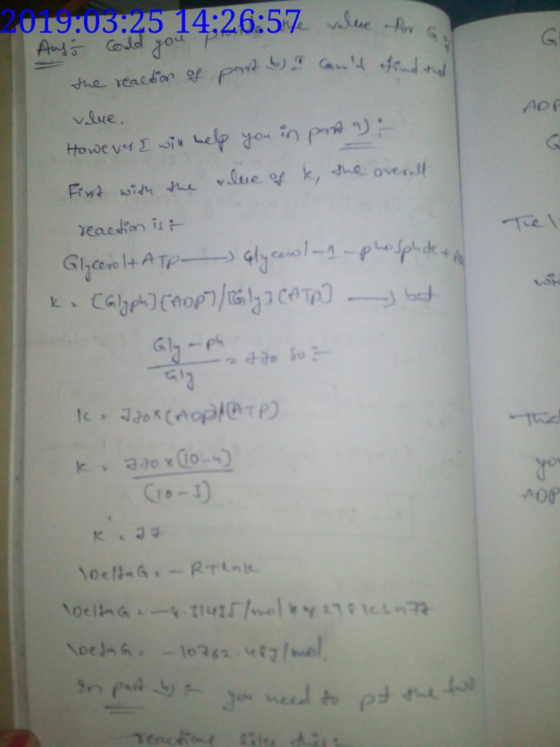
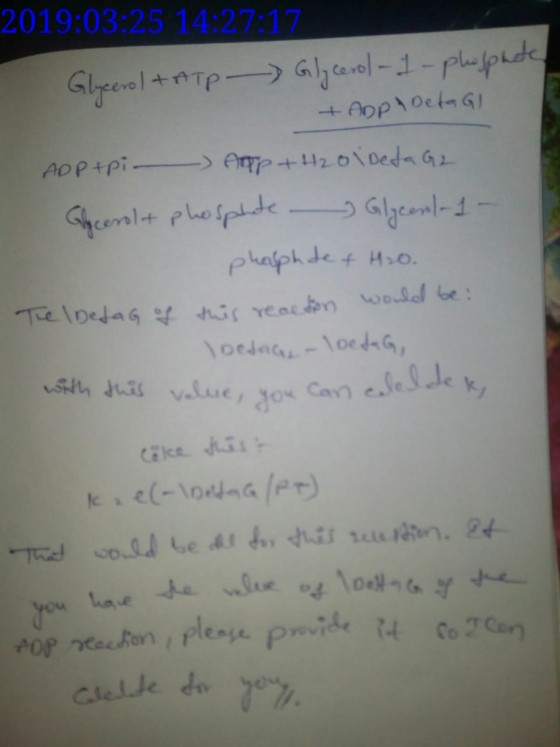
 3. A key step in the biosynthesis of triglycerides (fats) is the conversion of glycerol to glycerol- 1-phosphate by ATP (10+10-20) Glycerol + ATP glycerol-1-phosphate + ADP At a steady state in the living cell, [ATP] - 10 Mand (ADP) - 10 M. The cquilibrium value of the ratio of glycerol-1-phosphate - 770 at 298 K and pH-7. The standard (glycerol) free energy of hydrolysis of ATP to ADP is-30.5 kJ/mol. Calculate 4 Gº and K' for the reaction Glycerol...
The concentration of fructose 6-phosphate (F6P) and fructose 1, 6-biphosphate (F16BP), ATP, and ADP in muscle...
 The concentration of fructose 6-phosphate (F6P) and fructose 1, 6-biphosphate (F16BP), ATP, and ADP in muscle tissue were measured as 0.089, 0.012, 12.0, and 1.2 mM. For the reaction F6P(aq) + ATP(aq) rightarrow F16BP(aq) + ADP(aq) at 37 degree C, the standard Gibbs energy (at pFl=7) is -18.3 kJ/mol. Calculate the reaction Gibbs energy (kJ/mol) for the reaction in the muscle tissue environment. -71.2 -29.4 -7.3 +4.5 +11.2.
CHEM 351 Biochemistry I - Fall 2018 Study Problems for Metabolism and Glucose Catabolism For the...
 CHEM 351 Biochemistry I - Fall 2018 Study Problems for Metabolism and Glucose Catabolism For the reaction: aA + bB =cC + dD Gibbs free energy: AG = AG" + RT IN THE glucose + glucose 6-phosphate + H20 1. The equilibrium constant for phosphorylation of glucose is: Ke = 3.97 x 10- a. Calculate the standard Gibbs free energy for the uncatalyzed reaction. b. Use the physiological concentrations for glucose (2.0 mm) and inorganic phosphate (20 mM) to determine...
please help! thanks TABLE 12-4 Standard Free Energy Change for Phosphate Hydrolysis Compound AGⓇ' (kJ. mol-')...
 please help! thanks
TABLE 12-4 Standard Free Energy Change for Phosphate Hydrolysis Compound AGⓇ' (kJ. mol-') Phosphoenolpyruvate -61.9 1,3-Bisphosphoglycerate -49.4 ATP → AMP + PP, -45.6 Phosphocreatine -43.1 ATP ADP + P -30.5 Glucose-1-phosphate -20.9 PP, 2P, -19.2 Glucose-6-phosphate -13.8 Glycerol-3-phosphate -9.2 thioester bond AGⓇ' = -31.5 kJ•mol-1 H20 O CH3 -C-s-CoA I CH3 -C-0- + COA-SH Acetyl-CoA The formation of acetyl CoA from acetate is an ATP driven reaction: Acetate + ATP + COA <--> acetyl COA + AMP...
please help! thanks
TABLE 12-4 Standard Free Energy Change for Phosphate Hydrolysis Compound AGⓇ' (kJ. mol-') Phosphoenolpyruvate -61.9 1,3-Bisphosphoglycerate -49.4 ATP → AMP + PP, -45.6 Phosphocreatine -43.1 ATP ADP + P -30.5 Glucose-1-phosphate -20.9 PP, 2P, -19.2 Glucose-6-phosphate -13.8 Glycerol-3-phosphate -9.2 thioester bond AGⓇ' = -31.5 kJ•mol-1 H20 O CH3 -C-s-CoA I CH3 -C-0- + COA-SH Acetyl-CoA The formation of acetyl CoA from acetate is an ATP driven reaction: Acetate + ATP + COA <--> acetyl COA + AMP...
QUESTION 6 Allenosine-5-monophosphate (AMP) can react with inorganic phosphate ion (P;) in water to form Adenosine-5'-diphosphate...
 QUESTION 6 Allenosine-5-monophosphate (AMP) can react with inorganic phosphate ion (P;) in water to form Adenosine-5'-diphosphate (ADP) according to the following chemical equation: AMP (aq) + P; (aq) = ADP (aq) Solution concentrations of AMP, Pi, and ADP were measured at 25°C after the reaction reached equilibrium and found to be 0.241 M, 0.563 M, and 0.132 (that is 10-6 M), respectively. Use these observations to answer questions 6-8: What is the equilibrium constant (Keq) for the synthesis reaction of...
1) SHOW WORK 12. During glycolysis, glucose 1-phosphate is converted to fructose 6-phosphate in two successive...
 1) SHOW WORK
12. During glycolysis, glucose 1-phosphate is converted to fructose 6-phosphate in two successive reactions: glucose 1-phosphate → glucose 6-phosphate glucose 6-phosphate + fructose 6-phosphate AG'' = -7.1 kJ/mol AG'º = +1.7 kJ/mol 13. The standard free-energy changes for the reactions below are given. phosphocreatine → creatine + Pi ATP → ADP + Pi AG" = 43.0 kJ/mol AG" = -30.5 kJ/mol What is the overall AG' for the following reaction? Iw a dee Hydrolysis of 1 M...
1) SHOW WORK
12. During glycolysis, glucose 1-phosphate is converted to fructose 6-phosphate in two successive reactions: glucose 1-phosphate → glucose 6-phosphate glucose 6-phosphate + fructose 6-phosphate AG'' = -7.1 kJ/mol AG'º = +1.7 kJ/mol 13. The standard free-energy changes for the reactions below are given. phosphocreatine → creatine + Pi ATP → ADP + Pi AG" = 43.0 kJ/mol AG" = -30.5 kJ/mol What is the overall AG' for the following reaction? Iw a dee Hydrolysis of 1 M...
(a) For the following conditions, calculate the change in the Gibbs energy associated with transporting 1...
 (a) For the following conditions, calculate the change in the Gibbs energy associated with transporting 1 mole of sodium ions from inside to outside the cell. Is work required or produced? Outside: [Na+] = 130 mM [K+] 5 mM Electrical potential = 0 mV [Na+]= [K 110 mM Electrical potential =-70 mV Temperature 25 °C Inside: 10 mM (b) For the same conditions, calculate the change in the Gibbs energy associated with transporting 1 mole of potassium ions from outside...
NUMBER 10 PLEASE -Kor Cor The Henry's law constant of oxygen in water at 25 °C...
 NUMBER 10 PLEASE
-Kor Cor The Henry's law constant of oxygen in water at 25 °C is 773 atm mol'' kg of water. Calculate the molality of oxygen in water under a partial pressure of 0.20 atm. Assume that the solubility of oxygen in blood at 37 °C is roughly the same as that in water at 25 °C, comment on the prospect for our survival without hemoglobin molecules. The total volume of blood in the human body is about...
NUMBER 10 PLEASE
-Kor Cor The Henry's law constant of oxygen in water at 25 °C is 773 atm mol'' kg of water. Calculate the molality of oxygen in water under a partial pressure of 0.20 atm. Assume that the solubility of oxygen in blood at 37 °C is roughly the same as that in water at 25 °C, comment on the prospect for our survival without hemoglobin molecules. The total volume of blood in the human body is about...
Please help answer ALL the following questions in the attachment. Please answer only if you’re certain....
 Please help answer ALL the following questions in the
attachment. Please answer only if you’re certain. Thank you so much
for your help.
1 Find the mismatched pai a) Entropy (AS-measurement of disorder in a thermodynamic system b) AG<0-Energetically favorable (spontaneous) reaction c) First Law of Thermodynamics-Energy in a system is not created nor destroyed, only transformed d) Second Law of Thermodynamics-The entropy of a perfect crystal at 0 K is exactly equal to zero. e) Standard free energy (G-The...
Please help answer ALL the following questions in the
attachment. Please answer only if you’re certain. Thank you so much
for your help.
1 Find the mismatched pai a) Entropy (AS-measurement of disorder in a thermodynamic system b) AG<0-Energetically favorable (spontaneous) reaction c) First Law of Thermodynamics-Energy in a system is not created nor destroyed, only transformed d) Second Law of Thermodynamics-The entropy of a perfect crystal at 0 K is exactly equal to zero. e) Standard free energy (G-The...
Use the chart to answer the questions. Please be correct and careful In one step of...
 Use the chart to answer the questions. Please be correct and
careful
In one step of glycolysis, glyceraldehyde 3-phosphate is oxidized by NAD+ to yield 3-phosphoglycerate and NADH. 2 2 2 Table 10-2 Standard Reduction Potentials for Redox Pairs of Biological Relevance* Redox Pair Number of (oxidized form → reduced form) Electrons E.(V) acetate pyruvate 2 -0.70 succinate → a-ketoglutarate 2 -0.67 acetate acetaldehyde 2 -0.60 3-phosphoglycerate → glyceraldehyde-3-P 2 -0.55 a-ketoglutarate isocitrate -0.38 NAD+ → NADH 2 -0.32 FMN-FMNH2...
Use the chart to answer the questions. Please be correct and
careful
In one step of glycolysis, glyceraldehyde 3-phosphate is oxidized by NAD+ to yield 3-phosphoglycerate and NADH. 2 2 2 Table 10-2 Standard Reduction Potentials for Redox Pairs of Biological Relevance* Redox Pair Number of (oxidized form → reduced form) Electrons E.(V) acetate pyruvate 2 -0.70 succinate → a-ketoglutarate 2 -0.67 acetate acetaldehyde 2 -0.60 3-phosphoglycerate → glyceraldehyde-3-P 2 -0.55 a-ketoglutarate isocitrate -0.38 NAD+ → NADH 2 -0.32 FMN-FMNH2...
 3. A key step in the biosynthesis of triglycerides (fats) is the conversion of glycerol to glycerol- 1-phosphate by ATP (10+10-20) Glycerol + ATP glycerol-1-phosphate + ADP At a steady state in the living cell, [ATP] - 10 Mand (ADP) - 10 M. The cquilibrium value of the ratio of glycerol-1-phosphate - 770 at 298 K and pH-7. The standard (glycerol) free energy of hydrolysis of ATP to ADP is-30.5 kJ/mol. Calculate 4 Gº and K' for the reaction Glycerol...
 The concentration of fructose 6-phosphate (F6P) and fructose 1, 6-biphosphate (F16BP), ATP, and ADP in muscle tissue were measured as 0.089, 0.012, 12.0, and 1.2 mM. For the reaction F6P(aq) + ATP(aq) rightarrow F16BP(aq) + ADP(aq) at 37 degree C, the standard Gibbs energy (at pFl=7) is -18.3 kJ/mol. Calculate the reaction Gibbs energy (kJ/mol) for the reaction in the muscle tissue environment. -71.2 -29.4 -7.3 +4.5 +11.2.
 CHEM 351 Biochemistry I - Fall 2018 Study Problems for Metabolism and Glucose Catabolism For the reaction: aA + bB =cC + dD Gibbs free energy: AG = AG" + RT IN THE glucose + glucose 6-phosphate + H20 1. The equilibrium constant for phosphorylation of glucose is: Ke = 3.97 x 10- a. Calculate the standard Gibbs free energy for the uncatalyzed reaction. b. Use the physiological concentrations for glucose (2.0 mm) and inorganic phosphate (20 mM) to determine...
 please help! thanks
TABLE 12-4 Standard Free Energy Change for Phosphate Hydrolysis Compound AGⓇ' (kJ. mol-') Phosphoenolpyruvate -61.9 1,3-Bisphosphoglycerate -49.4 ATP → AMP + PP, -45.6 Phosphocreatine -43.1 ATP ADP + P -30.5 Glucose-1-phosphate -20.9 PP, 2P, -19.2 Glucose-6-phosphate -13.8 Glycerol-3-phosphate -9.2 thioester bond AGⓇ' = -31.5 kJ•mol-1 H20 O CH3 -C-s-CoA I CH3 -C-0- + COA-SH Acetyl-CoA The formation of acetyl CoA from acetate is an ATP driven reaction: Acetate + ATP + COA <--> acetyl COA + AMP...
please help! thanks
TABLE 12-4 Standard Free Energy Change for Phosphate Hydrolysis Compound AGⓇ' (kJ. mol-') Phosphoenolpyruvate -61.9 1,3-Bisphosphoglycerate -49.4 ATP → AMP + PP, -45.6 Phosphocreatine -43.1 ATP ADP + P -30.5 Glucose-1-phosphate -20.9 PP, 2P, -19.2 Glucose-6-phosphate -13.8 Glycerol-3-phosphate -9.2 thioester bond AGⓇ' = -31.5 kJ•mol-1 H20 O CH3 -C-s-CoA I CH3 -C-0- + COA-SH Acetyl-CoA The formation of acetyl CoA from acetate is an ATP driven reaction: Acetate + ATP + COA <--> acetyl COA + AMP...
 QUESTION 6 Allenosine-5-monophosphate (AMP) can react with inorganic phosphate ion (P;) in water to form Adenosine-5'-diphosphate (ADP) according to the following chemical equation: AMP (aq) + P; (aq) = ADP (aq) Solution concentrations of AMP, Pi, and ADP were measured at 25°C after the reaction reached equilibrium and found to be 0.241 M, 0.563 M, and 0.132 (that is 10-6 M), respectively. Use these observations to answer questions 6-8: What is the equilibrium constant (Keq) for the synthesis reaction of...
 1) SHOW WORK
12. During glycolysis, glucose 1-phosphate is converted to fructose 6-phosphate in two successive reactions: glucose 1-phosphate → glucose 6-phosphate glucose 6-phosphate + fructose 6-phosphate AG'' = -7.1 kJ/mol AG'º = +1.7 kJ/mol 13. The standard free-energy changes for the reactions below are given. phosphocreatine → creatine + Pi ATP → ADP + Pi AG" = 43.0 kJ/mol AG" = -30.5 kJ/mol What is the overall AG' for the following reaction? Iw a dee Hydrolysis of 1 M...
1) SHOW WORK
12. During glycolysis, glucose 1-phosphate is converted to fructose 6-phosphate in two successive reactions: glucose 1-phosphate → glucose 6-phosphate glucose 6-phosphate + fructose 6-phosphate AG'' = -7.1 kJ/mol AG'º = +1.7 kJ/mol 13. The standard free-energy changes for the reactions below are given. phosphocreatine → creatine + Pi ATP → ADP + Pi AG" = 43.0 kJ/mol AG" = -30.5 kJ/mol What is the overall AG' for the following reaction? Iw a dee Hydrolysis of 1 M...
 (a) For the following conditions, calculate the change in the Gibbs energy associated with transporting 1 mole of sodium ions from inside to outside the cell. Is work required or produced? Outside: [Na+] = 130 mM [K+] 5 mM Electrical potential = 0 mV [Na+]= [K 110 mM Electrical potential =-70 mV Temperature 25 °C Inside: 10 mM (b) For the same conditions, calculate the change in the Gibbs energy associated with transporting 1 mole of potassium ions from outside...
 NUMBER 10 PLEASE
-Kor Cor The Henry's law constant of oxygen in water at 25 °C is 773 atm mol'' kg of water. Calculate the molality of oxygen in water under a partial pressure of 0.20 atm. Assume that the solubility of oxygen in blood at 37 °C is roughly the same as that in water at 25 °C, comment on the prospect for our survival without hemoglobin molecules. The total volume of blood in the human body is about...
NUMBER 10 PLEASE
-Kor Cor The Henry's law constant of oxygen in water at 25 °C is 773 atm mol'' kg of water. Calculate the molality of oxygen in water under a partial pressure of 0.20 atm. Assume that the solubility of oxygen in blood at 37 °C is roughly the same as that in water at 25 °C, comment on the prospect for our survival without hemoglobin molecules. The total volume of blood in the human body is about...
 Please help answer ALL the following questions in the
attachment. Please answer only if you’re certain. Thank you so much
for your help.
1 Find the mismatched pai a) Entropy (AS-measurement of disorder in a thermodynamic system b) AG<0-Energetically favorable (spontaneous) reaction c) First Law of Thermodynamics-Energy in a system is not created nor destroyed, only transformed d) Second Law of Thermodynamics-The entropy of a perfect crystal at 0 K is exactly equal to zero. e) Standard free energy (G-The...
Please help answer ALL the following questions in the
attachment. Please answer only if you’re certain. Thank you so much
for your help.
1 Find the mismatched pai a) Entropy (AS-measurement of disorder in a thermodynamic system b) AG<0-Energetically favorable (spontaneous) reaction c) First Law of Thermodynamics-Energy in a system is not created nor destroyed, only transformed d) Second Law of Thermodynamics-The entropy of a perfect crystal at 0 K is exactly equal to zero. e) Standard free energy (G-The...
 Use the chart to answer the questions. Please be correct and
careful
In one step of glycolysis, glyceraldehyde 3-phosphate is oxidized by NAD+ to yield 3-phosphoglycerate and NADH. 2 2 2 Table 10-2 Standard Reduction Potentials for Redox Pairs of Biological Relevance* Redox Pair Number of (oxidized form → reduced form) Electrons E.(V) acetate pyruvate 2 -0.70 succinate → a-ketoglutarate 2 -0.67 acetate acetaldehyde 2 -0.60 3-phosphoglycerate → glyceraldehyde-3-P 2 -0.55 a-ketoglutarate isocitrate -0.38 NAD+ → NADH 2 -0.32 FMN-FMNH2...
Use the chart to answer the questions. Please be correct and
careful
In one step of glycolysis, glyceraldehyde 3-phosphate is oxidized by NAD+ to yield 3-phosphoglycerate and NADH. 2 2 2 Table 10-2 Standard Reduction Potentials for Redox Pairs of Biological Relevance* Redox Pair Number of (oxidized form → reduced form) Electrons E.(V) acetate pyruvate 2 -0.70 succinate → a-ketoglutarate 2 -0.67 acetate acetaldehyde 2 -0.60 3-phosphoglycerate → glyceraldehyde-3-P 2 -0.55 a-ketoglutarate isocitrate -0.38 NAD+ → NADH 2 -0.32 FMN-FMNH2...
Most questions answered within 3 hours.
-
Where is the error in this code sequence?
String s1 = "Hello";
String s2 = "ello";...
asked 10 months ago -
Financial data for Joel de Paris, Inc., for last year
follow:
Joel de Paris, Inc.
Balance...
asked 10 months ago -
Consider this reaction:
Al2(SO4)3 (aq)+ BaCl3
(aq) Al2Cl6 (aq)- +
3BaSO4(s) . What is the...
asked 10 months ago -
Suppose that Savneet is considering increasing her
recent random sample from 20 car rentals to 40...
asked 10 months ago -
Trucks arrive at an unloading terminal at an average rate of 120
per hour.
Trucks arrive...
asked 10 months ago -
Why are methanol and ethanol completely soluble in water while
octanol is not very little soluble....
asked 10 months ago -
A facilities manager at a university reads in a research report
that the mean amount of...
asked 10 months ago -
When the CuSO4 is rehydrated by adding water to the anhydrous
compound, is this an endothermic...
asked 10 months ago -
A ray of sunlight is passing from diamond into crown glass; the
angle of incidence is...
asked 10 months ago -
A block of mass 0.249 kg is placed on top of a light, vertical
spring of...
asked 10 months ago -
how do the kidneys compensate in the presences of acidosis
a) trigger hyperventilate
b) reserve acid...
asked 10 months ago -
Question 501 pts
The rental rate of capital to the firm increases. Which of the
following...
asked 10 months ago