
Homework Answers
![Solution > Glycerol -/- phosphate +ADP NOW, Glycerol + ATP K= (Gryph) (ADP) (G1Y) (ATP) But [Guy - ph] / (Guy) - 77080 x = 77](http://img.homeworklib.com/questions/cb626d60-9e15-11ea-a0b9-51d1e8058b77.png?x-oss-process=image/resize,w_560)
Add Answer to:
3. A key step in the biosynthesis of triglycerides (fats) is the conversion of glycerol to...
blems key step in the biosynthesis of triglycerides (fats) is the ion of glycerol to glycerol-1-phosphate...
 blems key step in the biosynthesis of triglycerides (fats) is the ion of glycerol to glycerol-1-phosphate by ATP: glycerol +ATP glycerol-1-phosphate + ADP At a steady state in the living cell, (ATP) 10- M and (ADP)-10 M. The maximum (equilibrium) value of the ratio (glycerol-1-P(glycerol) is observed to be 770 at 25°C and pH 7. a. Calculate K' and A,G298 for the reaction. b. Using the value of A,G98" for the reaction ADP P ATP H20, together with the answer...
1. Referring to Table 1, calculate the AGº' for the reactions shown and predict whether they...
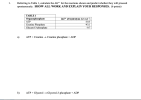 1. Referring to Table 1, calculate the AGº' for the reactions shown and predict whether they will proceed spontaneously. SHOW ALL WORK AND EXPLAIN YOUR RESPONSES. (6 points) TABLE 1 Organophosphate ATP Creatine Phosphate Glycerol-3-phosphate AGⓇ of hydrolysis (kJ mol!) -30.5 -43.1 -9.7 a) ATP + Creatine → Creatine phosphate + ADP b) ATP + Glycerol → Glycerol-3-phosphate + ADP
3. (4 pts) Living organisms use energy from the metabolism of food to create an energy-rich...
 3. (4 pts) Living organisms use energy from the metabolism of food to create an energy-rich molecule called adenosine triphosphate (ATP). The ATP then acts as an energy source for a variety of reactions that in living organisms must carry out to survive. ATP provides energy through its hydrolysis, which can be symbolized as follows: ATP(aq) + H2O(l) → ADP(aq) + Pin(aq) &Gorun =-30.5 kJ where ADP represents adenosine diphosphate and Pm represents an inorganic phosphate group (e.g., HPO,). In...
stion 8 of 25 > The table lists the standard free energies of hydrolysis (AGⓇ) of...
 stion 8 of 25 > The table lists the standard free energies of hydrolysis (AGⓇ) of some phosphorylated compounds. Compound kJ mol kcal mol-1 Phosphoenolpyruvate (PEP) -61.9 --14.8 1,3-Bisphosphoglycerate (1,3-BPG) -49.4 - 11.8 Creatine phosphate -43.1 ATP (to ADP) -30.5 -7.3 Glucose 1-phosphate -20.9 -5.0 Pyrophosphate (PP) Glucose 6-phosphate Glycerol 3-phosphate -9.2 -2.2 10.3 -4.6 -13.8 3.3 What is the direction of each of the following reactions when the reactants are initially present in equimolar amounts? The reaction ATP+H,O -...
please help! thanks TABLE 12-4 Standard Free Energy Change for Phosphate Hydrolysis Compound AGⓇ' (kJ. mol-')...
 please help! thanks
TABLE 12-4 Standard Free Energy Change for Phosphate Hydrolysis Compound AGⓇ' (kJ. mol-') Phosphoenolpyruvate -61.9 1,3-Bisphosphoglycerate -49.4 ATP → AMP + PP, -45.6 Phosphocreatine -43.1 ATP ADP + P -30.5 Glucose-1-phosphate -20.9 PP, 2P, -19.2 Glucose-6-phosphate -13.8 Glycerol-3-phosphate -9.2 thioester bond AGⓇ' = -31.5 kJ•mol-1 H20 O CH3 -C-s-CoA I CH3 -C-0- + COA-SH Acetyl-CoA The formation of acetyl CoA from acetate is an ATP driven reaction: Acetate + ATP + COA <--> acetyl COA + AMP...
please help! thanks
TABLE 12-4 Standard Free Energy Change for Phosphate Hydrolysis Compound AGⓇ' (kJ. mol-') Phosphoenolpyruvate -61.9 1,3-Bisphosphoglycerate -49.4 ATP → AMP + PP, -45.6 Phosphocreatine -43.1 ATP ADP + P -30.5 Glucose-1-phosphate -20.9 PP, 2P, -19.2 Glucose-6-phosphate -13.8 Glycerol-3-phosphate -9.2 thioester bond AGⓇ' = -31.5 kJ•mol-1 H20 O CH3 -C-s-CoA I CH3 -C-0- + COA-SH Acetyl-CoA The formation of acetyl CoA from acetate is an ATP driven reaction: Acetate + ATP + COA <--> acetyl COA + AMP...
the enzyme hexokinase can catalyze the following reaction: fructose + ATP -> fructose 6 phosphate +...
 the enzyme hexokinase can catalyze the following
reaction:
fructose + ATP -> fructose 6 phosphate + adp
if the deltaG of hydrolysis of fructose 6 phosphate to
fructose + Pi is -13.8 kj/mol and hydrolysis of atp to adp + pi is
-30kj/mol, calculate Keq for the reaction above (R = 8.31 j mol-1
K-1, T = 298 k
3a. The enzyme hexokinase can catalyze the following reaction: Fructose + ATP → Fructose-6-phosphate + ADP If the ΔGo of hydrolysis...
the enzyme hexokinase can catalyze the following
reaction:
fructose + ATP -> fructose 6 phosphate + adp
if the deltaG of hydrolysis of fructose 6 phosphate to
fructose + Pi is -13.8 kj/mol and hydrolysis of atp to adp + pi is
-30kj/mol, calculate Keq for the reaction above (R = 8.31 j mol-1
K-1, T = 298 k
3a. The enzyme hexokinase can catalyze the following reaction: Fructose + ATP → Fructose-6-phosphate + ADP If the ΔGo of hydrolysis...
10) The AG for the hydrolysis of creatine phosphate is -43.1 k/mol, whereas the AG for...
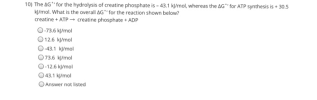 10) The AG for the hydrolysis of creatine phosphate is -43.1 k/mol, whereas the AG for ATP synthesis is+30.5 kj/mol, what is the overall ΔG., for the reaction shown below? creatine + ATP creatine phosphate+ADP O-73.6 kj/mol O12.6 k/mol -43.1 k/mol O73.6 k/mol -12.6 kj/mol 043.1 Wmol Answer not listed
Shown is acetyl phosphate. Say a new enzyme uses acetyl phosphate to phosphorylate ADP to make ATP (acetyl phosphate + ADP —> acetate + ATP). What is the standard free energy change of this reacti...
 Shown is acetyl phosphate. Say a new enzyme uses acetyl
phosphate to phosphorylate ADP to make ATP (acetyl phosphate + ADP
—> acetate + ATP). What is the standard free energy change of
this reaction?
CH3 Table 13-2 Standard Free Energies of Phosphate Hydrolysis of Some Compounds of Biological Interest AGo (kJ mol 1) 61.9 -49.4 45.6 43.1 -43.1 30.5 -20.9 19.2 13.8 13.8 -9.2 Compound Phosphoenolpyruvate 1,3-Bisphosphoglycerate ATP AMP + PP,) Acetyl phosphate Phosphocreatine ATP ㈠ ADP + Pi)...
Shown is acetyl phosphate. Say a new enzyme uses acetyl
phosphate to phosphorylate ADP to make ATP (acetyl phosphate + ADP
—> acetate + ATP). What is the standard free energy change of
this reaction?
CH3 Table 13-2 Standard Free Energies of Phosphate Hydrolysis of Some Compounds of Biological Interest AGo (kJ mol 1) 61.9 -49.4 45.6 43.1 -43.1 30.5 -20.9 19.2 13.8 13.8 -9.2 Compound Phosphoenolpyruvate 1,3-Bisphosphoglycerate ATP AMP + PP,) Acetyl phosphate Phosphocreatine ATP ㈠ ADP + Pi)...
CHEM 351 Biochemistry I - Fall 2018 Study Problems for Metabolism and Glucose Catabolism For the...
 CHEM 351 Biochemistry I - Fall 2018 Study Problems for Metabolism and Glucose Catabolism For the reaction: aA + bB =cC + dD Gibbs free energy: AG = AG" + RT IN THE glucose + glucose 6-phosphate + H20 1. The equilibrium constant for phosphorylation of glucose is: Ke = 3.97 x 10- a. Calculate the standard Gibbs free energy for the uncatalyzed reaction. b. Use the physiological concentrations for glucose (2.0 mm) and inorganic phosphate (20 mM) to determine...
1) SHOW WORK 12. During glycolysis, glucose 1-phosphate is converted to fructose 6-phosphate in two successive...
 1) SHOW WORK
12. During glycolysis, glucose 1-phosphate is converted to fructose 6-phosphate in two successive reactions: glucose 1-phosphate → glucose 6-phosphate glucose 6-phosphate + fructose 6-phosphate AG'' = -7.1 kJ/mol AG'º = +1.7 kJ/mol 13. The standard free-energy changes for the reactions below are given. phosphocreatine → creatine + Pi ATP → ADP + Pi AG" = 43.0 kJ/mol AG" = -30.5 kJ/mol What is the overall AG' for the following reaction? Iw a dee Hydrolysis of 1 M...
1) SHOW WORK
12. During glycolysis, glucose 1-phosphate is converted to fructose 6-phosphate in two successive reactions: glucose 1-phosphate → glucose 6-phosphate glucose 6-phosphate + fructose 6-phosphate AG'' = -7.1 kJ/mol AG'º = +1.7 kJ/mol 13. The standard free-energy changes for the reactions below are given. phosphocreatine → creatine + Pi ATP → ADP + Pi AG" = 43.0 kJ/mol AG" = -30.5 kJ/mol What is the overall AG' for the following reaction? Iw a dee Hydrolysis of 1 M...
 blems key step in the biosynthesis of triglycerides (fats) is the ion of glycerol to glycerol-1-phosphate by ATP: glycerol +ATP glycerol-1-phosphate + ADP At a steady state in the living cell, (ATP) 10- M and (ADP)-10 M. The maximum (equilibrium) value of the ratio (glycerol-1-P(glycerol) is observed to be 770 at 25°C and pH 7. a. Calculate K' and A,G298 for the reaction. b. Using the value of A,G98" for the reaction ADP P ATP H20, together with the answer...
 1. Referring to Table 1, calculate the AGº' for the reactions shown and predict whether they will proceed spontaneously. SHOW ALL WORK AND EXPLAIN YOUR RESPONSES. (6 points) TABLE 1 Organophosphate ATP Creatine Phosphate Glycerol-3-phosphate AGⓇ of hydrolysis (kJ mol!) -30.5 -43.1 -9.7 a) ATP + Creatine → Creatine phosphate + ADP b) ATP + Glycerol → Glycerol-3-phosphate + ADP
 3. (4 pts) Living organisms use energy from the metabolism of food to create an energy-rich molecule called adenosine triphosphate (ATP). The ATP then acts as an energy source for a variety of reactions that in living organisms must carry out to survive. ATP provides energy through its hydrolysis, which can be symbolized as follows: ATP(aq) + H2O(l) → ADP(aq) + Pin(aq) &Gorun =-30.5 kJ where ADP represents adenosine diphosphate and Pm represents an inorganic phosphate group (e.g., HPO,). In...
 stion 8 of 25 > The table lists the standard free energies of hydrolysis (AGⓇ) of some phosphorylated compounds. Compound kJ mol kcal mol-1 Phosphoenolpyruvate (PEP) -61.9 --14.8 1,3-Bisphosphoglycerate (1,3-BPG) -49.4 - 11.8 Creatine phosphate -43.1 ATP (to ADP) -30.5 -7.3 Glucose 1-phosphate -20.9 -5.0 Pyrophosphate (PP) Glucose 6-phosphate Glycerol 3-phosphate -9.2 -2.2 10.3 -4.6 -13.8 3.3 What is the direction of each of the following reactions when the reactants are initially present in equimolar amounts? The reaction ATP+H,O -...
 please help! thanks
TABLE 12-4 Standard Free Energy Change for Phosphate Hydrolysis Compound AGⓇ' (kJ. mol-') Phosphoenolpyruvate -61.9 1,3-Bisphosphoglycerate -49.4 ATP → AMP + PP, -45.6 Phosphocreatine -43.1 ATP ADP + P -30.5 Glucose-1-phosphate -20.9 PP, 2P, -19.2 Glucose-6-phosphate -13.8 Glycerol-3-phosphate -9.2 thioester bond AGⓇ' = -31.5 kJ•mol-1 H20 O CH3 -C-s-CoA I CH3 -C-0- + COA-SH Acetyl-CoA The formation of acetyl CoA from acetate is an ATP driven reaction: Acetate + ATP + COA <--> acetyl COA + AMP...
please help! thanks
TABLE 12-4 Standard Free Energy Change for Phosphate Hydrolysis Compound AGⓇ' (kJ. mol-') Phosphoenolpyruvate -61.9 1,3-Bisphosphoglycerate -49.4 ATP → AMP + PP, -45.6 Phosphocreatine -43.1 ATP ADP + P -30.5 Glucose-1-phosphate -20.9 PP, 2P, -19.2 Glucose-6-phosphate -13.8 Glycerol-3-phosphate -9.2 thioester bond AGⓇ' = -31.5 kJ•mol-1 H20 O CH3 -C-s-CoA I CH3 -C-0- + COA-SH Acetyl-CoA The formation of acetyl CoA from acetate is an ATP driven reaction: Acetate + ATP + COA <--> acetyl COA + AMP...
 the enzyme hexokinase can catalyze the following
reaction:
fructose + ATP -> fructose 6 phosphate + adp
if the deltaG of hydrolysis of fructose 6 phosphate to
fructose + Pi is -13.8 kj/mol and hydrolysis of atp to adp + pi is
-30kj/mol, calculate Keq for the reaction above (R = 8.31 j mol-1
K-1, T = 298 k
3a. The enzyme hexokinase can catalyze the following reaction: Fructose + ATP → Fructose-6-phosphate + ADP If the ΔGo of hydrolysis...
the enzyme hexokinase can catalyze the following
reaction:
fructose + ATP -> fructose 6 phosphate + adp
if the deltaG of hydrolysis of fructose 6 phosphate to
fructose + Pi is -13.8 kj/mol and hydrolysis of atp to adp + pi is
-30kj/mol, calculate Keq for the reaction above (R = 8.31 j mol-1
K-1, T = 298 k
3a. The enzyme hexokinase can catalyze the following reaction: Fructose + ATP → Fructose-6-phosphate + ADP If the ΔGo of hydrolysis...
 10) The AG for the hydrolysis of creatine phosphate is -43.1 k/mol, whereas the AG for ATP synthesis is+30.5 kj/mol, what is the overall ΔG., for the reaction shown below? creatine + ATP creatine phosphate+ADP O-73.6 kj/mol O12.6 k/mol -43.1 k/mol O73.6 k/mol -12.6 kj/mol 043.1 Wmol Answer not listed
 Shown is acetyl phosphate. Say a new enzyme uses acetyl
phosphate to phosphorylate ADP to make ATP (acetyl phosphate + ADP
—> acetate + ATP). What is the standard free energy change of
this reaction?
CH3 Table 13-2 Standard Free Energies of Phosphate Hydrolysis of Some Compounds of Biological Interest AGo (kJ mol 1) 61.9 -49.4 45.6 43.1 -43.1 30.5 -20.9 19.2 13.8 13.8 -9.2 Compound Phosphoenolpyruvate 1,3-Bisphosphoglycerate ATP AMP + PP,) Acetyl phosphate Phosphocreatine ATP ㈠ ADP + Pi)...
Shown is acetyl phosphate. Say a new enzyme uses acetyl
phosphate to phosphorylate ADP to make ATP (acetyl phosphate + ADP
—> acetate + ATP). What is the standard free energy change of
this reaction?
CH3 Table 13-2 Standard Free Energies of Phosphate Hydrolysis of Some Compounds of Biological Interest AGo (kJ mol 1) 61.9 -49.4 45.6 43.1 -43.1 30.5 -20.9 19.2 13.8 13.8 -9.2 Compound Phosphoenolpyruvate 1,3-Bisphosphoglycerate ATP AMP + PP,) Acetyl phosphate Phosphocreatine ATP ㈠ ADP + Pi)...
 CHEM 351 Biochemistry I - Fall 2018 Study Problems for Metabolism and Glucose Catabolism For the reaction: aA + bB =cC + dD Gibbs free energy: AG = AG" + RT IN THE glucose + glucose 6-phosphate + H20 1. The equilibrium constant for phosphorylation of glucose is: Ke = 3.97 x 10- a. Calculate the standard Gibbs free energy for the uncatalyzed reaction. b. Use the physiological concentrations for glucose (2.0 mm) and inorganic phosphate (20 mM) to determine...
 1) SHOW WORK
12. During glycolysis, glucose 1-phosphate is converted to fructose 6-phosphate in two successive reactions: glucose 1-phosphate → glucose 6-phosphate glucose 6-phosphate + fructose 6-phosphate AG'' = -7.1 kJ/mol AG'º = +1.7 kJ/mol 13. The standard free-energy changes for the reactions below are given. phosphocreatine → creatine + Pi ATP → ADP + Pi AG" = 43.0 kJ/mol AG" = -30.5 kJ/mol What is the overall AG' for the following reaction? Iw a dee Hydrolysis of 1 M...
1) SHOW WORK
12. During glycolysis, glucose 1-phosphate is converted to fructose 6-phosphate in two successive reactions: glucose 1-phosphate → glucose 6-phosphate glucose 6-phosphate + fructose 6-phosphate AG'' = -7.1 kJ/mol AG'º = +1.7 kJ/mol 13. The standard free-energy changes for the reactions below are given. phosphocreatine → creatine + Pi ATP → ADP + Pi AG" = 43.0 kJ/mol AG" = -30.5 kJ/mol What is the overall AG' for the following reaction? Iw a dee Hydrolysis of 1 M...
Most questions answered within 3 hours.
-
Where is the error in this code sequence?
String s1 = "Hello";
String s2 = "ello";...
asked 10 months ago -
Financial data for Joel de Paris, Inc., for last year
follow:
Joel de Paris, Inc.
Balance...
asked 10 months ago -
Consider this reaction:
Al2(SO4)3 (aq)+ BaCl3
(aq) Al2Cl6 (aq)- +
3BaSO4(s) . What is the...
asked 10 months ago -
Suppose that Savneet is considering increasing her
recent random sample from 20 car rentals to 40...
asked 10 months ago -
Trucks arrive at an unloading terminal at an average rate of 120
per hour.
Trucks arrive...
asked 10 months ago -
Why are methanol and ethanol completely soluble in water while
octanol is not very little soluble....
asked 10 months ago -
A facilities manager at a university reads in a research report
that the mean amount of...
asked 10 months ago -
When the CuSO4 is rehydrated by adding water to the anhydrous
compound, is this an endothermic...
asked 10 months ago -
A ray of sunlight is passing from diamond into crown glass; the
angle of incidence is...
asked 10 months ago -
A block of mass 0.249 kg is placed on top of a light, vertical
spring of...
asked 10 months ago -
how do the kidneys compensate in the presences of acidosis
a) trigger hyperventilate
b) reserve acid...
asked 10 months ago -
Question 501 pts
The rental rate of capital to the firm increases. Which of the
following...
asked 10 months ago