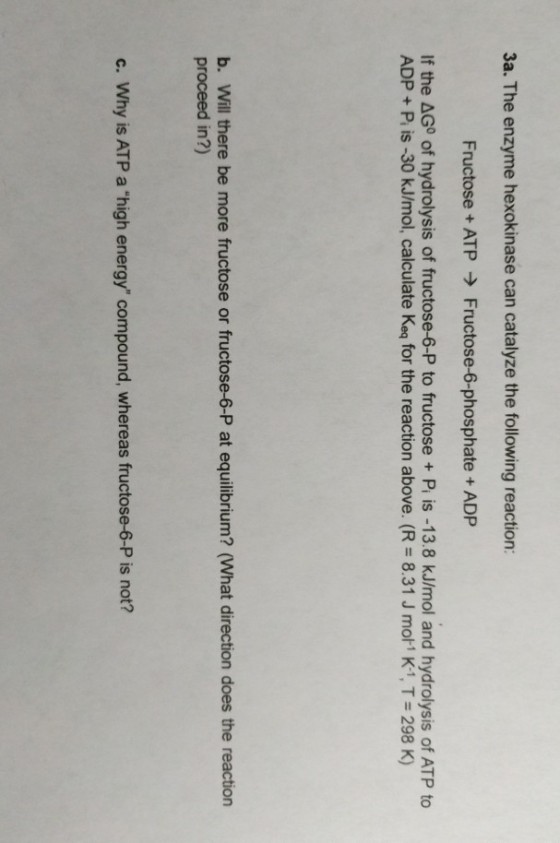
the enzyme hexokinase can catalyze the following reaction:
fructose + ATP -> fructose 6 phosphate + adp
if the deltaG of hydrolysis of fructose 6 phosphate to fructose + Pi is -13.8 kj/mol and hydrolysis of atp to adp + pi is -30kj/mol, calculate Keq for the reaction above (R = 8.31 j mol-1 K-1, T = 298 k
Homework Answers


Add Answer to:
the enzyme hexokinase can catalyze the following
reaction:
fructose + ATP -> fructose 6 phosphate +...
The enzyme hexokinase catalyzes the following reaction: Glucose + ATP ↔ Glucose 6-phosphate + ADP For...
The enzyme hexokinase catalyzes the following reaction: Glucose + ATP ↔ Glucose 6-phosphate + ADP For this reaction, ΔG° = +16.7 kJ/mol a. Calculate the equilibrium constant for this reaction at 25 °C. Is this reaction spontaneous under standard conditions at this temperature? Calculate the ΔG if the reaction temperature was 25 °C and the concentrations are: glucose, 55.0 mM,; ATP, 5.00 mM; ADP, 1.00 mM; and glucose 6-Phosphate, 0.100 mM. Would the reaction be spontaneous under the conditions of...
1) SHOW WORK 12. During glycolysis, glucose 1-phosphate is converted to fructose 6-phosphate in two successive...
 1) SHOW WORK
12. During glycolysis, glucose 1-phosphate is converted to fructose 6-phosphate in two successive reactions: glucose 1-phosphate → glucose 6-phosphate glucose 6-phosphate + fructose 6-phosphate AG'' = -7.1 kJ/mol AG'º = +1.7 kJ/mol 13. The standard free-energy changes for the reactions below are given. phosphocreatine → creatine + Pi ATP → ADP + Pi AG" = 43.0 kJ/mol AG" = -30.5 kJ/mol What is the overall AG' for the following reaction? Iw a dee Hydrolysis of 1 M...
1) SHOW WORK
12. During glycolysis, glucose 1-phosphate is converted to fructose 6-phosphate in two successive reactions: glucose 1-phosphate → glucose 6-phosphate glucose 6-phosphate + fructose 6-phosphate AG'' = -7.1 kJ/mol AG'º = +1.7 kJ/mol 13. The standard free-energy changes for the reactions below are given. phosphocreatine → creatine + Pi ATP → ADP + Pi AG" = 43.0 kJ/mol AG" = -30.5 kJ/mol What is the overall AG' for the following reaction? Iw a dee Hydrolysis of 1 M...
Shown is acetyl phosphate. Say a new enzyme uses acetyl phosphate to phosphorylate ADP to make ATP (acetyl phosphate + ADP —> acetate + ATP). What is the standard free energy change of this reacti...
 Shown is acetyl phosphate. Say a new enzyme uses acetyl
phosphate to phosphorylate ADP to make ATP (acetyl phosphate + ADP
—> acetate + ATP). What is the standard free energy change of
this reaction?
CH3 Table 13-2 Standard Free Energies of Phosphate Hydrolysis of Some Compounds of Biological Interest AGo (kJ mol 1) 61.9 -49.4 45.6 43.1 -43.1 30.5 -20.9 19.2 13.8 13.8 -9.2 Compound Phosphoenolpyruvate 1,3-Bisphosphoglycerate ATP AMP + PP,) Acetyl phosphate Phosphocreatine ATP ㈠ ADP + Pi)...
Shown is acetyl phosphate. Say a new enzyme uses acetyl
phosphate to phosphorylate ADP to make ATP (acetyl phosphate + ADP
—> acetate + ATP). What is the standard free energy change of
this reaction?
CH3 Table 13-2 Standard Free Energies of Phosphate Hydrolysis of Some Compounds of Biological Interest AGo (kJ mol 1) 61.9 -49.4 45.6 43.1 -43.1 30.5 -20.9 19.2 13.8 13.8 -9.2 Compound Phosphoenolpyruvate 1,3-Bisphosphoglycerate ATP AMP + PP,) Acetyl phosphate Phosphocreatine ATP ㈠ ADP + Pi)...
1. 2. 3. 4. Select all that apply. Identify the reaction(s) of glycolysis inhibited by ATP □ glyceraldehyde-3-phosphate → 1,3-bisphosphoglycerate phosphoenolpyruvate +pyruvate 3-phosphoglycerate...
 1.
2.
3.
4.
Select all that apply. Identify the reaction(s) of glycolysis inhibited by ATP □ glyceraldehyde-3-phosphate → 1,3-bisphosphoglycerate phosphoenolpyruvate +pyruvate 3-phosphoglycerate ~2-phosphoglycerate 1) fructose-6-phosphate→ fructose-1,6-bisphosphate . glucose glucose-6-phosphate Select all that apply. Alcohol fermentation: consumes ATP as it produces ethanol. O produces carbon dioxide begins as pyruvate is decarboxylated to acetaldehyde in a reaction catalyzed by alcohol dehydrogenase m regenerates NAD requires the enzyme alcohol dehydrogenase, In the figure below, what is the reaction occurring at the location...
1.
2.
3.
4.
Select all that apply. Identify the reaction(s) of glycolysis inhibited by ATP □ glyceraldehyde-3-phosphate → 1,3-bisphosphoglycerate phosphoenolpyruvate +pyruvate 3-phosphoglycerate ~2-phosphoglycerate 1) fructose-6-phosphate→ fructose-1,6-bisphosphate . glucose glucose-6-phosphate Select all that apply. Alcohol fermentation: consumes ATP as it produces ethanol. O produces carbon dioxide begins as pyruvate is decarboxylated to acetaldehyde in a reaction catalyzed by alcohol dehydrogenase m regenerates NAD requires the enzyme alcohol dehydrogenase, In the figure below, what is the reaction occurring at the location...
Hexokinase catalyzes the following reaction in glycolysis: Glucose + ATP ← → glucose-6-phosphate + ADP The...
Hexokinase catalyzes the following reaction in glycolysis: Glucose + ATP ← → glucose-6-phosphate + ADP The standard free-energy change for this reaction in the direction written is -16.7 kJ/mol. The concentrations of the related reaction components in the hepatocyte of a mammalian cell are: Glucose: 6 mM Glucose-6-phosphate: 0.074 mM ATP: 1.00 mM ADP: 0.25 mM What is the actual free-energy change for the reaction at body temperature (37 C)?
Question 1 1 pts The enzyme hexokinase transfers a phosphate from ATP to glucose, to make...
 Question 1 1 pts The enzyme hexokinase transfers a phosphate from ATP to glucose, to make ADP and glucose-6- phosphate. Which of the following is a substrate? hexokinase ADP glucose glucose-6-phosphate two of the above Question 2 1 pts The enzyme hexokinase transfers a phosphate from ATP to glucose, to make ADP and glucose-6- phosphate. Which of the following is a product? hexokinase ADP glucose glucose-6-phosphate two of the above
Consider the following reaction: Glucose + ATP ↔Glucose -6-phosphate + ADP Using the information in the...
 Consider the following reaction:
Glucose + ATP ↔Glucose -6-phosphate + ADP
Using the information in the below determine Go for
this reaction and comment on the spontaneity of this reaction.
What the information does the Go parameters in the
table below provides about the rate of the ATP hydrolysis.
Below is the structure of glucose-6-phosphate. Identify which
anomer does it represent?
Standard free energies of hydrolysis of some
phosphorylated compounds
compound
Go (kJ mol-1)
ATP (to ADP)
-30.5
pyrophosphate
-19.3...
Consider the following reaction:
Glucose + ATP ↔Glucose -6-phosphate + ADP
Using the information in the below determine Go for
this reaction and comment on the spontaneity of this reaction.
What the information does the Go parameters in the
table below provides about the rate of the ATP hydrolysis.
Below is the structure of glucose-6-phosphate. Identify which
anomer does it represent?
Standard free energies of hydrolysis of some
phosphorylated compounds
compound
Go (kJ mol-1)
ATP (to ADP)
-30.5
pyrophosphate
-19.3...
The concentration of fructose 6-phosphate (F6P) and fructose 1, 6-biphosphate (F16BP), ATP, and ADP in muscle...
 The concentration of fructose 6-phosphate (F6P) and fructose 1, 6-biphosphate (F16BP), ATP, and ADP in muscle tissue were measured as 0.089, 0.012, 12.0, and 1.2 mM. For the reaction F6P(aq) + ATP(aq) rightarrow F16BP(aq) + ADP(aq) at 37 degree C, the standard Gibbs energy (at pFl=7) is -18.3 kJ/mol. Calculate the reaction Gibbs energy (kJ/mol) for the reaction in the muscle tissue environment. -71.2 -29.4 -7.3 +4.5 +11.2.
7.5 Hexokinase catalyzes the reaction: ATP + Glucose A glucose-6-phosphate + ADP AG - -4 562...
7.5 Hexokinase catalyzes the reaction: ATP + Glucose A glucose-6-phosphate + ADP AG - -4 562 cal / mol Keg = 2.21 x 10³ Calculate the concentration of glucose-6-phosphate necessary to force the hexokinase reaction to go in the opposite direction (towards the synthesis of glucose and ATP) in the presence of 10-5 M glucose, 10-3 M ATP and 10-4 M ADP.
2. The first step in glycolysis is catalyzed by the enzyme herokinase: glucose + ATP glucose-6-P...
 2. The first step in glycolysis is catalyzed by the enzyme herokinase: glucose + ATP glucose-6-P + ADP This reaction can be thought of as two coupled reactions (P is phosphate): (1) glucose + P + glucose-6-P (2) ATP + ADP + P For the overall reaction, AG" = -16.7 kJ/mol. For the hydrolysis of ATP (equation 2), AG = -310 kJ/mol. All reactions are performed at 37°C. (a) What is AGº for reaction 1? Iglucose - 6-11 if AG...
 1) SHOW WORK
12. During glycolysis, glucose 1-phosphate is converted to fructose 6-phosphate in two successive reactions: glucose 1-phosphate → glucose 6-phosphate glucose 6-phosphate + fructose 6-phosphate AG'' = -7.1 kJ/mol AG'º = +1.7 kJ/mol 13. The standard free-energy changes for the reactions below are given. phosphocreatine → creatine + Pi ATP → ADP + Pi AG" = 43.0 kJ/mol AG" = -30.5 kJ/mol What is the overall AG' for the following reaction? Iw a dee Hydrolysis of 1 M...
1) SHOW WORK
12. During glycolysis, glucose 1-phosphate is converted to fructose 6-phosphate in two successive reactions: glucose 1-phosphate → glucose 6-phosphate glucose 6-phosphate + fructose 6-phosphate AG'' = -7.1 kJ/mol AG'º = +1.7 kJ/mol 13. The standard free-energy changes for the reactions below are given. phosphocreatine → creatine + Pi ATP → ADP + Pi AG" = 43.0 kJ/mol AG" = -30.5 kJ/mol What is the overall AG' for the following reaction? Iw a dee Hydrolysis of 1 M...
 Shown is acetyl phosphate. Say a new enzyme uses acetyl
phosphate to phosphorylate ADP to make ATP (acetyl phosphate + ADP
—> acetate + ATP). What is the standard free energy change of
this reaction?
CH3 Table 13-2 Standard Free Energies of Phosphate Hydrolysis of Some Compounds of Biological Interest AGo (kJ mol 1) 61.9 -49.4 45.6 43.1 -43.1 30.5 -20.9 19.2 13.8 13.8 -9.2 Compound Phosphoenolpyruvate 1,3-Bisphosphoglycerate ATP AMP + PP,) Acetyl phosphate Phosphocreatine ATP ㈠ ADP + Pi)...
Shown is acetyl phosphate. Say a new enzyme uses acetyl
phosphate to phosphorylate ADP to make ATP (acetyl phosphate + ADP
—> acetate + ATP). What is the standard free energy change of
this reaction?
CH3 Table 13-2 Standard Free Energies of Phosphate Hydrolysis of Some Compounds of Biological Interest AGo (kJ mol 1) 61.9 -49.4 45.6 43.1 -43.1 30.5 -20.9 19.2 13.8 13.8 -9.2 Compound Phosphoenolpyruvate 1,3-Bisphosphoglycerate ATP AMP + PP,) Acetyl phosphate Phosphocreatine ATP ㈠ ADP + Pi)...
 1.
2.
3.
4.
Select all that apply. Identify the reaction(s) of glycolysis inhibited by ATP □ glyceraldehyde-3-phosphate → 1,3-bisphosphoglycerate phosphoenolpyruvate +pyruvate 3-phosphoglycerate ~2-phosphoglycerate 1) fructose-6-phosphate→ fructose-1,6-bisphosphate . glucose glucose-6-phosphate Select all that apply. Alcohol fermentation: consumes ATP as it produces ethanol. O produces carbon dioxide begins as pyruvate is decarboxylated to acetaldehyde in a reaction catalyzed by alcohol dehydrogenase m regenerates NAD requires the enzyme alcohol dehydrogenase, In the figure below, what is the reaction occurring at the location...
1.
2.
3.
4.
Select all that apply. Identify the reaction(s) of glycolysis inhibited by ATP □ glyceraldehyde-3-phosphate → 1,3-bisphosphoglycerate phosphoenolpyruvate +pyruvate 3-phosphoglycerate ~2-phosphoglycerate 1) fructose-6-phosphate→ fructose-1,6-bisphosphate . glucose glucose-6-phosphate Select all that apply. Alcohol fermentation: consumes ATP as it produces ethanol. O produces carbon dioxide begins as pyruvate is decarboxylated to acetaldehyde in a reaction catalyzed by alcohol dehydrogenase m regenerates NAD requires the enzyme alcohol dehydrogenase, In the figure below, what is the reaction occurring at the location...
 Question 1 1 pts The enzyme hexokinase transfers a phosphate from ATP to glucose, to make ADP and glucose-6- phosphate. Which of the following is a substrate? hexokinase ADP glucose glucose-6-phosphate two of the above Question 2 1 pts The enzyme hexokinase transfers a phosphate from ATP to glucose, to make ADP and glucose-6- phosphate. Which of the following is a product? hexokinase ADP glucose glucose-6-phosphate two of the above
 Consider the following reaction:
Glucose + ATP ↔Glucose -6-phosphate + ADP
Using the information in the below determine Go for
this reaction and comment on the spontaneity of this reaction.
What the information does the Go parameters in the
table below provides about the rate of the ATP hydrolysis.
Below is the structure of glucose-6-phosphate. Identify which
anomer does it represent?
Standard free energies of hydrolysis of some
phosphorylated compounds
compound
Go (kJ mol-1)
ATP (to ADP)
-30.5
pyrophosphate
-19.3...
Consider the following reaction:
Glucose + ATP ↔Glucose -6-phosphate + ADP
Using the information in the below determine Go for
this reaction and comment on the spontaneity of this reaction.
What the information does the Go parameters in the
table below provides about the rate of the ATP hydrolysis.
Below is the structure of glucose-6-phosphate. Identify which
anomer does it represent?
Standard free energies of hydrolysis of some
phosphorylated compounds
compound
Go (kJ mol-1)
ATP (to ADP)
-30.5
pyrophosphate
-19.3...
 The concentration of fructose 6-phosphate (F6P) and fructose 1, 6-biphosphate (F16BP), ATP, and ADP in muscle tissue were measured as 0.089, 0.012, 12.0, and 1.2 mM. For the reaction F6P(aq) + ATP(aq) rightarrow F16BP(aq) + ADP(aq) at 37 degree C, the standard Gibbs energy (at pFl=7) is -18.3 kJ/mol. Calculate the reaction Gibbs energy (kJ/mol) for the reaction in the muscle tissue environment. -71.2 -29.4 -7.3 +4.5 +11.2.
 2. The first step in glycolysis is catalyzed by the enzyme herokinase: glucose + ATP glucose-6-P + ADP This reaction can be thought of as two coupled reactions (P is phosphate): (1) glucose + P + glucose-6-P (2) ATP + ADP + P For the overall reaction, AG" = -16.7 kJ/mol. For the hydrolysis of ATP (equation 2), AG = -310 kJ/mol. All reactions are performed at 37°C. (a) What is AGº for reaction 1? Iglucose - 6-11 if AG...
Most questions answered within 3 hours.
-
Where is the error in this code sequence?
String s1 = "Hello";
String s2 = "ello";...
asked 11 months ago -
Financial data for Joel de Paris, Inc., for last year
follow:
Joel de Paris, Inc.
Balance...
asked 11 months ago -
Consider this reaction:
Al2(SO4)3 (aq)+ BaCl3
(aq) Al2Cl6 (aq)- +
3BaSO4(s) . What is the...
asked 11 months ago -
Suppose that Savneet is considering increasing her
recent random sample from 20 car rentals to 40...
asked 11 months ago -
Trucks arrive at an unloading terminal at an average rate of 120
per hour.
Trucks arrive...
asked 11 months ago -
Why are methanol and ethanol completely soluble in water while
octanol is not very little soluble....
asked 11 months ago -
A facilities manager at a university reads in a research report
that the mean amount of...
asked 11 months ago -
When the CuSO4 is rehydrated by adding water to the anhydrous
compound, is this an endothermic...
asked 11 months ago -
A ray of sunlight is passing from diamond into crown glass; the
angle of incidence is...
asked 11 months ago -
A block of mass 0.249 kg is placed on top of a light, vertical
spring of...
asked 11 months ago -
how do the kidneys compensate in the presences of acidosis
a) trigger hyperventilate
b) reserve acid...
asked 11 months ago -
Question 501 pts
The rental rate of capital to the firm increases. Which of the
following...
asked 11 months ago