
Homework Answers
ANSWER : I have run your code nd output is given below.
HEre in the when we are passing 4,1 in mystery1() then it is going in the else if condition because a>b in mystery2() it is passing 1 and in the mystery2() count is first initialized with 1 and it is incremented also 1 and returning count so output it is giving as 2.
![1 public class ArrDemo { 2e public static int mystery1 (int a,int b) int result if(a<b) { -0; 4 result-mystery2(a) mystery2(a) result - mystery2(b); result-ab; else if(a>b) \ 6 7 8 9 10 else return result; 12 13 14e 15 16 public static int mystery2 (int x) int count =x; for(int i-0;i<x;i++) count+-1; return count; 18 19 20 public static void main(String[] args) 21 int result-mystery1 (4,1); System.out.println(result: +result); 23 24 25 Console 3 sterminateds ArrDemo [Java Application] CAProgram FilesJava jre1.8.0144 binjavaw.exe (07-Dec-2018, 9: esult:2](http://img.homeworklib.com/questions/7ff04ed0-56ca-11eb-97c7-f5dd277bd205.png?x-oss-process=image/resize,w_560)
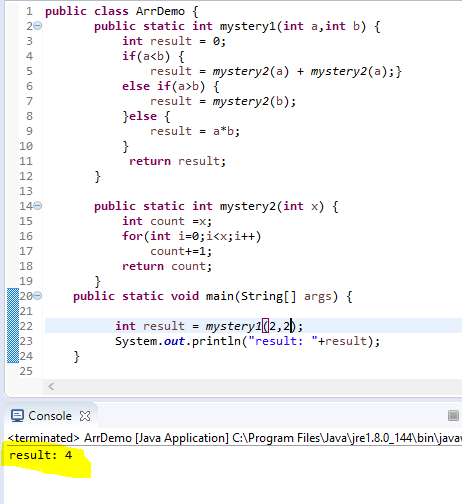
Here we Are passing the 2,2 in mystery1() so in this function our condition did not match so it will go in to the else part and result would store 2*2=4 and gives the output.
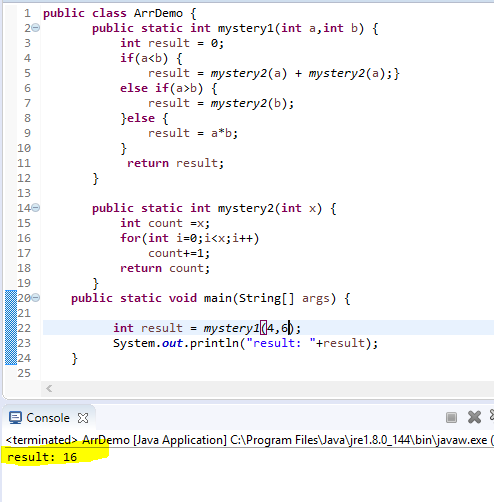
Here we are passing the 4,6 in mystery1() so our first condition becomes true and goes in to the mystery2() method and in this method we are passing the 4 and count will have 4 initially and added in the for loop as 4+4 means it will return 8 for first mystry2() method and second time also it will return 8 so result will be 8+8= 16
Add Answer to:
24) (3x2 marks) Consider the following method: public static int mysteryl (int a, int b) (...
Consider the following method: Linel: public static int mystery(int n) { Line2: if (n < 10)...
 Consider the following method: Linel: public static int mystery(int n) { Line2: if (n < 10) { ine3: return n; Line4: } else { Line5: int a = n/10; Line 6: int b = n % 10; Line 7: return mystery(a + b); Line 8: } Line 9: } What is the result of the following call? System.out.println(mystery(648)); 18 8 12
3. Consider the mystery method given. public static int mystery ( int n) [ if (n...
 3. Consider the mystery method given. public static int mystery ( int n) [ if (n == 0 ) { return 1; How do we get the values for recurse? else if (n%2 == 0 ) { int recurse = mystery ( n - 1); int result = recurse + n; return result; since n =5, we go to the else statement and do int recurse = mystery(5-1) which equals 4? why is 3 written? else { int recurse =...
Consider the following method: public static int mystery (int x, double y, char ch) { ...
Consider the following method: public static int mystery (int x, double y, char ch) { int u; if ('A' <= ch && ch <= 'R') return (2 * x + (int)(y)); else return((int)(2 * y) - x); } What is the output of the following Java statements? a. System.out.println (mystery(5, 4.3, 'B')); b. System.out.println (mystery(4, 9.7, 'v')); c. System.out.println (2 * mystery(6, 3.9, 'D'));
Recursive Tracing. For each call to the following method, indicate what value is returned: public static...
Recursive Tracing. For each call to the following method, indicate what value is returned: public static int mystery(int n) { if (n < 0) { return -mystery(-n); } else if (n == 0) { return 0; } else { return mystery(n / 10) * 10 + 9 - (n % 10); } Call Value Returned mystery(0) mystery(5) mystery(13) mystery(297) mystery(-3456) } Can any one help me with it?
Consider the following method. public static ArrayList<Integer mystery(int n) ArrayList<Integer seg - new ArrayList<IntegerO; for (int...
 Consider the following method. public static ArrayList<Integer mystery(int n) ArrayList<Integer seg - new ArrayList<IntegerO; for (int k = n; k > 0; k--) seq.add(new Integer(k+3)); return seq What is the final output of the following Java statement? System.out.println(mystery(3)); a. [1,2,4,5) b. [2,3,4,5) c. [6,5,4,3] d. [7, 7, 8, 8] e. [7,8,9, 8) O Consider the following method: public static int mystery(int[] arr, int k) ifk-0) return 0; }else{ return arr[k - 1] + mystery(arr, k-1):) The code segment below is...
In Java, Assume we have these two methods. public static boolean allAreEqual(int n1, int n2, int...
In Java, Assume we have these two methods. public static boolean allAreEqual(int n1, int n2, int n3) { return n1 == n2 && n2 == n3; } public static boolean mystery(int n1, int n2, int n3) { return !allAreEqual(n1, n2, n3) && (n1 == n2 || n1 == n3 || n2 == n3); } Part 1: What value will be returned by the following method calls? mystery(5, 5, 5) mystery(5, 5, 1) Part 2: What does the mystery method do...
public class F2{ public static int foo(ArrayList<Integer> a) { int sum = 0; for(int i =...
public class F2{ public static int foo(ArrayList<Integer> a) { int sum = 0; for(int i = 0; i <a.size(); i++){ if(i % 3 == 1) sum += a.get(i); else if(i % 3 == 2) sum -= a.get(i); else sum++; } return sum; } } What do the following method calls return? 1. foo(new ArrayList<>(Arrays.asList(1,2,3,4))) 2. foo(new ArrayList<>()) 3. foo(new ArrayList<>(Arrays.asList(1,2,-3,4325,-2))) 4. foo(new ArrayList<>(Arrays.asList(0,0,0)))
You will implement the following method public static int[] linearSearchExtended(int[][] numbers, int key) { // Implement...
You will implement the following method public static int[] linearSearchExtended(int[][] numbers, int key) { // Implement this method return new int[] {}; } There is a utility method provided for you with the following signature. You may use this method to convert a list of integers into an array. public static int[] convertIntegers(List<Integer> integers) Provided code import java.util.ArrayList; import java.util.Iterator; import java.util.List; import java.util.Scanner; public class MatrixSearch { // This method converts a list of integers to an array...
Exercise 4.b Answer the following questions for the method count () below: public static int count...
 Exercise 4.b Answer the following questions for the method count () below: public static int count (List list, Object element) // Effects: if list or element is null throw NullPointerException // else if element is in the list, return the number of times element is in list; else return-1 / for example, search (13,3,1], 3) 2, search ((1,7,5], 2)--1 the all combinations coverage criterion. In your solution remember to include .List of all the input variables, including the state variables...
in JAVA 24. Suppose that a class has an overloaded method named add with the following...
 in JAVA
24. Suppose that a class has an overloaded method named add with the following two implementations: double add (int x, double y) { return x + y; } double add (double x, int y) { return x + y + 1; } What, if anything, will be returned by the following method calls? A. add(3, 3.14) B. (3.14, 3) C. add (3, 3) D. add (3.14, 3.14) 29. Here is the code for a recursive method named mystery....
in JAVA
24. Suppose that a class has an overloaded method named add with the following two implementations: double add (int x, double y) { return x + y; } double add (double x, int y) { return x + y + 1; } What, if anything, will be returned by the following method calls? A. add(3, 3.14) B. (3.14, 3) C. add (3, 3) D. add (3.14, 3.14) 29. Here is the code for a recursive method named mystery....
 Consider the following method: Linel: public static int mystery(int n) { Line2: if (n < 10) { ine3: return n; Line4: } else { Line5: int a = n/10; Line 6: int b = n % 10; Line 7: return mystery(a + b); Line 8: } Line 9: } What is the result of the following call? System.out.println(mystery(648)); 18 8 12
 3. Consider the mystery method given. public static int mystery ( int n) [ if (n == 0 ) { return 1; How do we get the values for recurse? else if (n%2 == 0 ) { int recurse = mystery ( n - 1); int result = recurse + n; return result; since n =5, we go to the else statement and do int recurse = mystery(5-1) which equals 4? why is 3 written? else { int recurse =...
 Consider the following method. public static ArrayList<Integer mystery(int n) ArrayList<Integer seg - new ArrayList<IntegerO; for (int k = n; k > 0; k--) seq.add(new Integer(k+3)); return seq What is the final output of the following Java statement? System.out.println(mystery(3)); a. [1,2,4,5) b. [2,3,4,5) c. [6,5,4,3] d. [7, 7, 8, 8] e. [7,8,9, 8) O Consider the following method: public static int mystery(int[] arr, int k) ifk-0) return 0; }else{ return arr[k - 1] + mystery(arr, k-1):) The code segment below is...
 Exercise 4.b Answer the following questions for the method count () below: public static int count (List list, Object element) // Effects: if list or element is null throw NullPointerException // else if element is in the list, return the number of times element is in list; else return-1 / for example, search (13,3,1], 3) 2, search ((1,7,5], 2)--1 the all combinations coverage criterion. In your solution remember to include .List of all the input variables, including the state variables...
 in JAVA
24. Suppose that a class has an overloaded method named add with the following two implementations: double add (int x, double y) { return x + y; } double add (double x, int y) { return x + y + 1; } What, if anything, will be returned by the following method calls? A. add(3, 3.14) B. (3.14, 3) C. add (3, 3) D. add (3.14, 3.14) 29. Here is the code for a recursive method named mystery....
in JAVA
24. Suppose that a class has an overloaded method named add with the following two implementations: double add (int x, double y) { return x + y; } double add (double x, int y) { return x + y + 1; } What, if anything, will be returned by the following method calls? A. add(3, 3.14) B. (3.14, 3) C. add (3, 3) D. add (3.14, 3.14) 29. Here is the code for a recursive method named mystery....
Most questions answered within 3 hours.
-
Where is the error in this code sequence?
String s1 = "Hello";
String s2 = "ello";...
asked 11 months ago -
Financial data for Joel de Paris, Inc., for last year
follow:
Joel de Paris, Inc.
Balance...
asked 11 months ago -
Consider this reaction:
Al2(SO4)3 (aq)+ BaCl3
(aq) Al2Cl6 (aq)- +
3BaSO4(s) . What is the...
asked 11 months ago -
Suppose that Savneet is considering increasing her
recent random sample from 20 car rentals to 40...
asked 11 months ago -
Trucks arrive at an unloading terminal at an average rate of 120
per hour.
Trucks arrive...
asked 11 months ago -
Why are methanol and ethanol completely soluble in water while
octanol is not very little soluble....
asked 11 months ago -
A facilities manager at a university reads in a research report
that the mean amount of...
asked 11 months ago -
When the CuSO4 is rehydrated by adding water to the anhydrous
compound, is this an endothermic...
asked 11 months ago -
A ray of sunlight is passing from diamond into crown glass; the
angle of incidence is...
asked 11 months ago -
A block of mass 0.249 kg is placed on top of a light, vertical
spring of...
asked 11 months ago -
how do the kidneys compensate in the presences of acidosis
a) trigger hyperventilate
b) reserve acid...
asked 11 months ago -
Question 501 pts
The rental rate of capital to the firm increases. Which of the
following...
asked 11 months ago