
Homework Answers
Add Answer to:
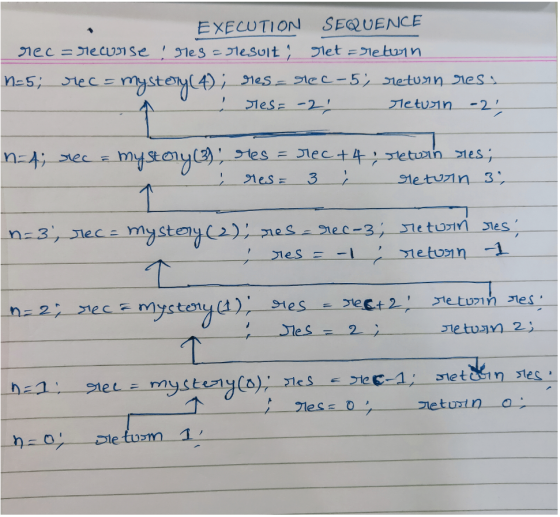
3. Consider the mystery method given. public static int mystery ( int n) [ if (n...
Consider the following method: Linel: public static int mystery(int n) { Line2: if (n < 10)...
 Consider the following method: Linel: public static int mystery(int n) { Line2: if (n < 10) { ine3: return n; Line4: } else { Line5: int a = n/10; Line 6: int b = n % 10; Line 7: return mystery(a + b); Line 8: } Line 9: } What is the result of the following call? System.out.println(mystery(648)); 18 8 12
b) Consider the following code. public static int f(int n) if (n == 1) return 0;...
 b) Consider the following code. public static int f(int n) if (n == 1) return 0; else if (n % 2 == 0). return g(n/2); else return g(n+1); public static int g(int n) int r = n % 3; if (r == 0) return f(n/3); else if (r == 1) return f(n+2); else return f(2 * n); // (HERE) public static void main(String[] args) { int x = 3; System.out.println(f(x)); (1) (5 points) Draw the call stack as it would...
Consider the following method. public static ArrayList<Integer mystery(int n) ArrayList<Integer seg - new ArrayList<IntegerO; for (int...
 Consider the following method. public static ArrayList<Integer mystery(int n) ArrayList<Integer seg - new ArrayList<IntegerO; for (int k = n; k > 0; k--) seq.add(new Integer(k+3)); return seq What is the final output of the following Java statement? System.out.println(mystery(3)); a. [1,2,4,5) b. [2,3,4,5) c. [6,5,4,3] d. [7, 7, 8, 8] e. [7,8,9, 8) O Consider the following method: public static int mystery(int[] arr, int k) ifk-0) return 0; }else{ return arr[k - 1] + mystery(arr, k-1):) The code segment below is...
Consider the following method: public static int mystery (int x, double y, char ch) { ...
Consider the following method: public static int mystery (int x, double y, char ch) { int u; if ('A' <= ch && ch <= 'R') return (2 * x + (int)(y)); else return((int)(2 * y) - x); } What is the output of the following Java statements? a. System.out.println (mystery(5, 4.3, 'B')); b. System.out.println (mystery(4, 9.7, 'v')); c. System.out.println (2 * mystery(6, 3.9, 'D'));
Java, how would i do this public static void main(String[] args) { int n = 3;...
 Java, how would i do this
public static void main(String[] args) { int n = 3; int result; result = factorial(n); + public static int factorial(int n) public static int factorial(int n) n = 3 { returns 3* 2 * 1 { if (n == 1) return n; else return (n * factorial(n-1)); if (n == 1) return n; else return (3 * factorial(3-1)); ܢܟ } public static int factorial(int n) n = 2 public static int factorial(int n) returns...
Java, how would i do this
public static void main(String[] args) { int n = 3; int result; result = factorial(n); + public static int factorial(int n) public static int factorial(int n) n = 3 { returns 3* 2 * 1 { if (n == 1) return n; else return (n * factorial(n-1)); if (n == 1) return n; else return (3 * factorial(3-1)); ܢܟ } public static int factorial(int n) n = 2 public static int factorial(int n) returns...
24) (3x2 marks) Consider the following method: public static int mysteryl (int a, int b) (...
 24) (3x2 marks) Consider the following method: public static int mysteryl (int a, int b) ( int result 0: if (a <b) ( else if (a b) else ( return result: result mystery2 (a) mystery2 (a)i result - mystery2 (b) result-ab; public static int mystery2 (int x) f int countx for (int i 0; іск; i++) count +1: return counti What are the values stored in the variable result after the following method calls? a) int result mysteryl(4,1): b) int...
mystery (numi, num2) ? public static void main(String[] args) int numl = 7; int num2 =...
 mystery (numi, num2) ? public static void main(String[] args) int numl = 7; int num2 = 13; int result = mystery (numi, num2); } public static int mystery (int firstNum, int secondNum) { firstNum = firstnym * 3; secondNum = secondnum * 2; return firstNum + secondNum; } numl: A num2: A int secondNum) firstNum = firstNum * 3; secondNum = secondNum * 2; return firstNum + secondNum; numl: A/ num2: result: A Previous Page Next Page
Recursive Tracing. For each call to the following method, indicate what value is returned: public static...
Recursive Tracing. For each call to the following method, indicate what value is returned: public static int mystery(int n) { if (n < 0) { return -mystery(-n); } else if (n == 0) { return 0; } else { return mystery(n / 10) * 10 + 9 - (n % 10); } Call Value Returned mystery(0) mystery(5) mystery(13) mystery(297) mystery(-3456) } Can any one help me with it?
1. public int function(int x, int n) { if (n == 0) return 1; return x...
1. public int function(int x, int n) { if (n == 0) return 1; return x * function(x, n -1); } function(3,3) - What is the expected output? 3 12 9 27 2. int fun(int x) { if(x == 0) return 1; else return fun(x - 1); } fun(4) 18 1 24 4 3. Which one of the following calls results 6? int mystery(int n){ if (n == 1) return 1; else return n * mystery(n - 1); } mystery(3)...
What does this program print? package javaapplication210; public class JavaApplication210 { public static void main(String[]args){ System.out.printf("Result...
 What does this program print? package javaapplication210; public class JavaApplication210 { public static void main(String[]args){ System.out.printf("Result is: % d/n", mystery (-5, -9));//System.out.printf("Result is: % d/n", mystery (-4, -8));//System.out.printf("Result is: % d/n", mystery (-6, -7));//} public static int mystery(int a, int b) { if(b - 1) returns a; else return a + mystery(a, b + 1); } }
 Consider the following method: Linel: public static int mystery(int n) { Line2: if (n < 10) { ine3: return n; Line4: } else { Line5: int a = n/10; Line 6: int b = n % 10; Line 7: return mystery(a + b); Line 8: } Line 9: } What is the result of the following call? System.out.println(mystery(648)); 18 8 12
 b) Consider the following code. public static int f(int n) if (n == 1) return 0; else if (n % 2 == 0). return g(n/2); else return g(n+1); public static int g(int n) int r = n % 3; if (r == 0) return f(n/3); else if (r == 1) return f(n+2); else return f(2 * n); // (HERE) public static void main(String[] args) { int x = 3; System.out.println(f(x)); (1) (5 points) Draw the call stack as it would...
 Consider the following method. public static ArrayList<Integer mystery(int n) ArrayList<Integer seg - new ArrayList<IntegerO; for (int k = n; k > 0; k--) seq.add(new Integer(k+3)); return seq What is the final output of the following Java statement? System.out.println(mystery(3)); a. [1,2,4,5) b. [2,3,4,5) c. [6,5,4,3] d. [7, 7, 8, 8] e. [7,8,9, 8) O Consider the following method: public static int mystery(int[] arr, int k) ifk-0) return 0; }else{ return arr[k - 1] + mystery(arr, k-1):) The code segment below is...
 Java, how would i do this
public static void main(String[] args) { int n = 3; int result; result = factorial(n); + public static int factorial(int n) public static int factorial(int n) n = 3 { returns 3* 2 * 1 { if (n == 1) return n; else return (n * factorial(n-1)); if (n == 1) return n; else return (3 * factorial(3-1)); ܢܟ } public static int factorial(int n) n = 2 public static int factorial(int n) returns...
Java, how would i do this
public static void main(String[] args) { int n = 3; int result; result = factorial(n); + public static int factorial(int n) public static int factorial(int n) n = 3 { returns 3* 2 * 1 { if (n == 1) return n; else return (n * factorial(n-1)); if (n == 1) return n; else return (3 * factorial(3-1)); ܢܟ } public static int factorial(int n) n = 2 public static int factorial(int n) returns...
 24) (3x2 marks) Consider the following method: public static int mysteryl (int a, int b) ( int result 0: if (a <b) ( else if (a b) else ( return result: result mystery2 (a) mystery2 (a)i result - mystery2 (b) result-ab; public static int mystery2 (int x) f int countx for (int i 0; іск; i++) count +1: return counti What are the values stored in the variable result after the following method calls? a) int result mysteryl(4,1): b) int...
 mystery (numi, num2) ? public static void main(String[] args) int numl = 7; int num2 = 13; int result = mystery (numi, num2); } public static int mystery (int firstNum, int secondNum) { firstNum = firstnym * 3; secondNum = secondnum * 2; return firstNum + secondNum; } numl: A num2: A int secondNum) firstNum = firstNum * 3; secondNum = secondNum * 2; return firstNum + secondNum; numl: A/ num2: result: A Previous Page Next Page
 What does this program print? package javaapplication210; public class JavaApplication210 { public static void main(String[]args){ System.out.printf("Result is: % d/n", mystery (-5, -9));//System.out.printf("Result is: % d/n", mystery (-4, -8));//System.out.printf("Result is: % d/n", mystery (-6, -7));//} public static int mystery(int a, int b) { if(b - 1) returns a; else return a + mystery(a, b + 1); } }
Most questions answered within 3 hours.
-
Where is the error in this code sequence?
String s1 = "Hello";
String s2 = "ello";...
asked 11 months ago -
Financial data for Joel de Paris, Inc., for last year
follow:
Joel de Paris, Inc.
Balance...
asked 11 months ago -
Consider this reaction:
Al2(SO4)3 (aq)+ BaCl3
(aq) Al2Cl6 (aq)- +
3BaSO4(s) . What is the...
asked 11 months ago -
Suppose that Savneet is considering increasing her
recent random sample from 20 car rentals to 40...
asked 11 months ago -
Trucks arrive at an unloading terminal at an average rate of 120
per hour.
Trucks arrive...
asked 11 months ago -
Why are methanol and ethanol completely soluble in water while
octanol is not very little soluble....
asked 11 months ago -
A facilities manager at a university reads in a research report
that the mean amount of...
asked 11 months ago -
When the CuSO4 is rehydrated by adding water to the anhydrous
compound, is this an endothermic...
asked 11 months ago -
A ray of sunlight is passing from diamond into crown glass; the
angle of incidence is...
asked 11 months ago -
A block of mass 0.249 kg is placed on top of a light, vertical
spring of...
asked 11 months ago -
how do the kidneys compensate in the presences of acidosis
a) trigger hyperventilate
b) reserve acid...
asked 11 months ago -
Question 501 pts
The rental rate of capital to the firm increases. Which of the
following...
asked 11 months ago