Consider a spring that does not obey Hooke's law very faithfully. One end of the spring...
Consider a spring that does not obey Hooke's law very faithfully. One end of the spring is fixed. To keep the spring stretched or compressed an amount x, a force along the x-axis with x-component Fx=kx−bx2+cx3 must be applied to the free end. Here k=100N/m, b=700N/m2, and c=12000N/m3. Note that x>0 when the spring is stretched and x<0 when it is compressed.
A)How much work must be done to stretch this spring by 0.050 m from its unstretched length?
B)How much work must be done to compress this spring by 0.050 m from its unstretched length?
C)Is it easier to stretch or compress this spring?
Homework Answers
Hi,
Hope you are doing well.
PART A:
Here,the spring doesn't obey Hooke's law and the force is variable. So to find the work done for stretching or compressing the spring, we have to integrate all the way from zero to x.
Work done for stretching the spring is given by,
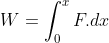
Here, Given that, 

 Work done on
the spring for stretching is given by,
Work done on
the spring for stretching is given by,


![W=k\left [\frac{x^{2}}{2} \right ]_{0}^{0.050}-b\left [ \frac{x^{3}}{3} \right ]_{0}^{0.050}+c\left [ \frac{x^{4}}{4} \right ]_{0}^{0.050}](http://img.homeworklib.com/questions/ac80b920-5754-11eb-8eb1-1f3dad8fb499.png?x-oss-process=image/resize,w_560)

Given that,


 |
Similarly,
PART B:
Work done to compress the spring is given by,

Here, Given that, 
Work done
for compressing is given by,




Given that,


 |
PART C:
We have got that work done for compressing the spring (W2) is greater than work done for stretching the spring (W).

It is easier
to stretch the spring.
Hope this helped for your studies. Keep learning. Have a good day.
Feel free to clear any doubts at the comment section.
Please don't
forget to give a thumbs up.
Thank you. :)
Hi,
Hope you are doing well.
PART A:
Here,the spring doesn't obey Hooke's law and the force is variable. So to find the work done for stretching or compressing the spring, we have to integrate all the way from zero to x.
Work done for stretching the spring is given by,

Here, Given that, 

 Work done on
the spring for stretching is given by,
Work done on
the spring for stretching is given by,


![W=k\left [\frac{x^{2}}{2} \right ]_{0}^{0.050}-b\left [ \frac{x^{3}}{3} \right ]_{0}^{0.050}+c\left [ \frac{x^{4}}{4} \right ]_{0}^{0.050}](http://img.homeworklib.com/questions/cf0381f0-5754-11eb-976b-af4588a8e429.png?x-oss-process=image/resize,w_560)

Given that,





 |
Similarly,
PART B:
Work done to compress the spring is given by,
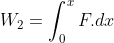
Here, Given that, 
Work done
for compressing is given by,




Given that,


 |
PART C:
We have got that work done for compressing the spring (W2) is greater than work done for stretching the spring (W).

It is easier
to stretch the spring.
Hope this helped for your studies. Keep learning. Have a good day.
Feel free to clear any doubts at the comment section.
Please don't
forget to give a thumbs up.
Thank you. :)
Add Answer to:
Consider a spring that does not obey Hooke's law very
faithfully. One end of the spring...
To understand the use of Hooke's law for a spring. Hooke's law states that the restoring...
To understand the use of Hooke's law for a spring. Hooke's law states that the restoring force F⃗ on a spring when it has been stretched or compressed is proportional to the displacement x⃗ of the spring from its equilibrium position. The equilibrium position is the position at which the spring is neither stretched nor compressed. Recall that F⃗ ∝x⃗ means that F⃗ is equal to a constant times x⃗ . For a spring, the proportionality constant is called the spring constant and denoted...
A spring is found to not obey Hooke's law. It exerts a restoring force F(x) =-ax-...
 A spring is found to not obey Hooke's law. It exerts a restoring force F(x) =-ax- 2 N if it stretched or compressed, where α = 60 N/m and β 18.0 Nm2/3. The mass of the spring is negligible. (a) Calculate the work function W(x) for the spring. Let U=0 when x=0. (b) An object of mass 0.900 kg on a horizontal surface is attached to this spring. The surface provides a friction force that is dependent on distance Fr(x)2x2...
(1 point) Finding the work done in stretching or compressing a spring. Hooke's Law for Springs....
 (1 point) Finding the work done in stretching or compressing a spring. Hooke's Law for Springs. According to Hooke's law, the force required to compress or stretch a spring from an equilibrium position is given by F(x) = kx, for some constant k. The value of k (measured in force units per unit length) depends on the physical characteristics of the spring. The constant k is called the spring constant and is always positive. Part 1. Suppose that it takes...
Suppose a force of 40 N is required to stretch and hold a spring 0.1 m from its equilibrium position. a. Assuming the spring obeys Hooke's law, find the spring constant k. b. How much work is req...
 Suppose a force of 40 N is required to stretch and hold a spring 0.1 m from its equilibrium position. a. Assuming the spring obeys Hooke's law, find the spring constant k. b. How much work is required to compress the spring 0.2 m from its equilibrium position? c. How much work is required to stretch the spring 0.5 m from its equilibrium position? d. How much additional work is required to stretch the spring 0.1 m if it has...
Consider a mass m suspended from a massless spring that obeys Hooke's Law (i.e. the force...
 Consider a mass m suspended from a massless spring that obeys Hooke's Law (i.e. the force required to stretch or compress it is proportional to the distance stretched/compressed). The kinetic energy T of the system is mv2/2, where v is the velocity of the mass, and the potential energy V of the system is kr-/2, where k is the spring constant and x is the displacement of the mass from its gravitational equilibrium position. Using Lagrange's equations for mechanics (with...
When a 2.00-kg object is hung vertically on a certain light spring described by Hooke's law,...
When a 2.00-kg object is hung vertically on a certain light spring described by Hooke's law, the spring stretches 2.78 cm. (a) What is the force constant of the spring? N/m (b) If the 2.00-kg object is removed, how far will the spring stretch if a 1.00-kg block is hung on it? cm (c) How much work must an external agent do to stretch the same spring 9.00 cm from its unstretched position?
SQU is trying a new particle accelerator design with a mechanical component using a spring that...
 SQU is trying a new particle accelerator design with a mechanical component using a spring that does not obey Hooke's law. When stretched/compressed x metres, it exerts a force of 38.6x3+40.6x (a) Compute the work required to stretch the spring from x=0.8 m to x=2.3 m (b) With one end of the spring fixed, a particle of mass 2.2 kg is attached to the other end of the spring when it is stretched by an amount x -2.3 m If...
When a 3.80-kg object is hung vertically on a certain light spring that obeys Hooke's law,...
When a 3.80-kg object is hung vertically on a certain light spring that obeys Hooke's law, the spring stretches 2.60 cm. (b) How much work must an external agent do to stretch the same spring 4.00 cm from its unstretched position? _____J
When a 3.70-kg object is hung vertically on a certain light spring that obeys Hooke's law,...
When a 3.70-kg object is hung vertically on a certain light spring that obeys Hooke's law, the spring stretches 2.60 cm. (a) If the 3.70-kg object is removed, how far will the spring stretch if a 1.50-kg block is hung on it? --------------------- cm (b) How much work must an external agent do to stretch the same spring 4.00 cm from its unstretched position? ---------------------- J
When a 2.30-kg object is hung vertically on a certain light spring described by Hooke's law,...
When a 2.30-kg object is hung vertically on a certain light spring described by Hooke's law, the spring stretches 2.98 cm. (b) If the 2.30-kg object is removed, how far will the spring stretch if a 1.15-kg block is hung on it? (c) How much work must an external agent do to stretch the same spring 7.00 cm from its unstretched position?
 A spring is found to not obey Hooke's law. It exerts a restoring force F(x) =-ax- 2 N if it stretched or compressed, where α = 60 N/m and β 18.0 Nm2/3. The mass of the spring is negligible. (a) Calculate the work function W(x) for the spring. Let U=0 when x=0. (b) An object of mass 0.900 kg on a horizontal surface is attached to this spring. The surface provides a friction force that is dependent on distance Fr(x)2x2...
 (1 point) Finding the work done in stretching or compressing a spring. Hooke's Law for Springs. According to Hooke's law, the force required to compress or stretch a spring from an equilibrium position is given by F(x) = kx, for some constant k. The value of k (measured in force units per unit length) depends on the physical characteristics of the spring. The constant k is called the spring constant and is always positive. Part 1. Suppose that it takes...
 Suppose a force of 40 N is required to stretch and hold a spring 0.1 m from its equilibrium position. a. Assuming the spring obeys Hooke's law, find the spring constant k. b. How much work is required to compress the spring 0.2 m from its equilibrium position? c. How much work is required to stretch the spring 0.5 m from its equilibrium position? d. How much additional work is required to stretch the spring 0.1 m if it has...
 Consider a mass m suspended from a massless spring that obeys Hooke's Law (i.e. the force required to stretch or compress it is proportional to the distance stretched/compressed). The kinetic energy T of the system is mv2/2, where v is the velocity of the mass, and the potential energy V of the system is kr-/2, where k is the spring constant and x is the displacement of the mass from its gravitational equilibrium position. Using Lagrange's equations for mechanics (with...
 SQU is trying a new particle accelerator design with a mechanical component using a spring that does not obey Hooke's law. When stretched/compressed x metres, it exerts a force of 38.6x3+40.6x (a) Compute the work required to stretch the spring from x=0.8 m to x=2.3 m (b) With one end of the spring fixed, a particle of mass 2.2 kg is attached to the other end of the spring when it is stretched by an amount x -2.3 m If...
Most questions answered within 3 hours.
-
Where is the error in this code sequence?
String s1 = "Hello";
String s2 = "ello";...
asked 10 months ago -
Financial data for Joel de Paris, Inc., for last year
follow:
Joel de Paris, Inc.
Balance...
asked 10 months ago -
Consider this reaction:
Al2(SO4)3 (aq)+ BaCl3
(aq) Al2Cl6 (aq)- +
3BaSO4(s) . What is the...
asked 10 months ago -
Suppose that Savneet is considering increasing her
recent random sample from 20 car rentals to 40...
asked 10 months ago -
Trucks arrive at an unloading terminal at an average rate of 120
per hour.
Trucks arrive...
asked 10 months ago -
Why are methanol and ethanol completely soluble in water while
octanol is not very little soluble....
asked 10 months ago -
A facilities manager at a university reads in a research report
that the mean amount of...
asked 10 months ago -
When the CuSO4 is rehydrated by adding water to the anhydrous
compound, is this an endothermic...
asked 10 months ago -
A ray of sunlight is passing from diamond into crown glass; the
angle of incidence is...
asked 10 months ago -
A block of mass 0.249 kg is placed on top of a light, vertical
spring of...
asked 10 months ago -
how do the kidneys compensate in the presences of acidosis
a) trigger hyperventilate
b) reserve acid...
asked 10 months ago -
Question 501 pts
The rental rate of capital to the firm increases. Which of the
following...
asked 10 months ago