Help me answer this question plz!
Homework Answers
given data:
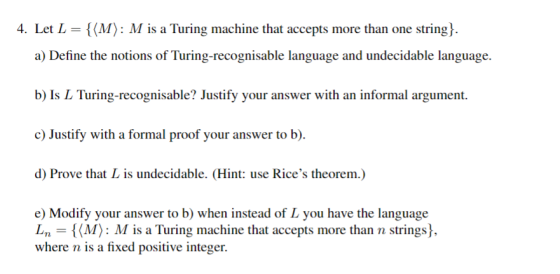
L = ((M):M is a Turing machine that accepts more than one string}
a) condition for decidability
considering the language of a Turing Machine M, denoted as L(M), is the set of all strings w on which M accepts.
property-1
A language L is decidable if there is a Turing machine M such that L(M) = L and M halts on every input. (which means it needs a prompt to accept the next input;in this case a delimiter like space or any other special symbol)
property-2
and also , A language L is recognizable if there is a Turing Machine M such that L(M) = L. whch means if M accepts the language L then it must satisfy the codition the all the input symbols supported by the machine gives the output symbols exactly similar to input symbols
Thus, if L is decidable then L is recursively enumerable.
condition for undecidability
Simply, A language L is undecidable if L is not decidable.
Thus, in this case there is no Turing machine M that halts on every input and L(M) = L. (This statement might seem funny but this is a standard definition seriously )
b) Condition for turing recognisability
L is turing recognisable as it satisfies the property-1(decidability) and property-2(recognizability) so we can say M recognises the given Language L ;
c) formal proff of recognisability
If A is Turing-decidable,
then it is also Turing-recognizable.
Let A ,A' be the symbols in the given language { }For all x
 and x''
holds that M,M'(turing machines dealing with separate strings
derived from the same language L) halts on input x. Combining
machines A and A' to run parallel gives a total Turing machine for
recognizing A.
and x''
holds that M,M'(turing machines dealing with separate strings
derived from the same language L) halts on input x. Combining
machines A and A' to run parallel gives a total Turing machine for
recognizing A.
So, we can say L isa recognisable over M
proof for L being Undecidable
This can be proven by reducing the halting problem to L: with an assumption that there are non zero halts for an input 's'
- For the halting problem instance (L,s) where s is a symbol belonging to L, create a new machine M for the L problem.
- On input n, M simulates (L,s) for length(n) steps.
- If the simulation halted within that number of steps, then M halts. Otherwise, M will go into infinite loop.
This reduction is valid because:
- If (L,s) does halt eventually in k steps, then M will halt for all inputs of length k or greater, thus M is in L.
- Otherwise (L,s) does not halt, then M will not halt for any input string no matter how long it is, thus M is not in L.
Finally, the halting problem is undecidable, therefore L is undecidable.
e)Considering this version of turing machine M where s
since n is a fixed value the simulations just iterate through all possible input strings of length N. the simulations will iterate through more strings, the machine doesnot acquire more knowledge, because only the first N symbols will be considered rest of the inputs will iterate through pre transited symbols. So the simulation can't go any further than N places(cells) as the Turing machines only move one cell per step.
resulting L being a turing recognisable.
2. Let L = {hMi: M is a Turing machine that accepts at least two binary strings}. a) Define the notions of a recognisabl...
 2. Let L = {hMi: M is a Turing machine that accepts at least two
binary strings}. a) Define the notions of a recognisable language
and an undecidable language. [5 marks] b) Is L Turing-recognisable?
Justify your answer with an informal argument. [5 marks] c) Prove
that L is undecidable. (Hint: use Rice’s theorem.) [20 marks] d)
Bonus: Justify with a formal proof your answer to b). [20
marks]
2. Let L-M M): M is a Turing machine that accepts...
2. Let L = {hMi: M is a Turing machine that accepts at least two
binary strings}. a) Define the notions of a recognisable language
and an undecidable language. [5 marks] b) Is L Turing-recognisable?
Justify your answer with an informal argument. [5 marks] c) Prove
that L is undecidable. (Hint: use Rice’s theorem.) [20 marks] d)
Bonus: Justify with a formal proof your answer to b). [20
marks]
2. Let L-M M): M is a Turing machine that accepts...
2. Let L-M M): M is a Turing machine that accepts at least two binary strings. a) Define the notions of a recognisable...
 2. Let L-M M): M is a Turing machine that accepts at least two binary strings. a) Define the notions of a recognisable language and an undecidable language. [5 marks [5 marks] b) Is L Turing-recognisable? Justify your answer with an informal argument. c) Prove that L is undecidable. (Hint: use Rice's theorem.) [20 marks] 20 marks] d) Bonus: Justify with a formal proof your answer to b).
2. Let L-M M): M is a Turing machine that accepts at...
2. Let L-M M): M is a Turing machine that accepts at least two binary strings. a) Define the notions of a recognisable language and an undecidable language. [5 marks [5 marks] b) Is L Turing-recognisable? Justify your answer with an informal argument. c) Prove that L is undecidable. (Hint: use Rice's theorem.) [20 marks] 20 marks] d) Bonus: Justify with a formal proof your answer to b).
2. Let L-M M): M is a Turing machine that accepts at...
please answer and I will rate! 3. Let L = {M M is a Turing machine...
 please answer and I will rate!
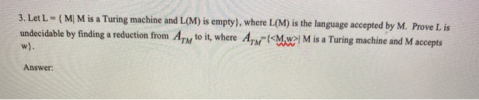
3. Let L = {M M is a Turing machine and L(M) is empty), where L(M) is the language accepted by M. Prove Lis undecidable by finding a reduction from Arm to it, where Ayv-<<MwM is a Turing machine and M accepts w). Answer:
please answer and I will rate!
3. Let L = {M M is a Turing machine and L(M) is empty), where L(M) is the language accepted by M. Prove Lis undecidable by finding a reduction from Arm to it, where Ayv-<<MwM is a Turing machine and M accepts w). Answer:
3. Let L= {MM is a Turing machine and L(M) is empty), where L(M) is the...
 3. Let L= {MM is a Turing machine and L(M) is empty), where L(M) is the language accepted by M. Prove L is undecidable by finding a reduction from Arm to it, where Arm={<M,w>| M is a Turing machine and M accepts w}
A Turing machine M decides a language L is M: Group of answer choices All of...
A Turing machine M decides a language L is M: Group of answer choices All of these apply. Accepts all strings in L and M rejects all strings not in L. Accepts some strings in L and M rejects some strings not in L. Accepts all strings in L that are recognizable.
Let Show that L is undecidable L = {〈M) IM is a Turing Machine that accepts w whenever it accepts L = {〈M) IM is a Turing Machine that accepts w whenever it accepts
Let Show that L is undecidable L = {〈M) IM is a Turing Machine that accepts w whenever it accepts L = {〈M) IM is a Turing Machine that accepts w whenever it accepts
2. Prove that {a"6"c" |m,n0}is not a regular language. Answer: 3. Let L = { M...
 2. Prove that {a"6"c" |m,n0}is not a regular language. Answer: 3. Let L = { M M is a Turing machine and L(M) is empty), where L(M) is the language accepted by M. Prove L is undecidable by finding a reduction from Aty to it, where Arm {<M.w>M is a Turing machine and M accepts Answer: 4. a) Define the concept of NP-completeness b) If A is NP-complete, and A has a polynomial time algorithm, then a polynomial time algorithm...
I'm not sure how to answer this problem. Can someone help me with this. thanks 5. Let M be the Turing machine BIBR 9 9 ala R a) Give a regular expression for L(M. b) Using the techniques from The...
 I'm not sure how to answer this problem. Can someone help me
with this. thanks
5. Let M be the Turing machine BIBR 9 9 ala R a) Give a regular expression for L(M. b) Using the techniques from Theorem 10.1.3, give the rules of an unrestricted gram- mar G that accepts L(M. c) Trace the computation of M when run with input bab and give the corresponding derivation in G.
5. Let M be the Turing machine BIBR 9...
I'm not sure how to answer this problem. Can someone help me
with this. thanks
5. Let M be the Turing machine BIBR 9 9 ala R a) Give a regular expression for L(M. b) Using the techniques from Theorem 10.1.3, give the rules of an unrestricted gram- mar G that accepts L(M. c) Trace the computation of M when run with input bab and give the corresponding derivation in G.
5. Let M be the Turing machine BIBR 9...
F F F 12. L={ <M> : L(M) = {b). Le SD/D. 13. L={<M> : L(M)...
 F F F 12. L={ <M> : L(M) = {b). Le SD/D. 13. L={<M> : L(M) CFLs). LED 14. L = {<M> : L(M) e CFLs). Rice's theorem could be used to prove that L 15. T T D. F L = {<M> : L(M) e CFLs). Le SD. That is, L is not semidecidable. T F 16. L <Mi,M2>:IL(M)L(IM21) 3. That is, there are more strings in L(M2) than in L(M). Rice's theorem could be used to prove that...
please answer a,b, and c Consider the following Turing Machine. M = “On input hA,Bi where...
please answer a,b, and c Consider the following Turing Machine. M = “On input hA,Bi where A and B are DFAs: 1. Iterate through strings in Σ∗ in shortlex order; where Σ represents the common symbols of their input alphabets. For each string iterated, simulate both A and B on it. 2. If a string is ever encountered that both A and B accept, then accept.” (a) (2 points) Give a description, in English, of the language that M recognizes....
 2. Let L = {hMi: M is a Turing machine that accepts at least two
binary strings}. a) Define the notions of a recognisable language
and an undecidable language. [5 marks] b) Is L Turing-recognisable?
Justify your answer with an informal argument. [5 marks] c) Prove
that L is undecidable. (Hint: use Rice’s theorem.) [20 marks] d)
Bonus: Justify with a formal proof your answer to b). [20
marks]
2. Let L-M M): M is a Turing machine that accepts...
2. Let L = {hMi: M is a Turing machine that accepts at least two
binary strings}. a) Define the notions of a recognisable language
and an undecidable language. [5 marks] b) Is L Turing-recognisable?
Justify your answer with an informal argument. [5 marks] c) Prove
that L is undecidable. (Hint: use Rice’s theorem.) [20 marks] d)
Bonus: Justify with a formal proof your answer to b). [20
marks]
2. Let L-M M): M is a Turing machine that accepts...
 2. Let L-M M): M is a Turing machine that accepts at least two binary strings. a) Define the notions of a recognisable language and an undecidable language. [5 marks [5 marks] b) Is L Turing-recognisable? Justify your answer with an informal argument. c) Prove that L is undecidable. (Hint: use Rice's theorem.) [20 marks] 20 marks] d) Bonus: Justify with a formal proof your answer to b).
2. Let L-M M): M is a Turing machine that accepts at...
2. Let L-M M): M is a Turing machine that accepts at least two binary strings. a) Define the notions of a recognisable language and an undecidable language. [5 marks [5 marks] b) Is L Turing-recognisable? Justify your answer with an informal argument. c) Prove that L is undecidable. (Hint: use Rice's theorem.) [20 marks] 20 marks] d) Bonus: Justify with a formal proof your answer to b).
2. Let L-M M): M is a Turing machine that accepts at...
 please answer and I will rate!
3. Let L = {M M is a Turing machine and L(M) is empty), where L(M) is the language accepted by M. Prove Lis undecidable by finding a reduction from Arm to it, where Ayv-<<MwM is a Turing machine and M accepts w). Answer:
please answer and I will rate!
3. Let L = {M M is a Turing machine and L(M) is empty), where L(M) is the language accepted by M. Prove Lis undecidable by finding a reduction from Arm to it, where Ayv-<<MwM is a Turing machine and M accepts w). Answer:
 3. Let L= {MM is a Turing machine and L(M) is empty), where L(M) is the language accepted by M. Prove L is undecidable by finding a reduction from Arm to it, where Arm={<M,w>| M is a Turing machine and M accepts w}
 2. Prove that {a"6"c" |m,n0}is not a regular language. Answer: 3. Let L = { M M is a Turing machine and L(M) is empty), where L(M) is the language accepted by M. Prove L is undecidable by finding a reduction from Aty to it, where Arm {<M.w>M is a Turing machine and M accepts Answer: 4. a) Define the concept of NP-completeness b) If A is NP-complete, and A has a polynomial time algorithm, then a polynomial time algorithm...
 I'm not sure how to answer this problem. Can someone help me
with this. thanks
5. Let M be the Turing machine BIBR 9 9 ala R a) Give a regular expression for L(M. b) Using the techniques from Theorem 10.1.3, give the rules of an unrestricted gram- mar G that accepts L(M. c) Trace the computation of M when run with input bab and give the corresponding derivation in G.
5. Let M be the Turing machine BIBR 9...
I'm not sure how to answer this problem. Can someone help me
with this. thanks
5. Let M be the Turing machine BIBR 9 9 ala R a) Give a regular expression for L(M. b) Using the techniques from Theorem 10.1.3, give the rules of an unrestricted gram- mar G that accepts L(M. c) Trace the computation of M when run with input bab and give the corresponding derivation in G.
5. Let M be the Turing machine BIBR 9...
 F F F 12. L={ <M> : L(M) = {b). Le SD/D. 13. L={<M> : L(M) CFLs). LED 14. L = {<M> : L(M) e CFLs). Rice's theorem could be used to prove that L 15. T T D. F L = {<M> : L(M) e CFLs). Le SD. That is, L is not semidecidable. T F 16. L <Mi,M2>:IL(M)L(IM21) 3. That is, there are more strings in L(M2) than in L(M). Rice's theorem could be used to prove that...
Most questions answered within 3 hours.
-
Where is the error in this code sequence?
String s1 = "Hello";
String s2 = "ello";...
asked 10 months ago -
Financial data for Joel de Paris, Inc., for last year
follow:
Joel de Paris, Inc.
Balance...
asked 10 months ago -
Consider this reaction:
Al2(SO4)3 (aq)+ BaCl3
(aq) Al2Cl6 (aq)- +
3BaSO4(s) . What is the...
asked 10 months ago -
Suppose that Savneet is considering increasing her
recent random sample from 20 car rentals to 40...
asked 10 months ago -
Trucks arrive at an unloading terminal at an average rate of 120
per hour.
Trucks arrive...
asked 10 months ago -
Why are methanol and ethanol completely soluble in water while
octanol is not very little soluble....
asked 10 months ago -
A facilities manager at a university reads in a research report
that the mean amount of...
asked 10 months ago -
When the CuSO4 is rehydrated by adding water to the anhydrous
compound, is this an endothermic...
asked 10 months ago -
A ray of sunlight is passing from diamond into crown glass; the
angle of incidence is...
asked 10 months ago -
A block of mass 0.249 kg is placed on top of a light, vertical
spring of...
asked 10 months ago -
how do the kidneys compensate in the presences of acidosis
a) trigger hyperventilate
b) reserve acid...
asked 10 months ago -
Question 501 pts
The rental rate of capital to the firm increases. Which of the
following...
asked 10 months ago