A Turing machine M decides a language L is M: Group of answer choices All of...
A Turing machine M decides a language L is M:
Group of answer choices
All of these apply.
Accepts all strings in L and M rejects all strings not in L.
Accepts some strings in L and M rejects some strings not in L.
Accepts all strings in L that are recognizable.
Homework Answers

Add Answer to:
A Turing machine M decides a language L is M:
Group of answer choices
All of...
Help me answer this question plz! 4. Let L = { (A) M is a Turing...
 Help me answer this question plz!
4. Let L = { (A) M is a Turing machine that accepts more than one string } a) Define the notions of Turing-recognisable language and undecidable language. b) Is L Turing-recognisable? Justify your answer with an informal argument. c) Justify with a formal proof your answer to b) d) Prove that L is undecidable. (Hint: use Rice's theorem.) e) Modify your answer to b) when instead of L you have the language Ln...
Help me answer this question plz!
4. Let L = { (A) M is a Turing machine that accepts more than one string } a) Define the notions of Turing-recognisable language and undecidable language. b) Is L Turing-recognisable? Justify your answer with an informal argument. c) Justify with a formal proof your answer to b) d) Prove that L is undecidable. (Hint: use Rice's theorem.) e) Modify your answer to b) when instead of L you have the language Ln...
2. Let L = {hMi: M is a Turing machine that accepts at least two binary strings}. a) Define the notions of a recognisabl...
 2. Let L = {hMi: M is a Turing machine that accepts at least two
binary strings}. a) Define the notions of a recognisable language
and an undecidable language. [5 marks] b) Is L Turing-recognisable?
Justify your answer with an informal argument. [5 marks] c) Prove
that L is undecidable. (Hint: use Rice’s theorem.) [20 marks] d)
Bonus: Justify with a formal proof your answer to b). [20
marks]
2. Let L-M M): M is a Turing machine that accepts...
2. Let L = {hMi: M is a Turing machine that accepts at least two
binary strings}. a) Define the notions of a recognisable language
and an undecidable language. [5 marks] b) Is L Turing-recognisable?
Justify your answer with an informal argument. [5 marks] c) Prove
that L is undecidable. (Hint: use Rice’s theorem.) [20 marks] d)
Bonus: Justify with a formal proof your answer to b). [20
marks]
2. Let L-M M): M is a Turing machine that accepts...
2. Let L-M M): M is a Turing machine that accepts at least two binary strings. a) Define the notions of a recognisable...
 2. Let L-M M): M is a Turing machine that accepts at least two binary strings. a) Define the notions of a recognisable language and an undecidable language. [5 marks [5 marks] b) Is L Turing-recognisable? Justify your answer with an informal argument. c) Prove that L is undecidable. (Hint: use Rice's theorem.) [20 marks] 20 marks] d) Bonus: Justify with a formal proof your answer to b).
2. Let L-M M): M is a Turing machine that accepts at...
2. Let L-M M): M is a Turing machine that accepts at least two binary strings. a) Define the notions of a recognisable language and an undecidable language. [5 marks [5 marks] b) Is L Turing-recognisable? Justify your answer with an informal argument. c) Prove that L is undecidable. (Hint: use Rice's theorem.) [20 marks] 20 marks] d) Bonus: Justify with a formal proof your answer to b).
2. Let L-M M): M is a Turing machine that accepts at...
please answer and I will rate! 3. Let L = {M M is a Turing machine...
 please answer and I will rate!
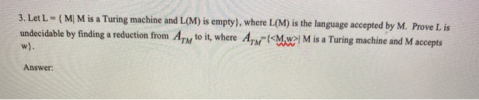
3. Let L = {M M is a Turing machine and L(M) is empty), where L(M) is the language accepted by M. Prove Lis undecidable by finding a reduction from Arm to it, where Ayv-<<MwM is a Turing machine and M accepts w). Answer:
please answer and I will rate!
3. Let L = {M M is a Turing machine and L(M) is empty), where L(M) is the language accepted by M. Prove Lis undecidable by finding a reduction from Arm to it, where Ayv-<<MwM is a Turing machine and M accepts w). Answer:
Describe a Turing machine that decides L5 = {0^3^n |n ∈ N} – the language consisting...
Describe a Turing machine that decides L5 = {0^3^n |n ∈ N} – the language consisting of all strings of zeroes whose length is a power of 3.
3. Let L= {MM is a Turing machine and L(M) is empty), where L(M) is the...
 3. Let L= {MM is a Turing machine and L(M) is empty), where L(M) is the language accepted by M. Prove L is undecidable by finding a reduction from Arm to it, where Arm={<M,w>| M is a Turing machine and M accepts w}
Show that the language A = {<M1> | the language accepted by the Turing Machine M1...
 Show that the language A = {<M1> | the language
accepted by the Turing Machine M1 is 1*} is
not decidable. Present your proof in the style of the proof of Th.
5.3, which shows below.
PROOF We let R be a TM that decides REGULARTm and construct TM S to decide ATM. Then S works in the following manner. S - "On input (M, w), where M is a TM and w is a string: 1. Construct the following...
Show that the language A = {<M1> | the language
accepted by the Turing Machine M1 is 1*} is
not decidable. Present your proof in the style of the proof of Th.
5.3, which shows below.
PROOF We let R be a TM that decides REGULARTm and construct TM S to decide ATM. Then S works in the following manner. S - "On input (M, w), where M is a TM and w is a string: 1. Construct the following...
Consider the language LOOPS = {<M,w> | M is a Turing machine and M loops forever...
 Consider the language LOOPS = {<M,w> | M is a Turing machine and M loops forever on input w} Is LOOPS Turing decidable? Explain why or why not. Is LOOPS Turing recognizable? Explain why or why not.
please answer a,b, and c Consider the following Turing Machine. M = “On input hA,Bi where...
please answer a,b, and c Consider the following Turing Machine. M = “On input hA,Bi where A and B are DFAs: 1. Iterate through strings in Σ∗ in shortlex order; where Σ represents the common symbols of their input alphabets. For each string iterated, simulate both A and B on it. 2. If a string is ever encountered that both A and B accept, then accept.” (a) (2 points) Give a description, in English, of the language that M recognizes....
3b. Consider the language FIN = { | M is a Turing machine and L(M) is...
3b. Consider the language FIN = { | M is a Turing machine and L(M) is finite }. Prove FIN is not decidable.
 Help me answer this question plz!
4. Let L = { (A) M is a Turing machine that accepts more than one string } a) Define the notions of Turing-recognisable language and undecidable language. b) Is L Turing-recognisable? Justify your answer with an informal argument. c) Justify with a formal proof your answer to b) d) Prove that L is undecidable. (Hint: use Rice's theorem.) e) Modify your answer to b) when instead of L you have the language Ln...
Help me answer this question plz!
4. Let L = { (A) M is a Turing machine that accepts more than one string } a) Define the notions of Turing-recognisable language and undecidable language. b) Is L Turing-recognisable? Justify your answer with an informal argument. c) Justify with a formal proof your answer to b) d) Prove that L is undecidable. (Hint: use Rice's theorem.) e) Modify your answer to b) when instead of L you have the language Ln...
 2. Let L = {hMi: M is a Turing machine that accepts at least two
binary strings}. a) Define the notions of a recognisable language
and an undecidable language. [5 marks] b) Is L Turing-recognisable?
Justify your answer with an informal argument. [5 marks] c) Prove
that L is undecidable. (Hint: use Rice’s theorem.) [20 marks] d)
Bonus: Justify with a formal proof your answer to b). [20
marks]
2. Let L-M M): M is a Turing machine that accepts...
2. Let L = {hMi: M is a Turing machine that accepts at least two
binary strings}. a) Define the notions of a recognisable language
and an undecidable language. [5 marks] b) Is L Turing-recognisable?
Justify your answer with an informal argument. [5 marks] c) Prove
that L is undecidable. (Hint: use Rice’s theorem.) [20 marks] d)
Bonus: Justify with a formal proof your answer to b). [20
marks]
2. Let L-M M): M is a Turing machine that accepts...
 2. Let L-M M): M is a Turing machine that accepts at least two binary strings. a) Define the notions of a recognisable language and an undecidable language. [5 marks [5 marks] b) Is L Turing-recognisable? Justify your answer with an informal argument. c) Prove that L is undecidable. (Hint: use Rice's theorem.) [20 marks] 20 marks] d) Bonus: Justify with a formal proof your answer to b).
2. Let L-M M): M is a Turing machine that accepts at...
2. Let L-M M): M is a Turing machine that accepts at least two binary strings. a) Define the notions of a recognisable language and an undecidable language. [5 marks [5 marks] b) Is L Turing-recognisable? Justify your answer with an informal argument. c) Prove that L is undecidable. (Hint: use Rice's theorem.) [20 marks] 20 marks] d) Bonus: Justify with a formal proof your answer to b).
2. Let L-M M): M is a Turing machine that accepts at...
 please answer and I will rate!
3. Let L = {M M is a Turing machine and L(M) is empty), where L(M) is the language accepted by M. Prove Lis undecidable by finding a reduction from Arm to it, where Ayv-<<MwM is a Turing machine and M accepts w). Answer:
please answer and I will rate!
3. Let L = {M M is a Turing machine and L(M) is empty), where L(M) is the language accepted by M. Prove Lis undecidable by finding a reduction from Arm to it, where Ayv-<<MwM is a Turing machine and M accepts w). Answer:
 3. Let L= {MM is a Turing machine and L(M) is empty), where L(M) is the language accepted by M. Prove L is undecidable by finding a reduction from Arm to it, where Arm={<M,w>| M is a Turing machine and M accepts w}
 Show that the language A = {<M1> | the language
accepted by the Turing Machine M1 is 1*} is
not decidable. Present your proof in the style of the proof of Th.
5.3, which shows below.
PROOF We let R be a TM that decides REGULARTm and construct TM S to decide ATM. Then S works in the following manner. S - "On input (M, w), where M is a TM and w is a string: 1. Construct the following...
Show that the language A = {<M1> | the language
accepted by the Turing Machine M1 is 1*} is
not decidable. Present your proof in the style of the proof of Th.
5.3, which shows below.
PROOF We let R be a TM that decides REGULARTm and construct TM S to decide ATM. Then S works in the following manner. S - "On input (M, w), where M is a TM and w is a string: 1. Construct the following...
 Consider the language LOOPS = {<M,w> | M is a Turing machine and M loops forever on input w} Is LOOPS Turing decidable? Explain why or why not. Is LOOPS Turing recognizable? Explain why or why not.
Most questions answered within 3 hours.
-
Where is the error in this code sequence?
String s1 = "Hello";
String s2 = "ello";...
asked 10 months ago -
Financial data for Joel de Paris, Inc., for last year
follow:
Joel de Paris, Inc.
Balance...
asked 10 months ago -
Consider this reaction:
Al2(SO4)3 (aq)+ BaCl3
(aq) Al2Cl6 (aq)- +
3BaSO4(s) . What is the...
asked 10 months ago -
Suppose that Savneet is considering increasing her
recent random sample from 20 car rentals to 40...
asked 10 months ago -
Trucks arrive at an unloading terminal at an average rate of 120
per hour.
Trucks arrive...
asked 10 months ago -
Why are methanol and ethanol completely soluble in water while
octanol is not very little soluble....
asked 10 months ago -
A facilities manager at a university reads in a research report
that the mean amount of...
asked 10 months ago -
When the CuSO4 is rehydrated by adding water to the anhydrous
compound, is this an endothermic...
asked 10 months ago -
A ray of sunlight is passing from diamond into crown glass; the
angle of incidence is...
asked 10 months ago -
A block of mass 0.249 kg is placed on top of a light, vertical
spring of...
asked 10 months ago -
how do the kidneys compensate in the presences of acidosis
a) trigger hyperventilate
b) reserve acid...
asked 10 months ago -
Question 501 pts
The rental rate of capital to the firm increases. Which of the
following...
asked 10 months ago