![Exercise 3 [Conditionals] Consider the following assembly code for a function F3 with two integer arguments: F3: push EBP mov EBP, ESP mov EDX, DWORD PTR [ebp+12] mov EAX, DWORD PTR [ebp+8] cmp EAX, EDX # setup stack #if # goto .L1 #EAX- mov EAX, EDX # ignore for now mov DWORD PTR [EBP-4], EAX mov ESP, EBP pop EBE ret # cleanup stack To the right of each instruction, show the contents of the register whose value changes as a result of executing that instruction, then fill in the corresponding C source code below. int F3 (int x, int y)](http://img.homeworklib.com/questions/282bb980-5777-11eb-8b98-77dc49a42bc1.png?x-oss-process=image/resize,w_560)
Homework Answers
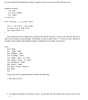
Equivalent C Code:
Int F3(int x, int y){
If(x>y){
Break;
}
Else{
x=y
}
}
For the blanks:
If(x>y)
EAX = y
Add Answer to:
Exercise 3 [Conditionals] Consider the following assembly code for a function F3 with two integer arguments:...
Assembly MASM x86 Write a complete program that sorts dword unsigned integer array in descending order....
Assembly MASM x86 Write a complete program that sorts dword unsigned integer array in descending order. Assume that the user doesn’t enter more than 40 integers. You MUST use the template and follow all the directions there. You can’t add any more procedures to the template. The procedures can’t use any global variables (variables that are inside .data segment). The caller of any procedures sends its argument through the stack. Inside any procedures, if you need to use a register,...
And also when recursive(5). Consider the following funtion int recursive(int n) f The assembly code equivalent...
 And also when recursive(5).
Consider the following funtion int recursive(int n) f The assembly code equivalent of the above function is: recursive push %ebp mov %esp,%ebp push %ebx sub $0x14,%esp cmpl $0x1,0x8(%ebp) je L1 cmpl $0x2,0x8(%ebp) jne L2 L1 mov 0x8 (%ebp),%eax jmp L3 L2 mov 0x8 (%ebp),%eax sub $0x1,%eax mov %eax, (%esp call recursive mov %eax,%ebx mov ox8(%ebp),%eax sub $0x2,%eax mov %eax, (%esp call recursive imul %ebx,%eax L3 add $0x14,%esp pop %ebx pop %ebp ret
And also when recursive(5).
Consider the following funtion int recursive(int n) f The assembly code equivalent of the above function is: recursive push %ebp mov %esp,%ebp push %ebx sub $0x14,%esp cmpl $0x1,0x8(%ebp) je L1 cmpl $0x2,0x8(%ebp) jne L2 L1 mov 0x8 (%ebp),%eax jmp L3 L2 mov 0x8 (%ebp),%eax sub $0x1,%eax mov %eax, (%esp call recursive mov %eax,%ebx mov ox8(%ebp),%eax sub $0x2,%eax mov %eax, (%esp call recursive imul %ebx,%eax L3 add $0x14,%esp pop %ebx pop %ebp ret
9. Consider the code below. At the location indicated by “RIGHT HERE”, what does the stack...
9. Consider the code below. At the location indicated by “RIGHT HERE”, what does the stack currently look like? Please draw a picture. Where will ESP and EBP currently be pointing? Add these pointers to your picture. main: push 13 push 17 call func_a add esp, 8 ret func_a: push ebp mov ebp, esp sub esp, 12 mov DWORD [ebp – 4], 19 mov DWORD [ebp – 8], 23 ; <-- RIGHT HERE. Draw a picture ; What does the...
the answer is movl 8(%ebp), %edx or movl 4(%ebp), %edx? Consider the following C and assembly...
 the answer is movl 8(%ebp),
%edx or movl 4(%ebp), %edx?
Consider the following C and assembly code: int increment(int x){ return x+1; } increment: 1 push? 2 movl 3 movl 4 addl 5 6 popl ret %ebp %esp, %ebp 8(%ebp), %eax $1, %eax %ebp Suppose we want to move the return address into register %edx on line 5. Write 1 line of assembly code to perform this action. (Write your answer with exactly 2 spaces: one after the instruction, and...
the answer is movl 8(%ebp),
%edx or movl 4(%ebp), %edx?
Consider the following C and assembly code: int increment(int x){ return x+1; } increment: 1 push? 2 movl 3 movl 4 addl 5 6 popl ret %ebp %esp, %ebp 8(%ebp), %eax $1, %eax %ebp Suppose we want to move the return address into register %edx on line 5. Write 1 line of assembly code to perform this action. (Write your answer with exactly 2 spaces: one after the instruction, and...
You are charged with maintaining a large C rogram and you come across the following code...
 You are charged with maintaining a large C rogram and you come across the following code typedef struct int left a-struct a [CNT] int right b-struct; void testlint i, b-struct *bp) int n bp- left bp-rights a-struct ap &bp- ali] ap- Cap- idx] n; The declaration of the compile time constant CNT and the structure a struct are in a file for which you don't have necessary access privilege. Fortunately you have a copy of the o' version of code,...
X86 Assembly Language Help to implement the CipherChar Procedure at the end of the given code...
X86 Assembly Language Help to implement the CipherChar Procedure at the end of the given code INCLUDE Irvine32.inc .data KeyPrompt BYTE "Enter the passphrase: ",0 TextPrompt BYTE "Enter the plaintest: ",0 str1 BYTE "The passphrase has length:",0 str2 BYTE "The plaintest has length:",0 KeyIs BYTE "The passphrase: ",0 PlainTextIs BYTE "The plaintext: ",0 CipherTextIs BYTE "The ciphertext: ",0 KMAX = 64 ; passphrase buffer maximum size BMAX = 128 ; test...
16. List the 3 types of memory partitions as discussed in class. 17. In which of...
16. List the 3 types of memory partitions as discussed in class. 17. In which of the 3 types of memory are static variables stored? 18. There are two things the NOP instruction accomplishes while doing nothing, list one. 19. Given ecx = 0x0000007B, so cl=0x7B, what is the minimum value that when added, would set the OVERFLOW flag? add cl, __________ ; minimum value to cause OF to be set Short Answer (40 pts) 20. (4 pts) Given...
Reverse Engineering
I need to reverse engineer from machine code to C, how do I do it?This problem will give you a chance to reverse engineer a switch statement frommachine code. In the following procedure, the body of the switch statement hasbeen removed:1 int switch_prob(int x, int n)2 {3 int result = x;45 switch(n) {67 /* Fill in code here */8 }910 return result;11 }Figure 3.44 shows the disassembled machine code for the procedure. We cansee in lines 4 and 5 that...
Task is to implement the following algorithms in Assembly language for x86 processor
Task is to implement the following algorithms in Assembly language for x86 processor1) Insertion sort Demonstrate Sorted Array of 10 elements in Watch Window for each one Running time of each algorithmsample bubble sort code:;----------------------------------------------------------BubbleSort PROC USES eax ecx esi,pArray:PTR DWORD, ; pointer to arrayCount:DWORD ; array size;; Sort an array of 32-bit signed integers in ascending; order, using the bubble sort algorithm.; Receives: pointer to array, array size; Returns: nothing;-----------------------------------------------------------mov ecx,Countdec ecx ; decrement count by 1L1: push ecx ; save outer...
LC-3 Programming Help!! The Stack Protocol The following outline is the protocol for passing arguments to...
LC-3 Programming Help!! The Stack Protocol The following outline is the protocol for passing arguments to a function and returning values. Everything is stored on the runtime stack so that space is used only when the function is executing. As a result the actual address of arguments and locals may change from call to call. However, the layout of the stack frame (activation record) is constant. Thus, the offests from the frame pointer (FP) to the parameters/locals are constant. All...
 And also when recursive(5).
Consider the following funtion int recursive(int n) f The assembly code equivalent of the above function is: recursive push %ebp mov %esp,%ebp push %ebx sub $0x14,%esp cmpl $0x1,0x8(%ebp) je L1 cmpl $0x2,0x8(%ebp) jne L2 L1 mov 0x8 (%ebp),%eax jmp L3 L2 mov 0x8 (%ebp),%eax sub $0x1,%eax mov %eax, (%esp call recursive mov %eax,%ebx mov ox8(%ebp),%eax sub $0x2,%eax mov %eax, (%esp call recursive imul %ebx,%eax L3 add $0x14,%esp pop %ebx pop %ebp ret
And also when recursive(5).
Consider the following funtion int recursive(int n) f The assembly code equivalent of the above function is: recursive push %ebp mov %esp,%ebp push %ebx sub $0x14,%esp cmpl $0x1,0x8(%ebp) je L1 cmpl $0x2,0x8(%ebp) jne L2 L1 mov 0x8 (%ebp),%eax jmp L3 L2 mov 0x8 (%ebp),%eax sub $0x1,%eax mov %eax, (%esp call recursive mov %eax,%ebx mov ox8(%ebp),%eax sub $0x2,%eax mov %eax, (%esp call recursive imul %ebx,%eax L3 add $0x14,%esp pop %ebx pop %ebp ret
 the answer is movl 8(%ebp),
%edx or movl 4(%ebp), %edx?
Consider the following C and assembly code: int increment(int x){ return x+1; } increment: 1 push? 2 movl 3 movl 4 addl 5 6 popl ret %ebp %esp, %ebp 8(%ebp), %eax $1, %eax %ebp Suppose we want to move the return address into register %edx on line 5. Write 1 line of assembly code to perform this action. (Write your answer with exactly 2 spaces: one after the instruction, and...
the answer is movl 8(%ebp),
%edx or movl 4(%ebp), %edx?
Consider the following C and assembly code: int increment(int x){ return x+1; } increment: 1 push? 2 movl 3 movl 4 addl 5 6 popl ret %ebp %esp, %ebp 8(%ebp), %eax $1, %eax %ebp Suppose we want to move the return address into register %edx on line 5. Write 1 line of assembly code to perform this action. (Write your answer with exactly 2 spaces: one after the instruction, and...
 You are charged with maintaining a large C rogram and you come across the following code typedef struct int left a-struct a [CNT] int right b-struct; void testlint i, b-struct *bp) int n bp- left bp-rights a-struct ap &bp- ali] ap- Cap- idx] n; The declaration of the compile time constant CNT and the structure a struct are in a file for which you don't have necessary access privilege. Fortunately you have a copy of the o' version of code,...
Most questions answered within 3 hours.
-
Where is the error in this code sequence?
String s1 = "Hello";
String s2 = "ello";...
asked 11 months ago -
Financial data for Joel de Paris, Inc., for last year
follow:
Joel de Paris, Inc.
Balance...
asked 11 months ago -
Consider this reaction:
Al2(SO4)3 (aq)+ BaCl3
(aq) Al2Cl6 (aq)- +
3BaSO4(s) . What is the...
asked 11 months ago -
Suppose that Savneet is considering increasing her
recent random sample from 20 car rentals to 40...
asked 11 months ago -
Trucks arrive at an unloading terminal at an average rate of 120
per hour.
Trucks arrive...
asked 11 months ago -
Why are methanol and ethanol completely soluble in water while
octanol is not very little soluble....
asked 11 months ago -
A facilities manager at a university reads in a research report
that the mean amount of...
asked 11 months ago -
When the CuSO4 is rehydrated by adding water to the anhydrous
compound, is this an endothermic...
asked 11 months ago -
A ray of sunlight is passing from diamond into crown glass; the
angle of incidence is...
asked 11 months ago -
A block of mass 0.249 kg is placed on top of a light, vertical
spring of...
asked 11 months ago -
how do the kidneys compensate in the presences of acidosis
a) trigger hyperventilate
b) reserve acid...
asked 11 months ago -
Question 501 pts
The rental rate of capital to the firm increases. Which of the
following...
asked 11 months ago