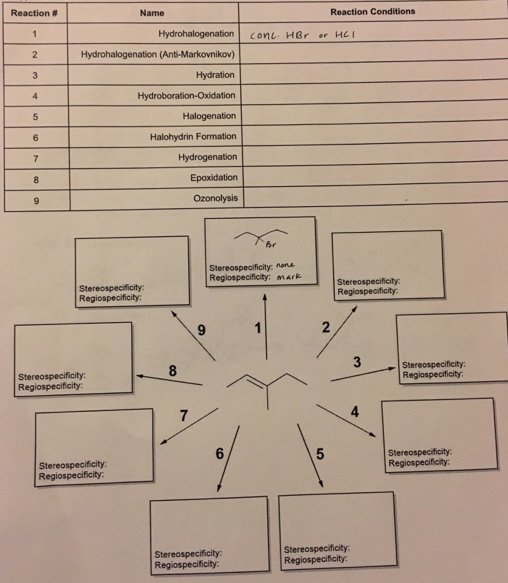
Complete the table below with reaction conditions for each named reaction.
Complete the table below with reaction conditions for each named reaction. Draw the products in the chart below for the given starting material. Be sure to note the stereospecificity (none, syn or anti) and regioselectivity (Markovnikov or anti-Markovnikov) as applicable.
Homework Answers

Add Answer to:
Complete the table below with reaction conditions for each named reaction.
For the following addition reactions of alkene, identify the fragments to be added, the name of the reaction type,...
 For the following addition reactions of alkene, identify the fragments to be added, the name of the reaction type, their regioselectivity (Markovnikov vs anti-Markovnikov or none) and the stereospecificity (anti vs syn or none).
For the following addition reactions of alkene, identify the fragments to be added the name of the reaction typ
 For the following addition reactions of alkene, identify the fragments to be added the name of the reaction type, their regioselectivity (Markovnikov vs anti-Markovnikov or none) and the stereospecificity (anti vs syn or none).
help please! 18. Predict the reactants necessary to complete each reaction below. Be sure to include...
 help please!
18. Predict the reactants necessary to complete each reaction below. Be sure to include all necessary reaction conditions (3 points each) 19. Given the current global epidemic involving the novel strain of coronavirus, COVID-19, the synthesis of anti-viral medications become increasingly more important. Provide the mechanism of the reaction below and discuss the observed regioselectivity. (6 points) HOMCO2Et CO2Et Но" Т TsOH 0 20. Unknown X is an acyclic 6-carbon alkane containing an alcohol with formula C6H13Bro. Treatment...
help please!
18. Predict the reactants necessary to complete each reaction below. Be sure to include all necessary reaction conditions (3 points each) 19. Given the current global epidemic involving the novel strain of coronavirus, COVID-19, the synthesis of anti-viral medications become increasingly more important. Provide the mechanism of the reaction below and discuss the observed regioselectivity. (6 points) HOMCO2Et CO2Et Но" Т TsOH 0 20. Unknown X is an acyclic 6-carbon alkane containing an alcohol with formula C6H13Bro. Treatment...
Provide Major products for the reactions below in the space provided for each part. If there...
 Provide Major products for the reactions below in the space provided for each part. If there are two major products, what is the relationship between the two products in each case. Please Show Stereochemistry using wedges and dashes. Provide mechanism, for Major product or products and the relationship between the products. Mention whether the addition is SYN, ANTI, Markovnikov (Mkv) or Anti Markovnikov for each reaction. Please draw clear and legible structures. Lewis structures must be used for the reagents....
B Mechanisms Complete the proposed mechanisms on the following pages by adding arrows or drawing products...
 B Mechanisms Complete the proposed mechanisms on the following pages by adding arrows or drawing products as indicated Complete the table below for each possible mechanism given. Label each type of mechanism as syn, anti or mix of syn and anti addition and label the expected products as of each mechanism as "meso, "racemic mix. or mix of meso and racemic" products Note: Are all of the proposed mechanisms acceptable arrow pushing mechanisms? Can any proposed mechanisms be eliminated prior...
can you explain both numbers 4 and 5 and give reasons as to why/how the answer was achieved 4. For each reaction, ma...
 can you explain both numbers 4 and 5 and give reasons as to
why/how the answer was achieved
4. For each reaction, mark all of the statements below that correctly describe the reaction X1,80 X 14, THX MGOMO H,0 2) H,O, NOH H, Markovnikov addition Anti-Markovnikov addition Syn addition Anti addition Syn and Anti addition Rearrangement acou Rearrangement does not coeur 5. Insert the necessary reagents and product to complete this synthetic pathway. HO Br H2SO, (conc.) H2, Pt heat
can you explain both numbers 4 and 5 and give reasons as to
why/how the answer was achieved
4. For each reaction, mark all of the statements below that correctly describe the reaction X1,80 X 14, THX MGOMO H,0 2) H,O, NOH H, Markovnikov addition Anti-Markovnikov addition Syn addition Anti addition Syn and Anti addition Rearrangement acou Rearrangement does not coeur 5. Insert the necessary reagents and product to complete this synthetic pathway. HO Br H2SO, (conc.) H2, Pt heat
10. The following substrate reacts differently with each set of conditions. For each reaction give ALL...
 10. The following substrate reacts differently with each set of conditions. For each reaction give ALL of the products, the mechanism (SN 1, SN2, E1 or E2), and the rate law. You may abbreviate the alkyl halide as R-Br in your rate law. (12) Draw reaction product(s) Mechanism Rate Law NaSH acetone 11. The following compound is shown with no designated stereochemistry. How many stereoisomers are there for this compound? Draw each of them and label them as either chiral...
draw the major products for the following transformations and determine whether it is a Markovnikov or...
 draw the major products for the following transformations and
determine whether it is a Markovnikov or anti-Markovnikov(if
applicable) Make sure products are stereochemically correct. (Write
down each reaction and draw products)
1) BH3. THE 2) H2O2, NaOH, H20 1) Hg(OAC)2, EtOH 2) NaBH4, H30+ 1-Ethylcyclohexene Br2, H2O
draw the major products for the following transformations and
determine whether it is a Markovnikov or anti-Markovnikov(if
applicable) Make sure products are stereochemically correct. (Write
down each reaction and draw products)
1) BH3. THE 2) H2O2, NaOH, H20 1) Hg(OAC)2, EtOH 2) NaBH4, H30+ 1-Ethylcyclohexene Br2, H2O
2. Provide the reagents/conditions required to accomplish each of the transformations (A-C) below. If a reaction...
 2. Provide the reagents/conditions required to accomplish each of the transformations (A-C) below. If a reaction consists of two steps, be sure to show this: 6 points. 3. Draw the starting materials (A and B) required to obtain the products shown below, using the reagents and conditions provided: 6 points. 1. HB(sia), THE 2. H2O2, NaOH, H20 produces 1.03 both products 2.(CH3)2S HgSO4 H2SO4, H20
4.(18 points) Using the arrow, provide the detailed reaction conditions necessary to give the following. You...
 4.(18 points) Using the arrow, provide the detailed reaction conditions necessary to give the following. You do not need to provide any starting material or product, just the reaction conditions (see example below) 1.B Example: Show reagent 'B' followed by aqueous acid: 2. H30 a. Markovnikov addition of H2O to a double bond: b. Anti-Markovnikov addition of H2O to a double bond: c. Markovnikov addition to form an alkyl bromide from an alkene: d. Reaction conditions to change 1,2-dimethylcyclohexene into...
 help please!
18. Predict the reactants necessary to complete each reaction below. Be sure to include all necessary reaction conditions (3 points each) 19. Given the current global epidemic involving the novel strain of coronavirus, COVID-19, the synthesis of anti-viral medications become increasingly more important. Provide the mechanism of the reaction below and discuss the observed regioselectivity. (6 points) HOMCO2Et CO2Et Но" Т TsOH 0 20. Unknown X is an acyclic 6-carbon alkane containing an alcohol with formula C6H13Bro. Treatment...
help please!
18. Predict the reactants necessary to complete each reaction below. Be sure to include all necessary reaction conditions (3 points each) 19. Given the current global epidemic involving the novel strain of coronavirus, COVID-19, the synthesis of anti-viral medications become increasingly more important. Provide the mechanism of the reaction below and discuss the observed regioselectivity. (6 points) HOMCO2Et CO2Et Но" Т TsOH 0 20. Unknown X is an acyclic 6-carbon alkane containing an alcohol with formula C6H13Bro. Treatment...
 Provide Major products for the reactions below in the space provided for each part. If there are two major products, what is the relationship between the two products in each case. Please Show Stereochemistry using wedges and dashes. Provide mechanism, for Major product or products and the relationship between the products. Mention whether the addition is SYN, ANTI, Markovnikov (Mkv) or Anti Markovnikov for each reaction. Please draw clear and legible structures. Lewis structures must be used for the reagents....
 B Mechanisms Complete the proposed mechanisms on the following pages by adding arrows or drawing products as indicated Complete the table below for each possible mechanism given. Label each type of mechanism as syn, anti or mix of syn and anti addition and label the expected products as of each mechanism as "meso, "racemic mix. or mix of meso and racemic" products Note: Are all of the proposed mechanisms acceptable arrow pushing mechanisms? Can any proposed mechanisms be eliminated prior...
 can you explain both numbers 4 and 5 and give reasons as to
why/how the answer was achieved
4. For each reaction, mark all of the statements below that correctly describe the reaction X1,80 X 14, THX MGOMO H,0 2) H,O, NOH H, Markovnikov addition Anti-Markovnikov addition Syn addition Anti addition Syn and Anti addition Rearrangement acou Rearrangement does not coeur 5. Insert the necessary reagents and product to complete this synthetic pathway. HO Br H2SO, (conc.) H2, Pt heat
can you explain both numbers 4 and 5 and give reasons as to
why/how the answer was achieved
4. For each reaction, mark all of the statements below that correctly describe the reaction X1,80 X 14, THX MGOMO H,0 2) H,O, NOH H, Markovnikov addition Anti-Markovnikov addition Syn addition Anti addition Syn and Anti addition Rearrangement acou Rearrangement does not coeur 5. Insert the necessary reagents and product to complete this synthetic pathway. HO Br H2SO, (conc.) H2, Pt heat
 10. The following substrate reacts differently with each set of conditions. For each reaction give ALL of the products, the mechanism (SN 1, SN2, E1 or E2), and the rate law. You may abbreviate the alkyl halide as R-Br in your rate law. (12) Draw reaction product(s) Mechanism Rate Law NaSH acetone 11. The following compound is shown with no designated stereochemistry. How many stereoisomers are there for this compound? Draw each of them and label them as either chiral...
 draw the major products for the following transformations and
determine whether it is a Markovnikov or anti-Markovnikov(if
applicable) Make sure products are stereochemically correct. (Write
down each reaction and draw products)
1) BH3. THE 2) H2O2, NaOH, H20 1) Hg(OAC)2, EtOH 2) NaBH4, H30+ 1-Ethylcyclohexene Br2, H2O
draw the major products for the following transformations and
determine whether it is a Markovnikov or anti-Markovnikov(if
applicable) Make sure products are stereochemically correct. (Write
down each reaction and draw products)
1) BH3. THE 2) H2O2, NaOH, H20 1) Hg(OAC)2, EtOH 2) NaBH4, H30+ 1-Ethylcyclohexene Br2, H2O
 2. Provide the reagents/conditions required to accomplish each of the transformations (A-C) below. If a reaction consists of two steps, be sure to show this: 6 points. 3. Draw the starting materials (A and B) required to obtain the products shown below, using the reagents and conditions provided: 6 points. 1. HB(sia), THE 2. H2O2, NaOH, H20 produces 1.03 both products 2.(CH3)2S HgSO4 H2SO4, H20
 4.(18 points) Using the arrow, provide the detailed reaction conditions necessary to give the following. You do not need to provide any starting material or product, just the reaction conditions (see example below) 1.B Example: Show reagent 'B' followed by aqueous acid: 2. H30 a. Markovnikov addition of H2O to a double bond: b. Anti-Markovnikov addition of H2O to a double bond: c. Markovnikov addition to form an alkyl bromide from an alkene: d. Reaction conditions to change 1,2-dimethylcyclohexene into...
Most questions answered within 3 hours.
-
Where is the error in this code sequence?
String s1 = "Hello";
String s2 = "ello";...
asked 10 months ago -
Financial data for Joel de Paris, Inc., for last year
follow:
Joel de Paris, Inc.
Balance...
asked 10 months ago -
Consider this reaction:
Al2(SO4)3 (aq)+ BaCl3
(aq) Al2Cl6 (aq)- +
3BaSO4(s) . What is the...
asked 10 months ago -
Suppose that Savneet is considering increasing her
recent random sample from 20 car rentals to 40...
asked 10 months ago -
Trucks arrive at an unloading terminal at an average rate of 120
per hour.
Trucks arrive...
asked 10 months ago -
Why are methanol and ethanol completely soluble in water while
octanol is not very little soluble....
asked 10 months ago -
A facilities manager at a university reads in a research report
that the mean amount of...
asked 10 months ago -
When the CuSO4 is rehydrated by adding water to the anhydrous
compound, is this an endothermic...
asked 10 months ago -
A ray of sunlight is passing from diamond into crown glass; the
angle of incidence is...
asked 10 months ago -
A block of mass 0.249 kg is placed on top of a light, vertical
spring of...
asked 10 months ago -
how do the kidneys compensate in the presences of acidosis
a) trigger hyperventilate
b) reserve acid...
asked 10 months ago -
Question 501 pts
The rental rate of capital to the firm increases. Which of the
following...
asked 10 months ago