
The 18-kg block A slides on the surface for which μk = 0.3. The block has a velocity v = 12 m/s when it is s = 4 m from the 12-kg block B. The unstretched spring has a stiffness k = 1100 N/m. Take e = 0.6. The coefficient of friction is the same for both blocks
Part A Determine the maximum compression of the spring due to the collision.
Express your answer to three significant figures and include the appropriate units.
Homework Answers
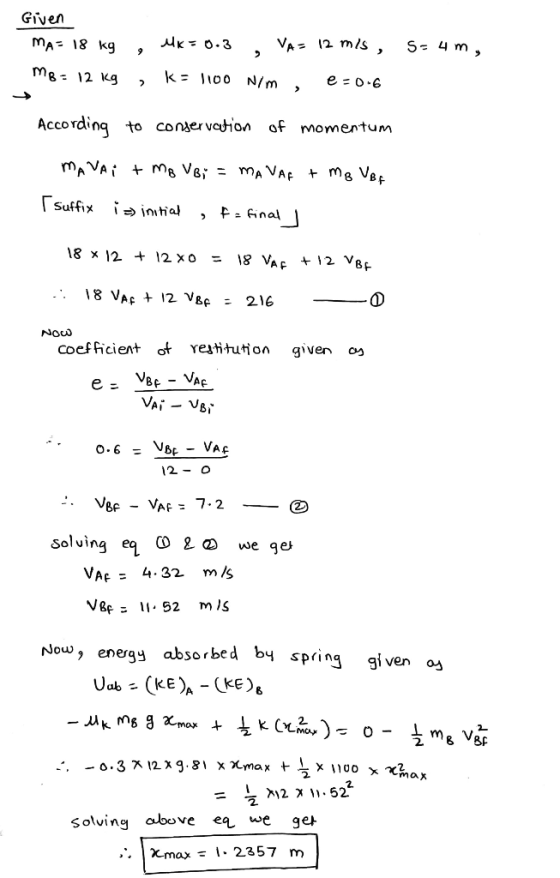
The 18-kg block A slides on the surface for which μk = 0.3. The block has...
The 18-kg block A slides on the surface for which μk = 0.3. The block has a velocity v = 11 m/s when it is s = 4 m from the 12-kg block B. The unstretched spring has a stiffness k = 1200 N/m . Take e = 0.6. The coefficient of friction is the same for both blocks. Determine the maximum compression of the spring due to the collision.
Review The 15-kg block A slides on the surface for which 144 = 0.3. The block...
 Review The 15-kg block A slides on the surface for which 144 = 0.3. The block has a velocity v = 12 m/'s when it is a = 4 m from the 12-kg block B. The unstretched spring has a stiffness k = 1200 N/m. Tako e=0.6. The coefficient of friction is the same for both blocks. (Figure 1). Part A Determine the maximum compression of the spring due to the collision. Express your answer three significant figures and include...
dynamic the answer is not 1.01 The 16-kg block A slides on the surface for which...
 dynamic
the answer is not 1.01
The 16-kg block A slides on the surface for which 4 = 0.3. The block has a velocity v = 11 m/s when it is s 3 m from the 11-kg block B. The unstretched spring has a stiffness k 1000 N/m . Take e = 0.6. The coefficient of friction is the same for both blocks. k WA B A Part A Determine the maximum compression of the spring due to the collision.
dynamic
the answer is not 1.01
The 16-kg block A slides on the surface for which 4 = 0.3. The block has a velocity v = 11 m/s when it is s 3 m from the 11-kg block B. The unstretched spring has a stiffness k 1000 N/m . Take e = 0.6. The coefficient of friction is the same for both blocks. k WA B A Part A Determine the maximum compression of the spring due to the collision.
13.2) A 1.3 -kg block slides along a horizontal surface with a coefficient of friction μk...
 13.2)
A 1.3 -kg block slides along a horizontal surface with a
coefficient of friction μk = 0.274. The block has a speed v = 2.28
m/s when it strikes a massless spring head-on.
a. If the spring has a force constant k = 30.9 N/m, how far is
the spring compressed?
b. What minimum value of the coefficient of static friction,
μs, will assure the spring remains compressed at the maximum
compressed position?
c. If μs is less than...
13.2)
A 1.3 -kg block slides along a horizontal surface with a
coefficient of friction μk = 0.274. The block has a speed v = 2.28
m/s when it strikes a massless spring head-on.
a. If the spring has a force constant k = 30.9 N/m, how far is
the spring compressed?
b. What minimum value of the coefficient of static friction,
μs, will assure the spring remains compressed at the maximum
compressed position?
c. If μs is less than...
The 8-1b box slides on the surface for which I = 0.3. The box has a...
 The 8-1b box slides on the surface for which I = 0.3. The box has a velocity v = 15 ft/s when it is 2 ft from the plate. (Figure 1) Part A If the box strikes the smooth plate, which has a weight of 19 lb and is held in position by an unstretched spring of stiffness k = 310 lb/ft, determine the maximum compression imparted to the spring. Take e = 0.8 between the box and the plate....
Problem 9.41 Part A A 3.0-kg block slides along a frictionless tabletop at 8.0 m/s toward...
 Problem 9.41 Part A A 3.0-kg block slides along a frictionless tabletop at 8.0 m/s toward a second block (at rest) of mass 4.5 kg. A coil spring, which obeys Hooke's law and has spring constant k = 720 N/m , is attached to the second block in such a way that it will be compressed when struck by the moving block. (Figure 1) What will be the maximum compression of the spring? Express your answer using two significant figures...
A 1.6 kg block slides along a frictionless surface at 1.0 m/s . A second block,...
A 1.6 kg block slides along a frictionless surface at 1.0 m/s . A second block, sliding at a faster 4.4 m/s , collides with the first from behind and sticks to it. The final velocity of the combined blocks is 2.5 m/s . Part A What was the mass of the second block? Express your answer to two significant figures and include the appropriate units.
A block having a mass of 0.800 kg is given an initial velocity vA= 1.25 m/s...
A block having a mass of 0.800 kg is given an initial velocity vA= 1.25 m/s to the right. It collides head-on with a horizontal spring of negligible mass and force constant k = 50 N/m, resting on the table. (a)Assuming the surface to be frictionless, calculate the maximum compression of the spring after the collision. Assume that the block gets stuck to the spring. (b)Suppose a constant force of kinetic friction acts between the block and the surface, with...
In the figure(Figure 1) a 1.5 kg block is held at rest against a spring with...
In the figure(Figure 1) a 1.5 kg block is held at rest against a spring with a force constant k = 720 N/m . Initially, the spring is compressed a distance d. When the block is released, it slides across a surface that is frictionless except for a rough patch of width 5.0 cm that has a coefficient of kinetic friction μk = 0.45. Part A Find d such that the block's speed after crossing the rough patch is 2.4...
If the horizontal surface has a coefficient of kinetic friction μk=0.500, what is the maximum compression...
 If the horizontal surface has a coefficient of kinetic friction
μk=0.500, what is the maximum compression of the spring?
An 8.0-9 bullet is shot into a 5.0-kg block, at rest on a frictionless horizontal surface (see the figure). The bullet remains lodged in the block and the bullet-block system moves to the right with speed V. The bullet-block system moves into an ideal massless spring and compresses it by 8.7 cm. The spring constant of the spring is 1200 N/m....
If the horizontal surface has a coefficient of kinetic friction
μk=0.500, what is the maximum compression of the spring?
An 8.0-9 bullet is shot into a 5.0-kg block, at rest on a frictionless horizontal surface (see the figure). The bullet remains lodged in the block and the bullet-block system moves to the right with speed V. The bullet-block system moves into an ideal massless spring and compresses it by 8.7 cm. The spring constant of the spring is 1200 N/m....
 Review The 15-kg block A slides on the surface for which 144 = 0.3. The block has a velocity v = 12 m/'s when it is a = 4 m from the 12-kg block B. The unstretched spring has a stiffness k = 1200 N/m. Tako e=0.6. The coefficient of friction is the same for both blocks. (Figure 1). Part A Determine the maximum compression of the spring due to the collision. Express your answer three significant figures and include...
 dynamic
the answer is not 1.01
The 16-kg block A slides on the surface for which 4 = 0.3. The block has a velocity v = 11 m/s when it is s 3 m from the 11-kg block B. The unstretched spring has a stiffness k 1000 N/m . Take e = 0.6. The coefficient of friction is the same for both blocks. k WA B A Part A Determine the maximum compression of the spring due to the collision.
dynamic
the answer is not 1.01
The 16-kg block A slides on the surface for which 4 = 0.3. The block has a velocity v = 11 m/s when it is s 3 m from the 11-kg block B. The unstretched spring has a stiffness k 1000 N/m . Take e = 0.6. The coefficient of friction is the same for both blocks. k WA B A Part A Determine the maximum compression of the spring due to the collision.
 13.2)
A 1.3 -kg block slides along a horizontal surface with a
coefficient of friction μk = 0.274. The block has a speed v = 2.28
m/s when it strikes a massless spring head-on.
a. If the spring has a force constant k = 30.9 N/m, how far is
the spring compressed?
b. What minimum value of the coefficient of static friction,
μs, will assure the spring remains compressed at the maximum
compressed position?
c. If μs is less than...
13.2)
A 1.3 -kg block slides along a horizontal surface with a
coefficient of friction μk = 0.274. The block has a speed v = 2.28
m/s when it strikes a massless spring head-on.
a. If the spring has a force constant k = 30.9 N/m, how far is
the spring compressed?
b. What minimum value of the coefficient of static friction,
μs, will assure the spring remains compressed at the maximum
compressed position?
c. If μs is less than...
 The 8-1b box slides on the surface for which I = 0.3. The box has a velocity v = 15 ft/s when it is 2 ft from the plate. (Figure 1) Part A If the box strikes the smooth plate, which has a weight of 19 lb and is held in position by an unstretched spring of stiffness k = 310 lb/ft, determine the maximum compression imparted to the spring. Take e = 0.8 between the box and the plate....
 Problem 9.41 Part A A 3.0-kg block slides along a frictionless tabletop at 8.0 m/s toward a second block (at rest) of mass 4.5 kg. A coil spring, which obeys Hooke's law and has spring constant k = 720 N/m , is attached to the second block in such a way that it will be compressed when struck by the moving block. (Figure 1) What will be the maximum compression of the spring? Express your answer using two significant figures...
 If the horizontal surface has a coefficient of kinetic friction
μk=0.500, what is the maximum compression of the spring?
An 8.0-9 bullet is shot into a 5.0-kg block, at rest on a frictionless horizontal surface (see the figure). The bullet remains lodged in the block and the bullet-block system moves to the right with speed V. The bullet-block system moves into an ideal massless spring and compresses it by 8.7 cm. The spring constant of the spring is 1200 N/m....
If the horizontal surface has a coefficient of kinetic friction
μk=0.500, what is the maximum compression of the spring?
An 8.0-9 bullet is shot into a 5.0-kg block, at rest on a frictionless horizontal surface (see the figure). The bullet remains lodged in the block and the bullet-block system moves to the right with speed V. The bullet-block system moves into an ideal massless spring and compresses it by 8.7 cm. The spring constant of the spring is 1200 N/m....
Most questions answered within 3 hours.
-
Where is the error in this code sequence?
String s1 = "Hello";
String s2 = "ello";...
asked 10 months ago -
Financial data for Joel de Paris, Inc., for last year
follow:
Joel de Paris, Inc.
Balance...
asked 10 months ago -
Consider this reaction:
Al2(SO4)3 (aq)+ BaCl3
(aq) Al2Cl6 (aq)- +
3BaSO4(s) . What is the...
asked 10 months ago -
Suppose that Savneet is considering increasing her
recent random sample from 20 car rentals to 40...
asked 10 months ago -
Trucks arrive at an unloading terminal at an average rate of 120
per hour.
Trucks arrive...
asked 10 months ago -
Why are methanol and ethanol completely soluble in water while
octanol is not very little soluble....
asked 10 months ago -
A facilities manager at a university reads in a research report
that the mean amount of...
asked 10 months ago -
When the CuSO4 is rehydrated by adding water to the anhydrous
compound, is this an endothermic...
asked 10 months ago -
A ray of sunlight is passing from diamond into crown glass; the
angle of incidence is...
asked 10 months ago -
A block of mass 0.249 kg is placed on top of a light, vertical
spring of...
asked 10 months ago -
how do the kidneys compensate in the presences of acidosis
a) trigger hyperventilate
b) reserve acid...
asked 10 months ago -
Question 501 pts
The rental rate of capital to the firm increases. Which of the
following...
asked 10 months ago