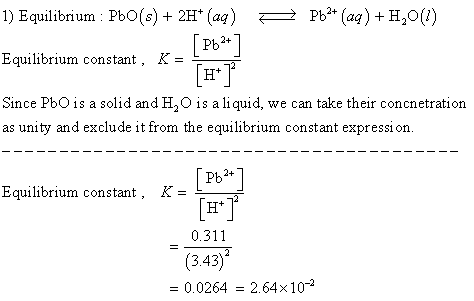
1. Solve for K under the following conditions with the following reaction: PbO (s) + 2H...
1. Solve for K under the following conditions with the following reaction: PbO (s) + 2H + (aq) ⇌ Pb2+ (aq) + 2H2O (l)
PbO (s) = 8.67 g [H + ] = 3.43 M [Pb 2+ ] = 0.311 M H2O (l) = 5.02 M
Find K
2. H2 (g) + I2 (s) ⇌ 2 HI (g)
0.162 atm H2 (g), 8.012 g I2 (s), 1.449 atm HI (g)
Calculate the pressures of H2 and HI at equilibrium.
Homework Answers
Add Answer to:
1. Solve for K under the following conditions with the following
reaction: PbO (s) + 2H...
For the reaction, Pb(s) + 2HCIO(aq) + 2H+(aq) → Pb2+(aq) + Cl2(g) + 2H2O(1) the value...
 For the reaction, Pb(s) + 2HCIO(aq) + 2H+(aq) → Pb2+(aq) + Cl2(g) + 2H2O(1) the value of Eºcell is 1.74 V. What is the value of Eºcell for the related reaction given below? YPb2+(aq) + 42Cl2(g) + H2O(1) → YPb(s) + HCIO(aq) + H+(aq) O 1.74 V -0.87 V -1.74 V 0.87 V 0.0 V
Classify the half‑reactions as reduction half‑reactions or oxidation half‑reactions. H2(g)⟶2H+(aq)+2e−H2(g)⟶2H+(aq)+2e− 12O2(g)+2H+(aq)+2e−⟶H2O(g)12O2(g)+2H+(aq)+2e−⟶H2O(g) Cd(s)+2OH−(aq)⟶Cd(OH)2(s)+2e−Cd(s)+2OH−(aq)⟶Cd(OH)2(s)+2e− 2NiO(OH)(s)+2H2O(l)+2e
Classify the half‑reactions as reduction half‑reactions or oxidation half‑reactions. H2(g)⟶2H+(aq)+2e−H2(g)⟶2H+(aq)+2e− 12O2(g)+2H+(aq)+2e−⟶H2O(g)12O2(g)+2H+(aq)+2e−⟶H2O(g) Cd(s)+2OH−(aq)⟶Cd(OH)2(s)+2e−Cd(s)+2OH−(aq)⟶Cd(OH)2(s)+2e− 2NiO(OH)(s)+2H2O(l)+2e−⟶2Ni(OH)2(s)+2OH−(aq)2NiO(OH)(s)+2H2O(l)+2e−⟶2Ni(OH)2(s)+2OH−(aq) Fe(s)⟶Fe2+(aq)+2e−Fe(s)⟶Fe2+(aq)+2e− oxidation reduction reduction oxidation reduction
Pb2+(aq) + 2e− ⇌ Pb(s) E° = -0.126 V 2H+(aq) + 2e− ⇌ H2(g) E° =...
Pb2+(aq) + 2e− ⇌ Pb(s) E° = -0.126 V 2H+(aq) + 2e− ⇌ H2(g) E° = 0.000 V E°cell (in V)= 0.126 V 2. The electrochemical cell is comprised of a Pb electrode in a 1.67 × 100 M solution of Pb2+ (aq) coupled to a Pt electrode in a solution containing H+ (aq) where the pH of the solution is 0.37 and the partial pressure of H2(g) is 0.571 atm. The temperature of the cell is held constant at...
Please explain, thank you! (4) Consider a cell at 298 K in which the reaction is Pb (s)+2H (aa-Pb2+ (ag) +H2 (g) (a) Cr ions are added to the Pb|Pb2+ half-cell to precipitate PbCh. The cell voltage is...
 Please explain, thank you!
(4) Consider a cell at 298 K in which the reaction is Pb (s)+2H (aa-Pb2+ (ag) +H2 (g) (a) Cr ions are added to the Pb|Pb2+ half-cell to precipitate PbCh. The cell voltage is then measured to be +0.210 V. If [H]-1.0 M and the partial pressure of hydrogen is 1.0 atm, what is [Pb2*]? (answer: 1.57 x 10³ M) (b) Calculate the Kp of PbCh if [Cl]-0.10 M in the PblPb2 half-cell. (answer: 1.57 x...
Please explain, thank you!
(4) Consider a cell at 298 K in which the reaction is Pb (s)+2H (aa-Pb2+ (ag) +H2 (g) (a) Cr ions are added to the Pb|Pb2+ half-cell to precipitate PbCh. The cell voltage is then measured to be +0.210 V. If [H]-1.0 M and the partial pressure of hydrogen is 1.0 atm, what is [Pb2*]? (answer: 1.57 x 10³ M) (b) Calculate the Kp of PbCh if [Cl]-0.10 M in the PblPb2 half-cell. (answer: 1.57 x...
calculate ecell for the following electrochemical cell at 25 C. Pt(s)| H2 (g,1.00 atm) | H+...
calculate ecell for the following electrochemical cell at 25 C. Pt(s)| H2 (g,1.00 atm) | H+ (aq, 1.00 M) || (Pb2+ (aq, 0.150 M) | Pb (s) Pb^2+(aq) + 2e- ---> Pb (s) Eo=-0.126 V 2H^+ (aq) + 2e- ---> H2 (g) Eo=0.00 V Thank you!
Given: 2H+(aq)+2e– ⇌H2(g);E°=0.00 Li+(aq)+e– ⇌Li(s);E°=–3.04V F2(g)+2e– ⇌2F–(aq);E°=2.87 Al3+(aq)+3e– ⇌Al(s);E°=–1.66V Pb2+(aq)+2e– ⇌Pb(s);E°=–0.13V Under standard-state conditions, which is...
Given: 2H+(aq)+2e– ⇌H2(g);E°=0.00 Li+(aq)+e– ⇌Li(s);E°=–3.04V F2(g)+2e– ⇌2F–(aq);E°=2.87 Al3+(aq)+3e– ⇌Al(s);E°=–1.66V Pb2+(aq)+2e– ⇌Pb(s);E°=–0.13V Under standard-state conditions, which is the strongest oxidizing agent? Select one: a. Pb2+ b. Al3+ c. F2 d. Li+ e.H+
NO−3(aq)+4H+(aq)+3e−→NO(g)+2H2O(l) E∘=0.96V ClO2(g)+e−→ClO−2(aq) E∘=0.95V Cu2+(aq)+2e−→Cu(s) E∘=0.34V 2H+(aq)+2e−→H2(g) E∘=0.00V Pb2+(aq)+2e−→Pb(s) E∘=−0.13V Fe2+(aq)+2e−→Fe(s) E∘=−0.45V You may want to...
NO−3(aq)+4H+(aq)+3e−→NO(g)+2H2O(l) E∘=0.96V ClO2(g)+e−→ClO−2(aq) E∘=0.95V Cu2+(aq)+2e−→Cu(s) E∘=0.34V 2H+(aq)+2e−→H2(g) E∘=0.00V Pb2+(aq)+2e−→Pb(s) E∘=−0.13V Fe2+(aq)+2e−→Fe(s) E∘=−0.45V You may want to reference (Pages 898 - 902) Section 19.4 while completing this problem. Part A Use data from the table above to calculate E∘cell for the reaction. Fe(s)+2H+(aq)→Fe2+(aq)+H2(g) Express your answer using two decimal places.
For all of the following experiments, under standard conditions, which species could be spontaneously produced? A...
 For all of the following
experiments, under standard conditions, which species could be
spontaneously produced?
A lead wire is placed in a solution containing
Cu2+
yes no Cu
yes no PbO2
yes no No reaction
Crystals of I2 are added to a solution of
NaCl.
yes no I-
yes no No reaction
yes no Cl2
A silver wire is placed in a solution containing
Cu2+
no yes Cu
no yes No reaction
no yes Ag+
Half-Reaction 8° (V) Half-Reaction 8° (V) 2.87 1.99 1.82 1.78 1.70 1.69 1.68 1.60...
For all of the following
experiments, under standard conditions, which species could be
spontaneously produced?
A lead wire is placed in a solution containing
Cu2+
yes no Cu
yes no PbO2
yes no No reaction
Crystals of I2 are added to a solution of
NaCl.
yes no I-
yes no No reaction
yes no Cl2
A silver wire is placed in a solution containing
Cu2+
no yes Cu
no yes No reaction
no yes Ag+
Half-Reaction 8° (V) Half-Reaction 8° (V) 2.87 1.99 1.82 1.78 1.70 1.69 1.68 1.60...
1- The equilibrium constant, Kc, for the following reaction is 1.80×10⁻² at 698 K. 2HI(g) -------->...
1- The equilibrium constant, Kc, for the following reaction is 1.80×10⁻² at 698 K. 2HI(g) --------> H2(g) + I2(g) Calculate the equilibrium concentrations of reactant and products when 0.395 moles of HI are introduced into a 1.00 L vessel at 698 K. [HI] = M [H2] = M [I2] = M 2- student ran the following reaction in the laboratory at 1090 K: 2SO3(g) ----------> 2SO2(g) + O2(g) When he introduced SO3(g) at a pressure of 1.05 atm into a 1.00...
Question 7 (1 point) Consider the following cell: Pb(s) | PbSO4(s) S042-(aq) || Pb2+(aq) | Pb(s)...
 Question 7 (1 point) Consider the following cell: Pb(s) | PbSO4(s) S042-(aq) || Pb2+(aq) | Pb(s) The reaction utilized by this cell is O Pb(s) + 2H+(aq) --> Pb2+(aq) + H2(g) O s042-(aq) + H+(aq) --> HSO4-(aq) O PbSO4(s) --> Pb2+(aq) + SO42-(aq) O Pb2+(aq) + SO42- (aq) --> PbSO4(s) O s042-(aq) + H20(1) --> HS04"(aq) + OH(aq)
 For the reaction, Pb(s) + 2HCIO(aq) + 2H+(aq) → Pb2+(aq) + Cl2(g) + 2H2O(1) the value of Eºcell is 1.74 V. What is the value of Eºcell for the related reaction given below? YPb2+(aq) + 42Cl2(g) + H2O(1) → YPb(s) + HCIO(aq) + H+(aq) O 1.74 V -0.87 V -1.74 V 0.87 V 0.0 V
 Please explain, thank you!
(4) Consider a cell at 298 K in which the reaction is Pb (s)+2H (aa-Pb2+ (ag) +H2 (g) (a) Cr ions are added to the Pb|Pb2+ half-cell to precipitate PbCh. The cell voltage is then measured to be +0.210 V. If [H]-1.0 M and the partial pressure of hydrogen is 1.0 atm, what is [Pb2*]? (answer: 1.57 x 10³ M) (b) Calculate the Kp of PbCh if [Cl]-0.10 M in the PblPb2 half-cell. (answer: 1.57 x...
Please explain, thank you!
(4) Consider a cell at 298 K in which the reaction is Pb (s)+2H (aa-Pb2+ (ag) +H2 (g) (a) Cr ions are added to the Pb|Pb2+ half-cell to precipitate PbCh. The cell voltage is then measured to be +0.210 V. If [H]-1.0 M and the partial pressure of hydrogen is 1.0 atm, what is [Pb2*]? (answer: 1.57 x 10³ M) (b) Calculate the Kp of PbCh if [Cl]-0.10 M in the PblPb2 half-cell. (answer: 1.57 x...
 For all of the following
experiments, under standard conditions, which species could be
spontaneously produced?
A lead wire is placed in a solution containing
Cu2+
yes no Cu
yes no PbO2
yes no No reaction
Crystals of I2 are added to a solution of
NaCl.
yes no I-
yes no No reaction
yes no Cl2
A silver wire is placed in a solution containing
Cu2+
no yes Cu
no yes No reaction
no yes Ag+
Half-Reaction 8° (V) Half-Reaction 8° (V) 2.87 1.99 1.82 1.78 1.70 1.69 1.68 1.60...
For all of the following
experiments, under standard conditions, which species could be
spontaneously produced?
A lead wire is placed in a solution containing
Cu2+
yes no Cu
yes no PbO2
yes no No reaction
Crystals of I2 are added to a solution of
NaCl.
yes no I-
yes no No reaction
yes no Cl2
A silver wire is placed in a solution containing
Cu2+
no yes Cu
no yes No reaction
no yes Ag+
Half-Reaction 8° (V) Half-Reaction 8° (V) 2.87 1.99 1.82 1.78 1.70 1.69 1.68 1.60...
 Question 7 (1 point) Consider the following cell: Pb(s) | PbSO4(s) S042-(aq) || Pb2+(aq) | Pb(s) The reaction utilized by this cell is O Pb(s) + 2H+(aq) --> Pb2+(aq) + H2(g) O s042-(aq) + H+(aq) --> HSO4-(aq) O PbSO4(s) --> Pb2+(aq) + SO42-(aq) O Pb2+(aq) + SO42- (aq) --> PbSO4(s) O s042-(aq) + H20(1) --> HS04"(aq) + OH(aq)
Most questions answered within 3 hours.
-
Where is the error in this code sequence?
String s1 = "Hello";
String s2 = "ello";...
asked 11 months ago -
Financial data for Joel de Paris, Inc., for last year
follow:
Joel de Paris, Inc.
Balance...
asked 11 months ago -
Consider this reaction:
Al2(SO4)3 (aq)+ BaCl3
(aq) Al2Cl6 (aq)- +
3BaSO4(s) . What is the...
asked 11 months ago -
Suppose that Savneet is considering increasing her
recent random sample from 20 car rentals to 40...
asked 11 months ago -
Trucks arrive at an unloading terminal at an average rate of 120
per hour.
Trucks arrive...
asked 11 months ago -
Why are methanol and ethanol completely soluble in water while
octanol is not very little soluble....
asked 11 months ago -
A facilities manager at a university reads in a research report
that the mean amount of...
asked 11 months ago -
When the CuSO4 is rehydrated by adding water to the anhydrous
compound, is this an endothermic...
asked 11 months ago -
A ray of sunlight is passing from diamond into crown glass; the
angle of incidence is...
asked 11 months ago -
A block of mass 0.249 kg is placed on top of a light, vertical
spring of...
asked 11 months ago -
how do the kidneys compensate in the presences of acidosis
a) trigger hyperventilate
b) reserve acid...
asked 11 months ago -
Question 501 pts
The rental rate of capital to the firm increases. Which of the
following...
asked 11 months ago